Showing posts with label travel. Show all posts

Sunday, June 23, 2024

Blue Highways by William Least Heat-Moon

Here the earth, as if to prove its immensity, empties itself. Gertrude Stein said: "In the United States there is more space where nobody is than where anybody is. That is what makes America what it is." The uncluttered stretches of the American West and the deserted miles of roads force a lone traveler to pay attention to them by leaving him isolated in them. The squander of land substitutes a sense of self with a sense of place by giving him days of himself until, tiring of his own small compass, he looks for relief to the bigness outside--a grandness that demands attention not just for its scope, but for its age, its diversity, its continual change. The isolating immensity reveals what lies covered in places noisier, busier, more filled up. For me, what I saw revealed was this (only this): a man nearly desperate because his significance had come to lie within his own narrow ambit.

One day in 1978, William Least Heat-Moon found himself without a job and without a wife. He gets into his truck and heads east from his home of Columbia, Missouri, to see the United States, and write about what he sees. His goal is to stick to the "Blue Highways," the small roads on the Atlas that are colored blue, in contrast to the red interstates. His route is roughly circular, heading down the eastern seaboard and then across the southernmost regions of America's desert country, then up through the Sierra Nevadas, over the topmost edge of the Great Plains, into New England--and back home. This route, he explains, borrows something from Native American traditions about journeys, like all things, being shaped as wheels. (Perhaps it's best that we pass over the speciously Native name William Trogdon has passed down to him from his grandfather, the original Heat-Moon, or that he names the truck 'Ghost-Dancing.')

Or maybe it's just the way things shake out. At the end of his journey, Heat-Moon travels through a hedge maze planted by utopianists in New Harmony, Indiana, but the "true" path is worn so thoroughly into the dirt that "knowing the way made traveling perfectly meaningless." The wonder inherent in the journey's program is that there is no program at all, unless it is to investigate the places in the Atlas whose names token strangeness and mystery: Nameless, Tennessee; Othello, New Jersey; Dime Box, Texas. Heat-Moon's gift as a traveler is the way he gets people in these places to open up to him, as if they have been waiting their whole lives for someone to come by and ask how it is a place gets a name like "Nameless." Over and over again, an inquiry at a diner leads Heat-Moon to some superannuated resident who represents the repository of a place's history, which along the Blue Highways, always seems to be a diminishing resource. And once he's granted access, Heat-Moon has a gift for capturing the small, specific things that turn a person into a character, like the woman who listens to the radio hospital report each day, faithfully recording a register of the region's deaths, or the woman who trades between her glasses marked NEAR and the ones marked FAR. As Heat-Moon remarks at one point, "A person shows himself in the way he opens an orange."

I loved, loved, loved this book. I felt like it was the kind of book I had been looking for for a long time: a travelogue about America--next time you're in a bookstore, count how many of the travel books are about Italy or the French Riviera and how many are about Missouri--that tries to take in the whole of this massive, messy, melodramatic country. Heat-Moon can't see all of it, of course, but his circular route circumscribes it, and somehow contains it; when it's over, there's no doubt that he has "seen America," or come as close to a true fulfillment as possible of the phrase. What he finds is sometimes hostile, sometimes violent, sometimes troubled--see the way he asks everyone he comes across near Selma, Alabama, white or black, what's changed in the decade since the famous march--but it's impossible to come away with anything but love and wonder for the nation as project, in which we are all collaborators. I was hooked, of course, from the first section, when Heat-Moon travels through my own home state of North Carolina. He goes from the mountains to Manteo (where I can tell you first-hand that the locals are still arguing about how high a hotel should be permitted to be), and in between, the sleepy, clay-baked towns of the Piedmont where I grew up. Some of these places, the thought of spending an hour in them makes my skin crawl--and yet, Heat-Moon's account brought up stores of bittersweet affection I barely knew I possessed.

Heat-Moon can write. A lot of people can, even those who write travelogues. Perhaps the writing here feels different than, say, the writing of Paul Theroux because Heat-Moon is not interested in treating this journey sociologically. In Theroux's book about the South, he comes off like an alien on Earth. But Heat-Moon is implicated in his own journey; by searching America he searches for himself, and so his prose benefits not just from talent but from wisdom as well. Of a group of children playing on a Civil War battlefield, he observes, "Even though Titans and Tridents and MX's have not made 'the red business,' as Whitman called it, a thing of the past, they have eliminated future battlefield parks where boys can play at war--unless scientist find means to hang monuments in the sky." Taking water from a reservoir that has covered up a cemetery, he writes, "In my splashing, I broke the starlight. And then I too drank from the grave." And here is a sentence that captures the heart of the road trip, in words that stopped me cold: "In a hotel room at the geographical center of North America, a neon sign blinking red through the cold curtains, I lay quietly like a small idea in a vacant mind."

As with every journey, Heat-Moon finds that he comes back to himself in the end: "If the circle had come full turn, I hadn't. I can't say, over the miles, that I had learned what I had wanted to know because I hadn't known what I wanted to know. But I did learn what I didn't know I wanted to know." Traveling doesn't fix you; maybe it doesn't even change you. But the experience of travel stands alone, an act of unparalleled seeing: In a season on the blue roads, what had I accomplished? I hadn't sailed to the Atlantic in a washtub, or crossed the Gobi by goat cart, or bicycled to Cape Horn. In my own country, I had gone out, had met, had shared. I had stood as witness."

Monday, May 31, 2010

Travels with My Aunt by Graham Greene

“Do you know what you’ll think about when you can’t get to sleep in your double bed? Not of women… You will think of how every day, you are getting a little closer to death. It will stand there as close as the bedroom wall. And you’ll become more and more afraid of the wall because nothing can prevent you from coming closer and closer to it every night while you try to sleep.”

Travels with My Aunt
could have been renamed Graham Greene’s Carpe Diem without doing injury to its themes and ideas. It opens at a funeral, where Henry Puller meets his long lost Aunt Augusta. Her first words to him are, “I was once present at a premature cremation.” After the funeral, they get together for a cup of tea and she convinces him to travel with her. The rest of the novel is concerned with their movement from one place to the other, as Henry tries to figure out exactly what kind of man he is.

Aside from a fairly obvious twist near the end, Travels with My Aunt isn’t terribly concerned with plot. It is, however, populated with some of Greene’s most memorable characters: the irascible Aunt Augusta, seventy-five and not ready to slow down yet; Visconti, the Italian lover who sounds like Al Pacino but looks like Danny DeVito; Wordsworth, Augusta’s black lover; the two Tooleys, father and daughter; and dozens more, some appearing in the main narrative, some existing only in the stories told to Henry by his aunt.

The real emphasis of the novel is the inner life of the protagonist, Henry. When the novel opens, Henry is a recently retired banker whose only hobby is raising Dahlias and whose only romantic interest is a somewhat dull, matronly woman named Ms. Keene. During his time with his aunt, Henry’s attitude turns from disbelief and disdain of his aunt’s dissolute and somewhat illegal lifestyle to admiration and, finally, embracing it. As he says near the end, “I have been happy, but I have been bored for so long.”

It’s interesting, then, to look at Travels with My Aunt in comparison with Greene’s other novels. In his most famous works, the Catholic books, his protagonists are driven by something higher than themselves. Whether they believe in God or not, their lives revolve around the bigger questions in life. In Travels, God hardly makes an appearance—though Aunt Augusta claims to be a Roman Catholic, she says, “I just don’t believe the things they believe”—and big picture issues are hardly considered at all. On the one hand, Travels is clearly a comic novel, and such themes might not work in context; on the other, Aunt Augusta and Henry are well-developed characters and share poignant moments. It seems somewhat disappointing then that the ultimate theme of the book seems to be the ephemeral “live for the moment”, when the themes of Greene’s best works could be characterized as “live for the world to come.” However, it’s these contradictions that make Greene such a fascinating man and author, and I’d recommend Travels with My Aunt to anyone wanting a lighter-hearted visit to Greeneland.

Wednesday, December 19, 2007

The Sun Also Rises by Ernest Hemingway

A group of ex-patriots go out drinking in Paris and San Sebastian sometime after WWI but before the Great Depression. Jake, a journalist and classic Hemingway bad-ass tough guy catch-fish-with-his-bare-hands character, once had/still secretly does have a thing for Bret Ashley, a somewhat shallow yet entirely human British aristocrat who is basically a tease to every man she meets. All they and their cohorts seem to do is get drunk in cafés, an activity that culminates in a week-long bull fighting fiesta in Northern Spain.

The novel, like every other Hemingway, is written in a really simple, natural style, but is never lacking in depth or characterization or description or anything else that makes a great novel great. I personally liked The Old Man and the Sea better, but that's probably because I just don't understand this generation at all. They don't really do anything. It actually reminds me of some of my friends who just go to the same bars with the same people week after week after week and never do anything exciting or unique. Except in this novel the people were doing stuff... fishing, bull fighting, traveling, but they were still incredibly jaded.

I'd read The Sun Also Rises over The Great Gatsby for sure. Plus, Hemingway could kick Fitzgerald's ass if it came down to it. Solid B+

Saturday, November 17, 2007

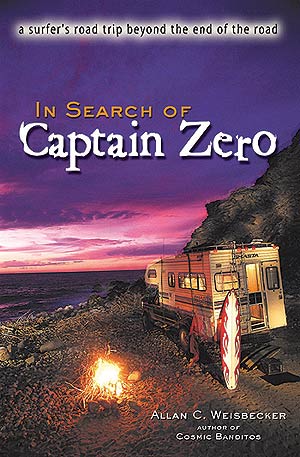
In Search of Captain Zero by Allan Weisbecker

A friend of mine who doesn't read much more than he has to once turned down a night buffoonery and drunken revelry to stay home and finish reading this book. So, I decided to pick up a copy. Good call.

Here's the premise. Weisbecker's old friend and surfing buddy Chris, aka Captain Zero, deserts his old life in the States and heads somewhere into Central America, cutting off all contact with his family and friends. Something like five years later, Weisbecker loads up his trailer and sets off along the Pacific in search of him.

It's more than just an account of his journey, it's a memoir. He inserts little tales from his past with Christopher. He talks about living in Hawaii during the advent of the short board. He describes a few failed attempts at running drugs from South America, and talks about growing up fishing off the far end of Long Island. He lets his personal philosophy bleed into all of the stories, and he really draws you into his worldview. Above all, it's entertaining. You'll probably find yourself wanting to do something slightly illegal and adventurous when you're finished.

As a side note, I think Nathan met Captain Zero in Costa Rica. Apparently he owns a book store somewhere near Puerto Viejo on the Caribbean side.

Wednesday, November 14, 2007

You Shall Know Our Velocity by Dave Eggers

Dave Eggers started McSweeney's. He runs a high school literary group in San Francisco called 828 Valencia that puts together The Best American Nonrequired Reading every year (they also sell pirate apparel I think). He wrote A Heartbreaking Work of Staggering Genius and a bunch of other books that people like, but the only one I've read is You Shall Know Our Velocity!

The story takes you inside the mind of a couple mental-whack-job characters as they travel the world giving away wads of cash. Their goal is to completely circle the globe in a week and hand out something like $30,000 to total strangers. The story's told from the perspective of an understandably disillusioned, fairly idealistic but totally irrational thirty-something named Will. His travel-mate, Will, brings a little reason and adventure along.

In this updated edition, Eggers has inserted a 50 page interlude narrated by Hand into the middle of Will's story. After reading both sides of the story, you can really see how unstable both of these characters are. The insertion is a good improvement on a great characterization novel. Everyone (in the English-speaking world anyway) can relate to parts of both of these personalities. Read it.

Friday, May 4, 2007

A Year in Provence by Peter Mayle

This is good, simple travel writing. A Year in Provence is part satire, part cookbook, part narrative and part guide. Mayle and his wife moved to Provence from England after vacationing there inspired them to buy a 200 year-old farmhouse. Mayle lives what so many travel enthusiasts and Francophiles only ever dream of. The life he describes is incredibly bucolic: his only responsibilities are to buy new vines at the start of each grape growing season, and collect his profit in either cash or bottles at the end of it.

Through the open door we could hear the croaking of our resident frog, and the long, sliding song of a nightingale. We took a final glass of wine outside and looked by the light of the moon at the new lavender bed while the dogs rooted for mice in the Lucerne fields. The rabbits would eat well this summer and, Faustin had promised, would taste all the better for it in the winter. We realized we were becoming as obsessive about food as the French, and went back indoors to attend to some unfinished business with a goat’s cheese.

Mayle and his wife live in the Lubéron, a Provençal mountain range, supposedly out of the way of so much of the Côte d’Azur tourism. However, even in 1989, he talked about how the region was changing to become more commercial. The impression that I got was that, in France, Provence is viewed as its own, culturally isolated country. Parisians scorn the rustic, simple Provençal life, yet flock there in the millions (along with Germans, Belgians, Swiss and English) to weekend and vacation homes. Mayle occupied a sort of middle ground, not quite tourist and not quite native, from which he could satirize both. It’s interesting, to me, to learn more about a small corner of the world that dealt with so many of its own localized problems when I was only three years old, still learning to feed myself properly. All of his anecdotes about rural life were interesting, but where he really excelled were his descriptions of fresh, country food. This book actually made me hungry; Mayle spent pages on thick stews, roasted lambs with rosemary, black truffles, local wines, fresh cheeses and hearty, crusty breads that made my mouth literally start watering.

He describes so well such a simple, idyllic lifestyle that I wonder, and hope against, how much change the region must have gone through in the past 18 years. But Mayle is very impersonal, and, for that reason, Bill Bryson is still my favorite travel writer. Where Bryson really helps you relate to him, and see experiences through his eyes, Mayle keeps the reader at arm’s length. The book is minimal on dialogue, at least on Mayle’s part, and relies more on observations and briefly summed up conversations. It’s a quick read, and often very humorous, as only an outsider’s perspective can be. You could probably get through it on a slow afternoon if you wanted too, and it’s definitely worth the time.

Tuesday, March 13, 2007

A Walk in the Woods by Bill Bryson

A Walk in the Woods is the second of Bill Bryson’s books that I’ve read (the first was Notes from a Small Island), and I think I can now safely call myself a fan of his work. He’s principally a travel writer, but it would be impossible to classify his work so simply. Bill Bryson is a regular renaissance man, and his wide-ranging intelligence shows in his work. A Walk in the Woods is about the eight month long hike that he took along the roughly 2,100 mile Appalachian Trail in 1996. Bryson’s account of his so-called ‘walk through the woods’ would’ve been enough to keep this book at the top of the NY Times bestseller list for so many months, but he rounded out his story with a fairly interesting history of conservation, hiking, the Appalachians and mountain ecology, to name a few.

Bryson has an amazing mind, and his books range over every possible aspect of their subject: history, economics, social effects, ecology, and so on. One thing about Bill Bryson and his work comes to mind before anything else, however: he’s absolutely hilarious. I’m talking laugh out loud, giggle in public funny. I can’t remember how many times I’d start chuckling to myself involuntarily, on the bus, in the back of class, wherever I was. Sometimes I’d read the same line two or three times and just keep laughing.

The most plausible explanation was that any [mountain] lions out there—if [mountain] lions they were—were released pets, bought in haste and later regretted. It would be just my luck, of course, to be savaged by an animal with a flea collar and a medical history. I imagined lying on my back, being extravagantly ravaged, inclining my head slightly to read a dangling silver tag that said: “My name is Mr. Bojangles. If found please call Tanya and Vinny at 924-4667.”

So many of the jokes seem to sneak themselves into the last line of a relatively dry section on botany, or some such thing, which is what makes them work so well. His writing seemed to make me laugh more the further I read into the book; it was as if getting to know his style lets you in on the subtleties and unexpected nature of some of his jokes (perfectly placed in some scholarly section that’s drifting dangerously close to boring). He’s unbelievably intelligent, but he loves to make fun of himself, which is one of the things (besides his wit) that I like best about him. He paints himself as a grinning, bumbling fool, which couldn’t be further from the truth, and loves to recount tales of him whimpering in his tent at the sound of a cracked stick outside. And the best part of reading anything by Bryson is that he’s so good at letting you get to know his characters (namely, himself and a hiking friend) that their slapstick antics get funnier as you learn their personalities better. Reading this book, you might be led to think that Bryson waits for the worst possible situation to strike so that he can write about it and we can laugh about it. I think he just has a great ability to tell stories, and an incredible skill with the English language. Even if you don’t care to learn anything interesting about the Appalachian Trail and its mountains (which, I assure you, you will), you should read this book for its abundance of hearty, smart laughs (as well as chuckles, giggles and big, stupid grins). As with the last of his books I read, I was disappointed to see it end, but he wrapped it up completely perfectly.

(If hiking isn’t your thing, but a road trip around England and Scotland sounds fun, you should read instead Notes from a Small Island, which is easily just as funny and clever as A Walk in the Woods)