Showing posts with label japanese. Show all posts

Saturday, October 26, 2019

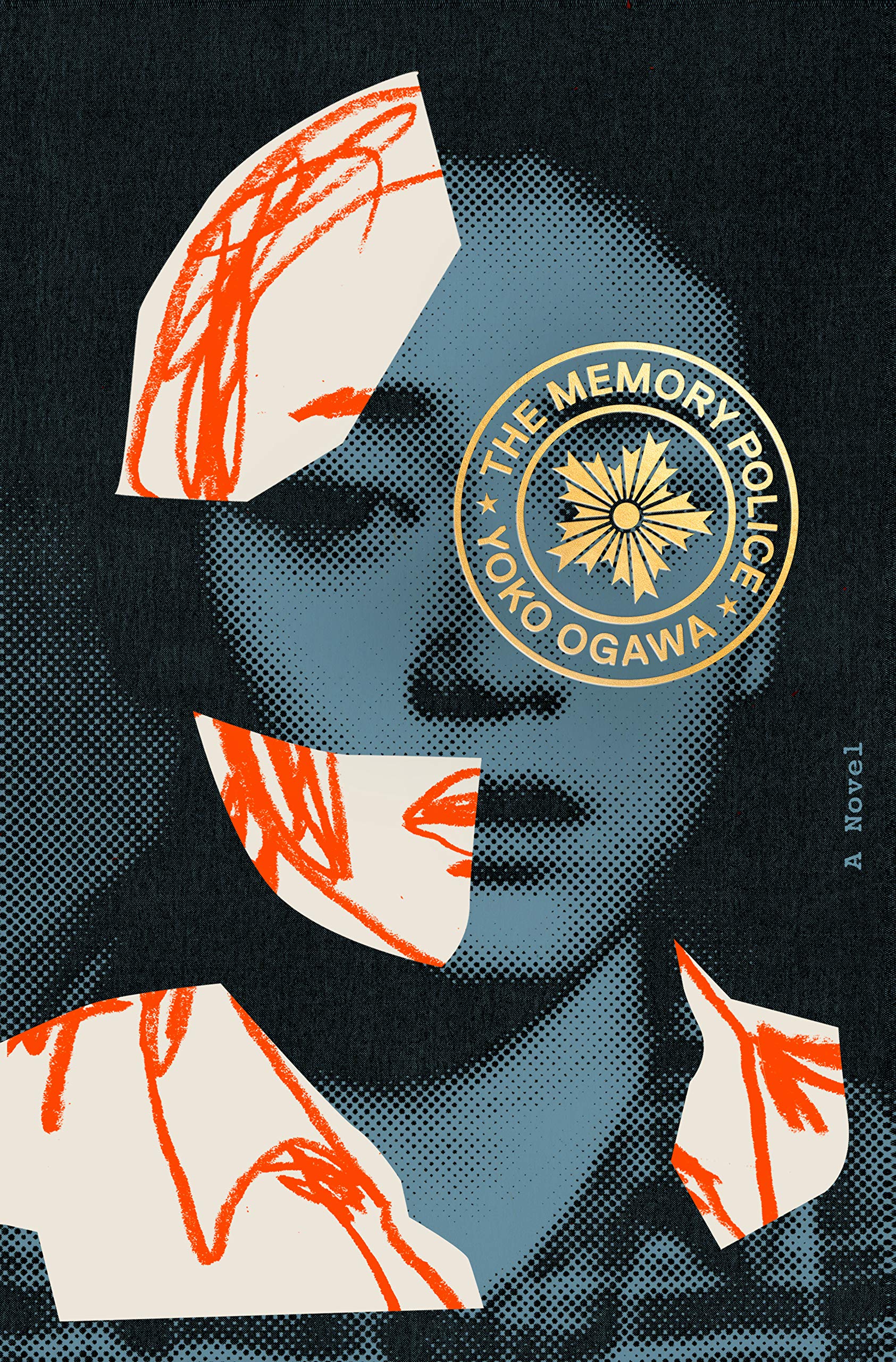
The Memory Police by Yoko Ogawa

Each owner seemed to be saying good-bye to his bird in his own way.  Some were calling their names, others rubbing them against their cheeks, still others giving them a treat, mouth to beak.  But once these little ceremonies were finished, they opened up the cages and held them to the sky.  The little creatures, confused at first, fluttered for a moment around their owners, but they soon were gone, as if drawn away into the distance.

When they were gone, a calm fell as though the air itself were breathing with infinite care.  The owners turned for home, empty cages in hand.

And that was how the birds disappeared.

On a small island things have been disappearing.  When they disappear, they are quite literally forgotten--not entirely, at first, but when people wake up feeling that something has disappeared they must search their memories for the gaps.  As a collective ritual, they dispose of whatever it is that has disappeared from memory: they burn calendars and ribbon, they trash emeralds, they let all their birds go free.  The nameless narrator's friend, referred to only as on old man, still lives in the rusty old boat that once was the ferry to the mainland, but the ferry itself has disappeared.

Ogawa walks a very tight line here; it's never really clear what it means when something has "disappeared."  The objects themselves don't vanish, and sometimes if the islanders try hard enough they can dredge the word up from memory: the narrator remembers, for instance, that "birds" are what her father once studied before his death.  She explains it as a kind of loss of emotional or resonant attachment; she looks at the emerald her mother has hidden away and feels no associations with it at all.  These disappearances are enforced by a totalitarian force called the Memory Police, who search homes for contraband and even hunt down people who seem to have a genetic ability to remember everything.  The narrator's editor, R--she's a novelist--is one of those people, and the narrator hides him in a special hidden room she's rigged up in her house to protect him from the Memory Police.

There's a line, spoken by the egotistical narrator of Martin Amis' Money, that I have never forgotten, although I'm sure I'm only paraphrasing it: "Don't you think memory is fascinating?" he says; "Me neither."  That sticks with me because I think it's true; a lot of literary meditations on memory fall short of saying anything interesting.  (Proust excepted.)  So it's even more impressive that The Memory Police ends up so compelling and thoughtful.  For Ogawa, memory is a vital constituent part of our identity, and to lose memories means to lose oneself.  It's one thing to lose birds and calendars, but what happens when novels disappear?  Later on, this problem becomes quite literal, when everyone's left leg disappears:

I pulled back the quilt and made a bizarre discovery--something was stuck fast to my hip.  And no matter how much I pulled or pushed or twisted, it would not come off, just as though it had been welded to me.

It's possible to read this politically, as a parable about how totalitarian regimes adjust memory and history for their own purposes.  1984 gave us the term "memory hole" for this kind of intentional memory loss, and Ogawa, too, describes the process as a kind of cavity opening up.  But The Memory Police is too eerie, too fantastical, to have any kind of political teeth; it seems more like an existential, even phantasmagoric, kind of horror novel.  R remains chipper and tries to guide the narrator through the process of recovering her memories.  He massages her leg when it disappears, encourages her to sit at the typewriter banging out words until the novel reforms.  But these efforts always seem in vain, and perhaps even slightly sinister.  If the narrator is only whole in R's memory, can't he make of her what he wants?

Ogawa's language is sparse, controlled, ironic.  It's funny and strange in a very subdued way.  I wanted to pair it with Kobo Abe's The Woman in the Dunes, and I can see a bright line of influence between them, passing through Orwell and, like, Fellini or something.  What impressed me most about the book, I think, is that the strangeness of it might have come at the cost of emotional realism, but the narrator feels human, real.  The ending is elegiac and sad, and as affecting as anything I've read this year.  Ironically, this is a book I won't quickly forget.

Sunday, October 20, 2019

The Woman in the Dunes by Kobo Abe

Suddenly a horrible sound interrupted him.  As the woman had predicted the night before, the brow of sand on the north side had lost its moisture and collapsed.  The whole house seemed to let out a soulful shriek, as if mortally wounded, and a gray blood began to drop down with a rustling sound from the new gap between the eaves and the wall.  The man began to tremble, the mouth full of saliva.  It was as if his own body had been crushed.

This entire nightmare could not be happening.  It was too outlandish.  Was it permissible to snare, exactly like a mouse or an insect, a man who had his certificate of medical insurance, someone who paid his taxes, who was employed, and whose family records were in order?  He could not believe it.  Perhaps there was some mistake; it was bound to be a mistake. There was nothing to do but assume that it was a mistake.

An entomologist named Jumpei travels from the city to the Japanese coast, looking for rare insects that live among the sand.  He stumbles upon a strange village that seems almost half-buried in the dunes: houses lie at the bottom of great pits of sand.  The villagers kindly let him stay the night at one of these houses, where he's lowered into the pit by means of a great rope ladder, and hosted by a beautiful but distant woman who seems to live alone there.  Soon, he realizes that he hasn't been hosted, but kidnapped, and the villagers expect him, like the woman, to spend his life scooping up the shifting sand around the house and placing it into buckets, keeping not only the house safe from the moving dunes but also the village, for which houses like these are the first line of defense.

Most of the narrative of The Woman in the Dunes concerns Jumpei's various attempts to escape.  He's clever, and approaches the task from a scientific angle, but sand is unpredictable and the villagers watchful.  At the same time he finds himself drawn to the strange woman, who is never given a name, and who seems to accept her lot blithely.  (Among other things, The Woman in the Dunes gives a frightening picture of what it's like to have sex in a place where you can never get the sand off of your body.)  If he escapes, what will happen to her?  Does he have an obligation to her, or is she part of the same forces that have trapped him?

Sand, as Jumpei thinks of it, is a strange and dangerous thing.  It is a collection of small stones, about an eighth of a millimeter, but it emerges when the forces of wind and water separate these small stones from larger ones.  It is forever moving, and in fact, it may be more appropriate to think of sand as the movement rather than the stones that are moved--an action, rather than an object.  The shifting sands will never stop threatening the house or the village; Jumpei's story is a variation of Sisyphus'.

The sand is a symbol for--what?  Death and life, at least, and maybe the natural passage of time that scares the shit out of everyone who's old enough to figure out what it means.  Set against these forces are the pathetic systems of bourgeois society: when Jumpei cleverly advises planting a hedge of trees to keep the sand at bay, the woman notes that it's just cheaper to keep up a system of forced labor.  Jumpei, in the passage above, can't believe that the rewards of civilized society have failed to protect him: the medical insurance, the tax bill.  But medical insurance can't stop deterioration and disease, and being a good citizen can't fend of realities that shift like the sand.  What he fails to realize is that the things he hopes will keep him safe are of the same order as the things the village will hope keep them safe: bureaucratic, short-sighted, systematic, unequal.

Spoiler alert: ultimately, Jumpei escapes, only to be caught and brought back to his sand-prison.  He throws himself into scientific experiments with the sand he thinks will help him escape, but when luck arrives--a rope ladder is thoughtlessly left by the house--he chooses to put off his escape, to better go on with his experiments.  At a subconscious level he acknowledges that there he has no more control over his life out there than he does at the bottom of the sand pit; who can blame him for choosing to go on with his experiments--the small things he can control--a little bit longer?

The Woman in the Dunes recalls classic dystopias like 1984 in that the forces that dominate are always outside the individual's understanding.  But it also has one foot in the world of fantasy and allegory; it reminds me of a book like TloothThe sand landscape is as terrifying as any horror novel, and you can totally see how it was turned into a classic of Japanese new wave cinema.

Saturday, March 17, 2018

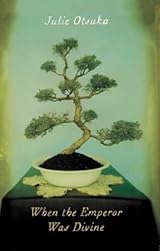
When the Emperor Was Divine by Julie Otsuka

In early autumn the farm recruiters arrived to sign up new workers, and the War Relocation Authority allowed many of the young men and women to go out and help harvest the crops. Some came back wearing the same shoes they'd left in and swore they would never go out there again. They said they'd been shot at. Spat on. Refused entrance to the local diner. The movie theater. The dry goods store. They said the signs in the windows were the same wherever they went: 'No Japs Allowed.' Life was easier, they said, on this side of the fence.

The Japanese internment during World War II may be the least-discussed major shame in American history. In spite of resistance from some fronts, there is at least a general recognition that slavery was bad and we shouldn't have killed all the the Indians. The Japanese internment, on the other hand, I didn't even learn about in high school. Right-wing shill Michelle Malkin wrote a book in defense of internment, no doubt hoping it would spur a smililar movement toward her own group non grata, Muslims. And Asians, now treated as a model minority by the "I'm not racist but" crowd, are often spoken of as though their American experience has been smooth sailing, never mind that even high profile figures like George Takai were actually in these camps. This isn't ancient history.

I'm not confident I've read anything about the internment in the course of Fifty Books, and When the Emperor Was King did a good job whetting my appetite for more. It's a terse, unsentimental little novel that doesn't even name its characters even as it follows them through the arrest of their father, their own move to and life in an internment camp, and their eventual return home, where they are finally, after several years, reuinited.

When I say this book is unsentimental, it's no joke. The first section--the book is split into five--follows the unnamed mother as she prepares their house for their indefinite absence. Some of the preparations are benign--packing things aways, making sure the faucets are off. Others are more chilling and speak to uncertainty and permenance of their dislocation, like when we follow her to the store where she purchases a new shovel with which to kill and bury the family dog. Does this make her sad? Angry? Resigned? We're never told, just as the children are never told why White Dog isn't coming when she's called.

The train ride to the camp and life in the camp itself is endless monotony punctuated by the terror of being completely powerless and surrounded by those who are indifferent. The girl thinks she seems some humanity on a guard's face, but the reader has no reason to think its real. Shades are kept low lest a passby lob a brick through a window upon realizing the bus is full of 'the enemy'.

And finally, the family returns home, to a house that's been destroyed by tenants who paid no rent or respect; they are greeted, or not greeted, by old friends who now see them as the enemy; they sleep every night with the threat of vandalism, arson, or worse; and they wait for their father to come home. But when he does, he's not the man they remember:

As the days grew longer our father began spending more and more time alone in his room. He stopped reading the newspaper. He no longer listened to Dr. IQ. with us on the radio. "There's already enough noise in my head," he explained. The handwriting in his notebook grew smaller and fainter and then disappeared from the page altogether. Now whenever we passed by his door we saw him sitting on the edge of his bed with his hands in his lap, staring out through the window as though he were waiting for something to happen. Sometimes he'd get dressed and put on his coat but he could not make himself walk out the front door.

In the evening he often went to bed early, at seven, right after supper - 'Might as well get the day over with' - but he slept poorly and woke often from the same recurring dream: It was five minutes past curfew and he was trapped outside, in the world, on the wrong side of the fence. "I've got to get back,' he'd wake up shouting.

'You're home now,' our mother would remind him. 'It's all right. You can stay.”

That "You can stay" breaks my heart. It communicates so much that has been surpressed in the book and in history itself. The heartbreak of disassociation, the despair of rejection, the pointless brokenness resulting from racism and fear. And it's a message that can't help but resonate now in the age of Trump, with Muslim bans, mosque bombings, "the wall", and the desire to Make America Great Again--when the question that really needs to be asked is, "Was there ever a time when America was really great?" The least of these would probably answer "no." But maybe instead of repeating history, there is a faint hope that we can learn.