"For example, then," continued Holgrave. "A dead man, if he happen to have made a will, disposes of wealth no longer his own; or, if he die intestate, it is distributed in accordance with the notions of men much longer dead than he. A dead man sits on all our judgment seats; and living judges do but search out and repeat his decisions. We read in dead men's books! We laugh at dead men's jokes, and cry at dead men's pathos! We are sick of dead men's diseases, physical and moral, and die of the same remedies with which dead doctors killed their patients! We worship the living Deity according to dead men's forms and creeds. Whatever we seek to do, of our own free motion, an icy head obstructs us! Turn our eyes to what point we may, a dead man's white, immitigable face encounters them, and freezes our very heart! And we must be dead ourselves before we can have our proper influence on the world, which will be no longer our world, but the world of another generation, with which we shall have no shadow of a right to interfere. I ought to have said, too, that we live in dead men's houses; as, for instance, in this of the Seven Gables!"
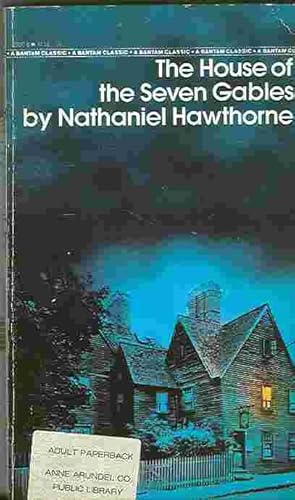
In Puritan New England, Colonel Pyncheon manages to swindle the poor Matthew Maule out of a plot of land that Pyncheon uses to build a great, seven-gabled house. Maule, accused of witchcraft, uses his last breath before he is hanged to curse the house and the Pyncheon family, declaring, "God hath given them blood to drink!" And true enough, on the day of his housewarming party, Colonel Pyncheon is found dead in his study as if by an unseen hand.
The main narrative of The House of Seven Gables occurs 150 years later, as the Pyncheon family, having come down in the world, still struggles under the weight of Maule's curse. The only inhabitants of the House of the Seven Gables are Hepzibah, an elderly woman forced to open a store to make ends meet, and a daguerreotypist named Holgrave who rents a room. To this are quickly added the sunny, saintly Phoebe, a Pyncheon cousin, and Clifford Pyncheon, released after thirty years of wrongful imprisonment and unsurprisingly maladjusted to the outside world. A wealthy cousin, Judge Jaffrey Pyncheon, lurks at the edge of the story with some very vague evil intent.
Once you take Hawthorne's prose with a grain of salt, his books are a lot of fun. He violates that first principle of modern writing--show, don't tell--with such gleeful abandon and wordiness that I often laugh. At the same time, his writing is not very difficult, on the level of the sentence, and there's something delightful about the sheer weirdness and silliness he's capable of. (I particularly like the detail of the old chicken family, made imbecile by inbreeding, that Hawthorne uses as a representation of the Pyncheons.) And he also manages to capture really finely nuanced human emotions and relationships in a way that the modern show-don't-tell-iness leaves intentionally vague.
The best parts of The House of Seven Gables are all historical: the story of Colonel Pyncheon and Matthew Maule, and another interstitial story about a descendant of Maule who uses his powers of mesmerism to bind young Alice Pyncheon to him for life. The "modern-day" narrative, which tries to show us how the curse lives on in the penury of Hepzibah and the injustice done against Clifford, shies away from a direct approach of the supernatural and puts more demands on the reader's patience. The novel's major flaw is that Hawthorne jealously reserves two pieces of crucial information until the end--spoiler alert: that Holgrave is a descendant of Matthew Maule, and that it's Jaffrey Pyncheon who committed the murder for which Clifford took the fall. Hawthorne reserves these facts to give us a kind of typical Gothic reveal at the end, but I wonder if knowing these things wouldn't deepen the relationships between Holgrave and Phoebe--thrust together from warring families like Romeo and Juliet--or Clifford and Jaffrey. (It seems typically Hawthornean that Jaffrey's whole role in the story is to walk past the house and be menacing, then finally get inside and immediately die in an arm chair.)
The big theme of The House of Seven Gables is the past: the way that it exerts an effect on the living, and the possibility of escape or reconciliation. Holgrave's marriage to Phoebe and the death of Jaffrey, who looks exactly like the portrait of old Colonel Pyncheon, put the curse to rest once and for all. In this way it doesn't have the complexity or conflicted nature of The Scarlet Letter. Like a lot of Gothic novels, it really has a heart of pure sunshine.
Showing posts with label Nathaniel Hawthorne. Show all posts
Sunday, June 4, 2017
Tuesday, August 26, 2014
The Scarlet Letter by Nathaniel Hawthorne
She could no longer borrow from the future to help her through the present grief. Tomorrow would bring its own trial with it, as would the next day, and yet the very same that was now so unutterably grievous to be be borne. The days of the far-off future would toil onward; still with the same burden for her to take up and bear along with her, but never to fling down; for the accumulating days and added years would pile up their misery upon the heap of shame. Throughout them all, giving up her individuality, she would become the general symbol at which the preacher and moralist might point, and in which they might vivify and embody their images of a woman's frailty and sinful passion. Thus the young and pure would be taught to look at her, with the scarlet letter flaming on her breast--at her, the child of honorable parents, at her, the mother of a babe, that would hereafter be a woman, at her, who had once been innocent--as the figure, the body, the reality of sin.
A student that I deeply respect told me at the end of the year that she hadn't enjoyed reading The Scarlet Letter. That's sadly typical, I think--even students who like reading don't often like to read Hawthorne, who is an accomplished stylist but also a ponderous and stuffy one. I told her that I had felt the same way about it when I read it in high school, but it wasn't until I was an adult that I learned to appreciate it, when I realized just how profoundly weird it is. The lurking Satan-allied witch Mrs. Hibbins, the comet shaped like an "A" in the sky, the destructive, yet difficult to describe force that Chillingworth exerts on Dimmesdale--it's all bizarre. Of course, we live in a world where Hester Prynne's "A" has become the dominant image of social ostracism, but for those who can approach The Scarlet Letter fresh, it's am immensely rewarding book. (And much better than The Marble Faun.)
Moreover: Is there any book by a male writer in the history of American literature with a female protagonist as strong as Hester Prynne? The letter on Hester's breast is meant to reduce her to a symbol, a warning sign--to make her a literary trope instead of a person. Reading it now, I was struck by how that ostracism, by alienating Hester from her society, makes her a better person:
Hawthorne is pretty down on Puritan society, and in part Hester's strength is a result of her alienation from it. But comparing her with the Reverend Dimmesdale, her partner in crime, reveals just how strong she already is. As he yearns to unite his public face with his private one, and undergo the kind of atonement that keeping his adultery secret has denied him, he withers into a sickly mess. Many critics have noticed the flipping of gender roles here, and I think that's an important contrast even to today. How many films and television shows have you seen just this year in which a principal female character, no matter how strong she otherwise may be, requires saving by another male figure? Here, Dimmesdale clings to Hester when he can, so much that the rescue plot--their escape back to the Europe--is her plan, and it only fails because of his own weakness.
Ultimately, the symbol of the "A"--and the symbol of Hester--refuses to remain unchanged. Her life of solitude and hard work causes some to interpret it as "able," and critics have subsumed many other "a" words into it as well. (My favorite is "America.") Hester herself is something of a Moby Dick--the symbol that keeps slipping in meaning. But Moby Dick can do it because he is inscrutable, unconquerable; Hester can do it because she exerts ownership over herself in a way that Dimmesdale never could. She refuses to be inscribed upon, to be turned into text, and in this way The Scarlet Letter is a powerful assertion of individualism against the community.
Here's Brent's review from earlier this year.
A student that I deeply respect told me at the end of the year that she hadn't enjoyed reading The Scarlet Letter. That's sadly typical, I think--even students who like reading don't often like to read Hawthorne, who is an accomplished stylist but also a ponderous and stuffy one. I told her that I had felt the same way about it when I read it in high school, but it wasn't until I was an adult that I learned to appreciate it, when I realized just how profoundly weird it is. The lurking Satan-allied witch Mrs. Hibbins, the comet shaped like an "A" in the sky, the destructive, yet difficult to describe force that Chillingworth exerts on Dimmesdale--it's all bizarre. Of course, we live in a world where Hester Prynne's "A" has become the dominant image of social ostracism, but for those who can approach The Scarlet Letter fresh, it's am immensely rewarding book. (And much better than The Marble Faun.)
Moreover: Is there any book by a male writer in the history of American literature with a female protagonist as strong as Hester Prynne? The letter on Hester's breast is meant to reduce her to a symbol, a warning sign--to make her a literary trope instead of a person. Reading it now, I was struck by how that ostracism, by alienating Hester from her society, makes her a better person:
For years past she had looked from this estranged point of view at human institutions, and whatever priests or legislators had established; criticizing all with hardly more reverence than the Indian would feel for the clerical band, the judicial robe, the pillory, the gallows, the fireside, or the church. The tendency of her fate and fortunes had been to set her free. The scarlet letter was her passport into regions where other women dared not tread.
Hawthorne is pretty down on Puritan society, and in part Hester's strength is a result of her alienation from it. But comparing her with the Reverend Dimmesdale, her partner in crime, reveals just how strong she already is. As he yearns to unite his public face with his private one, and undergo the kind of atonement that keeping his adultery secret has denied him, he withers into a sickly mess. Many critics have noticed the flipping of gender roles here, and I think that's an important contrast even to today. How many films and television shows have you seen just this year in which a principal female character, no matter how strong she otherwise may be, requires saving by another male figure? Here, Dimmesdale clings to Hester when he can, so much that the rescue plot--their escape back to the Europe--is her plan, and it only fails because of his own weakness.
Ultimately, the symbol of the "A"--and the symbol of Hester--refuses to remain unchanged. Her life of solitude and hard work causes some to interpret it as "able," and critics have subsumed many other "a" words into it as well. (My favorite is "America.") Hester herself is something of a Moby Dick--the symbol that keeps slipping in meaning. But Moby Dick can do it because he is inscrutable, unconquerable; Hester can do it because she exerts ownership over herself in a way that Dimmesdale never could. She refuses to be inscribed upon, to be turned into text, and in this way The Scarlet Letter is a powerful assertion of individualism against the community.
Here's Brent's review from earlier this year.
Labels:
Boston,
Nathaniel Hawthorne,
Puritanism,
symbolism,
The Scarlet Letter
Thursday, July 31, 2014
The Marble Faun by Nathaniel Hawthorne
This was the time, perhaps, when Kenyon first became sensible what a dreary city is Rome, and what a terrible weight there is imposed on human life, when any gloom within the heart corresponds to the spell of ruin, that has been thrown over the site of ancient empire. He wandered, as it were, and stumbled over the fallen columns, and among the tombs, and groped his way into the sepulchral darkness of the catacombs, and found no path emerging from them. The happy may well enough continue to be such, beneath the brilliant sky of Rome. But, if you go thither in melancholy mood--if you go with a ruin in your heart, or with a vacant site there, where once stood the airy fabric of happiness, now vanished--all the ponderous gloom of the Roman Past will pile itself upon that spot, and crush you down as with the heaped-up marble and granite, the earth-mounds, and multitudinous bricks, of its material decay.
The Marble Faun is about three American artists in Rome, a city that would be unrecognizable to anyone who has visited in the sprawling metropolis in the 21st century. Until the Industrial Revolution, Rome was underpopulated, described by Hawthorne as a city of mostly ruins, freighted with an intense heritage of music and art but also prone to summer outbreaks of debilitating malaria. The artists--Miriam, Hilda, and Kenyon--are joined by a fourth friend, an Italian Count with a carefree personality named Donatello, who is the uncanny likeness of the Greek sculpture the Faun of Praxiteles:
Donatello's similarity to the titular faun is one of those quasi-mystical touches Hawthorne likes that he never bothers to explain; think of the meteor shaped like the letter "A" in The Scarlet Letter. The Marble Faun borrows heavily from the Anne Radcliffe school of Gothic Romance, including the Roman setting, but refuses to explain away its ghosts Scooby Doo-style, like Radcliffe does. On the other hand, there's is nothing as explicitly supernatural as in Dracula or The Monk--rather, Hawthorne employs these mystical flourishes so matter-of-factly that it seems beside the point to ask for any sort of rational explanation at all.
The other mystical touch in The Marble Faun is a doozy: Miriam gets lost on a group outing to the Roman Catacombs, and when the others find her again, she is in the company of a sinister stranger who may or may not be a thousand-year old phantom haunting the catacombs:
"Inquire not what I am, nor wherefore I abide in the darkness," said he, in a hoarse, harsh voice, as if a great deal of damp were clustering in his throat. "Henceforth, I am nothing but a shadow behind her footsteps. She came to me when I sought her not. She has called me forth, and must abide the consequences of my re-appearance in the world."
[Spoiler alert for the following paragraph.] From then on, the stranger follows Miriam everywhere, stalking constantly at the edge of every room. Miriam, in a strange and ill-advised move, bargains with him that she can convert him to Christianity on penalty of her immortal soul. One night, Donatello, who has fallen deeply in love with Miriam, pushes the stranger over a cliff to his death. The rest--in fact, the bulk--of the novel deals with the consequences of this action, as the guilt from this deed destroys Donatello's once-cheery personality and chases Miriam out of Rome.
Ultimately The Marble Faun becomes a story like The Scarlet Letter, about a single misdeed that becomes a psychological torment to more than the one or two who actually committed it. But where the pyrotechnics of guilt in The Scarlet Letter are enhanced by the repressive Puritan society that proscribes adultery, Miriam and Donatello's guilt seems discordant in spooky, malarial Rome. I didn't find that their anguish--or Hilda's virginal shock--was enough to carry the plot after the intriguing first few chapters. It doesn't help that the novel is padded with material from the journal Hawthorne kept when in Rome, stopping the plot to opine on architecture, painting, sculpture, and other travelogue-type stuff. Though The Marble Faun comes to a satisfyingly creepy ending, set in a masquerade-style carnival, I had already lost interest.
The Marble Faun is about three American artists in Rome, a city that would be unrecognizable to anyone who has visited in the sprawling metropolis in the 21st century. Until the Industrial Revolution, Rome was underpopulated, described by Hawthorne as a city of mostly ruins, freighted with an intense heritage of music and art but also prone to summer outbreaks of debilitating malaria. The artists--Miriam, Hilda, and Kenyon--are joined by a fourth friend, an Italian Count with a carefree personality named Donatello, who is the uncanny likeness of the Greek sculpture the Faun of Praxiteles:
![]() |
| Hey baby. |
Donatello's similarity to the titular faun is one of those quasi-mystical touches Hawthorne likes that he never bothers to explain; think of the meteor shaped like the letter "A" in The Scarlet Letter. The Marble Faun borrows heavily from the Anne Radcliffe school of Gothic Romance, including the Roman setting, but refuses to explain away its ghosts Scooby Doo-style, like Radcliffe does. On the other hand, there's is nothing as explicitly supernatural as in Dracula or The Monk--rather, Hawthorne employs these mystical flourishes so matter-of-factly that it seems beside the point to ask for any sort of rational explanation at all.
The other mystical touch in The Marble Faun is a doozy: Miriam gets lost on a group outing to the Roman Catacombs, and when the others find her again, she is in the company of a sinister stranger who may or may not be a thousand-year old phantom haunting the catacombs:
"Inquire not what I am, nor wherefore I abide in the darkness," said he, in a hoarse, harsh voice, as if a great deal of damp were clustering in his throat. "Henceforth, I am nothing but a shadow behind her footsteps. She came to me when I sought her not. She has called me forth, and must abide the consequences of my re-appearance in the world."
[Spoiler alert for the following paragraph.] From then on, the stranger follows Miriam everywhere, stalking constantly at the edge of every room. Miriam, in a strange and ill-advised move, bargains with him that she can convert him to Christianity on penalty of her immortal soul. One night, Donatello, who has fallen deeply in love with Miriam, pushes the stranger over a cliff to his death. The rest--in fact, the bulk--of the novel deals with the consequences of this action, as the guilt from this deed destroys Donatello's once-cheery personality and chases Miriam out of Rome.
Ultimately The Marble Faun becomes a story like The Scarlet Letter, about a single misdeed that becomes a psychological torment to more than the one or two who actually committed it. But where the pyrotechnics of guilt in The Scarlet Letter are enhanced by the repressive Puritan society that proscribes adultery, Miriam and Donatello's guilt seems discordant in spooky, malarial Rome. I didn't find that their anguish--or Hilda's virginal shock--was enough to carry the plot after the intriguing first few chapters. It doesn't help that the novel is padded with material from the journal Hawthorne kept when in Rome, stopping the plot to opine on architecture, painting, sculpture, and other travelogue-type stuff. Though The Marble Faun comes to a satisfyingly creepy ending, set in a masquerade-style carnival, I had already lost interest.
Labels:
gothic,
Nathaniel Hawthorne,
Rome,
The Marble Faun
Wednesday, June 18, 2014
The Scarlet Letter by Nathaniel Hawthorne
I feel bad that I've fallen so far behind on my reviews, because I've read some great books this year that are definitely going to get the short shrift because it's been so long since I read them. That includes this one, possibly the most widely-disparaged book ever to find its way onto high school reading lists.
Of course, it's not too surprising that The Scarlet Letter doesn't connect with most high-schoolers. For those unfamiliar, the story concerns Hester Prynne, a single woman in a strict Puritan community, who is discovered to be pregnant and sentenced to spend the rest of her life wearing a red letter "A"--for adultery--as punishment for her transgression. As for the father, well, that's the Reverend Arthur Dimmsdale, the town's most respected citizen and the next thing to an angel in the eyes of the townfolk.
What follows from this is a long meditation on sin, guilt, the nature of love and religious belief, all written in Hawthorne's typically slow-moving and flowery prose. Oh, and the book opens with a fifty-page framing story about an accounting house where the record of The Scarlet Letter is found, to discourage the rare kid who found the adultery story compelling.
And, in spite of all this, I loved it. It might be the best thing I've read so far this year.
Some of this is just my literary taste--I love Hawthorne's baroque verbiage and slow pace, but I can see how it could be a turn off--but there's more to the story than that. For one thing, the novel is full of ambiguity. As I recall, it never even spells out that Rev. Dimmsdale was the father until the very end of the novel, although the reader is expected to have intuited it pretty early. The meaning of the scarlet "A" is never explicitly mentioned either, and those are two of the main plot points of the book! They aren't hard to discern but it does demonstrate the confidence Hawthorne has in his readers.
Hand in hand with the plot ambiguities, Hawthorne allows a lot of moral wiggle room as well. Until a short speech at the end, which feels shoehorned in to please censors, Hawthorne casts no shade on Hester. In fact, as the story progresses, she sometimes seems like the only moral person in a town full of hypocrites. Knowing how Hawthorne felt about Puritans, it seems likely that he DID feel this way, but it's still strange to see a woman have an illegitimate child and come out of the situation better then she went in. I don't know that I've ever read a book this old that was so loath to pass judgement on its characters.
Also, despite its stuffy rep, The Scarlet Letter is a deeply strange book. Occurrences throughout--Hester's vindictive ex, a vision in the sky, Dimmsdale's ever-increasing torment, and Hester's possibly-demented daughter--point to supernaturalism without ever spelling it out. At points, it feels almost like a Gothic novel, with "ghosts" everywhere, and skeletal hands behind the scenes pushing things along, except in this case, the hands are God's and the devil is a disgruntled ex.
Of course, it's not too surprising that The Scarlet Letter doesn't connect with most high-schoolers. For those unfamiliar, the story concerns Hester Prynne, a single woman in a strict Puritan community, who is discovered to be pregnant and sentenced to spend the rest of her life wearing a red letter "A"--for adultery--as punishment for her transgression. As for the father, well, that's the Reverend Arthur Dimmsdale, the town's most respected citizen and the next thing to an angel in the eyes of the townfolk.
What follows from this is a long meditation on sin, guilt, the nature of love and religious belief, all written in Hawthorne's typically slow-moving and flowery prose. Oh, and the book opens with a fifty-page framing story about an accounting house where the record of The Scarlet Letter is found, to discourage the rare kid who found the adultery story compelling.
And, in spite of all this, I loved it. It might be the best thing I've read so far this year.
Some of this is just my literary taste--I love Hawthorne's baroque verbiage and slow pace, but I can see how it could be a turn off--but there's more to the story than that. For one thing, the novel is full of ambiguity. As I recall, it never even spells out that Rev. Dimmsdale was the father until the very end of the novel, although the reader is expected to have intuited it pretty early. The meaning of the scarlet "A" is never explicitly mentioned either, and those are two of the main plot points of the book! They aren't hard to discern but it does demonstrate the confidence Hawthorne has in his readers.
Hand in hand with the plot ambiguities, Hawthorne allows a lot of moral wiggle room as well. Until a short speech at the end, which feels shoehorned in to please censors, Hawthorne casts no shade on Hester. In fact, as the story progresses, she sometimes seems like the only moral person in a town full of hypocrites. Knowing how Hawthorne felt about Puritans, it seems likely that he DID feel this way, but it's still strange to see a woman have an illegitimate child and come out of the situation better then she went in. I don't know that I've ever read a book this old that was so loath to pass judgement on its characters.
Also, despite its stuffy rep, The Scarlet Letter is a deeply strange book. Occurrences throughout--Hester's vindictive ex, a vision in the sky, Dimmsdale's ever-increasing torment, and Hester's possibly-demented daughter--point to supernaturalism without ever spelling it out. At points, it feels almost like a Gothic novel, with "ghosts" everywhere, and skeletal hands behind the scenes pushing things along, except in this case, the hands are God's and the devil is a disgruntled ex.
Labels:
christianity,
feminism,
gothic,
hypocrisy,
Nathaniel Hawthorne,
Puritanism,
sex
Tuesday, April 2, 2013
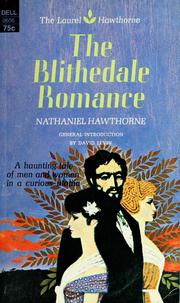
The Blithedale Romance by Nathaniel Hawthorne
In truth, it was dizzy work, amid such fermentation of opinions as was going on in the general brain of the Community. It was a kind of Bedlam, for the time being; although, out of the very thoughts that were wildest and most destructive, might grow a wisdom, holy, calm, and pure, and that should incarnate itself with the substance of a noble and happy life. But, as matters now were, I felt myself (and having a decided tendency toward the actual, I never liked to feel it) getting quite out of my reckoning, with regard to the existing state of the world. I was beginning to lose the sense of what kind of world it was, along innumerable schemes of what it might or out to be.
How do you balance the world as it is with what it might or ought to be? How can you, when the latter is imagined a million ways, when it is constructed from "innumerable schemes?" As Miles Coverdale, the protagonist of Hawthorne's Blithedale Romance, tells the ingenue Priscilla, "People never do get just the good they seek. If it come at all, it is something else, which they never dreamed of, and did not particularly want."
The Blithedale Romance is all about competing visions of "the good." It's based on Hawthorne's abortive experience at the Utopian community of Brook Farm, with which Blithedale shares a lot of similarities: A place of communal farming, cooking, and living, like an American kibbutz or something. These Utopian communities were, apparently, an important part of 19th century ideas of reform: They promoted both social and individual improvement, and emphasized a closeness to the land. Coverdale, a famous poet who goes to live at Blithedale, is Hawthorne's stand-in, and he grows to believe very strongly in the Community's mission, perhaps more strongly than Hawthorne himself ever did.
The problem, as presented through Coverdale's eyes, is the surfeit of good intentions: His friend and fellow Community member Hollingsworth is a philanthropist committed to prison reform, and surreptitiously plans to purchase Blithedale's land and build a prison on it. The scene where Hollingsworth begs Coverdale for his allegiance is a really fantastic chapter, full of pathos:
It is not at all clear to me who is being selfish here. Is it Hollingsworth, steamrolling Coverdale's (and everyone else's) ideas about the common good to establish his own? Is it Coverdale, whose idea of reform stops conspicuously short of doing anything for other people? At the heart of The Blithedale Romance is, I think, this idea that even the best intentions can destroy each other.
Complicating this relationship is the love triangle between Hollingsworth, the wealthy beauty Zenobia, and the waifish, innocent Priscilla. Though Blithedale is supposedly about an entire community, only these four seem to exist in it, and even Coverdale admits that some of his tension with Hollingsworth comes from a feeling of being left out:
Coverdale styles himself as an outsider, and observer, selectively ignoring the way that he, Heisenberg-like, participates in the very events he imagines himself to be separate from. He observes and wonders: Which does Hollingsworth love? Is he after Zenobia's money for his ludicrous prison? What is his interest in Priscilla? And yet for all his watching, he never penetrates much into the reality of what he sees, which involves (in some typically Hawthornian twists) a suspicious stranger, a fortune teller who never removes her veil, and long-lost siblings.
Ultimately, Blithedale is a very small and human drama which seems more tragic against the backdrop of the Community, with its all-encompassing social project and Utopian aims. It it is about the bittersweet triumph of people and relationships over ideas:
How do you balance the world as it is with what it might or ought to be? How can you, when the latter is imagined a million ways, when it is constructed from "innumerable schemes?" As Miles Coverdale, the protagonist of Hawthorne's Blithedale Romance, tells the ingenue Priscilla, "People never do get just the good they seek. If it come at all, it is something else, which they never dreamed of, and did not particularly want."
The Blithedale Romance is all about competing visions of "the good." It's based on Hawthorne's abortive experience at the Utopian community of Brook Farm, with which Blithedale shares a lot of similarities: A place of communal farming, cooking, and living, like an American kibbutz or something. These Utopian communities were, apparently, an important part of 19th century ideas of reform: They promoted both social and individual improvement, and emphasized a closeness to the land. Coverdale, a famous poet who goes to live at Blithedale, is Hawthorne's stand-in, and he grows to believe very strongly in the Community's mission, perhaps more strongly than Hawthorne himself ever did.
The problem, as presented through Coverdale's eyes, is the surfeit of good intentions: His friend and fellow Community member Hollingsworth is a philanthropist committed to prison reform, and surreptitiously plans to purchase Blithedale's land and build a prison on it. The scene where Hollingsworth begs Coverdale for his allegiance is a really fantastic chapter, full of pathos:
"Coverdale," he murmured, "there is not the man in this wide world, whom I can love as I could you. Do not forsake me!"
As I look back upon this scene, through the coldness and dimness of so many years, there is still a sensation as if Hollingsworth had caught hold of my heart, and were pulling it towards him with an almost irresistible force. It is a mystery to me, how I withstood it. But, in truth, I saw in his scheme of philanthropy nothing but what was odious. A loathsomeness that was to be forever in my daily work! A great, black ugliness of sin, which he proposed to collect out of a thousand human hearts, and that we should spend our lives in an experiment of transmuting it into virtue!"
It is not at all clear to me who is being selfish here. Is it Hollingsworth, steamrolling Coverdale's (and everyone else's) ideas about the common good to establish his own? Is it Coverdale, whose idea of reform stops conspicuously short of doing anything for other people? At the heart of The Blithedale Romance is, I think, this idea that even the best intentions can destroy each other.
Complicating this relationship is the love triangle between Hollingsworth, the wealthy beauty Zenobia, and the waifish, innocent Priscilla. Though Blithedale is supposedly about an entire community, only these four seem to exist in it, and even Coverdale admits that some of his tension with Hollingsworth comes from a feeling of being left out:
Generosity is a very fine thing, at a proper time, and within due limits. But it is an insufferable bore, to see one man engrossing every thought of all the women, and leaving his friend to shiver in outer seclusion, without even the alternative of solacing himself with what the more fortunate individual has rejected. Yes; it was out of a foolish bitterness of heart that I had spoken.
Coverdale styles himself as an outsider, and observer, selectively ignoring the way that he, Heisenberg-like, participates in the very events he imagines himself to be separate from. He observes and wonders: Which does Hollingsworth love? Is he after Zenobia's money for his ludicrous prison? What is his interest in Priscilla? And yet for all his watching, he never penetrates much into the reality of what he sees, which involves (in some typically Hawthornian twists) a suspicious stranger, a fortune teller who never removes her veil, and long-lost siblings.
Ultimately, Blithedale is a very small and human drama which seems more tragic against the backdrop of the Community, with its all-encompassing social project and Utopian aims. It it is about the bittersweet triumph of people and relationships over ideas:
The bands, that were silken once, are apt to become iron fetters, when we desire to shake them off. Our souls, after all, are not our own. We convey a property in them to those with whom we associate, but to what extent can never be known, until we feel the tug, the agony, of our abortive effort to resume an exclusive sway over ourselves.
Monday, January 28, 2013
“Right from chapter one I could tell this was going to be rough"...
'...said
the 192-page book, citing Dobson’s speculation in the margin that in
addition to “adulteress,” the scarlet “A” worn by the novel’s main
character, Hester Prynne, might stand for “America.” “At that point I
thought, ‘Oh, boy, here we go.’ And then she wrote ‘red = success.’ I
mean, good lord. How could that even begin to make sense?”'
Labels:
Nathaniel Hawthorne,
The Onion,
The Scarlet Letter
Subscribe to:
Posts (Atom)