Showing posts with label Puritanism. Show all posts

Sunday, April 26, 2015

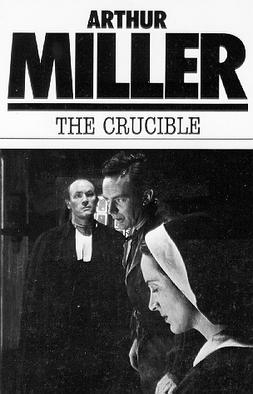
The Crucible by Arthur Miller

PROCTOR: You are the high court, your word is good enough!  Tell them I confessed myself; say Proctor broke his knees and wept like a woman; say what you will, but my name cannot--

DANFORTH, with suspicion: It is the same, is it not?  If I report it or you sign to it?

PROCTOR--he knows it is insane: No, it is not the same!  What others say and what I sign to is not the same!

DANFORTH: Why?  Do you mean to deny this confession when you are free?

PROCTOR: I mean to deny nothing!

DANFORTH: Then explain to me, Mr.  Proctor, why you will not let--

PROCTOR, with a cry of his whole soul: Because it is my name!  Because I cannot have another in my life!  Because I lie and sign my name to lies!  Because I am not worth the dust on the feet of them that hang!  I have given you my soul; leave me my name!

The Crucible is famously an allegory for McCarthyism, in which the accusations of witchcraft which rapidly multiply in 17th-century Salem stand in for the similar mania for secret Communists which Joseph McCarthy inspired in the 1950's.  But allegories are reductive--once you have observed that X is a representation of Y, or that Napoleon is Stalin and Snowball is Trotsky, you have solved the puzzle the allegory represents and need go no further.  I didn't find the McCarthyism angle necessary or helpful in reading The Crucible.  Yes, Miller draws parallels between the 17th and 20th centuries, but The Crucible is far less interested in using the past to illuminate the present than it is in observing something frightening and true about human nature: the fragility of community, and the tyranny that public morality can exert over the moral self.

What happens in Salem happens, Miller observes, thanks to a poisonous mix of noble motives and evil ones.  Governor Danforth, who sentences Proctor and others to hang for witchcraft, is never anything less than a devout, if myopic, figure who takes Proctor's claims that the accusations are false quite seriously.  But others, like Putnam, seize the opportunity to punish their enemies and seize their property once they've been accused.  The worst of these is Abigail, the chilling villainess of the play, only a teenager, whose calculated show of being afflicted by witchcraft is terrifying in its malice.  Abigail, having had an affair with Proctor, makes his wife one of her principal targets--as Proctor says, she "means to dance on my wife's grave."  At the end of Act III, Abigail whips herself into a possessed frenzy in front of the courtroom, pretending to be menaced by the spirit of a girl she wants to ruin--and ultimately forces an abject apology out of the very girl she wants to destroy.  It's a frightening moment, partly because of Abigail's shameless cruelty, but also because it shows how weak the individual spirit can be.  It's probably awesome on stage.

The hero, Proctor, is not a very good man--he has an affair with Abigail, after all, and is renowned for not being much of a churchgoer--but fights valiantly to preserve his own sense of right and wrong in the face of immense social pressure.  At the end, in prison, he faces a choice: sign his name to a confession and live, or refuse and be hanged.  The choice is between public absolution and private morality--is it worthwhile to be a good and honest man, the play asks, if it means the rest of the world sees you as a bad one?  Proctor begs to keep his name, though he's given the community his soul, but it seems like the terms have gotten switched around: his name, that part of his identity which belongs to the community, has already been robbed from him, but his refusal to sign the document allows him to retain something of himself, even at the cost of his own life.

Putting The Crucible in the McCarthyism box prevents us from really understanding the power of Proctor's doomed choice, and from realizing that we still fall prey to the same kind of savage mania as the Puritans.  I'd argue that, in the social media age, we're constantly finding new victims on whom to exert the will of public shame.  Like Danforth, sometimes our motives are essentially good ones--I'm looking at you, Racists Getting Fired Tumblr page--but we fail to anticipate the destruction and abuse they foster, and so we devour ourselves.

Tuesday, August 26, 2014

The Scarlet Letter by Nathaniel Hawthorne

She could no longer borrow from the future to help her through the present grief.  Tomorrow would bring its own trial with it, as would the next day, and yet the very same that was now so unutterably grievous to be be borne.  The days of the far-off future would toil onward; still with the same burden for her to take up and bear along with her, but never to fling down; for the accumulating days and added years would pile up their misery upon the heap of shame.  Throughout them all, giving up her individuality, she would become the general symbol at which the preacher and moralist might point, and in which they might vivify and embody their images of a woman's frailty and sinful passion.  Thus the young and pure would be taught to look at her, with the scarlet letter flaming on her breast--at her, the child of honorable parents, at her, the mother of a babe, that would hereafter be a woman, at her, who had once been innocent--as the figure, the body, the reality of sin.

A student that I deeply respect told me at the end of the year that she hadn't enjoyed reading The Scarlet Letter.  That's sadly typical, I think--even students who like reading don't often like to read Hawthorne, who is an accomplished stylist but also a ponderous and stuffy one.  I told her that I had felt the same way about it when I read it in high school, but it wasn't until I was an adult that I learned to appreciate it, when I realized just how profoundly weird it is.  The lurking Satan-allied witch Mrs. Hibbins, the comet shaped like an "A" in the sky, the destructive, yet difficult to describe force that Chillingworth exerts on Dimmesdale--it's all bizarre.  Of course, we live in a world where Hester Prynne's "A" has become the dominant image of social ostracism, but for those who can approach The Scarlet Letter fresh, it's am immensely rewarding book.  (And much better than The Marble Faun.)

Moreover: Is there any book by a male writer in the history of American literature with a female protagonist as strong as Hester Prynne?  The letter on Hester's breast is meant to reduce her to a symbol, a warning sign--to make her a literary trope instead of a person.  Reading it now, I was struck by how that ostracism, by alienating Hester from her society, makes her a better person:

For years past she had looked from this estranged point of view at human institutions, and whatever priests or legislators had established; criticizing all with hardly more reverence than the Indian would feel for the clerical band, the judicial robe, the pillory, the gallows, the fireside, or the church.  The tendency of her fate and fortunes had been to set her free.  The scarlet letter was her passport into regions where other women dared not tread.

Hawthorne is pretty down on Puritan society, and in part Hester's strength is a result of her alienation from it.  But comparing her with the Reverend Dimmesdale, her partner in crime, reveals just how strong she already is.  As he yearns to unite his public face with his private one, and undergo the kind of atonement that keeping his adultery secret has denied him, he withers into a sickly mess.  Many critics have noticed the flipping of gender roles here, and I think that's an important contrast even to today.  How many films and television shows have you seen just this year in which a principal female character, no matter how strong she otherwise may be, requires saving by another male figure?  Here, Dimmesdale clings to Hester when he can, so much that the rescue plot--their escape back to the Europe--is her plan, and it only fails because of his own weakness.

Ultimately, the symbol of the "A"--and the symbol of Hester--refuses to remain unchanged.  Her life of solitude and hard work causes some to interpret it as "able," and critics have subsumed many other "a" words into it as well.  (My favorite is "America.")  Hester herself is something of a Moby Dick--the symbol that keeps slipping in meaning.  But Moby Dick can do it because he is inscrutable, unconquerable; Hester can do it because she exerts ownership over herself in a way that Dimmesdale never could.  She refuses to be inscribed upon, to be turned into text, and in this way The Scarlet Letter is a powerful assertion of individualism against the community.

Here's Brent's review from earlier this year.

Wednesday, June 18, 2014

The Scarlet Letter by Nathaniel Hawthorne

I feel bad that I've fallen so far behind on my reviews, because I've read some great books this year that are definitely going to get the short shrift because it's been so long since I read them. That includes this one, possibly the most widely-disparaged book ever to find its way onto high school reading lists.

Of course, it's not too surprising that The Scarlet Letter doesn't connect with most high-schoolers. For those unfamiliar, the story concerns Hester Prynne, a single woman in a strict Puritan community, who is discovered to be pregnant and sentenced to spend the rest of her life wearing a red letter "A"--for adultery--as punishment for her transgression. As for the father, well, that's the Reverend Arthur Dimmsdale, the town's most respected citizen and the next thing to an angel in the eyes of the townfolk.

What follows from this is a long meditation on sin, guilt, the nature of love and religious belief, all written in Hawthorne's typically slow-moving and flowery prose. Oh, and the book opens with a fifty-page framing story about an accounting house where the record of The Scarlet Letter is found, to discourage the rare kid who found the adultery story compelling.

And, in spite of all this, I loved it. It might be the best thing I've read so far this year.


Some of this is just my literary taste--I love Hawthorne's baroque verbiage and slow pace, but I can see how it could be a turn off--but there's more to the story than that. For one thing, the novel is full of ambiguity. As I recall, it never even spells out that Rev. Dimmsdale was the father until the very end of the novel, although the reader is expected to have intuited it pretty early. The meaning of the scarlet "A" is never explicitly mentioned either, and those are two of the main plot points of the book! They aren't hard to discern but it does demonstrate the confidence Hawthorne has in his readers.

 Hand in hand with the plot ambiguities, Hawthorne allows a lot of moral wiggle room as well. Until a short speech at the end, which feels shoehorned in to please censors, Hawthorne casts no shade on Hester. In fact, as the story progresses, she sometimes seems like the only moral person in a town full of hypocrites. Knowing how Hawthorne felt about Puritans, it seems likely that he DID feel this way, but it's still strange to see a woman have an illegitimate child and come out of the situation better then she went in. I don't know that I've ever read a book this old that was so loath to pass judgement on its characters.

Also, despite its stuffy rep, The Scarlet Letter is a deeply strange book. Occurrences throughout--Hester's vindictive ex, a vision in the sky, Dimmsdale's ever-increasing torment, and Hester's possibly-demented daughter--point to supernaturalism without ever spelling it out. At points, it feels almost like a Gothic novel, with "ghosts" everywhere, and skeletal hands behind the scenes pushing things along, except in this case, the hands are God's and the devil is a disgruntled ex.

Monday, May 27, 2013

The Private Memoirs and Confessions of a Justified Sinner by James Hogg

I felt greatly strengthened and encouraged that night, and the next morning I ran to meet my companion, out of whose eye I had now no life.  He rejoiced at seeing me so forward in the great work of reformation by blood, and said many things to raise my hopes of future fame and glory; and then, producing two pistols of pure beaten gold, he held them out and proffered me the choice one, saying, 'See what thy master hath provided thee!'  I took one of them eagerly, for I perceived at once that they were two of the very weapons that were let down from Heaven in the cloudy veil, the dim tapestry of the firmament; and I said to myself, 'Surely this is the will of the Lord.'

The Private Memoirs and Confessions of a Justified Sinner is a first hand account of religious fanaticism as told by the fanatic, who sees his deeds as divinely inspired.  It is also an account of the fanatic's mental, physical, and spiritual destruction, perhaps at his own hands, perhaps at the hands of darker forces.  Its narrator, Robert Wringhim Colwan--the "justified sinner"--is consumed, in both senses, by his fanaticism.

Legally, Robert is the son of the wealthy Laird Dalcastle, but his probable father--Robert calls him "my spiritual father"--is the Reverend Robert Wringhim, a severe Puritan Calvinist preacher who serves as the Lady Dalcastle's spiritual adviser.  Brought up in this strict Puritanism, Robert Jr. is well instructed in the tenets of Calvinism, which say that only the elect, those whom God has predestined, will be redeemed, and Robert wavers between a profound anxiety regarding his redemption and a snobbishness toward those he knows to be unchosen reprobates, like the Lord Dalcastle and his half-brother George.

One day, Robert meets a stranger in the woods who calls himself Gil-Martin and looks strangely like himself:

'My countenance changes with my studies and sensations,' said he.  'It is a natural peculiarity in me, over which I have not full control.  If I contemplate a man's features seriously, mine own gradually assume the very same appearance and character.  And what is more, by contemplating a face minutely, I not only attain the same likeness, but, with the likeness, I attain the very same ideas as well as the same mode of arranging them, so that, you see, by looking at a person attentively, I by degrees assume his likeness, and by assuming his likeness I attain to the possession of his most secret thoughts.'

What is Gil-Martin?  Is he a projection of Robert's own mind?  Is he, as is frequently suggested, a demon?  The novel is not particularly interested in providing answers to these questions.  Whatever he is, Gil-Martin has a knack for echoing Robert's own theology back to him in a way that strikes Robert as slightly askew, even as it seems to agree with him precisely.  Gil-Martin helps to assure Robert of his position in the elect, and persuades him that the Lord has chosen him to "cut off" the wicked by murdering those who are not along God's elect, including his father and half brother.

Justified Sinner is a parody of antinomianism--the idea that the elect are exempt from God's moral law because they are already redeemed, and their sins cannot affect their redemption.  But Robert's position in the elect looks increasingly like a membership in a group of one (or two, if you discount the fact that Gil-Martin frequently seems little more than a shadow of Robert's own self) and ultimately none, as Robert himself begins to unravel.  He begins to black out, losing long periods of time where he is told that he has been doing some serious sinning, including seducing a young girl and bringing about her ruin--and possibly murdering his own mother.  His self divorced, as antinomianism dictates, from his own deeds, he begins to dissolve:

Immediately after this I was seized with a strange distemper, which neither my friends nor physicians could comprehend... I generally conceived myself to be two people.  When I lay in bed, I deemed there were two of us in it; when I sat up, I always beheld another person, and always in the same position from the place where I sat or stood, which was about three paces off me toward my left side... The most perverse part of it was that I rarely conceived myself to be any of the two persons.  I thought for the most part that my companion was one of them, and my brother the other; and I found, that to be obliged to speak and answer in the character of another man, was a most awkward business at the long run.

Ultimately, Robert tries to run from his "companion," Gil-Martin, but he is unshakeable, because, as Gil-Martin tells him, "I am wedded to you so closely, that I feel as if we were the same person.  Our essences are one, our bodies and spirits being united, so, that I am drawn towards you as by magnetism, and wherever you are, there must my presence be with you."  There is no avoiding the tormentor, because Robert's tormentor may as well be himself.  The final scenes of Robert's account are feverish, terrifying visions of demonic torture that directly parody the book of Revalation.

Robert's account is book-ended by "The Editor's Narrative," in which the scientific-minded Editor tries to make some sense the story.  He dismisses the possibility of any supernatural truth, but his own biases hardly equal an objective take, and so the novel lies on shifting, indeterminate ground.  This quality--as well as a very strange and funny cameo by the author himself as a rustic shepherd--have led some to claim Justified Sinner as a precursor to the postmodern novel.

That's a fair description--and in fact, of all the books I read for my class on the 19th-century Romantic novel, this is the one that seems most attuned to 21st Century sensibilities, and one of only two I'd say are really worth reading (the other being The Monk).  But it also obscures the way that Justified Sinner is deeply invested in its own time and place, and what it meant to be a Calvinist in Scotland in the 1800's.