2016 brought a bunch of new literary surprises for me, including the inimitable Alice Munro, whose books I plan on reading all of, and Christina Stead's The Man Who Loved Children, which is a book that is so totally sui generis I'm not sure if I even want to read another of Stead's novels. Unfamiliar (to me) authors like Renata Adler, William T. Vollmann, and Elaine Dundy crowded a lot of more familiar names out of my top ten list this year.
I'm happy to say that this is the tenth year I've been able to reflect on the books I've read this year, and choose the ten that have meant the most to me. During those years I've read 512 books--okay, some of them have been repeats, but not many--and the net effect has mostly been to point me toward other books I want to read. So, it is with great joy that I present not only the ten best books I've read this year, but the fifty best books I have read over the last decade.
I set some arbitrary rules for myself: I didn't include Shakespeare, and I didn't include any author twice. That may seem artificial--a more honest list would have a whole bunch of Muriel Spark, Graham Greene, and Penelope Fitzgerald on it--but I like the way this list presents the intense diversity of what I've been able to read. And I didn't include anything I didn't read for the first time for this project.
2016 Honorable Mention:
The Ballad of the Sad Cafe by Carson McCullers
The Beginning of Spring by Penelope Fitzgerald
Flow My Tears, the Policeman Said by Philip K. Dick
The Slynx by Tatyana Tolstaya
The Summer Book by Tove Jansson
Tracks by Louise Erdrich
2016 Top Ten:
10.) The Takeover by Muriel Spark - Spark's "Italian novel" benefits from an enlarged cast of brilliantly realized characters--something not always true for a writer as chilly and distant as Spark. (For a contrast, think of The Driver's Seat--a novel with one really significant character, who ultimately remains a totally mystery to author and reader both.) The result is a masterpiece of black humor, involving pagan cults, murderous plots, and lots of illicit sex.
9.) The Three Christs of Ypsilanti by Milton Rokeach - Rokeach's study on schizophrenia, which reports with what I assume is unfailing accuracy the conversations of three men who believe they are Jesus Christ, ought to be unreadable. But in truth it is a profound meditation on how we construct--and scrupulously defend--the boundaries of our own identities.
8.) Despair by Vladimir Nabokov - Nabokov famously hated Dostoevsky, and it's tempting to see Despair as his way of tweaking on the ubermensch dourness of Crime and Punishment. What if the perfect crime, he asks, was not just flawed, but a complete bungle? Nabokov's narrator sets out to murder a man who looks just like him, but the joke is that they look nothing alike. It was worth reading if just to remember how funny Nabokov can be.
7.) Tempest-Tost by Robertson Davies - There's something cruel about the central character of Davies' Tempest-Tost, an utter philistine who joins an amateur theater production of Shakespeare's The Tempest, though he doesn't have the least capability of understanding or appreciating it. But then again, no one in the novel does--they use the play as a means of performing their own deep insecurities and desires, to impress their crushes, or assuage their own egos. Davies, like Shakespeare, understands what's both tragic and comic about human pettiness and frailty.
6.) Argall by William T. Vollmann - Argall is, by any metric, bloated and overstuffed, partly because of its need for fealty to the literal story of John Smith and Pocahontas. But that over-literalness is more than balanced out by Vollmann's modernist approximation of 17th-century diction, which manages to bridge the divide between the present and the past. This year's showdown at the Standing Rock reservation made this book, about the immeasurable change that European colonization foisted on Native Americans, feel especially powerful and timely.
5.) Speedboat by Renata Adler - I am tempted to reduce this capsule just to a quote, my favorite sentence of the year: "A hideous family pledged itself to margarine." But I'll add that no book has really captured, for me, the frenetic quality of city life like Renata Adler's frenetic, slapdash novel Speedboat.
4.) The Dud Avocado by Elaine Dundy - Dundy's novel seems to be designed to answer the question, What if Isabel Archer were funny? It's a loving thumb-in-the-eye to the Bohemian dream of Europe, and sports a stronger, more confident first-person narrator than any other novel I've read in a long time. It's evidence that you don't have to be overly serious to be, you know--serious.
3.) The Givenness of Things by Marilynne Robinson - I have no real problem with Bob Dylan winning the Nobel Prize, except that it means that other exceptional living American writers--a list with Robinson squarely at the top--will you never get the chance. Robinson's book of essays reassured me that there is a place for God in the modern world, but it also challenged me to reexamine some of my most cherished beliefs. And like in her novels, Robinson's style is simple and homespun, but somehow devastatingly powerful.
2.) The Man Who Loved Children by Christina Stead - I am still coming to terms with this book. Is it really like I imagined it? Or was it some kind of strange fever dream? Stead's semi-autobiographical story of a selfish but idealistic man who destroys his dysfunctional family is more bizarre than Naked Lunch, or any science fiction novel you might choose, even while it's made up of the stuff of real life. I understand why no one might read this anymore--in fact, I expect most people would hate it-- but I'll never be able to forget it.
1.) Lives of Girls and Women by Alice Munro - Unlike The Man Who Loved Children, it's hard to put a finger on what makes Munro's work so exceptional. As a prose stylist, Munro is spun from the same cloth as someone like Robinson, steeped in the language of the home and reliant on the perfectly turned metaphor. But the power of Munro's meditation of what it means to grow up female hit me like very little else has in the past ten years. Her story collection The Progress of Love, while not quite the tour de force that Lives is, convinced me that Munro is one of those authors I should have discovered years ago.
The Fifty Best! (2007-2016):
1. Parade's End by Ford Madox Ford
2. The Blue Flower by Penelope Fitzgerald
3. The Moviegoer by Walker Percy
4. The Prime of Miss Jean Brodie by Muriel Spark
5. The Power and the Glory by Graham Greene
6. Wuthering Heights by Emily Bronte
7. Voss by Patrick White
8. Invisible Man by Ralph Ellison
9. A Passage to India by E. M. Forster
10. The Heart is a Lonely Hunter by Carson McCullers
11. Lives of Girls and Women by Alice Munro
12. Housekeeping by Marilynne Robinson
13. Catcher in the Rye by J. D. Salinger
14. The Man Who Loved Children by Christina Stead
15. Jane Eyre by Charlotte Bronte
16. Moby Dick by Herman Melville
17. Paradise Lost by John Milton
18. Emma by Jane Austen
19. The Remains of the Day by Kazuo Ishiguro
20. The Lost Estate by Alain-Fournier
21. The Ponder Heart by Eudora Welty
22. Middlemarch by George Eliot
23. The Transmigration of Timothy Archer by Philip K. Dick
24. The Adventures of Augie March by Saul Bellow
25. Lolita by Vladimir Nabokov
26. Rabbit, Run by John Updike
27. The Dud Avocado by Elaine Dundy
28. Blood Meridian by Cormac McCarthy
29. Far from the Madding Crowd by Thomas Hardy
30. A House for Mr. Biswas by V. S. Naipaul
31. The Private Memoirs and Confessions of a Justified Sinner by James Hogg
32. The Day of the Locust by Nathanael West
33. Kleinzeit by Russell Hoban
34. The Towers of Trebizond by Rose Macaulay
35. Possession by A. S. Byatt
36. Play It as It Lays by Joan Didion
37. The Name of the Rose by Umberto Eco
38. Catch-22 by Joseph Heller
39. Speedboat by Renata Adler
40. The Master and Margarita by Mikhail Bulgakov
41. Under the Net by Iris Murdoch
42. Rebecca by Daphne du Maurier
43. Gormenghast by Mervyn Peake
44. To the Lighthouse by Virginia Woolf
45. Argall by William T. Vollmann
46. One Flew Over the Cuckoo's Nest by Ken Kesey
47. Watership Down by Richard Adams
48. The Bell Jar by Sylvia Plath
49. The Monk by Matthew Lewis
50. Silence by Shusaku Endo
Thanks for a great ten years, everyone! If you'd like to join us next year, we're always looking for new friends to chronicle their reading with us. Let us know in the comments.

Tuesday, December 27, 2016

Thirteen Ways of Looking by Colum McCann

Who in the world invented pockets for pajamas anyway? And for what purpose? A place for a little extra bread or cracker or toast in case we get hungry during the night? A spot for the love letters from long ago? A slipcase for the alter ego, waiting, out there, in the wings?Colum McCann opens each chapter of Thirteen Ways of Looking with a stanza from Wallace Stevens' "Thirteen Ways of Looking at a Blackbird." Just like the poem, the novella plays with the concept of perception, both literally and figuratively. McCann moves from the internal, winding monologue of the elderly Mendelssohn as he lives out his final days in New York City, to flashes of his past in Ireland, to cameras filming his movements in his home and throughout the city. McCann does his usual effortless weaving of narratives spanning decades and continents, and the snapshots he captures and beautifully rendered, even more impressively in such a short span.
The internal narrative chapters are my favorites. McCann meditates on phrases and images, building on them each time: "I was born in the middle of my very first argument," "I was born in the middle of my last epic voyage." We learn of the love of his life, his career, his children, and the high and low points of each. He's old, so the narrative meanders accordingly, but it balances between nostalgic recollections and stark descriptions of the day to day indignities of getting older.
There is a mystery at the center of the story, and it's unveiled artfully. McCann uses the device of perspective to slowly unwind the solution. Sometimes it's a little on the nose: the use of cameras as a symbol for perspective occasionally felt like a little much, but his descriptions are beautiful enough that it still works.
This felt very much like Let the Great World Spin and TransAtlantic, McCann has a gift for wide ranging stories. This one wasn't as ambitious as TransAtlantic in its scope or as nuanced as Let the Great World Spin in its characters, but it packed so much into so few pages. I enjoyed the use of the Stevens poem as a device as well, it lent a new dimension to both the poem and each chapter.
Happy Birthday, Wanda June by Kurt Vonnegut

How do you do. My name is Penelope Ryan. This is a simple-minded play about men who enjoy killing--and those who don't.This is the first Vonnegut play I've ever read (I didn't know he wrote plays!), but it was exactly as you'd expect. It's darkly funny, bitingly sarcastic, and deeply critical of government, the military, and institutions of all kinds. As Penelope states, it is a play about men obsessed with killing--humans, animals, living things of all sorts--and men who don't. Harold, the Odysseus of this saga, is a man who loves killing. His home is plastered in taxidermied beasts, and he's been missing for eight years. He and his pilot, Colonel Looseleaf (another man who loves to kill; he dropped the bomb over Nagasaki), went missing in a plane over the Amazon while hunting for diamonds. In his absence, Penelope has taken up two suitors: Dr. Woodley and Herb Shuttle. Woodley is a kindly obstetrician; he lives across the hall, cares for his mother, and values human life. Shuttle is a sycophantic vacuum salesman who appears to be interested in Penelope mostly out of adoration for her heroic husband.
The play opens as Harold and Looseleaf return to find the world changed. Not only is Penelope engaged and their son, Paul, grown, but the wider world has changed. As Looseleaf remarks: "Now everybody says 'fuck' and 'shit,' 'fuck' and 'shit' all the time. Something very big must have happened while we were out of the country" and "Something very important about sex must have happened while we were gone." Both men are bowled over by the changes they see around them, and both struggle to find their places in their families and the world.
A bizarre side plot involves Wanda June, a girl who died on her birthday, and whose birthday cake was purchased by Shuttle to honor Harold's birthday--Harold happens to return that night and finds the cake with Wanda June's name on it very confusing. Wanda June ends up in heaven, and the play alternates between scenes of Harold's return and abuse of Penelope and Wanda June in heaven playing shuffleboard with Hitler, Einstein, and Jesus.
Vonnegut does his usual surreal, over the top everything, and the play absolutely has moments where the absurdity is funny, but it also (classic Vonnegut) dips into the serious. Harold is overbearingly awful, but he seems somewhat self aware. Even as he swaggers back into his old life, he acknowledges just how awful he is: "When I was a naive young recruit in Spain, I used to wonder why soldiers bayoneted oil paintings, shot the noses off statues and defecated into grand pianos. I now understand: It was to teach civilians the deepest sort of respect for men in uniform--uncontrollable fear." But, as can be expected, he is proud of his awfulness, not remorseful.
This was a quick read, and fun. The dark twist on the Odyssey narrative still works and feels relevant today, and the ending is satisfyingly odd and confusing.
Saturday, December 24, 2016
The Summer Book by Tove Jansson
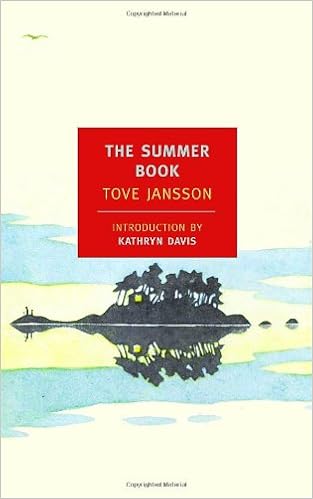
Who reads a book called The Summer Book in the middle of winter? I do--but Brent is to blame, because he got me this slim collection of stories for Christmas. They are by the Swedish-Finnish novelist Tove Jansson, better known for her collection of Moomintroll books for kids, and they all deal with the relationship between a young girl, Sophia, and her grandmother, on the island where they live during summers in the Gulf of Finland.
Sophia's mother has recently died--it gets one sentence in the novel--so it falls to Grandmother, a caring but prickly and reserved woman, to bring up Sophia. Sophia's father--Grandmother's son--lurks in the corners of the narrative, planting bulbs and gathering supplies, but seems utterly distant from the girl and the old woman. Jansson has a light, sardonic touch that helps these stories mine that relationship for simple, but profound, truths. Grandmother indulges Sophia's childlike views on the world: in one story, Sophia prays to God for something eventful to happen because she is bored. When a wild storm whips up, Sophia is elated, until Grandmother reminds her that people may be hurt, and Sophia is aghast: her prayer has brought the storm. Not so fast, Grandmother says--I prayed for it first:
"You said yourself that He listens," said Sophia coldly. "You said He hears everything you pray for."
Grandmother lay down on the herring net and said, "Yes, He does. But you see I was first."
"What do you mean?"
"I prayed for a storm before you did, that's what."
"When did you pray?" asked Sophia suspiciously.
"This morning."
"But then why," Sophia burst out sternly, "why did you take along so little food and not enough clothes? Didn't you trust him?"
"Yes, of course... But maybe I thought it would be exciting to try and get along without..."
Sophia sighed. "Yes," she said. "That's just like you. Did you take your medicine?"
"Yes, I did."
"Good. Then you can go to sleep and stop worrying about all the trouble you've caused. "I won't tell anyone."
"That's nice of you," Grandmother said.
The relationship between Sophia and Grandmother is not always positive:
One evening, Sophia wrote a letter and stuck it under the door. It said, "I hate you. With warm personal wishes, Sophia."
All the words were correctly spelled.
But it is always rich and deep. In one of my favorite stories, Grandmother gets Sophia a cat named Moppy, who turns out to be a savage beast, killing birds and leaving them in the family house. Moppy returns no affection. So Grandmother trades with a local family, Moppy for a docile cat named Fluff:
Fluff purred and stretched warm sleepy legs in all directions. The sheet was covered with cat hair.
"Get up!" Sophia shouted. "it's a storm!" But the cat just turned over on its broad stomach. And suddenly Sophia was furious. She kicked open the door and threw the cat out in the wind and watched how it laid its ears back, and she screamed, "Hunt! Do something! Be like a cat!" And then she started to cry and ran to the guest room and banged on the door.
"What's wrong now? Grandmother said.
"I want Moppy back!" Sophia screamed.
"But you know how it'll be," Grandmother said.
"It'll be awful," said Sophia gravely. "But it's Moppy I love."
And so they traded cats again.
I also really liked a story in which Grandmother encourages Sophia, recently freaked out by having accidentally split a worm in half--and watched the two halves become separate worms--to write a book investigating the vermin of the island, so she might face her fears:
"Presumably, everything that happened to them after that only seemed like half as much, but this was sort of a relief, and then, too, nothing they did was their fault any more, somehow. They just blamed each other. Or else they'd say that after a thing like that, you just weren't yourself anymore..."
In each of these stories, Jansson is playing an old game: mining the immature perceptions of children for their deeper wisdom, in opposition to the received knowledge of the adult. But The Summer Book never descends into sentimentality, and succeeds by casting an oblique eye on danger, trauma, and death. Its prose is clean and unadorned, but often understatedly beautiful, and belies a steely intelligence. It may be a book about summer, but it has a sobering, clear-eyed quality that--here at the end of the year, at least--seems a bit winterish to me.
Tuesday, December 20, 2016
The Dud Avocado by Elaine Dundy
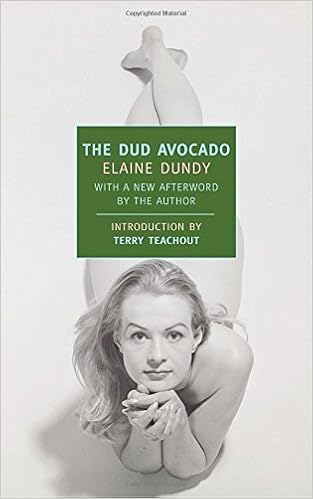
"Stefan, please..."
"No, it's true. And I will tell you something really extraordinary, mes enfants. Do you know that you can just take the stones of these luscious fruits, put them in water--just plain water, mind you--anywhere, any place in the world, and in three months up comes a sturdy little plant full of green leaves? That is their sturdy little souls bursting into bloom," he finished off, well satisfied with his analogy."
"Well, this one isn't going to burst into bloom," I said morosely, putting my nose in my drink. "What you've got here is a dead one."
"A what? A dud one?"
I took my face out of the glass. "No, dead. Dead. Oh, forget it."
Max raised his glass and smiled at me. "The dud avocado," he said, proposing the toast.
Sally Jay Gorce walks down the Boulevard St. Michel in the morning in an evening dress--it's laundry day--on the way to meet her Italian lover. Instead, she's waylaid by an old American friend, Larry, with whom she has a drink, and falls instantly in love. This sets off a variation on the old innocents abroad story, in which Gorce is introduced to a bunch of bohemian types, drinks and sleeps around a lot, spends a disastrous month at a cottage in the French Riviera, and becomes, eventually, inevitably, disillusioned of her initial wonder:
And then one day, one memorable day in the early evening, I stumbled across the Champs Elysees. I know it seems crazy to say, but before I actually stepped onto it (at what turned out to be the Etoile) I had not even been aware of its existence. No, I swear it. I'd heard the words "Champs Elysees," of course, but I thought it was a park or something. I mean that's what it sounds like, doesn't it? All at once I found myself standing there gazing down that enchanted boulevard in the blue, blue evening. Everything seemed to fall into place. Here was all the gaiety and glory and sparkle I knew was going to be life if I could just grasp it.
It's kind of familiar story that has an expected resolution: Gorce has to find out that she doesn't need to travel to experience life. To emphasize this point, her Uncle Roger--who's footing the bill for this two-year jaunt in Paris--writes her that he's given up the study of astronomy and started studying microscopic animals. The big for the small--the sky for the earth.
It's a kind of familiar story, but Gorce is such a strong presence, and Dundy has such a confident way with the voice of a young, clever woman who is quickly growing up, that that doesn't matter. ("[A]ll the impulsive, outrageous things my heroine did, I did," Dundy writes in the post-script. "All the sensible things she did, I made up.") And the book is peopled with vivid, specific comic characters: the snobbish Italian Contessa; the Ancient, a kind of Hemingway figure that the bohemian sat gather around like royalty; the sickly friend Judy who lives vicariously through Gorce's exploits; a man named Hugo who hangs around great authors offering his services as a model for characters; and various blue-bloods, rakes, and buffoons. And there's Larry, who's Bohemian charisma turns out to mask something much more sinister:
The mat of auburn hair curling to his skull, the gray-green eyes now so blank and far away, the delicate scar running down the pale skin of his forehead, the well-shaped nose covered with a faint spray of freckles, with his large mouth, gently curved, all contributed to give his face, especially in repose, a look of sappy sweetness that was sharply at odds with--and yet at the same time enhanced--his tough, wise-guy manner. Maybe because I had been out very late the night before and was not able to put up my usual resistance, but it seemed to me, sitting there with the sound of his voice dying in my ears, that I could fall in love with him.
And then, as unexpected as a hidden step, I felt myself actually stumble and fall. And there it was, I was in love with him! As simple as that.
I want to quote pages and pages of this book because of the wonderfulness of the voice. It reminds me--and I hate myself for saying this--of a female Holden Caulfield. Gorce is not bitter, but rather a little naive, but the breezy casualness that belies a profound thoughtfulness is straight out of the Salinger playbook. I fear that it might sound a little Bridget Jones from these excerpts--Terry Southern makes that comparison in the introduction--but there's too much real humor and too much real tragedy in The Dud Avocado. I'll just quote the end; I won't ruin it by telling you what she's talking about but it's too perfect not to quote:
It's so chic. It's so suave and so sleek and exotic. It's the end, it's the end... It's the last word.
It's zymotic.
Saturday, December 17, 2016
The Takeover by Muriel Spark
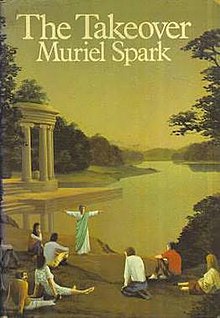
Muriel Spark spent much of her life living in Italy with her companion Penelope Jardin; but even still her fiction tended to focus on the Scotland and the England of her relative youth. The Takeover gives an image of what Spark might have been attracted to in Italy: one of its two protagonists, Hubert Mallindaine, lives on the secluded shores of Lake Nemi where he believes his ancestress, the goddess Diana, once roamed, and which is still redolent with the kind of nature she prized. Hubert is in the midst of being thrown out by his old friend and landlady, Maggie Radcliffe, who wants to take possession of the house she has lent him; but Italian law makes this obscenely difficult.
Like most of Spark's books, that summary really doesn't get to the strange and complex things happening inside The Takeover. It's a little longer than most of her novels, and Spark uses the extra space to people The Takeover with a rich caste of characters: the patriotic young noblewoman Letizia, the pansexual, perpetually aggrieved servant Lauro, Hubert's loyal but stupid secretary Pauline, even a couple of Jesuit priests who are strangely delighted when Hubert starts his own cult of Diana-worship at Nemi. That's a Spark book for you: people never do what you expect them to; in fact, they do the opposite. Just like the obscure lawyer who Maggie enlists to help her oust Hubert, only for him to abscond immediately to Hubert and offer him his two-timing services. The effect is a book which can only be appropriately described as madcap.
The house which Maggie owns and Hubert inhabits turns out to have been built on the land of the servant Lauro's fiancee. It is, according to Italian law, abusivo, illegal--it doesn't exist. In the eyes of the law, it's pure fiction, and it doesn't really belong to anyone. I think part of Spark's intention in The Takeover is to show just how deeply we are invested in things we feel are material, but really are not. Maggie gives her fortune to be entrusted to a shady jetsetter with the excellent name of Coco de Renault; it disappears, spread among the balance sheets of hundreds of shady banks. The connection Hubert feels to his home, and to Nemi, are pure imagination. The wealthy set who make up the caste of The Takeover, Spark asks--what do they really own? What do they look like when they are, in the words of King Lear, nothing but "unaccommodated man?"
It also has the benefit of being one of Spark's funniest books. A late scene where Pauline interrupts one of Hubert's cult meetings, trying to ruin it by injecting a Bible verse, only for the whole thing to turn into a riot and an orgy, is especially satisfying. And in her cynical, mordant way it can be quite insightful, as when she talks about Hubert's belief in his prayer to Diana:
...so ardently had he been preaching the efficacy of prayer that he now, without thinking, silently invoked the name of Diana for every desire that passed through his head, wildly believing that her will not only existed but would certainly come to pass. Thus, like ministers of any other religion, he was estranged from reality in proportion as he mistook the nature of prayer, offering up words of praise, of gratitude, penitence, intercession and urgent petition in the satisfaction that his god would reply in kind, hear, smile, and wave a wand. So that, merely because he had known in the past that the unforeseen stroke of luck can happen, and that events which are nothing short of a miracle can take place, Hubert had come secretly to take it with a superstitious literalness that the miraculous may happen in front of your eyes; speak the word, Diana, and my wish will be fulfilled. Whereas, in reality, no farmer prays for rain unless the rain is long overdue; and if a miracle of good fortune occurs it is always at the moment of grace unthought-of and when everybody is looking the other way.
For a woman whose conversion to Catholicism is such a notable part of her biography, Spark always seems to look at religion with a jaundiced and pragmatic eye.
I enjoyed The Takeover quite a bit. I always worry that getting deep into an author's oeuvre will bear diminishing returns, that after you read the notable stuff you're just going to end up disabusing yourself of your admiration. But The Takeover gave me hope that there's still some hidden gems in Spark's back-catalogue.
Wednesday, December 14, 2016
Olive Kitteridge by Elizabeth Strout

And yet, standing behind her son, waiting for the traffic light to change, she remembered how in the midst of it all there had been times when she'd felt a loneliness so deep that once, not so many years ago, having a cavity filled, the dentist's gentle turning of her chin with his soft fingers had felt to her like a tender kindness of almost excruciating depth, and she had swallowed with a groan of longing, tears springing to her eyes. ("Are you all right, Mrs. Kitteridge?" the dentist had said.)
There are times when Olive Kitteridge is only incidental to the stories which make up the book that bears her name. Sometimes she'll walk in and out of a story, only glimpsed. Other times a character will turn out to be a student of hers at school, a long time ago. It's a clever gimmick, but it expresses something powerful and affirming: to really tell the story of a person, Strout argues, you have to tell the various stories of the people whose lives have been impacted by them. That's a beautiful thought, especially for a teacher like me, like Olive, though it seems to paper over some of the more negative ways that we might impact others. (Even taciturn, crabby Olive mostly seems to have been a positive influence on her students.)
But Olive is a powerful character--strong-willed, ill-tempered, but also deep and thoughtful--that this gimmick becomes the collection's weakness. The stories which mostly bypass Olive, and tell the stories of the other denizens of Crosby, Maine, often don't work as well. For every one that works--like the Alice Munro-like "Ship in a Bottle," about a young girl coming to understand the fraught relationship between her mother and sister--there's one, like "The Piano Player," which feels rote or doesn't land. And Olive isn't always well-used: in the worst story, she counsels a young man against committing suicide. Another story, in which Olive and her husband are held hostage by masked gunmen, seems strangely incongruous, even though it makes a powerful final statement.
But when the focus is on the inner life of Olive, the collection really works. It's hard to place the best moments because they happen over several stories, which seem less contained than the non-Olive ones: over the course of the book Olive watches her son leave for California, a man she loved die in a car wreck, and her husband fall paralyzed from a stroke. Through these moment Strout contrasts Olive's human fear of aging and death with the harshness of her exterior. It's only then that we really understand the Olive who is regarded as a kind of surly saint by her students, and when the book really succeeds.
Sunday, December 11, 2016
Breakfast at Tiffany's by Truman Capote

"No, the blues are because you're getting fat, or maybe it's been raining too long. You're sad, that's all. But the mean reds are horrible. You're afraid and you sweat like hell, but you don't know what you're afraid of. Except something bad is going to happen, only you don't know what it is. You've had that feeling?""Quite often. Some people call it angst."All right. Angst. But what do you do about it?""Well, a drink helps.""I've tried that. I've tried aspirin, too. Rusty thinks I should smoke marijuana, and I did for a while, but it only makes me giggle. What I've found does the most good is just to get into a taxi and go to Tiffany's. It calms me down right away, the quietness and the proud look of it; nothing very bad could happen to you there, not with those kind men in their nice suits, and that lovely smell of silver and alligator wallets. If I could find a real-life place that made me feel like Tiffanny's, then I'd buy some furniture and give the cat a name."I've never been as big of a fan of the movie version of Breakfast at Tiffany's as everyone else seems to be. I found Holly Golightly obnoxious and unlikeable, Mickey Rooney's Mr. Yunioshi scary and racist, and I had trouble idolizing Hepburn's Holly the way many of my girlfriends seem to. In the initial pages of the novella, I had many of the same feelings. Holly is flighty and dismissive and self-centered (and blonde!!), and reminded me a lot of Daisy from The Great Gatsby; she is so used to being the center of the universe that she doesn't seem able to acknowledge that other people exist in the world.
Unlike Hepburn's character, though, I found that Capote's Holly really does gather some depth as the novella progresses, mostly in the scenes where she drops her guard a little. The novella is much darker than the movie, and Holly is allowed to be a little less in control and a little more human. The narrator's obsession with her (and every other male character's) is still a little frustrating, but it's also more understandable. She lets her guard down for these snippets--moments where we see past the artifice that she's built up around herself--that do more to humanize her than her monumental breakdown over the death of her brother.
The final cab ride, especially, gives Holly the depth she deserves. Not only does she admit to fear:
"I'm very scared, Buster. Yes, at last. Because it could go on forever. Not knowing what's yours until you've thrown it away. The mean reds, they're nothing. The fat woman, she nothing. This, though: my mouth's so dry, if my life depended on it I couldn't spit."The ending of the movie has a version of this, but it's saccharine and shallow, and felt like Holly manipulating "Fred." Because the ending of the novella is so much sadder (or at least so much more ambiguous), this feels less like a calculated move and more like genuine vulnerability, something the movie Holly lacks.
She's still not my favorite literary woman by a long shot, but Capote's won me over to Holly as a living, multidimensional person, which I wasn't ready for him to do.
Carry this Book by Abbi Jaconson

You are what you carry.
Abbi Jacobson's Carry This Book with You is ridiculously fantastic. In it, Jacobson imagines the contents of the bags of a variety of celebrities (current and historical) and draws them in life-size, cartoonish detail. The marker strokes are visible and she annotates particularly funny or concerning details, sometimes entering into long annotation conversations with herself, like this one about Indiana Jones' whip:
I'm not a "bull whip" kinda gal, but...I'd make an exception.
Yes I am flirting sort of through this fictional book with Indiana Jones.
Okay it's not a completely crazy idea, me + Indy.
Indy + I
Okay I'm done.
Let's just say I have a few "bull-like" qualities.
I'm grossing myself out now...but I'd be down.
None of the drawings are labeled, so part of the fun is deciphering each one from clues (tiny gloves, several brands of self tanner, and a copy of Building Walls for Dummies belong to...). There's an index at the back in case you get really stuck.
Scattered throughout are the contents of Jacobson's own travel toiletry kit, purse, and life as well as a few pages with pictures of the drafts in progress that I especially loved. This is the kind of book that I've imagined in my head (I'm sure you have too) and never would sit down to actually draw. It's what you were daydreaming about (and probably doodling) in high school English, but in real life book form. It's funny--I snorted (and laughed) aloud several times-- and Jacobson's drawings are accessible and relatable. She even leaves in a few crossed-out or drawn over mistakes to show her own humanity (Stars: they're just like us! Their markers run out of ink too!).
My favorite is this one. Further proof that Leslie Knope and I are the same person! I, too, carry around reminders to go to Papersource, meditate with my husband, and a Joe Biden quotebook.

I loved this. It may or may not qualify as a book, but it says book in the title so I counted it. Everyone should go buy it for all the Broad City fans on their lists (or fans of Michael Jordan, RBG, or Oprah, among many others.).
Nerdy teacher side note: This would be a great creative extra project after reading a novel: draw (or just list) the contents of a character's bag. What do they carry with them everywhere? Why? What does this show about them. We're reading The Road next, so lots of creepy potential there. uhn
Great by Sara Benicasa

Then she did something I'll never forget. The girl stood up, facing the lake. The white light from the laptop screen lent her face an unearthly glow from below as she stretched out her arms toward the twinkling houselights in the distance. She held it for a long moment, like some kind of yoga pose, just reaching and reaching for something I couldn't identify. Then, after what seemed like hours, she scooped up her laptop and went into the house, leaving me a lone in the moon-drenched yard.
Sara Benicasa gives us a gender bent Great Gatsby in her YA novel Great. Naomi Rye is our narrator, and like Nick Carraway, gives us an outsider view on both Jacinta Trimalchio (famous, super rich fashion blogger and Gatsby stand-in) and the opulent lives of teens summering in East Hampton.
The book stays close enough to Gatsby that you know what's coming, but Benicasa's twists make it fun and engaging. I loved the references scattered throughout: Trimalchio (the early title of The Great Gatsby), the Rye/Carraway (seeds!) parallel, and the green light of a laptop charger replacing Daisy's green light. I generally enjoyed the modernization of Gatsby's ostentation and wealth (as well as his depravity and hidden past).
There are few translated scenes that fell a little flat--the first was a scene in which Delila (the Daisy stand-in) first comes to Jacinta's home. Where Daisy dissolves into tears over a pile of Gatsby's beautiful shirts, the collection Jacinta has amassed for Delila is a closet full of Birkin bags. Here's the Gatsby scene:
Great managed to avoid some of the sappy, self-conscious prose that YA novels are prone to, and Naomi is a far better developed (and more sympathetic) character than Nick ever was. I enjoyed her crazy mother (newly rich cupcake tycoon), agro lesbian best friend, and her biting observations of the wealth surrounding her. More explicitly than Nick, she is a critic. She remains more of an outsider and has far more internality and depth than Nick.
This was a fun read. The end jumps the shark a little, but it's well imagined and an entertaining revisiting of a great story.
He took out a pile of shirts and began throwing them, one by one, before us, shirts of sheer linen and thick silk and fine flannel, which lost their folds as they fell and covered the table in many-colored disarray. While we admired he brought more and the soft rich heap mounted higher — shirts with stripes and scrolls and plaids in coral and apple-green and lavender and faint orange, and monograms of Indian blue. Suddenly, with a strained sound, Daisy bent her head into the shirts and began to cry stormily....and the Great scene:
“They’re such beautiful shirts,” she sobbed, her voice muffled in the thick folds. “It makes me sad because I’ve never seen such — such beautiful shirts before.”
In response, Jacinta flung open the door to reveal a set of display shelves, dramatically lit from above. On the shelves was a series of similar looking handbags in a rainbow of colors. They didn't look too impressive to me, but Delilah seemed bowled over. She stared at the bags, her blue eyes filling with tears.I've always read this scene in Gatsby as Daisy mourning the change in Jay and the path not travelled. She's saddened by the contrast between the person he's become and the person he was, and is realizing it won't work out, even before their affair really begins. The fact that he would do all this for her is too much, and it's overwhelming and beautiful and sad, and I just love this scene. I realize there is a reading that paints her as a materialistic whore, regretting her choices because Gatsby's rich now, and she can't have him, but I've never read it that way. When you get to this part of Great, you don't know the back story yet, and the scene is somewhat glossed over. Later, Naomi finds out that part of Jacinta and Dalila's friendship as little girls revolved around having matching Birkin bags, and the closet is a nod to their past. That really grossed me out. Who gives small children $15,000 purses? How is this a thing? This choice plays up the materialistic side of this scene so much that it took away any chance at nostalgia or sweetness and left me just hating everyone (which I realize you're kind of supposed to do in Gatsby as well, but I was never fully able to). The backstory also takes away from some of the more interesting dynamics at play in the original. Rather than a rags to riches story, Benicasa gives us a riches to rags to riches story, making Jacinta a little less interesting and a little less compelling.
"They're--they're so beautiful," she said softly, her voice catching a little. "They're all Birkins, aren't they?"
Jacinta nodded.
Great managed to avoid some of the sappy, self-conscious prose that YA novels are prone to, and Naomi is a far better developed (and more sympathetic) character than Nick ever was. I enjoyed her crazy mother (newly rich cupcake tycoon), agro lesbian best friend, and her biting observations of the wealth surrounding her. More explicitly than Nick, she is a critic. She remains more of an outsider and has far more internality and depth than Nick.
This was a fun read. The end jumps the shark a little, but it's well imagined and an entertaining revisiting of a great story.
Subscribe to:
Posts (Atom)