Saturday, January 10, 2015

Inherent Vice by Thomas Pynchon

As Doc approached downtown L.A., the smog grew thicker til he couldn't see to the end of the block.  Everybody had their headlights on, and he recalled that somewhere behind him, back at the beach, it was still another classic day of California sunshine.  Being on the way to visit Adrian Prussia, he'd decided not to smoke too much, so he was at a lost to account for the sudden appearance, rising ahead, of a dark metallic gray promontory about the size of the Rock of Gibraltar.  Traffic crept along, nobody else seemed to see it.  He thought about Sortilege's sunken continent, returning, surfacing this way in the lost heart of L.A., and wondered who'd notice if it did.  People in this own saw only what they'd all agreed to see, they believed what was on the tube or in the morning papers half of them read while they were driving to work on the freeway, and it was all their dream about being wised up, about the truth setting them free.  What good would Lemuria do them?  Especially when it turned out to be a place they'd been exiled from too long ago to remember.

I'm a big fan of P. T. Anderson, and I loved the only other Pynchon novel I've read, The Crying of Lot 49, so I wanted to read Pynchon's latest, Inherent Vice, before Anderson's film came out.  I've read the book and I've seen the film, which axes about a third of the novel's intricate plot.  Normally, such a drastic cutting might hinder the intelligibility of an adaptation, but the movie makes as much sense as the book does.  That is, it makes no sense at all.

Of course, Pynchon's not really in the business of making sense.  In fact, here and in Lot 49 he seems to be after a kind of anti-sense, or the impeccably cultivated impression of sense, created by an overwhelming accumulation of details.  Most thrillers and mystery stories are no different these days, but Pynchon's skill is in the careful parody and deconstruction of those books and movies.  Like Lot 49, Inherent Vice is a conspiracy story, but it never quite becomes clear who's behind the conspiracy, or why, or even what it is they want.

The story centers around Doc Sportello, a private investigator looking into the disappearance of a Los Angeles real estate mogul named Mickey Wolfmann.  Wolfmann happens to be the lover of Sportello's ex, Shasta, who warns Doc of a plot by Wolfmann's wife to extort Mickey and have him committed, and then promptly disappears herself.  Behind this lies a mysterious organization called The Golden Fang, which is the name of both a 19th century schooner currently docked just off the Port of Los Angeles and a consortium of dentists set up by tax purposes, and who are probably mixed up with both the FBI, the Aryan Brotherhood, and the LAPD.  The powers that be, as best as I can tell, want Wolfmann to disappear because he feels bad about his life of capitalist exploit and wants to build a community called Arrepentimiento in the Nevada desert where people can live rent free.  This is a threat to the white-collar, straight-arrow interests that Pynchon thrusts together by sinister suggestion.

Sportello, by contrast, is a hippie who is perpetually high on grass, acid, or cocaine, who doesn't seem to ever ask to be paid for his services, and whom Pynchon sets up as a moral foil to the forces of evil.  Inherent Vice is set at the tail end of the 1960's, when the Manson murders seem to have discredited the hippie philosophy, and Sportello is presented to us as one of the last of an increasingly endangered species.  This is the worst thing about Inherent Vice.  The bitter end of the 1960's "era of good feelings" became a tired trope as early as Gimme Shelter, and it's currently being done in a more interesting way on Mad Men than Pynchon's callow depiction of it, which seems rely mostly on bad jokes about drug use and the overuse of the word "groovy."  The conspiracy paranoia of The Crying of Lot 49 is effective because it's so closely tied to our paranoia about the future, and a capitalist and technocratic society that becomes increasingly inhuman and difficult to understand.  Inherent Vice sacrifices that dread for shallow nostalgia, like being forced to listen to the oldies station in the car with your Dad.

The lost continent Lemuria (like a Pacific Atlantis) in the passage I quoted above stands in for the inexorable feeling that there is a world just past our understanding, something ancient and lost to us that defies our attempts to investigate it.  The problem with Inherent Vice is not that it merely is nonsensical, but it wants to have it both ways: Pynchon wants both to insist that the values of 1960's hippie culture embody that lost world, and to slyly suggest that when you investigate closely enough, there's nothing there.  If the conspiracy at the heart of Inherent Vice is nothing but a postmodern heap of silly jokes and red herrings, what is Sportello supposed to be opposing?

Both the novel and the film struck me as the work of innovative artists who are capable of a whole lot more.  That's Pynchon's fault, I think, and not necessarily Anderson's.  Inherent Vice is too loose, too diffident, too tired, and somehow at the same time too sincere to work.

Wednesday, January 7, 2015

The Lowland by Jhumpa Lahiri

Most people trusted in the future, assuming that their preferred version of it would unfold. Blindly planning for it, envisioning things that weren't the case. This was the working of the will. This was what gave the world purpose and direction. Not what was there but what was not.

My first book for 2015 (and this blog!) is The Lowland by Jhumpa Lahiri. The story begins in 1960’s Calcutta and follows the lives of the two Mitra brothers who are quite different in ways that siblings often are. Subhash Mitra is the older brother by 15-months – academically gifted, cautious, yet ambitious in his own right. Udayan Mitra, the younger brother, is intelligent and extremely passionate – fiery and driven by his political and social ideology to change India. Though different in personality, each brother understands himself better in the company of the other, and as a result, they are inseparable.

As the brothers mature, their futures diverge – Subhash pursues a PhD program in Rhode Island leading him into a career of scientific research in the U.S. Udayan becomes increasingly involved with the Naxalite movement, a radical leftist Communist uprising in support of Maoist politics and thinking in India. During their time apart, Subhash would receive an occasional letter from Udayan with updates on their parents, neighborhood, and the woman he has chosen to marry in a private ceremony without the approval of their parents. Subhash continues to remain in the U.S. pursuing his education until he’s forced to return to India upon the news of Udayan’s death.

Shot by the police in front of his family, Udayan’s death leaves the Mitra family overwhelmed with grief and the depth of his involvement in the controversial guerilla movements of the day is in question. Also in question is the future of Gauri, Udayan’s relatively new wife, now widow, who is ignored by the in-laws who continue to disapprove of their deceased son’s decision to marry her. Things become complicated as Gauri discovers she is pregnant, Udayan unaware of this at the time of his death.

During Subhash’s homecoming, it is his ongoing dutiful nature to his brother and his commitment to his career and life in the U.S. that leads him to marry Gauri. In doing so, he believes he is providing Gauri with an escape from her oppressive living arrangement and the memories affiliated with Calcutta while also taking care of her and the child on the way.

I found that up until this point, the novel’s pace was a bit slow (though I thoroughly enjoyed taking a Wiki Walk starting with the Naxalite movement). The first quarter of the novel was begging for more details and emotions in order to move beyond historical fiction and really bring the story to life. It is not until Gauri is living with Subhash in the U.S. that the characters and story truly take off, urging the reader to empathize with varying levels of frustration, hope and disappointment from several different perspectives.

Though it takes some getting used to, Lahiri’s decision to forgo quotes and conventional dialogue enhances the story. The more we get to know the characters, the more freely the uninterrupted narrative flows. This tactic also lends itself well to the reemergence of the past throughout the novel, illustrating familiar personality traits, decisions, and youthful impulsiveness from the story’s beginnings.

I enjoyed the book for this unique storytelling, but in a strange way it is the incredible connected sadness from one generation of the Mitra family to the next that I found so compelling.  My one critique is that I wish Gauri had been fleshed out more - she is such a seemingly complex character, yet so much about her is still unclear, as if the omnipresent narrator is unable to get through to her any better than Subhash can.  This is not the feel good novel of the year (and it is also not the most depressing), but I found it well-worth the read.  

Tuesday, January 6, 2015

A Far Cry from Kensington by Muriel Spark

At this point the man whom I came to call the pisseur de copie enters my story.  I forget which of the French symbolist writers of the late nineteenth century denounced a hack writer as a urinator of journalistic copy in the phrase 'pisseur de copie', but the description remained in my mind, and I attached it to a great many of the writers who hung around or wanted to meet Martin York; and finally I attached it for life to one man alone, Hector Bartlett...  Pisseur de copie!  Hector Bartlett, it seemed to me, vomited literary matter, he urinated and sweated, he excreted it.

Mrs. Hawkins used to be looked to for advice from everyone; that was before she lost all the weight and no one looked at her that way anymore.  It was back in Kensington, when she was working for a series of small publishers, each their own kind of insane: one a very bad blackmailer, another obsessed with a pseudo-scientific program called "radionics" which involves turning the knobs of a mysterious box (perhaps inspired by the Scientologists and their e-meter?  Writing in England in 1988, it's hard to say).  One day, Mrs. Hawkins is pressed for an introduction to her boss by Hector Bartlett, a terrible but vain writer, and she calls him a "pisseur de copie"--a French term meaning, basically, prose-pisser.  But Hector is friends with a powerful novelist, and Mrs. Hawkins loses her job for the outburst.  Then she loses another, because she refuses to apologize for it.  It's not hard to read that kind of proud irascibility as something Spark saw in herself.

At the same time, Mrs. Hawkins neighbor at the boarding house, Wanda Podolak, has begun to receive threatening letters:

Mrs Podolak,

We, the  Organisers, have our eyes on you.  You are conducting a dressmaking business but you are not declaring your income to the Authorities.

Take care.

An Organiser.

(Spark loves secret, cryptic messages--like the unexplained phone calls in Memento Mori.)  Mrs. Hawkins knows the threat is hollow, but Wanda doesn't, and eventually worry causes her to commit suicide.  I found this passage to be one of the most elegiac and touching things Spark's ever written, describing the process of cleaning out Wanda's apartment:

The sadness of these last gatherings of personal effects, the siftings and sortings and parcelling-up, is more inexpressible than the funeral, where at least there is a fixed rite, there are words, the coffin has a shape and the grave a certain depth, and even the sorrow of the mourners has some silent eloquence if only conveyed and formally interpreted by their standing still.  But the grief which is latent in relics like Wanda's pair of worn shoes has no equivalent at all.

I've read quite a few Spark books, and I expected these disparate storylines to stay disparate.  But to my surprise, I was wrong; Spark ties the different threads--the publishing houses, Bartlett, Wanda--rather neatly at the end.  That, and the uncharacteristic strength of Mrs. Hawkins as a character and a narrator, make this one of the more innately satisfying of Spark's novels.  Her protagonists are often enigmatic ciphers or sociopaths, or sometimes both.  The exceptions, like The Mandelbaum Gate's Barbara Vaughan and Loitering with Intent's Fleur Talbot, all seem to be self-portraits to some extent, and that's the case here, too.  I'm not totally sure, but I think this is one of only two Spark novels I've read with a first-person narrator, which gives it a sense of intimacy that undercuts her more savage tendencies.  (The other is Robinson.)  All in all, this is easily one of my favorites.

Sunday, January 4, 2015

The Divorce Papers by Susan Rieger

This was a book unlike any I'd read before.  The Divorce Papers tells the story of a young associate at a law firm handling her first divorce case while also dealing with some of her own personal issues.  However, The gimmick is that it is entirely told through emails, inter-office memoranda, letters, statutes and cases.

Set in 1999 (so back when people used email, but inter-office memoranda and hand written letters were still common), The Divorce Papers follows Sophie Diehl, a young criminal lawyer at a small firm in Narraganset, a fictional state in New England.  Because of scheduling conflicts of her firms' more experienced divorce attorneys, Sophie is called upon to do the intake interview for Mia Meiklejohn Durkheim, the daughter of one of the firm's biggest clients whose marriage is falling apart.  Sophie desperately does not want to get involved with a divorce case, but she has a rapport with Mia, and Mia specifically requests that Sophie be the primary attorney on her case.  Sophie must deal with office drama, a sleazy, bully opposing counsel, and her relative inexperience to settle the separation while juggling boyfriends and issues lingering from her parents' divorce (seen through emails with her best friend).

I'm not sure if I enjoyed this book more or less because I'm an attorney.  On one hand, I loved that portions of the book were invented cases about relevant law and excerpts of Narraganset state statutes.  The negotiations were interesting and the effects of the divorce on the couple's 11 year old daughter were heart wrenching.  On the other hand, having worked in a small firm, a lot of the office drama didn't rang false, and the way the associate interacted with the partners was bizarre (like the one partner who ended his letters "Love, Joe").  Also, there wasn't a ton of drama or character development.  The stakes were pretty low because the couple has millions in investments and the wife, who the reader is supposed to root for, is an heiress.  Several times Sophie used interesting arguments to bolster Mia's side during negotiations, and while I thought they were interesting academically, it was hard not to think, "Who cares? You're both still going to be rich either way and this is making your daughter miserable. Stop squabbling over the extra few hundred grand."

Still, though there wasn't much drama, the procedural aspects were very well done and I enjoyed the novel.

Side note: I heard about this book after reading a Jezebel article about how the cover (the paperback version is above and the hardback version is just as PINK!) had gotten the chick lit treatment.  The article argued that it was a sign that the publisher was pigeonholing a serious book into the fluffy, women's section because it was written by a woman who, though she is a legal scholar and former Yale dean, hadn't written fiction before.  On one hand, I object to the idea that because something is marketed to women, it isn't serious or worthy of respect.  On the other, I understand that what they were saying is that the decision makers at the publisher (who, most likely, are old white men) consider "chick lit" to be less than, not that it actually is.  But in general, it's interesting to think about how we actually do judge books by their covers and how publisher's intend us to.

Randy's Top Books: 2014

I like Brittany's stats, so I'm doing the same here:

Twenty-seven books; five re-reads; six non-fiction, fourteen fiction, four lit-reviews, two art, one philosophy.

Also, oddly a big year for me and Pulitzers (four).

And, in my amorphous "law" category (i.e., the books I read, regardless of genre, that I read because it has some conceivable relationship to the law): seven books.

I'm going with the top 20% again, so here are my top five for the year:

Honorable mention: Devil in the Grove: Thurgood Marshall, the Groveland Boys, and the Dawn of a New America: I felt I couldn't do my end-year review without mentioning this book because it was one of the best non-fiction I read...other than The New Jim Crow.  Still, this book is one I'd say anyone should read because of how it shows the relationship between the death penalty and race.

(5)  The New Jim Crow: Mass Incarceration in the Age of Colorblindness by Michelle Alexander:  the best contemporary book about criminal justice I've ever read.  Alexander describes the racial overtones of our criminal justice system.  As the year unfolded, Alexander's book proved to be more and more relevant.  Of course, the media and pop-culture reactions to Brown and Garner only superficially reflected the complexity of the issues involved.  I think Alexander's book will continue to be relevant over the coming years as we, hopefully, decide to confront what needs to be fixed.

(4)  On Revolution by Hannah Arendt:  As always, Arendt blows my mind with her insight.  It's only a matter of time before I decide lawyering isn't for me and that I need to hole away in a basement to become an unrecognized Arendt scholar.  Watch out, world.

(3)  The Goldfinch by Donna Tartt:  A Pulitzer prize much deserved.  I am still wavering on whether this was a "great" novel v. a merely really, really good book.  I realize the distinction shouldn't matter, but I've got this ongoing debate permeating one of my friendships, so it's on the mind.  Nonetheless, a great novel, editors of The Paris Review notwithstanding.

(2)  Building Stories by Chris Ware:  If I was only ranking new books, this would easily be the best book I read this year.  In fact, it might be the best (new-to-me) novel I've read over the last couple of years.  I can't recommend this novel enough to anyone.  This will certainly be a novel I re-visit in the future.  I'll add, too, that this novel helps to justify my subscription to The Paris Review--if every year The Paris Review introduces me to a novel I love this much, I'll be extremely happy.

(1)  To Kill a Mockingbird by Harper Lee: it's not an accident that this novel is a classic.  It deserves all the accolades it receives.  Nothing else to say about it, I guess.

Some things to look forward to in 2015.  Allegedly, we'll be getting a new J.D. Salinger novel.  We're also going to get new novels from Ishiguro and Danielewski.  The Danielewski, in particular, I've been looking forward to for a while (I want to say years, but I can't remember when he first announced this project).  It's supposed to be the first volume of a 27 volume series.  Given that, according to Amazon, it's clocking in at 880 pages, I hope that all 27 volumes are in there.  I suppose we'll have to wait and see.  Here's looking at you, 2015.

Saturday, January 3, 2015

Building Stories by Chris Ware


As I mentioned in my Paris Review Review, the interview with Chris Ware made an impression on me.  Enough so that I went and got Building Stories.  It is as good as I hoped it would be; I can't recommend this more.

The novel is composed of 14 pieces of varying size and material.  Here's a photo culled from the internets:


This photo is reflects one of my first observations, the title represents what Ware is doing on multiple levels.  He is building stories, both by writing them and by assembling the materials the compose the novel itself.  This works another way: the arrangement of the images within the comics is itself something built by Ware.  (Of course, the stories center on a physical building, so the title works literally too.)

The 14 pieces can be read in any order, which gives the novel a non-linear feel (although, one could read them in linear order by accident or intention--I preferred reading the comics randomly).  I suspect Ware wanted the non-linear feel because it fits what plot-goal of the novel, which is to reflect normal, every day life in a literary way.  There are a couple of panels that show this (I laughed at this self-awareness, and so felt a need to share them specifically):  


The book captures this character at various times of her life, but as we follow her in the moment she is both recollection of past, coping with the present, and hopeful for the future.  Because, the reader is/is not aware of her future/past these her thoughts (and the reader's perception of those thoughts) have different meanings depending on how much of the rest of the novel the reader has read.  In some future, I expect to re-read the novel and imagine starting and ending with different comics and how much that would change how the novel feels.

Nonetheless, the lack of linearity contributes to the book's goal: to reflect ordinary life.  At any given moment, one's life is an amalgamation of memories and hopes.  We view those memories differently depending on where we currently are.  And, our hopes have a different meaning during different parts of our life.  Building Stories captures this.

It also successfully depicts the every-day in literary form.  If I were to describe the novel's plot, one might easily accuse it of being melodramatic.  Such an accusation would be misplaced, however, because of how uncompromisingly honest Ware's depiction of his character's is.  By being so honest, the plot avoids feeling melodramatic and instead feels beautiful.  Of course, this kind of honesty is no accident, and I wish I understood how one writer's honesty is literary and another writer's honesty is trite.

I suspect part of it is being a graphic novel.  By showing the characters' actions while also giving us their thoughts, Ware is able to give us the characters without using trite language.  In this regard, the novel's medium (i.e., the fact that it's a graphic novel) matters.  This is neither a movie nor a (just-text) novel.  So, it is flexible in a way that other media are not.  (Namely, I suspect a movie or a just-text-novel with the same content would very seriously risk being melodramatic).

I'm about to write my top 20% for the year (again, I didn't read enough novels to do a Top Ten), and I still haven't decided if this is going to top my list this year--it's competing against To Kill a Mockingbird.  I mention this because, I think the fact I'm having trouble deciding which of the two is the best for this year says a great deal about how good this novel is.

Highly recommended.


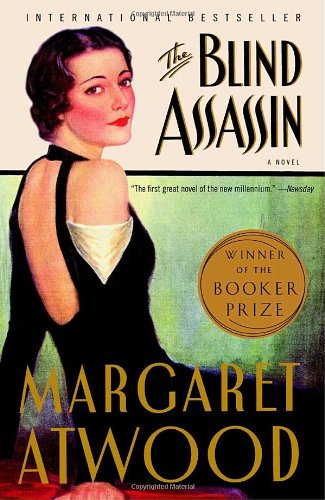
The Blind Assassin by Margaret Atwood

I could have stopped there.  I could have chosen ignorance, but I did what you would have done -- what you've already done, if you've read this far.  I chose knowledge instead.

Most of us will.  We'll choose knowledge no matter what, we'll maim ourselves in the process, we'll stick our hands into the flames for it if necessary.   Curiosity is not our only motive: love or grief or despair or hatred is what drives us on.  We'll spy relentlessly on the dead: we'll open their letters, we'll read their journals, we'll go through their trash, hoping for a hint, a final word, an explanation, from those who have deserted us -- who've left us holding the bag, which if often a good deal emptier than we'd supposed.

The Blind Assassin has at least five distinct threads: (1) The present-tense, first-person narrative of Iris Chase Griffen, a widow near the end of her life, (2) Iris' past-tense recollections of her early life as the daughter of a wealthy Canadian industrialist, and later as the reluctant wife of Richard Griffen, who temporarily saves her family's button business in exchange for the marriage, (3) a series of dialogues between two unnamed lovers, meeting in secret, (4) a science fiction story called "The Blind Assassin," being composed extemporaneously by the male lover, and (5) a series of newspaper clippings, most of which deal with Iris' sister's Laura's suicide, and the success of her posthumously published novel--The Blind Assassin.

Iris' story is that of a woman caught up in the machinations of cruel and powerful men, isolated by the resentment of her sister and the demands of her husband.  At times, Richard and his malicious sinister Winifred are cartoonishly evil, going so far as to institutionalize Laura and, later, separate Iris from her daughter and granddaughter.  But the greater moral ambiguity is Iris', reflecting at the end of her life on the fine line between helplessness and complicity:

I thought I could cope with Richard, with Winifred.  I could live like a mouse in the castle of the tigers, by creeping around out of sight inside the walls; by staying quiet, by keeping my head down.  No: I give myself too much credit.  I didn't see the danger.  I didn't even know they were tigers.  Worse: I didn't know I might become a tiger myself.  I didn't know Laura might become one, given the proper circumstances.  Anyone might, for that matter.

Atwood controls the narrative with a hand just subtle enough to keep the reader in doubt as to which of the two sisters, Iris or Laura, is the unnamed lover who is the audience for, and sometimes participant in, "The Blind Assassin."  Either way, the story is devised mostly by the male, Alex, and the novel attributed to Laura after her suicide is a kind of monument to a love that could never be public or permanent.  In it, the titular assassin falls in love with a girl marked for sacrifice, and whose vocal cords have been cut.  Of course, these characters are stand-ins for the lovers, themselves maimed, voiceless, and uncertain.

I found myself wanting more of this "novel within a novel," and less of the primary narrative, which struck me as overlong and over-detailed.  Atwood invests a lot in her fictional town, Port Ticonderoga*, but the insistent realism she wants it to have was, for me, far less compelling than the fantasy world, Sakiel-Norn.  I've only read a handful of Atwood's books, but they seem best when she really allows her imagination to run freely.  The narrative of the assassin's escape with the voiceless girl is never really resolved, and though I know that we're meant to understand that either Iris or Laura completes it--the act of writing, as always, is a marker of agency--it left me dissatisfied.  Though I enjoyed it, a lot of the novel's energy and attention seemed to me to be misplaced.

*Am I the only one that found the similarity to "Fort Ticonderoga" really distracting?

Friday, January 2, 2015

Brittany's Top Books of 2014

Compared to last year (when I was blogging by my lonesome at My Year In Books), I read....1 more book! However, the books I read this year were much less serious due to the fact that I'm done with grad school and not teaching any new classes that require me to brush up on my reading. 2014 was a binge on the candy cornucopia of Young Adult Lit. 

By The Numbers
37 complete books read (12 young adult, 7 non-fiction, 5 "classics," 3 plays [in one book], 2 graphic novels, 1 classic poem, 1 choreopoem)
30 authors (repeats included: Veronica Roth, Marissa Meyer, Ransom Riggs, Gillian Flynn)
11 female authors, 19 male authors
26 living authors, 4 dead authors
7 nationalities (American, French, Canadian, Egyptian, British, Nigerian, Russian)
1 book was read because I had a super major crush on a man and he said he loved it (just like last year)

My Top Books
1. Americanah by Chimamanda Ngozi Adichie: If a person is looking to read a book about race, right now this is my number one recommendation. The perspective of African immigrants in America and Britain is one that is incredibly interesting. When people say things that make it obvious they don't understand race and racism, I find myself using examples from this book to try to make the world make sense to them. (Like when a family member mentioned how people would be so offended if there were a White magazine, but Jet magazine is okay - I pulled an anecdote from the novel of this EXACT argument between a black woman and her white boyfriend. The woman takes her boyfriend to a grocery store and shows him how none of the magazines have black women on the cover [fun fact: British Vogue is doing a solo black cover model for the first time in 12 years], very few black women as models, and how the hair, makeup, and fashion tips are completely irrelevant for many black women (this web magazine article about how 'nude' heels will make legs appear longer features 4 white women and 16 pairs of shoes that would only match the skin tone of white women - I have seen this fashion tip in various magazines and they never feature shoes for non-beige women to match their skin tone to).

2. Suite Francaise by Irene Nemirovsky: The writing of this book is so beautiful and the scope of the novel is so ambitious. It was an absolute pleasure read, but one that was deeply satisfying the way that 'great'  novels satisfy. For anyone interesting in France, World War II, or romance, this novel is lovely. The only reason to not read this text is because of the unfinished nature of it.

3. The Storyteller by Jodi Picoult: Absolute pleasure read. I have no idea who I would recommend this book to - it's a mystery, history, romance, fantasy novel that covers generations of stories interwoven. I vividly remember reading the last chapter by headlamp while camping. I finished and tears were streaming down my face. (My top 3 are all these long ambitious interconnected stories. I wish that were its own section in the bookstore as I would immediately go there every time).

4. The Martian by Andy Weir: I know I'm a little late to this game, but this was the most satisfying sci-fi book I have read in years. I didn't have a chance to review this, but if you are at all into sci-fi you must read this book. The novel opens with a man who was thought-to-be-dead and left behind on America's third manned mission to Mars. The first couple of chapters are his typed logs as he tries to survive alone on Mars. It then switches to the perspective of the people on Earth who think they have just lost one of the men on the mission. By the end of the book I was incredibly taken with the main character and regularly laughing out loud.

He is ridiculous when his life is in danger: “The screen went black before I was out of the airlock. Turns out the “L” in “LCD” stands for “Liquid.” I guess it either froze or boiled off. Maybe I’ll post a consumer review. “Brought product to surface of Mars. It stopped working. 0/10.”

He also puts science jargon into words anyone can understand: "Problem is (follow me closely here, the science is pretty complicated), if I cut a hole in the Hab, the air won't stay inside anymore.” 

5. Dark Places by Gillian Flynn: Flynn is the only author to appear on both last year's list and this year's list. Her more well-known novel is Gone Girl, but I actually liked this book better. Her choices in using point of view and time are really interesting and effective. I love how Flynn builds suspense and creates characters who are absolutely unlikeable and yet...I still care what happens to them. The shifting perspectives of Libby Day in the present trying to find the truth while the audience is also in the past getting closer to finding the truth was really really compelling. I can't wait to see what Flynn does next.

6. Into Thin Air by Jon Krakauer: My climbing partner is incredibly into Mt. Everest, so this book has been on my radar for a long time. This book details the events of the 1997 Everest disaster where 8 people died which was - I believe - the most deadly day on Everest until the 2014 avalanche that killed 16 sherpa guides. Although I'm not an Everest fiend, I am a climber, so my interest is definitely due to the fact that I have wondered if I would ever get into ice climbing (answer: no. I was recently out in 40* weather and my Las-Vegas-born body refused to function well enough to climb). My hands were sweating and my heart was pounding through almost the entire book - but I don't know that I would recommend it for anyone who isn't into climbing. I am definitely not going to climb Mt. Everest (not because the accidents in the book scared me, but because altitude sickness just sounds terrible. Also, the cold).

7. Handmaid's Tale by Margaret Atwood: Everyone who is interested in women's issues should read this novel at some point in their reading life. I put this on my list of Outside Reading options for my English 101 class because my students are very interested in feminism, sex work, and sex education, and every student who picked it flew through it and enjoyed it. (Fun fact: sex ed is now the second topic that is banned from my class. This has been a hot topic in my district this year, and out of 30 students, I had 3 who were focused on sex ed for the whole first semester over multiple assignments (synthesis paper, research paper, argument paper, and speech), so it is now banned. The Handmaid's Tale was a perfect present for them before I banned the topic.)

8. Three Plays by Rajiv Joseph: I still love Rajiv Joseph and am very happy that he's still writing (The North Pool, The Monster at the Door, The Lake Effect all came after his first three plays. In 2015 he's debuting two new plays, Mr. Wolf and Guards at the Taj.) I will read and see everything he does.

Honorable Mention: Divergent series and Cinder series: 7 of the 12 young adult novels I read this year were from these two series, and especially in comparison to the other YA, these were stand out awesomes. Both have female protagonists in interesting situations, and both are a sharp turn away from what has been the trend in romantically focused plots in YA. I don't feel like they can quite get onto my top list because they're candy books, but I do want to put them out into the universe as solid reads. 

The Reef by Edith Wharton

"...What I meant was that when you've lived a little longer you'll see what complex blunderers we all are: how we're struck blind sometimes, and mad sometimes--and then, when our sight and our sense come back, how we have to set to work, and build up, little by little, bit by bit, the precious things we'd smashed to atoms without knowing it.  Life's just a perpetual piecing together of broken bits."

The Reef is, apparently, Edith Wharton's attempt at writing a novel in the style of Henry James.  I love Wharton, but I find James to be very frustrating, so it's no surprise that The Reef is one of my least favorite of all the Wharton novels I've read.  In the Jamesian way, the plot is barely a plot at all, little more than a barebones structure on which to hang an investigation into the complexities of human thought and experience.  Most of the events in the novel involve one person ushering another person into a different room than the one they're standing in so that they can have a heart-to-heart conversation.  Those conversations never quite reach a satisfactory conclusion--that's why they keep having to do it over and over again.

But Wharton is a canny observer, and her clear prose makes The Reef a more enjoyable experience than wading through something like The AmbassadorsThe story follows George Darrow, an older man who is disappointed by the reticence of the woman he's loved for many years, Anna Leath.  His dissatisfaction compels him to drift into a brief affair with a young and impecunious woman named Sophy Viner.  This affair lasts for only a few days, and it drifts out of Darrow's mind, but later, when he and Anna are about to be reconciled, he visits her estate in the south of France to realize that her new governess is none other than--you guessed it--Sophy Viner.  And what's more, Sophy is engaged to Anna's stepson, Owen.

Sophy's low status gives Darrow the excuse he needs to mildly oppose the marriage, contrary to Anna's wishes, but this position threatens to divide the two older lovers as much as the revelation of Darrow's affair would.  The Reef is one of those strange reading experiences that remind us what a foreign world was the past of even a hundred years ago; it's impossible to imagine Darrow having the kind of anxiety he exhibits here in 2015.  His affair with Sophy would be unfortunate, and a bizarre coincidence, but it wouldn't drive him to the desperation to interfere with her marriage to Owen that he exhibits here.  Part of appreciating The Reef is accepting that Darrow's actions force him into a real moral dilemma, and that the choice he has to make between his own marital happiness and Sophy's is a reasonable one.  What is at risk for Darrow is the wholeness of a past, present, and future in Anna's love:

And so she seemed now to be walking to him down the years, the light and shade of old memories and new hopes playing variously on her, and each step giving him the vision of a different grace  She did not waver or turn aside; he knew she would come straight to where he stood; but something in her eyes said "Wait," and again he obeyed and waited.

Darrow's affair comes out of course; Anna is too observant and has been too intimate with Darrow than to be held in the dark.  Much of the psychological richness of the novel comes from the way that the characters "read" each other, always incompletely and inconsistently, but also with surprising perceptiveness.  Eventually--spoiler alert--the two of them come to a place of reconciliation, but Wharton refuses to offer a cheap solution to the question of which of the two, Darrow and Sophy, will get their marriage and their happiness.  Sophy drifts off in the end, away from the Leaths and back into poverty and uncertainty, toward the chaotic East represented by India.  The way in which the novel gives her up--in which she gives herself up for Darrow and Anna--is a bitter price that mutes the happiness we are meant to feel for Darrow and Anna.  It's hard not to feel that Sophy, always inherently honest and, if I can say so, a thousand times more interesting than the mild widow Anna, doesn't deserve what happens to her.  But then again, neither do Archer Newland and Countess Olenska, nor does Lily Bart.  (Ethan Frome probably deserves it, though.)

Thursday, January 1, 2015

Maud Martha by Gwendolyn Brooks

Maud Martha thought of her parents' back yard.  Fresh.  Clean.  Smokeless.  In her childhood, a snowball bus had shone there, big above the dandelions.  The snowballs had been big, healthy.  Once, she and her sister and brother had waited in the back yard for their parents to finish readying themselves for a trip to Milwaukee.  The snowballs had been so beautiful, so fat and startlingly white in the sunlight, that she had suddenly loved home a thousand times more than ever before, and had not wanted to go to Milwaukee.  But as the children grew, the bush sickened.  Each year the snowballs were smaller and more dispirited.  Finally a summer came when there were no blossoms at all.  Maud Martha wondered what had become of the bush.  For it was not there now.  Yet she, at least, had never seen it go.

This summer I asked for suggestions for a book to add to our ninth grade curriculum.  It's a great set of books, but lacking in women and persons of color, as both characters and authors.  The book which had been chosen to fill some of those gaps, Kindred, just isn't good enough as a book to really fit the criterion.  But finding a replacement turned out to be surprisingly hard, often because the best choices, like Their Eyes Were Watching God, were already taken by the other grades.  I got a lot of great suggestions, though, many of which I've never heard of, and which forced me to admit that I could do a better job of seeking these kind of books out.

Maud Martha was by far my favorite of those suggestions I read, and very nearly made my end-of-year list.  The only novel of poet Gwendolyn Brooks, it tells the story of the titular protagonist from childhood to marriage and motherhood.  The early chapters, when Maud Martha is young, have a kind of dreamy quality that captures being a child very well, and reveals the poetic quality of Brooks' prose:

To be cherished was the dearest wish of the heart of Maud Martha Brown, and sometimes when she was not looking at dandelions (for one would not be looking at them all the time, often there were chairs and tables to dust or tomatoes to slice or beds to make or grocery stores to be gone to, and in the colder months there were no dandelions at all), it was hard to believe that a thing of only ordinary allurements--if the allurements of any flower could be said to be ordinary--was as easy to love as a thing of heart-catching beauty.

What I like most about Maud Martha is that very little happens.  The most intense conflict comes from the petty drama of married life, like her husband Paul's desire to become a well-respected member of the Foxy Cats club in Harlem, or Maud Martha's dissatisfaction with the smallness and meanness of her apartment.  Mostly, Maud Martha is a celebration of domestic life, and Brooks' poetic eye dwells on the small and significant stuff of ordinary lives.  Other suggestions, like I Know Why the Caged Bird Sings and The Bluest Eye are far more interested in exposing the terrible consequences of black estrangement in America, and though they do that important task well, they would be bleak additions to an already admittedly bleak curriculum.  But Maud Martha's insistence that domestic life, and black domestic life at that, can be a source of poetic interest strikes me as being as important, and even more radical.  Racial conflict is persistent here, but muted, as in Paul and Maud Martha's realization that they are the only black people in a crowded theater and the vague shame it inspires.  Few books do such a good job of observing how issues of race affect the ordinary and the quotidian.

Anyway, we're not teaching it, not yet.  I would really like to, but it didn't help that I lost my copy and couldn't loan it anyone--that's why this review is so late (it seems amusingly appropriate that I only found it today, the first day of the new year).  I wonder how students would deal with what seems to me to be an aggressive plotlessness, and the unprosiness of its prose.  I found it very affecting, and I think they would, too.