Showing posts with label symbolism. Show all posts

Tuesday, August 26, 2014

The Scarlet Letter by Nathaniel Hawthorne

She could no longer borrow from the future to help her through the present grief.  Tomorrow would bring its own trial with it, as would the next day, and yet the very same that was now so unutterably grievous to be be borne.  The days of the far-off future would toil onward; still with the same burden for her to take up and bear along with her, but never to fling down; for the accumulating days and added years would pile up their misery upon the heap of shame.  Throughout them all, giving up her individuality, she would become the general symbol at which the preacher and moralist might point, and in which they might vivify and embody their images of a woman's frailty and sinful passion.  Thus the young and pure would be taught to look at her, with the scarlet letter flaming on her breast--at her, the child of honorable parents, at her, the mother of a babe, that would hereafter be a woman, at her, who had once been innocent--as the figure, the body, the reality of sin.

A student that I deeply respect told me at the end of the year that she hadn't enjoyed reading The Scarlet Letter.  That's sadly typical, I think--even students who like reading don't often like to read Hawthorne, who is an accomplished stylist but also a ponderous and stuffy one.  I told her that I had felt the same way about it when I read it in high school, but it wasn't until I was an adult that I learned to appreciate it, when I realized just how profoundly weird it is.  The lurking Satan-allied witch Mrs. Hibbins, the comet shaped like an "A" in the sky, the destructive, yet difficult to describe force that Chillingworth exerts on Dimmesdale--it's all bizarre.  Of course, we live in a world where Hester Prynne's "A" has become the dominant image of social ostracism, but for those who can approach The Scarlet Letter fresh, it's am immensely rewarding book.  (And much better than The Marble Faun.)

Moreover: Is there any book by a male writer in the history of American literature with a female protagonist as strong as Hester Prynne?  The letter on Hester's breast is meant to reduce her to a symbol, a warning sign--to make her a literary trope instead of a person.  Reading it now, I was struck by how that ostracism, by alienating Hester from her society, makes her a better person:

For years past she had looked from this estranged point of view at human institutions, and whatever priests or legislators had established; criticizing all with hardly more reverence than the Indian would feel for the clerical band, the judicial robe, the pillory, the gallows, the fireside, or the church.  The tendency of her fate and fortunes had been to set her free.  The scarlet letter was her passport into regions where other women dared not tread.

Hawthorne is pretty down on Puritan society, and in part Hester's strength is a result of her alienation from it.  But comparing her with the Reverend Dimmesdale, her partner in crime, reveals just how strong she already is.  As he yearns to unite his public face with his private one, and undergo the kind of atonement that keeping his adultery secret has denied him, he withers into a sickly mess.  Many critics have noticed the flipping of gender roles here, and I think that's an important contrast even to today.  How many films and television shows have you seen just this year in which a principal female character, no matter how strong she otherwise may be, requires saving by another male figure?  Here, Dimmesdale clings to Hester when he can, so much that the rescue plot--their escape back to the Europe--is her plan, and it only fails because of his own weakness.

Ultimately, the symbol of the "A"--and the symbol of Hester--refuses to remain unchanged.  Her life of solitude and hard work causes some to interpret it as "able," and critics have subsumed many other "a" words into it as well.  (My favorite is "America.")  Hester herself is something of a Moby Dick--the symbol that keeps slipping in meaning.  But Moby Dick can do it because he is inscrutable, unconquerable; Hester can do it because she exerts ownership over herself in a way that Dimmesdale never could.  She refuses to be inscribed upon, to be turned into text, and in this way The Scarlet Letter is a powerful assertion of individualism against the community.

Here's Brent's review from earlier this year.

Monday, January 12, 2009

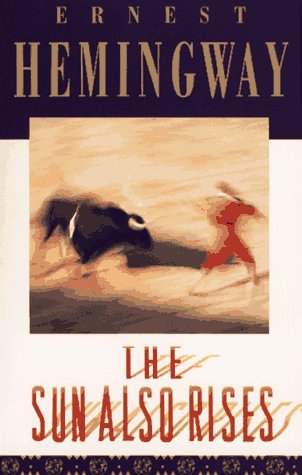
The Sun Also Rises by Ernest Hemingway

"You're an expatriate. You've lost touch with the soil. You get precious. Fake European standards have ruined you. You drink yourself to death. You become obsessed by sex. You spend all your time talking, not working. You are an expatriate, see. You hang around cafés."


The Sun Also Rises, Ernest Hemingway's first major novel, focuses on a group of American expatriates living in Paris, and their subsequent trip together to Pamplona, Spain for fishing and bullfighting during the Running of the Bulls. The narrator, Jake Barnes, is a veteran of World War I whose war injuries have left him impotent and harboring an unfulfillable desire for Brett Ashley, an insecure, promiscuous woman. Other characters in include Michael Campbell, Brett's Scottish veteran fiancée, Robert Cohn, a friendly but disliked Jew who can't get over the weekend he once spent with Brett, and Bill Gorton, the group's most lighthearted member and also the only one with no obvious interest in Brett. The tension between the characters comes to a head when Brett begins an affair with a young Spanish matador, and chaos ensues, or as close as the story ever gets to chaos.


The Sun Also Rises is often cited as the greatest novel ever written about the “Lost Generation”, those whose lives were wrecked by World War I. The characters that inhabit the novel are all aimless or incapable of achieving the aims they do have. Jake's emasculating war injury serves as a symbol for his own feelings of powerlessness to control even his own life, let alone to better himself. Robert Cohn is incapable of moving on past a conquest in the past, and incapable of gaining the respect of the others since he didn't serve in the war in any capacity. And so on. Brett herself is probably the most complex character and symbol in the work, hailed as a goddess by virtually every mans she meets and eventually uses. In spite of her cavalier attitude toward those she hurts, however, Brett is a sympathetic character, acting more like a junkie who can't live without a new fix than a seductress who enjoys toying with men's hearts.


There are interesting ideas and excellent scenes in The Sun Also Rises, such as the scene Robert Cohn's assault and subsequent attempt at reconciliation with Jake, or the closing lines, which embody the crushing sadness of the novel in seven words. Ultimately though, I'm not sure The Sun Also Rises was a great fit for me. Aside from Jake and sometimes Michael, none of the characters was particularly sympathetic and, although their constant drinking and talking about nothing at all did a good job of demonstrating how little joy they received from life, it provoked more sympathy than interest from me. I enjoyed The Old Man and the Sea more, but I'm definitely still interested in checking out more Hemingway.