Showing posts with label rock and roll. Show all posts

Sunday, January 7, 2018

A Visit From the Goon Squad by Jennifer Egan

I slide open a glass door and go onto Lou’s balcony. I’ve never seen San Francisco from so high up: it’s a soft blue-black, with colored lights and fog like gray smoke. Long piers reach out into the flat dark bay. There’s a mean wind, so I run in for my jacket and then come back out and curl up tightly on a white plastic chair. I stare at that view until I start to get calm. I think, The world is actually huge. That’s the part no one can really explain.

A Visit From the Goon Squad initially turned me off because of the guitar on the cover. It's silly, perhaps, but my experience with books that prominently feature rock and roll has been that they tend to be goofy pangyrics aimed straight at baby boomers. And the fictional songs... they make Lost's You All Everybody look like I Wanna Hold Your Hand.

But the acclaim Jennifer Egan's novel got everywhere convinced me to pick it up, and its accessible writing sucked me right in when I finally started it. That, and the opening section, about a cynical pickpocket named Sasha. I was immediately impressed at Egan's ability to sketch out a believable character quickly--a real benefit for a novel with as many wide-ranging characters and stories as this one has.

As the cover indicates, music does play a large role. Most of the players who get their own sections are connected in some way to a band called The Flaming Dildos, a band fronted by Bennie Salazar and his enigmatic friend, Scotty. But in reality, the book really works in practice more like a collection of short stories revolving around a recurring cast, of which Sasha, Scotty, and Bennie form only a small part. They're joined by a skeezy record executive safari-ing in Africa, a closeted gay football player in rural America, and dozens of others.

If there's a recurring theme in these stories, which jump in time between the 70s and the near future (maybe 2020 or so) and place (Africa, New York, Italy), it's the way time has a way of changing, crushing, flattening out, and sometimes, rarely, even fulfilling dreams. I won't lie--a lot of the characters have arcs that end in less than cheery places. There is a technique, which seems to me to be uniquely Sparkian, where Egan will sometimes spell out a character's entire future in the middle of a story that ends when they're still a teenager. In a way, this is depressing--learning that a bright young teen grows up to commit suicide at 20, or that a young girl ends up hooked on crack has a way of bringing a reader down--but at the same time, Egan skillfully uses this narrative irony to highlight the eternality of the good moment that is currently happening. Whatever happens going forward, those shining moments can't be snuffed out.

There's also the recurring question of image. Is Scotty an amazing guitarist or a burnout? Is Sasha a housewife or a wild child? Is a Mugabe-like dictator really so evil, or is it all a matter of perspective? And does it matter?

And if Dolly could get people to ask [if he was dating a starlet], the general’s image problems would be solved. It didn’t matter how many thousands he’d slaughtered—if the collective vision of him could include a dance floor, all that would be behind him.

And there is a hope, something just out of the grasp of these characters, elucidated near the end by Bix, who will go on to a reasonably happy ending himself:

“We’re going to meet again in a different place,” Bix says. “Everyone we’ve lost, we’ll find. Or they’ll find us.” “Where? How?” Drew asks. Bix hesitates, like he’s held this secret so long he’s afraid of what will happen when he releases it into the air. “I picture it like Judgment Day,” he says finally, his eyes on the water. “We’ll rise up out of our bodies and find each other again in spirit form. We’ll meet in that new place, all of us together, and first it’ll seem strange, and pretty soon it’ll seem strange that you could ever lose someone, or get lost.”

Finally, Visit includes a lot of structural play--there's a chapter that's a clear piss-take/homage to David Foster Wallace, complete with endnotes that are longer than the text. There's a section, surpsingly affecting, that takes the form of a Powerpoint presentation. There's a chapter in 2nd person. But in all the play, Egan never loses the emotional thread of the stories she tells. And that's a lot more rare than finding someone who can put together a tricky sentence.

Monday, July 6, 2015

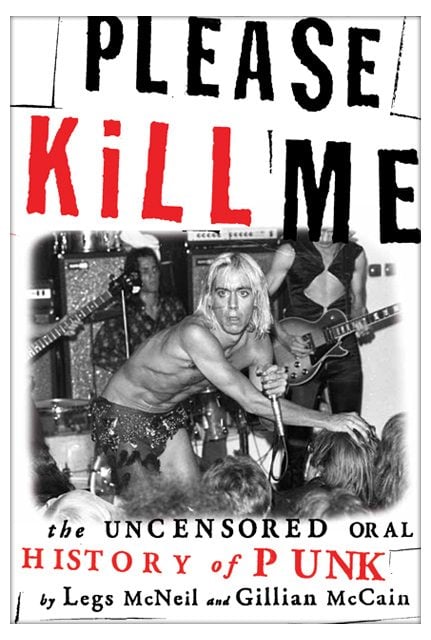
Please Kill Me: The Uncensored History of Punk Rock by Legs McNeil and Gillian McCain

So, long time, no review. And I'm reviewing this because it'll be short, sweet, and sloppy, just like the best punk songs.

I'm listening to the Richard Hell album Blank Generation while I'm writing this, but I'm not much of a punk fan. I like The Ramones, The Clash, and some embarrassing pop-punk which didn't come within a mile of the sort of stuff Please Kill Me covers, so in one sense, I might not be the best person to review this book. On the other hand, Sid Vicious didn't know how to play bass and they made a movie about him.

The nice thing about oral histories is that they're super fast reads. Please Kill Me is 600 pages but I read it in a few days. It's kind of like, I don't know, The Clash's Sandanista in some way because it's long but flies by or something. Ask someone else. Lou Reed definitely wouldn't spend his time sorting out this stupid analogy.

So instead of writing this review, I could be out copping, but thanks to the various punks, groupies, and disaffected elder statesmen--say hello again, Richard Hell--I know that drugs are a) awesome b) terrible c) everywhere d) completely necessary but you do have to be careful. If you're Iggy Pop you can do whatever the heck you want and you'll end up bloody and beaten but basically ok. If you're a member of the New York Dolls, you're probably already dead so this warning isn't helping. you much.

I don't think I'll talk much about the music itself because the book doesn't either. I think various groupies and drag queens got about as much ink as the musicians and journalists of the movement. Not that that's a bad thing--one could argue that there's not a whole lot about punk's raw aggression that can be captured in print anyway. Maybe the intensity is best captured in a whirlwind of eyewitness testimony to the debauchery and anger that drove the movement and if you want it to punch you in the gut, you can listen to the music itself while locked in a squalid bathroom somewhere, covered in blood, eyeliner, and sweat. Sex, drugs, and a little rock and roll--Just Kill Me does what it says on the tin.

Also, I really enjoyed how the Dead Boys apparently had no idea where swastikas came from. Would read again if I hadn't read it but condensed to 2 minutes it would be epic.

Thursday, January 10, 2008

Basket Case by Carl Hiaasen

"This is how I'm guessing it started. They were hanging out at the house in the islands, Jimmy and his bride. She probably walked into his studio and caught just enough of the track to know it was better than anything she had in the can. She asked her husband to play it again and he probably said, “No, it's not ready.” Then she batted her eyes and stroked his neck and asked if he'd give her the song, and he said, “Sorry babe. This one's mine.” Time went by and Cleo's label was hounding her and she kept nagging Jimmy for the cut. She probably flirted and teased and begged and cried and threw a hissy, but he wouldn't budge. And when it became plain to Cleo that her husband was keeping 'Shipwrecked Heart' for himself, she decided to kill him. And what little she remembered of the song, she sang at his funeral. Touching."

I'm having a little trouble reading prestigious books so far this year. I picked up Basket Case at Goodwill for 69 cents mostly because it was in good shape and because I'd often heard Hiaasen compared to Dave Barry, one of my favorite humorists. I went into this book expecting something like a Terry Pratchett book with mystery instead of magic. Instead, I ended up with a halfway decent murder mystery that had no distinguishing characteristics.


There is, however, an easy way to determine if you'll find Basket Case more entertaining than I did. Ask yourself these three questions:


  1. Do I find the band name “Jimmy and the Slut Puppies” even faintly amusing?

  2. Does the idea of a man being bludgeoned nearly to death with a frozen lizard make me smile?

  3. Is the ability to solve a mystery within the first two chapters a quality I look for in my whodunits?


If you answered “no” to all three of these questions, Basket Case might not be the book for you. I'd give a summary, but really, if you've ever read a mystery novel, you could probably outline it yourself, especially since most of it is contained in the excerpt at the top of this review. Overly formulaic and underly amusing, Basket Case will hopefully be the worst book I read this year.


Oh, and here's a list of things I'm officially tired of now: Random namedropping, especially of bands; incredibly unlikely romances between obviously incompatible and cardboard characters; witty banter that's not funny; ancient obituary writers who won't die; and that's all.