Showing posts with label pirates. Show all posts

Thursday, March 1, 2018

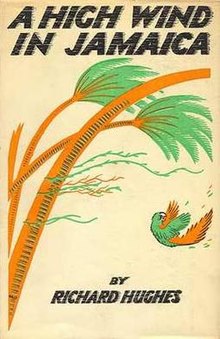
A High Wind in Jamaica by Richard Hughes

Jamaica had faded into the past.  England to which they had supposed they were going, and of which a very curious picture had formerly been built up in their minds by their parents' constant reference to it, receded again into the mists of myth.  They lived in the present, adapted themselves to it, and might have been born in a hammock and christened at a binnacle before the had been there many weeks.  They seemed to have no natural fear of heights, and the farther they were above the deck, the happier.

The Bas-Thornton children live in Jamaica with their parents, but when a terrible hurricane levels their estate, the parents decide that it's time the children were educated in England.  They send the kids off on what is to be a lengthy voyage by ship, but along the way, the ship is boarded by pirates.  The pirates take everything they can, including the kids.  They're kind of a nuisance to have upon a pirate ship--always underfoot, inventing games, chasing the pig or the monkey, making common objects into dolls, getting in the rigging, murdering captured sailors out of abject fear--but in a matter of months the impressionable children have pretty much forgotten all about their former life.

A High Wind in Jamaica is, above all things, a study in the peculiarity of children.  The pirates are an odd bunch, but they hold no candle to the eccentricities of the Bas-Thornton kids, for whom the pirate ship adventure is all mixed up with imagination and ignorance.  Hughes does a good job capturing the mental processes of kids, especially with the oldest, Emily, who idly suspects that she might be God--a clever sort of expression of the way the experience of youth is suffused with an infinite possibility that is whittled down as you become a teenager.  But he refuses to enter the consciousnesses of the younger kids, insisting that it is almost impossible:

Possibly a case might be made out that children are not human either: but I should not accept it.  Agreed that their minds are not just more ignorant and stupider than ours, but differ in kind of thinking (are mad, in fact): but one can, by an effort of will and imagination, think like a child at least in a partial degree--and even if one's success is infinitesimal it invalidates the case: while one can more think like a baby, in the smallest respect, than one can think like a bee.

Hughes walks an interesting tightrope here, capturing the life of children as well as he does while still operating at a remove from them that suggests he doesn't really know what's going on in their minds at all.

He shows us how mutable they can be, for one.  Life on a pirate ship, for a child, is no more nightmarish or weird than the productions of their own brains.  See how Emily treasures the memory of the earthquake she experienced in Jamaica as a real happening, but seems to have no recognition that being captured by pirates is something out of the ordinary.  (In fact, most of the children seem unaware that they've been captured at all, assuming that the transfer from one ship to another is just a part of the voyage they keep forgetting.)  There are more chilling--and spoilery--examples.  One of the children dies by falling from a parapet in Cuba, trying to see a fight between circus animals, and is quickly forgot by all of his siblings.  (Hughes does a good job making us forget him, too, until the end when the children are reunited with their parents, and their mother asks, "Wait, where's John?")  Somehow worse than that is the coda, when Emily, who grows close to the captain Jonsen over the voyage, in the unexamined way that children do, takes the stand in England and fails to exonerate the captain for a murder he did not commit, never realizing that she sends him to the gallows.

A High Wind in Jamaica is weird, funny, and dark, a kind of poisonous take on Peter Pan, which itself is actually quite dark.  Here it's the pirates who are the victims, locked out as they are from the impenetrable psyche of their own captives, who can't even understand that they are captive.  Unlike Peter Pan, in which growing up is frightening specter, it's childhood itself that is terrifying.

Thursday, May 11, 2017

The Republic of Pirates by Colin Woodard

Engaging as their legends are--particularly as enhanced by Robert Louis Stevenson and Walt Disney--the true story of the pirates of the Caribbean is even more captivating; a long-lost tale of tyranny and resistance, a maritime revolt that shook the very foundations of the newly formed British Empire, bringing transatlantic commerce to a standstill and fueling the democratic sentiments that would later drive the American revolution.  At its center was a pirate republic, a zone of freedom in the midst of an authoritarian age.

Psychologists say you're more willing to accomplish something if you commit to it by sharing your goal with others, so: I'm trying to write a book.  It involves, for some reason, pirates.  But like most people, I think, what I know about pirates is filtered through the lens of Hollywood movies, bad cartoons, and my childhood abridged copy Treasure Island: yo-ho-ho and a bottle of rum, etc., etc.  So I picked up Colin Woodard's book about the history of the pirates of the Caribbean and their short-lived haven at Nassau in the Bahamas.

Woodard's book is antiprogrammatic; there's no real historical argument here except perhaps an emphasis on the surprisingly humane and democratic sentiments of the pirates involved.  Mostly it's a straightforward history about a surprisingly brief period of time.  Among the interesting things I learned are:

  • The whole pirate thing was really very brief.  The Golden Age of Piracy starts at the turn of the century, around 1700, and extends only to about the 1730's.  By that time the bigwig pirates like Blackbeard, Sam Bellamy, and Charles Vane, are dead, and the pirate hunter and Bahamian governor Woodes Rogers--those are the four focal points of Woodard's book, Rogers and the three pirates--has reestablished peace at Nassau.
  • Blackbeard was more bark than bite.  In all of the recorded stories about him, there's not a single instance of Blackbeard killing another human being.  Instead, he relied on a sense of theatricality, including placing lit fuses under this hat to look like a scary smoke monster, to intimidate those whose ships he wanted to plunder into submission.  This was in contrast to the raping and pillaging ways of the ruthless Charles Vane.
  • Pirates were political.  Many of them started out as privateers during Queen Anne's Wars, attacking French ships with commissions from the British government.  When the war ended, they found themselves without government support, and turned to piracy as sort of a way of keeping their careers going.  But beyond that, many pirates were Jacobites, meaning they supported the right of James Stuart of Scotland to the throne over George I, a German imported in order to avoid having a Catholic King.  Some of them even plotted aiding James in an attack on British soil, though that was never carried out.

Similarly, pirate ships could be highly democratic.  They tended to elect their captains, and the captains took a far smaller share of the plunder than commissioned privateers.  Most decisions were made by voting.  They often returned to the owners of the ships they plundered what they could not used, and even paid for what they took, though forcibly.  And pirate ships were one of the only places in Americas where black Africans shared in the freedom of whites--it's possibly that a quarter of Blackbeard's men were, at one time, escaped slaves from the Middle Passage.

The stories of piracy which captivated the world in the 1710's and 20's are engaging enough, but for me the most interesting part of Woodard's account comes at the end, when George I, operating under the advice of Woodes Rogers, offers a pardon to any pirate willing to take it.  This tears the pirates, who thought they'd never be able to live on the right side of the law again, into warring pro-pardon and anti-pardon factions.  Blackbeard's mentor Benjamin Hornigold even takes up pirate hunting after receiving his pardon, helping to chase down the staunchly anti-pardon Vane.

All in all, The Republic of Pirates was a fun look at a period of history that's often clouded by popular myth.  One thing the movies do get right is the rum: those pirates couldn't get enough rum.