
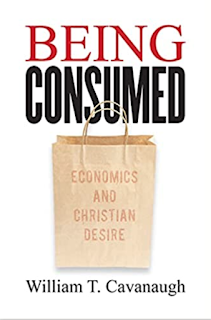
In consumer culture, we plunge ever more deeply into the world of things. Dissatisfaction and fulfillment cease to be opposites, for pleasure is not in possessing objects, but in their pursuit. The dynamic is not that of inordiate attachment to material things, but an irony and detatchment from all things.
This isn't a healthy detatchment as is taught in ascetic Christianity and Buddhism. Rather it's a detatchment more akin to Marx's alienation--we are alienated from the products (and people) we consume because we lack a real desire to possess the object at all. Far from being a people that keep things forever, Americans are instead increasingly familiar with the idea of planned obsolescence and disposability. And even if corporations weren't in on the grift, who really wants to be using last year's iPhone?
Kavanaugh structures the book around four paradoxical concepts undergirding consumerism: freedom/unfreedom, detatchment/attachment, global/local, and scarcity/abundance. Each one is treated in a few pages and is then contrasted with a spiritual practice or theological concept: positive freedom via Augustine, Christian community, Balthassar's "concrete universal", and the Eucharist.
Every chapter is worthwhile: Augustine's concepts of "freedom to" counterpoints beautifully with Thomas Friedman's "freedom from"; persistent Christian community as an antidote to the consume/replace cycle of consumerism; the Eucharist as a model of abundance (one is reminded of Gerald Manly Hopkins "for all this nature is never spent"). The only contrast that didn't fully work for me was the "concrete universal", which I suspect I didn't fully understand. But that chapter also introduced a concept that I know I'll be thinking about for some times, that most attempts to globalize things--products, "diversity", religion--are actually a way of homogenizing them and stripping them of what is unique:
The mobility and universalization of transnational corporations has had a profound effect on culture. It is possible to drive from one coast of the United States to the other and eat the same food, stay at the same motel, shop at the same mall, hear the same music on the radio, hear the news delivered in the same accent, see the same cars, see the same clothes, and hear the same narrow range of political opinions all the way from Florida to Oregon, from California to Maine... I have heard "Disco Duck" in Yugoslavia and eaten at a Pizza Hut in Chile.
A diversity program where the skin tones are different but the culture stays the same; religions where a God of some sort is a constant but truth claims must be restricted to the most anodyne and agreeable, and steakhouses with identical menus but different copyrighted names for the dishes: as Hank Hill would say, "you're not making [the world] better, you're making [the world] worse. Ultimately such flattening erases any edges that can be picked at to escape the suffocating homogeneity of the modern world, and with no loose ends to pull, what is there to do but consume, replace, consume?
The most effective theological move in the book is the Eucharist--the infinite yet distinct body of Christ--as a model of abundance, one that doesn't simply state that abundance is an achievable state for some but actually overthrows the idea of scarcity altogether. I was strongly persuaded by the argument that Kavanaugh puts forth, that scarcity is manufactured to produce need and stimulate the borderline-metaphysical market:
It is not simply that the market encourages an erotic attachment toward things, not persons. It is that the market story establishes a fundamentally individualistic view of the human person. The idea of scarcity assumes that the normal condition for the communication of goods it through trade: to get something, one must relinquish someting else. The idea of scarcity implies that goods are not held in common, that the consumption of goods is essentially a private experience. The idea of scarcity establishes the view that no one has enough.
"The idea of scarcity establishes the view that no one has enough." What a powerful statement, and what an indictment of a nation where most of the populace lay claim to "life more abundant" while simultaneously affirming the sacred nature of commerce, the divine right of billionaire oligarchs, the destruction of the literal planet to drive endless growth (but only for the few) and the essential rightness of a world where millions starve while we consume more and more and more.

