
 Gods, my gods! How sad the earth is at eventide! How mysterious are the mists over the swamps. Anyone who has wandered in these mists, who has suffered a great deal before death, or flown above the earth, bearing a burden beyond his strength knows this. Someone who is exhausted knows this. And without regret he forsakes the mists of the earth, its swamps and rivers, and sinks into the arms of death with a light heart, knowing that death alone...
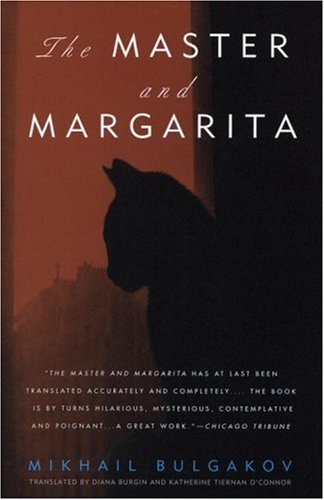
The Master and Margarita is one of those books whose fame comes partly from being discovered too late. Bulgakov was a famed playwright in Soviet Russia, and in the twelve years prior to his death he labored over this book, knowing completely that it wouldn't be published in his lifetime. It wasn't published until the 1960s, and today is one of the hallmarks of 20th century Russian literature.
The Master and Margarita is a rich, Faustian satire about the devil appearing in Moscow. He calls himself Woland, and begins by interrupting a conversation between an editor and a poet about the existence of Christ. After the conversation ends, the editor has been beheaded and the poet driven nearly into madness. This is just the first step--the book's first half chronicles the various and sundry ways that Woland causes havoc in Moscow, inducing death, madness, arson, and imprisonment, mostly in the city's literary and dramatic community. Most of these antics are performed by his retinue, which include a naked witch and a talking cat named Behemoth (which is totally what I'm going to name a cat, if I ever get one).
The titular characters don't appear until about halfway through the book: The Master, who has been arrested for writing a novel about Pontius Pilate, and Margarita, who desperately loves the Master. In exchange for returning the Master to her, Margarita agrees to become a witch and serve as the hostess for Satan's grand ball, which is as colorful as you might imagine. Interspersed are chapters of the Master's book about Pilate.
It's clear why the Soviet powers wouldn't have found The Master and Margarita acceptable. For one, religious subjects were taboo in atheistic Russia. Secondly, much of the havoc caused by Woland is a sly jab at the reigning policies of censorship and imprisonment. In this respect, Woland and his crew serve both as a symbol and its opposite. Though it is they who nearly destroy Moscow's literary elite, it is also Woland who saves the Master's manuscript about Pilate. The Master, regretting the trouble it has caused him, tries to burn it, but Woland reproduces it, quipping that "Manuscripts don't burn"--apparently now a rather well-known phrase in Russian. Here is the implication--the hope?--that authors survive in their works, something Bulgakov must have clung to in the face of a terminal disease. The book is largely comic, but also bittersweet, and the paragraph I've quoted above is one of the last that Bulgakov wrote. It expresses his exhaustion and frustration, and though he leaves the paragraph unfinished it is simple enough to imagine that the sentiment is "death alone can calm him." I don't know if death brought Bulgakov calm, but one hopes that he would have felt validated by The Master and Margarita's publication and subsequent popularity.

