Showing posts with label Italian. Show all posts

Sunday, February 4, 2024

S. S. Proleterka by Fleur Jaeggy

All the rooms know. Likewise the portraits. Ancestors who do not favor a better lot for their successors. For the children. Perhaps Johannes's twin in his wheelchair went from garden to garden trampling over the fate of Johannes's daughter. Objects and predecessors, names no longer uttered, a genealogy of images was against me. I stand listening to the news, the decision of my departure. Orsola's voice comes from a chair behind the desk. "It is for your own good." "And Johannes?" "Your father will do as we decide." It is for my own good. A venomous expression. But it sounds good. I know that that expression has never boded any good. Since then it has worsened my condition as a minor. You ought to watch your back when listening to diktats of this kind. When you are a hostage to the good. A prisoner to the good. The good of the people. Expressions typical of dictatorships. I leave the house with a suitcase and my schoolbag. I have been consigned to others.

For my own good.

Happy SHORT BOOK FEBRUARY, everyone. I've got all the books in my house that are under 200 pages stacked up, ready to be read in a 29-day frenzy. First up is S. S. Proleterka, a crisp 120-pager from Swisss author Fleur Jaeggy, a book as compact and sharp as "incorruptible crystal," a phrase the narrator uses to describe her heart. Having just received the ashes of her dead father, Johannes, she reminisces about a Mediterranean voyage they once took to Greece among the namesake ship. On this trip, the daughter fails to grow any closer to her aloof, unknowable father. She does get to know, however, at the age of fifteen, several of the ship's mates, who induct her into the world of sexual maturity--at her demand:

Johannes's daughter follows him to the cabin. He tells her to strip. He tells her to do what she does with Nikola. And no nonsense. The daughter thinks that this is part of experience. She strips and does what she does with Nikola. The mate's rough fingers fondle her. Scales. Like Nikola, he is violent. She feels as if drawn by lots. Drawn by lots by the crew. she feels pleasure in the disgust. I don't like it, I don't like it, she thinks. Yet she does it all the same. She no longer has much time. The Proleterka is the locus of experience. By the time the voyage is over, she must know everything. At the end of the voyage, Johannes's daughter will be able to say: never again, not ever. No experience ever again. "I want to go," she says now. The other throws her clothes at her. "Be my guest." He laughs, pointing at the door.

S. S. Proleterka is a book that makes you want to quote it rather than write about it, partially because of Jaeggy's staccato, almost violent, prose, and partially because it is so self-contained and self-possessed that it leaves you unsure of what to say about it. The key word in this passage seems to me to be "knowing": the narrator desires knowledge through experience, and sexual experience specifically, knowledge as in "carnal knowledge." Yet on the deck, she emphasizes over and over again how little she knows of her father, with whom she does not live, and who expresses no feelings whatsoever toward her, though it seems he has asked for her to accompany him on this jaunt. At the end of his life, she puts a nail in his pocket before cremation, hoping that something of hers will be mingled with him at last, but it comes back from the crematory whole alongside his ashes.

Jaeggy's narrator flips back and forth between the first person and third, between "I" and "Johannes's daughter"; her alienation from him is linked to an alienation from herself. (Anyone who's ever tried to play around with point of view in writing might recognize what a skillful thing this is.) She slips between the present tense and the past tense, too, mingling the present with memory in a way that collapses the distinction. She describes herself as haunted by a spectral twin, as Johannes had his own twin, a version of himself confined to a wheelchair. And then, at the end of the novel, a surprise, a swerve: the narrator is contacted by an aging man who insists that he is her biological father. The spectral twin, then, is that man's son, who died as a little boy. It's almost as if, for Jaeggy, learning the truth about oneself means nothing at all, has no impact. The strange man and his wife enter the narrator's life with belated chumminess, and we're not sure what to make of them. The truth, if it is the truth, has the air of falsehood. Who could be the real father of this narrator, so detached and severe, so haunted by the limitations of her own knowledge, than the man in the urn, Johannes?

Wednesday, March 7, 2018

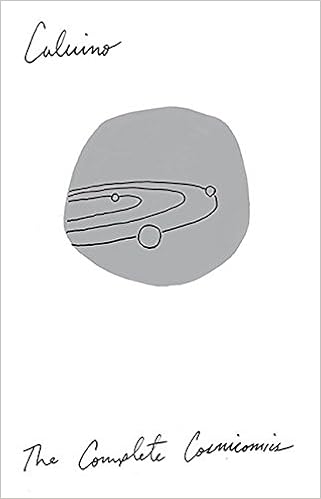
The Complete Cosmicomics by Italo Calvino

And then it was that my brother Rwzfs, an infant at the time; at a certain point I felt him--who knows?--slamming or digging or writhing in some way, and I asked: 'What are you doing?'  And he said: 'I'm playing.'

'Playing?  With what?'

'With a thing,' he said.

You understand?  It was the first time.  There had never been things to play with before.  And how could we have played?  With that pap of gaseous matter?  Some fun: that sort of stuff was all right perhaps for my sister G'd(w)n.  If Rwzfs was playing, it meant he had found something new; in fact, afterwards, exaggerating as usual, they said he had found a pebble.  It wasn't a pebble, but it was surely a collection of more solid matter or--let's say--something less gaseous.  He was never very clear on this point; that is, he told stories, as they occurred to him, and when the period came when nickel was formed and nobody talked of anything but nickel, he said: "That's it: it was nickel.  I was playing with some nickel!"

Each of Italo Calvino's Cosmicomics begins with an assertion about the earth or the universe before the advent of human beings: once, the moon was much closer to the earth, or, the more distant a galaxy is from us, the farther away it moves.  Then the voice of the narrator, an immortal named Qwfwq, chimes in to tell us exactly what it was like in those days.  Sure, he says, the moon was much closer; we used to row our boats out to it and jump on to harvest moon milk.  The stories are both fanciful and charming, melding speculative science with a casual and playful voice.  Qwfwq has been a single-celled organism, a mollusk, a dinosaur, a camel.  Qwfwq's immortality is not explained; the cosmicomics aren't those kinds of stories.  In mode they hew closer to the tall tales of the American frontier than hard science fiction, like the unbelievable tales of Paul Bunyan or Pecos Bill.

The subtle brilliance of the Cosmicomics, collected here in total, is that they encourage us to enlarge our view of the universe in its entirety, temporally as well as spatially.  It's all well and good to be told that everything that exists used to be crammed into a single infinitesimal point, but it's quite another to imagine what that was actually like, when everyone's all ass-to-elbows on top of each other like a crowed tenement building.  Of course, it wasn't like that at all; there is no way to describe what it would be like to be alive before the Big Bang because the circumstances would permit neither human existence nor sensory experience, but that's not the point.  The point is that the very thought that you could imagine it is breathtakingly bold.

But the Cosmicomics rely also on a canny set of observations about contemporary human nature.  One of the best stories, "The Aquatic Uncle," provides a sketch of a fish who refuses to adapt once everyone else in his family has grown legs and started living on the land:

This business about warts was a widespread prejudice among the old fish: a notion that, from living on dry land, we would develop warts all over our bodies, exuding liquid matter: this was true enough for the toads, but we had nothing in common with them; on the contrary, our skin, smooth and slippery, was such as no fish had ever had; and our great-uncle knew this perfectly well, but he still couldn't stop larding his talk with all the slanders and intolerance he had grown up in the midst of.

Qwfwq's great-uncle is an image of every uncle whose prejudices are indulged at the Thanksgiving table; no one wants to upset him too much by insisting that his worldview is antiquated.  But it also extends a great sympathy toward the uncle, whose world has changed very rapidly, and presents an understanding of how and why particular atavisms can be so beguiling (Qwfwq's land-raised fiancee ends up running off with his aquatic uncle).  In "All at One Point," the universe begins to expand because a single beloved woman laments that she does not have enough space to "make tagliatelle for all you boys," and the very conception of such generosity pushes the limits of the known universe.  These are finely drawn portraits of human nature, even as they find their setting in places and times that no human ever was.

The Cosmicomics were a life's work for Calvino, and they are perhaps not best read all in a row--they too can get to feeling like a universe's worth of knowledge pressed into a single point.  Later logic experiments with probability and time get very tedious, borrowing from Borges with less purpose and clarity.  But when Qwfwq's voice is strongest--casual, insightful, funny, but a little smug--the stories are really inspired.

Sunday, December 11, 2016

Invisible Cities by Italo Calvino

And Polo said: "The inferno of the living is not something that will be; if there is one, it is what is already here, the inferno where we live every day, that we form by being together.  There are two ways to escape suffering it.  The first is easy for many: accept the inferno and become such a part of it that you can no longer see it.  The second is risky and demands constant vigilance and apprehension: seek and learn to recognize who and what, in the midst of the inferno, are not inferno, then make them endure, give them space."

Invisible Cities is framed as a conversation between the Mongol lord Kublai Khan, who has conquered an area of the world too large for him to experience or understand, and the traveler Marco Polo, who describes to Khan the various cities that belong to his kingdom.  Each city, given a woman's name, is described in one to three pages, and represents a meditation on human life, understanding, memory, or desire.

One of my favorites is the city of Tamara, where signs tell you each building's purpose in the system of the city.  This becomes a meditation on the reliability of signs to express what is signified:

Your gaze scans the streets as if they were written pages: the city says everything you must think, makes you repeat her discourse, and while you believe you are visiting Tamara you are only recording the names with which she defines herself an all her parts.

However the city may be, beneath this thick coating of signs, whatever it may contain or conceal, you leave Tamara without having discovered it.  Outside, the land stretches, empty, to the horizon; the sky opens, with speeding clouds.  In the shape that chance and wind give the clouds, you are already intent on recognizing figures: a sailing ship, a hand, an elephant...

Another is Zobeide, the city which "men of various nations" built after seeing it identical dreams wherein they pursue a beautiful woman:

This was the city of Zobeide, where they settled, waiting for that scene to be repeated one night.  None of them, asleep or awake, ever saw the woman again.  The city's streets were streets where they went to work every day, with no link any more to the dreamed chase.  Which, for that matter, had long been forgotten.

New men arrived from other lands, having a dream like theirs, and in the city of Zobeide, they recognized something of the streets of the dream, and they changed the positions of the arcades and stairways to resemble more closely the path of the pursued woman and so, at the spot where she had vanished, there would remain no avenue of escape.

The first to arrive could not understand what drew these people Zobeide, this ugly city, this trap.

There are 55 of these cities.  It would be easy for a book like this to become repetitive or tedious, but Calvino's achievement relies on his ability to surprise within a few pages of narrative, and the seeming inexhaustibility of his imagination.  I think the ideal way to read this book would be one city a day, like a devotional.  But Calvino is so adept at looking at the same ideas from new and fresh perspectives that the book's contrivances never really get old.

And at the center of the book are Polo and Kublai, who give the narrative a human element and allow us to imagine in them our own relationship to the places we have known.  What do the places we have been, or the places we have dreamed of going, tell us about our memories and desires?  Though it's not about real places--really, it casts a skeptical eye on what we mean by the idea of place at all--Invisible Cities has a lot to say about the way we move through the real world.