Sunday, December 31, 2017

One Hundred Nights of Hero by Isabel Greenberg

We shall tell all the stories that are never told. Stories about bad husbands and murderous wives and mad gods and mothers and heroes and darkness and friends and sisters and lovers...
Yes! And above all...stories about brave women who don't take shit from anyone
.
In a reimagining of Scheherazade's 1001 nights, Greenberg gives us Hero, who tells a hundred nights' worth of stories to keep her lover, Cherry, safe from a gentlemen's bet. The stories are packed full of brave, independent women. Women who read and write and tell stories to stay alive. The stories are about love and loss and all the varied meanings of sisterhood.

This was a really beautiful companion to Fahrenheit 451. I didn't intend to pair the two, but this gives a whole new dimension to the power of stories. Women are largely absent from Bradbury's novel, but here women are the bearers of history. Despite being trapped in a patriarchal hierarchy designed (or re-designed...their world was initially built by a god's daughter and then re-vamped by the god when he grows bored) by a vengeful god, these women push to break through. They aren't always successful--in fact, they often fail--but they rally around each other and build each other up in ways that are rare in literature and in life.

Greenberg's drawings are whimsical and angular, and her women float through the panels as though defying gravity. As happens too often with me and graphic novels, I breezed through this. Her written style is engaging and funny, and the stories moved quickly which made it easy to skip over the images. I want to go back and read it again!

Christopher's Top Ten 2017

It's top ten time, everyone!  Gather round the warmth of the fire and I shall regale with you with my top ten books of the year.

My resolution this year was to beat my personal best, which I set in the very first year of the blog's existence: 62 books.  Resolution achieved--I finished with 67.  In 2018 I'm going to beat my record again, and if I can, I'd like to read 75 books.  There are just too many books in the world, and too little time in a life.  So why not read as much as you can?

As a consequence, I feel like my list of favorite books this year is very deep.  I'm not sure I read anything that bowled me over like last year's Lives of Girls and Women or The Man Who Loved Children, but I think I may have really liked more of what I read than any other year.  Even some books I really enjoyed, like Molloy, Love in the Ruins, and The Radiance of the King, didn't crack the honorable mentions below.

Before the top ten, let me say, as I always do, we would love to have people join us in our yearly quest.  It was great to have John join us this year, and to enjoy a second year of Chloe.  If you'd like to try it out, send me an e-mail at misterchilton at gmail dot com.

Honorable Mentions 2017:

The Apprenticeship of Duddy Kravitz by Mordechai Richler
The Bingo Palace by Louise Erdrich
The Chess Garden by Brooks Hansen
The Crossing by Cormac McCarthy
Fifth Business by Robertson Davies
The Medusa Frequency by Russell Hoban
The Mosquito Coast by Paul Theroux
A Perfect Vacuum by Stanislaw Lem
The Sinking of Odradek Stadium by Harry Mathews
The Wreath by Sigrid Undset

Top Ten 2017:

10. Martian Time-Slip by Philip K. Dick - I realized in December that I hadn't read any of PKD's books all year--and since he wrote dozens, that meant I was going to fall behind if I wanted to read them all.  I picked this one more or less at random, and I was blown away by how good it was.  Its vision of a schizophrenic unmoored in time is terrifying, and its black cynicism toward the future of space colonization is some of the most trenchant of PKD's career.  Dick's talent for churning out books in the same style without getting repetitive or tired was truly something.

9. The Twyborn Affair by Patrick White - The Twyborn Affair is, like Nightwood, exceptional because of its vision of the life of a trans woman before we even had the language to really talk about such things.  We track the protagonist as a sensuous young woman, transitioning back into a man doing hard labor in the Australian Outback, to a madam in a London brothel.  It works because no one writes about the body, in its ugliness as well as its possibility, as well as White does, and because, uncharacteristically, it leaves some room for hope of acceptance, not just for Eadie, but for all those who feel estranged from their own bodies.

8. Breakfast at Tiffany's by Truman Capote - I've never seen this movie.  But I can't imagine it has the same kind of spare, slimmed-down confidence as Capote's novel, or as deep an understanding of its troubled heroine.  Like Gatsby--and a million or so other literary characters--Holly Golightly turns toward wealth, status, New York, and crime in order to escape from the burdens of the past.  But Holly Golightly's run from the pettiness of small town American life seems heartbreakingly real in a way that Gatsby's melodrama never does.

7. Mr. Fortune by Sylvia Townsend Warner - I love it when books seem like they're going to be one kind of book, and then they turn out to be another.  For a long time Mr. Fortune seems like a particularly sharp satire of colonialism and repressed sexuality, and then it takes a sudden turn, and becomes a touching meditation on the pain that comes from really loving someone.  It manages to be deeply, darkly funny, but never sacrifices empathy for its misbegotten missionary or the young Polynesian man who is the object of his affections.

6. I Served the King of England by Borumil Hrabal - I Served the King of England is a comedy about a man caught up in the great social upheavals of Eastern Europe in the 20th century: first Nazism, then Soviet Communism.  But it works so well because its protagonist, the hotel waiter Ditie, isn't a mere victim of historical circumstance, but a proud and ambitious man who keeps reaching for his dream of owning a beautiful hotel in the midst of war and farce.  It's the funniest book I read this year, but it also exhibits a deep Voltaire-like wisdom.

5. Loving by Henry Green - What's better than picking up a new author for the first time and saying, "Huh--I didn't know fiction could do that."  How can a book be so tightly written, so unadorned, yet demand such patience and care?  Loving is slow, slow, work, but tells a story worth the effort, about a group of bored servants waiting for their master to return at the height of World War II.  It's a book that knows how much pathos is to be found in the mundane, and it's written accordingly.

4. Augustus by John Williams - How can you humanize a character as immense as Augustus, a man who brought the whole world under his sway?  Much less one that existed at such a historical distance to ourselves.  Williams' strategy is to write an epistolary novel, one in which we are forced to manage the manifold versions of Augustus Caesar as reported by his friends, his family, his enemies, his subjects.  And only then do we get to see Augustus' own account of his actions, an account whose wisdom and acuity he knows to be irrelevant, because the voice of even such a famous man isn't enough to counteract that of history.

3. Runaway by Alice Munro - The story that's stuck with me the most of Munro's from this year has actually been "The Office," about a woman who literally can't get a Room of One's Own because her landlord is always pestering her.  That story's in The Dance of the Happy Shades, but it's Runaway that's the best collection.  Every story here is like a little novel in miniature, a self-contained masterpiece wrought with great care and ingenuity.  The title story, with its lost goat and its subversive ending, is as good as anything Munro ever wrote--so far as I know, at least.

2. Herzog by Saul Bellow - Bellow's style isn't really to what I might call my taste--it's overcrowded, throwing every possible detail at the reader, as if to see what sticks.  But Bellow's just so good at it that it can't help but win me over.  Word-for-word, he's one of the best writers I've ever read, and I'm amazed at his ability to keep it up for the space and length of a book like Herzog.  The neurotic, cuckolded title character might be an early (that is, good) Woody Allen character; he's the kind of character Philip Roth has been trying to create for decades, but Roth has never had Bellow's genius, or his vitality.  This book just explodes off the page.

1. Independent People by Halldor Laxness - Independent People is my favorite novel of the year.  It's a classic old Russian novel, filtered through the particular sensibility of Iceland, a small, cold, isolated place.  It's got a little James Joyce in it, and a little Thomas Hardy.  But mostly, like all good novels, it's a good depiction of character, and no character was affecting this year as Bjartur, the fiercely independent Icelandic farmer who must adhere to his own sense of dignity in the face of death, starvation, and the estrangement of his daughter.  "You can always call the air you breathe your own," he tells us.  Well it feels like Iceland outside right now, and I can see the air that I breathe, so I've been thinking about that advice quite a bit.

And now the list resets, and we get to start again.  Happy new year, everyone!

The Sense of Style: The Thinking Person's Guide to Writing in the 21st Century

The fact that many prescriptive rules are worth keeping does not mean that every pet peeve, bit of grammatical folklore, or dimly remembered lesson from Miss Thistlebottom's classroom is worth keeping.

Writing, amirite? Can't live with it, can't live without it. Or at least, I can't because most of my work involves writing. But writing is one thing, writing well is another. Steven Pinker's book is aimed at helping its readers write well.

Or at least, kind of. The books is focused on helping its readers write well in a technical sense. Style, as referred in the title, is writing in the "classical" style; this means writing with as little ambiguity as possible, and in a way that does not condescend to its readers. Here is Pinker writing about a Judith Butler passage, which Pinker feels exemplifies the opposite of classical style:
A reader of this intimidating passage can marvel at Butler's ability to juggle abstract propositions about still more abstract propositions, with no real-world referent in sight . . . . What the reader cannot do is understand it--to see with her own eyes what Butler is seeing.
Pinker identifies the "curse of knowledge," which he suggests is the root of much bad writing. The curse of knowledge is that the writer knows; when the writer writes, unfortunately, this  knowing prevents the writer from spotting ambiguity or obfuscation in his writing. The writer cannot see the ambiguity because when the writer reads his own writing, it appears clear.

I think this is right. My experience with myself, my colleagues and opposing counsel--professional writers in a sense--is that we are often blind to how confusing our writing can be. Our level of expertise works against our writing because we do not see where concepts need to be simplified; we do not see that a sentence could convey two meanings because we intuitively reject the wrong interpretation; that is, we only see the interpretation we intended to convey, not the accidentally-conveyed interpretation.

Pinker's concept of classical style is a remedy: write to maximize your audience's understanding. Simple, clear prose; not jargon-riddled, dense word-vomit. I would add, and I think Pinker would agree, that the jargon-filled and dense prose often hides undeveloped ideas.

After describing classical style, and what is not classical style, Pinker identifies a number of ways that writing can be more clear. What follows is a series of writing problems, and how to avoid them. He provides a new (to me, at least) way of diagramming sentences (using trees), how to develop and maintain "arcs of coherence," and, finally, a long list (spanning the last 100 pages of the book) of grammar myths and grammar truths.

This is the first writing style book I've ever read for general writing (I've read a handful of legal writing style books). I thoroughly enjoyed it and found it very helpful. The tree diagramming method is helpful in contemplating how one should structure sentences; his description of classical v. not classical writing was helpful in thinking about what good writing is; his list of grammar myths/truths will be my go-to source whenever I need to know how to approach a grammar problem.

Pinker explicitly disavows any interest in replacing more classic writing style guides. Having never read any others, I do not have a strong opinion about whether this work will or will not replace others. That said, I do think, for me, I will be reluctant to read older style guides because Pinker convincingly indicates that many of them are outdated. Being a more casual reader of grammar guides, I'm not sure I have the patience or fortitude to figure out which parts of Strunk and White are still good or bad. In contrast, because of The Sense of Style's more recent publication, I feel fairly confident relying on it. So, for me, this is probably going to be my definitive writing style guide for the foreseeable future.

[Sidenote: a colleague pointed out that there are hilarious one-star reviews of this book on Amazon, which, in a way, are their own endorsement of the book].

Fahrenheit 451 by Ray Bradbury

Do you know why books such as this are so important? Because they have quality. And what does the word quality mean? To me it means texture. The book has pores. It has features. This book can go under the microscope. You'd find life under the glass, streaming past in infinite profusion. The more pores, the more truthfully recorded details of life per square inch you can get on a sheet of paper, the more 'literary' you are. That's my definition anyway. Telling detail. Fresh detail. The good writers touch life often. The mediocre ones run a quick hand over her. The bad ones rape her and leave her for the flies. 
I'm embarrassed to admit that this is my first time reading Fahrenheit 451. I've always preferred Vonnegut to Bradbury and have passed this one over a few times in favor of other dystopias. We're reading it in ninth grade English next month, so it was time to bite the bullet, and I'm glad I did.

I won't dwell too much on the plot here (even I knew the bulk of it before sitting down to read it). In Guy Montag's world, books are illegal. Firemen like Montag come to the rescue when books are discovered and gleefully burn them. Montag, we discover, has had subconscious doubts about this system for a while and has been stashing books salvaged from these fires. He starts to read them and all hell breaks loose.

I was struck by a couple of things while reading this. First and foremost, Bradbury's eerie prescience about the power of screens and technology. The book describes a natural turn away from literature and towards the bright, explosive entertainment of a version of television that doesn't seem far off from what we have today. A system that probably seemed impossibly futuristic 60 years ago--screens the size of parlor walls that created an immersive entertainment system--now feel totally within reach (if not something that already exists in fancier homes than mine). I'm intrigued as to how my students, who grew up with the omnipresence of screens and are often frustrated with or bored by books, will take all of this.

We throw around the concept of banned books and our reaction to them as somewhat of a badge of honor in this country. The Strand has a display table called Banned Books (Catcher in the Rye, To Kill a Mockingbird, Handmaid's Tale), and liberal outrage when schools or districts ban a particular book or author is loud and justified. That being said, we do not (as of yet) make it a nationwide practice to limit our citizen's access to literature. I spent six months in Moscow in college, and while I was there I struggled through Bulgakov's Master and Margarita in Russian (by struggled through I mean that I would read a few pages in Russian and then cave and read the chapter in English). After dinner one night, my host mother brought a dusty manuscript out of the closet. It was a thick, handbound, typewritten stack of papers; the cover read: Мастер и Маргарита. When she was a student, Bulgakov had been banned, and she and her friends had passed a single copy of the book around. She had loved it so much that she wanted to re-read it, so she sat down one night and typed the whole thing out. Start to finish. An entire class of intellectuals in the Soviet Union was doing the same with Solzhenitzyn, Pasternak, and more. Just a decade after Bradbury's intellectuals huddled by campfires, holding tight to their memorized Byron, Confucius, and Jefferson, the same scene was playing out in Soviet dorms (as I'm sure it did in Nazi Germany and every other oppressive regime that has attempted to limit access to literature). It's comforting to look back at Russian and Soviet literature and see what grew out of that time period: Akhmatova, Pasternak, Brodsky. Censorship hasn't worked yet. The jury is still out on screens, though.

Saturday, December 30, 2017

The Leavers by Lisa Ko

Never had there been a time when sound, color, and feeling hadn’t been intertwined, when a dirty, rolling bass line hadn’t induced violets that suffused him with thick contentment, when the shades of certain chords sliding up to one another hadn’t produced dusty pastels that made him feel like he was cupping a tiny, golden bird. It wasn’t just music but also rumbling trains and rainstorms, occasional voices, a collective din.
Lisa Ko's The Leavers follows Deming Guo as he becomes Daniel Wilkinson. Deming's mother, Polly, an undocumented immigrant, disappears one day, leaving Deming behind in the Bronx. Deming is adopted by the Wilkinsons and moves upstate, leaving his old life and self behind. As Daniel grows older, pieces of Deming start to surface within him, and the novel centers around his attempts to reconcile the various versions of himself.

Deming's growing up is a little bumpy (as could be expected). He struggles with addiction and figuring out who he is is not as simple as drawing a line from one version of himself to the next. Those aspects of the novel are well written and engaging, but not particularly earth-shattering. On some level, it's a regular coming of age story. Throughout, however, Ko does shine some insight into the perils of interracial adoption, and those perils are revealed gradually and well.

If Deming's story is fairly run of the mill, Polly's is exceptional. Her ambivalence about being a mother is artfully and sympathetically portrayed, and her decisions and development throughout the novel are fascinating. While Deming/Daniel operates largely in spaces I'm familiar with, Polly's universe is totally alien to me. It's more Deming's story than Polly's, but she lends it the nuance and the depth that makes the novel worthwhile.


Men Explain to Me by Rebecca Solnit

I had just begun to make the case for hope in writing, and I argued that you don't know your actions are futile; that you don't have the memory of the future; that the future is indeed dark, which is the best thing it could be; and that, in the end, we always act in the dark. The effects of your actions may unfold in ways you cannot foresee or even imagine. They may unfold long after your death. This is when the words of so many writers often resonate most. 
I've seen this essay collection floating around for a while now, and in the wake of the most recent wave of sexual assault allegations, it seemed time to break it open. Solnit starts with a chillingly familiar story; at a party she finds herself in conversation with a man who is hell-bent on explaining her most recent book to her--a "very important" book that she couldn't possibly have read, let alone written. Her essay about that incident inspired both the title of the collection and the term "mansplaining."

As is her style, Solnit ranges pretty widely here. Assault on Indian busses, the IMF, Virginia Woolf, Cassandra. Despite some of the essays being close to a decade old, Solnit's insights on navigating the world as a woman are largely heart-wrenchingly spot on. She describes a college class which unearths a "chasm" between the male and female experience: "The intricate ways [women] stayed alert, limited their access to the world, took precautions, and essentially thought about rape all the time (while the young men in the class, he added, gaped in astonishment," and the ways in which women around the world are consistently marginalized in every sense of the word: "Billions of women must be out there on this seven-billion-person planet being told that they are not reliable witnesses to their own lives, that the truth is not their property, now or ever." Her prose is beautiful and intricate and painfully accurate.

Violence is a focus throughout--physical, emotional, verbal--but Solnit shows a serious blindspot as she tackles statistics about both American and international violence against women. This statement, made early on in the book, really rubbed me the wrong way: "Violence doesn't have a race, a class, a religion, or a nationality, but it does have a gender." I understand her point here, that women, on the whole, are subjected disproportionately to violence and abuse, but the reality is that violence does have a race, a class, a religion, and a nationality. White women, Solnit included, operate a space of privilege that not only shelters them from some of this violence, but that also prioritizes their voices and stories. Solnit seems fairly blind to this fact throughout her essays; she talks about the experiences of women of color abroad, but largely neglects the experiences of women of color in this country, and her writing loses some credibility as a result.

Overall, this felt very, very relevant. The book was published before the current torrent of accusations, firings, and the #metoo movement, and I like to think that Solnit might permit herself to feel some hope in the reactions over the past few months. White Feminism aside (and the essays have a serious White Feminism problem), the book does an excellent job of describing the underlying infrastructure that enabled the culture of assault that is slowly coming to light. Taken with a (white) grain of salt, it's worth a read.

Thursday, December 28, 2017

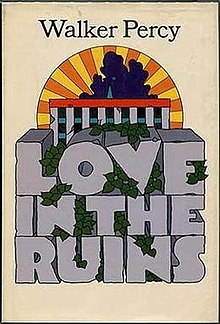
Love in the Ruins by Walker Percy

Undoubtedly something is about to happen.

Or is it that something has stopped happening?

Is it that God has at last removed his blessing from the U.S.A. and what we feel now is just the clank of the old historical machinery, the sudden jerking ahead of the roller-coaster cars as the chain catches hold and carries us back into history with its ordinary catastrophes, carries us out and up toward the brink from that felicitous and privileged siding where even unbelievers admitted that if it was not God who blessed the U.S.A., then at least some great good luck had befallen us, and that now the blessing or the luck is over, the machinery clanks, the chain catches hold, and the cars jerk forward?

Dr. Tom More lives in Louisiana, in an America some vague time in the future, a few decades past the old "Auto Age."  Of course, life in Louisiana in the future looks a lot like it did in Percy's day; there's no flying cars or technological upheaval.  There's a bit of unintentional irony in the fact that much of the novel takes place at an abandoned Howard Johnson's.  The real difference is that the political tension that Percy observed has been carried to its extremes: right-wing "Knotheads" battle bloodthirsty Lefts, and separatist black guerillas are scheming against the country-club towns of Louisiana in the woods.  The U.S.A. is on the verge of breaking up, and symbolic vines have taken over much of the abandoned infrastructure of the "Auto Age"--the highway cloverleaves and the Howard Johnson'ses.

Percy suggests that the partisan strife is part and parcel with the strife of the human soul: Knotheads have their rage and Lefts their terror.  More's invited a machine, a More Ontological Qualitative-Quantitative Lapsometer, which can identify the specific points in the brain of psychological abnormality.  It might even be able to cure what More calls the pervasive "angelism-bestialism" of modern man, the bipolar sense of detachment from the body, alternating with the primitivist wallowing in animalistic urges.  There's a fine theological point being made here about the precarious balance between soul and body, and the need to believe in the reality of both.  Someone has been sniping at More from the woods, and others seem to want to use his device not to cure the ills of America, but to exacerbate them, and bring about a literal culture war.

It's hard not to feel, on the eve of 2018, that such a vision of the future was spot-on.  Percy's intuition that political and cultural divisions in America would only deepen has to be considered confirmed.  And yet there's an aspect to Percy's vision that I no longer feel like endorsing: the belief that all are equally responsible for these divisions, Knothead and Leftist, white country clubber and black guerilla.  Or, if not equally responsible, that each comes to their enmity through the same malady of mind and soul, in a way that seems to dismiss the actual dynamics of power that create racial conflict.  I am not at all sure about this paragraph, in which More is shocked by a friend's admission that he chased a black couple out of a bowling alley:

Where did the terror come from?  Not from the wrongness, violence gives release from terror.  Not from Leroy's wrongness, for if he were altogether wrong, an evil man, the matter would be simple and no cause for terror.  No, it came from Leroy's goodness, that he is a decent, sweet-natured man who would help you if you needed help, go out of his way and bind up a strangers wounds.  No, the terror comes from the goodness and what lies beneath, some fault in the soul's terrain so deep that all is well on top, evil grins like good, but something shears and tears deep down and the very ground stirs beneath one's feet.

I think Percy is probably right that it's too easy to dismiss racism as evil, and that the more difficult and productive thing is to grapple with the way racism can take root even among people's more altruistic impulses.  But it no longer seems tenable to hold, as Love in the Ruins does, Leroy's racism on one side of the scale and the anger of the black guerillas in the swamp on the other.

Here's another part that struck me:

The poor U.S.A.!

Even now, late as it is, nobody can really believe that it didn't work after all.  The U.S.A. didn't work!  Is it even possible that from the beginning it never did work? that the thing always had a flaw in it, a place where it would shear, and that all this time we were really not different form Ecuador and Bosnia-Herzegovina, just richer.  Moon Mullins blames it on the n----rs.  Hm.  Was it the n----r business from the beginning?  What a bad joke: God saying, here it is, the new Eden, and it is yours because you're the apple of my eye; because you the lordly Westerners, the fierce Caucasian-Gentile-Visigoths, believed in me and in the outlandish Jewish Event even though you were nowhere near it and had to hear the news of it from strangers.  But you believed and so I gave it all to you, gave you Israel and Greece and science and art and the lordship of the earth, and finally even gave you the new world that I blessed for you.  And all you had to do was pass one little test, which was surely child's play for you because you had already passed the big one.  One little test: here's a helpless man in Africa, all you have to do is not violate him.  That's all!

One little test: you flunk!

The irony here is so thick that it's difficult to parse.  Is it satirizing the belief in America as divinely procured, or does it believe in it, deep down?  I sense that the truth is somewhere between; that Percy, through More, wants keenly to believe in the ideal of America but knows that slavery and colonalism put it to the lie.  The tone is outrageous, but I think this passage properly acknowledges how immensely slavery blots out our most cherished ideas about America, and ourselves--us whites, that is.  And it shows how difficult, perhaps impossible, that can be to process.  And yet I feel like this admission ought to lead somewhere that the novel isn't prepared to go: a greater understanding of black voices, and an acknowledgement that America's deepest problem isn't just that we all don't get along anymore.  What the past two years have taught me is that such statements are only true if the borders of "we" are drawn very tightly.

That said, Love in the Ruins is many times more successful than The Thanatos Syndrome (which is a sequel to this, though I didn't know it when I picked it up).  Percy uses his near-future setting more nimbly, sticking with pure farce instead of the CSI-type forensic quest that characterizes the sequel, and steering clear of the humor-killing blackness of the child abuse plotline.  Parts of Love in Ruins are just fun.  In the future, apparently, medical doctors battle for diagnostic supremacy before their students in a cage match called "The Pit."  More uses his battle in the Pit to test his lapsometer on his unsuspecting opponent, and proves to everyone that the mute octogenarian they're fighting over is really just pissed about living in an old folks' home.  It's silly and weird and makes perfect use of the slight separation that science fiction provides from the real world.  Leave it to Percy to find the humor in the end of the world.

Sunday, December 24, 2017

Fates and Furies by Lauren Grofft

It was mathematical, marriage. Not, as one might expect, additional. It was exponential.
Fates and Furies is blurbed as a book about a marriage, and on the surface it is. Mathilde and Lotto are married at 23 in the opening pages, and the work of their relationship takes up the bulk of the novel. That being said, it is also a book about perspective (although perhaps any good book about marriage is inherently also a book about perspective). Lotto's side comes first: his childhood, his career, his side of their partnership. Mathilde's--far more interesting--takes up the second half of the novel.

Lotto is an actor and a playwright, and scattered throughout both sections of the novel are parenthetical asides; the audience is acknowledged and addressed directly. These asides break the flow of the narrative and take you out of the story, sometimes for a sentence sometimes for an entire paragraph, but they drive home the idea that this is a book about perspective and they acknowledge that you, the reader, are partaking in the story along with the characters. One of my favorite of these asides comes as Mathilde and Lotto are struggling through a particularly chaotic family holiday, one filled with tears and accusations and surfaced bitternesses. As the evening winds down, Groff pulls us out of their basement apartment to this:
A stranger hurrying as fast as he could over the icy sidewalks looked in. He was a circle of singing people bathed in the clean white light from a tree, and his heart did a somersault, and the image stayed with him; it merged with him even as he came home to his own children, who were already sleeping in their beds, to his wife crossly putting together the tricycle without the screwdriver that he'd run out to borrow. It remained long after his children ripped open their gifts and abandoned their toys in puddles of paper and grew too old for them and left their house and parents and childhoods, so that he and his wife gaped at each other in bewilderment as to how it had happened so terribly swiftly. All those years, the singers in the soft light in the basement apartment crystalized in his mind, became the very idea of what happiness should look like. 
Groff does some of her best, most sweeping writing in these moments. She condenses time and space and perspective in just a few sentences, and it makes a nice break from the pacing of the rest of the novel.

It's hard to write a full review of this book without spoilers, but I think it's worth a try. In some ways, the novel feels complete at the end of Lotto's section, and Mathilde's retelling feels like it could be a totally separate piece. That being said, her perspective reshapes and reforms the entire story in unexpected ways that make the novel far more engaging and worthwhile. It gets darker, more layered, and far more imaginative with her version laid over his.

Overall, this was a fun read. It wasn't hugely literary, but it was suspenseful and the characters, while not entirely likeable, were engaging. I rarely say this, but this would be a good book to read on an e-reader. I read it in paper form, and when things really started getting crazy, I wanted to be able to reach back and find specific moments and characters. Doing that on an e-reader would have been much easier, and I think there are a few things I missed by just flipping back and forth.

Saturday, December 23, 2017

Cat's Eye by Margaret Atwood

So I am left to the girls, real girls at last, in the flesh. But I'm not used to girls, or familiar with their customs. I feel awkward around them, I don't know what to say. I know the unspoke rules of boys, but with girls I sense that I am always on the verge of some unforeseen, calamitous blunder. 
Atwood's novel, Cat's Eye, is told in brutal flashbacks to the narrator's girlhood. After a young childhood spent on the road in Northern Canada with her entomologist father, her family settles in Toronto and Elaine is taken in by a group of elementary school girls. The novel alternates between Elaine's adulthood (she is a surrealist painter, in Toronto for a retrospective show of her work) and her painful progression from elementary school through to that adult future.

Elaine's early childhood and family relationships are the comforting center of the novel. Her eccentric parents and nerdy brother provide the kind of delightfully oblivious stability that families ought to provide throughout a particularly turbulent adolescence (and, like any particularly turbulent adolescent, Elaine is fully immune to their virtues). Inserted in between the horrors of puberty are delightfully odd moments: tours of her father's entomology lab, astronomy lessons from her brother, her mother cooking dinner over a camp stove in a men's workshirt. Where Elaine is being dragged under by the current of teenage society, her family drifts somehow above it.

Where Atwood excels, and what makes the book both fabulous and at times difficult to read, is in her portrayal of the viciousness of young female relationships. Elaine's little knot of friends identifies her early on as the black sheep and spends middle and high school brutalizing her. Their attacks run the gamut from subtle ("training" Elaine by quietly pointing out her every fault) to downright cold-blooded (forcing her down a snowy riverbank and leaving her once she falls through the ice). We know Elaine survives it all, but it's touch and go there for a while. I found myself terrified that my unborn child might be a girl--no part of this experience seems okay and all parts of it felt unsettlingly familiar.

A novel build on catty female relationships could easily slide into the trashy, but Atwood's writing keeps it centered. The whole book is haunting and beautifully written, but the first paragraphs may have been my favorite (and among my favorites this year):
Time is not a line but a dimension, like the dimensions of space. If you can bend space you can bend time also, and if you knew enough and could move faster than light you could travel backward in time and exist in two places at once.
It was my brother Stephen who told me that, when he wore his raveling maroon sweater to study and spent a lot of time standing on his head so that the blood would run down to his brain and nourish it. I didn't understand what he meant, but maybe he didn't explain it very well. He was already moving away from the imprecision of words.
But I began then to think of time as having a shape, something you could see, like a series of liquid transparencies, one laid on top of another. You don't look back along time but down through it, like water. Sometimes this comes to the surface, sometimes that, sometimes nothing. Nothing goes away. 
The sweater; the slow drift of the older sibling; the fluidity of memory. All in half a page. This was an emotionally challenging read and a little bit of a slog plot-wise, but flashes like this one made it very worth it.
 

Monday, December 18, 2017

Molloy by Samuel Beckett

Let me tell you this, when social workers offer you, free, gratis and for nothing, something to hinder you from swooning, which with them is an obsession, it is useless to recoil, they will pursue you to the ends of the earth, the vomitory in their hands.  The Salvation Army is no better.  Against the charitable gesture there is no defence, that I know of.  You sink your head, you put out your hands all trembling and twined together and you say, Thank you, thank you lady, thank you kind lady.

Molloy is a vagrant on his way to meet his aged mother.  He gets waylaid: he is arrested for sitting on bicycle in a suggestive way; he accidentally runs over and kills a woman's dog; he is invited to live with that women (in place of her dog?); he kills a man in the forest.  It's never clear how long these digressions take, because Molloy's sense of time is fragmented; it could be years.  He write this story from what seems to be a kind of cell, where every now and then a man comes to take his pages away and return to him edited pages, which he does not read.

His work is peppered with aphorisms: "The fact is," he tells us, "it seems, that the most you can hope for is to be a little less, in the end, the creature that you were in the beginning, and the middle."  His style is confused but somehow, grammatically, at least, hyperclear, the stylistic effect of Beckett's method of writing in French and translating himself back into his native language, English.  He talks a lot about his body: his bad leg, and his farting.  The modernists all love pooping and farting, and Beckett's no different.  All in all, he gives an image of the world seen from the outside, not in the gritty mode of the social realist, but from the distance needed to see through the false bourgeois assurances of social realism.  He never does make it to his mother.

And then, the book shifts: done with Molloy, we follow an investigator, Jacques Moran, who has been tasked with tracking down Molloy.  For what purpose, we don't know, and neither does Moran.  Though he's less quotable than Molloy, I enjoyed Moran's half of the book--and they are almost perfectly balanced, 85 pages each--a little more.  I loved his anal retentiveness, his fastidious grumpiness, and the cruelty with which he treats his son, who he demands accompany him on this journey.  (No, Jacques Jr. cannot bring his stamp collection along.)  Along the way, Moran's body begins to fail him.  His leg starts to go wonky, and he demands his son go into town to buy him a bicycle.  He begins to take on Molloy's mannerisms--small things, like tying his hat to the lapel of his coat.

Is Moran turning into Molloy?  The novel suggests that Moran's part comes after Molloy's, but the conclusion is difficult to escape.  It's like the highbrow version of every dumb detective story where the detective turns out to be the killer.  We become what we seek, maybe.  If so, Molloy's vagrancy might redeem the uptight smallness of Moran's life.  But then again, what becomes of his son?  And where did he get this mother?  There's no answer to those questions, of course, although Beckett lulls us into forgetting that Molloy and Moran are nothing but fictional constructs of people, nothing more than what we see on the page.  And he does it not through, again, social realism, but the construction of a little circular puzzle that seems like it ought to resolve but--like life in the 20th century--doesn't.