Sunday, February 10, 2008

Born Standing Up by Steve Martin

I talked to Brent a couple of days ago regarding this book. Because apparently neither of us had anything better to do in the middle of the afternoon on a Thursday. It told him that I didn't really agree with with his assessment of the book. We argued for a while, and then I hung up in a huff. It was very Hannity and Colmes.

Unlike Brent, I felt that Martin really gave the reader an inside look at his comedic process. The time that he spent at Knott's Berry Farm and Disneyland was an essential part of his comedic growth. It was while working in the cheap little magic shop at Disneyland that he first learned how to banter with an audience. The Bird Cage Theatre at Knott's gave him his first opportunity to perform consistently on a stage in front of any audience. These early experiences were seminal to the act that Martin created and honed in the years to come. He details his time as an opener for acts such as Sonny and Cher and the Nitty Gritty Dirt Band, and he describes the lonely years spent on the road as a not-quite-famous headliner.

At one point, Martin cogently describes a watershed moment in his comedic thinking. "These notions stayed with me for months, until they formed an idea that revolutionized my comic direction: What if there were no punch lines? What if I created tension and never released it? What would the audience do with all that tension? Theoretically, it would have to come out sometime. But if I kept denying them the formality of a punch line, the audience would eventually pick their own place to laugh, essentially out of desperation. This type of laugh seemed stronger to me, as they would be laughing at something they chose, rather than being told exactly when to laugh."

Not only does Martin provide insights into his comedic thought processes, but he lets the reader in just a little on his personal life. Romantic trysts, long-term girlfriends, etc. He does remain rather mum about some aspects of his personal life, but this seems understandable.

Brent and I are on the same page when it comes to some of Martin's more recent films. If he wants to make the case that he stopped doing standup because he felt that his act was stale, that it was no longer original, then how does Martin justify making dreck like, Bringing Down the House, The Pink Panther, and Cheaper by the Dozen? Mr. Martin, if you're reading this, I loved Shopgirl, both the book and the film.

Born Standing Up was interesting and insightful. While it wasn't riotously funny, Martin's writing was clever. Quite often I found myself laughing out loud at his witty turns of phrase. And whenever Martin would quote from his act, it was always funny. Ultimately, I really enjoyed this book.

Friday, February 8, 2008

The Language of God by Francis S. Collins

Carlton recommended and loaned me this book. I enjoyed it for the most part. I do not yet know how to link my post with previous bloggers reviews of the same book, but I think that this book was reviewed last year. The book was actually quite different from what I expected. The cover proclaims “A Scientist Presents Evidence for Belief”, but the book doesn’t spend much time with such issues. In the sections where the topic “evidence for belief” arises, the reader is usually presented with extensive quotes or paraphrases of C. S. Lewis.
Ultimately, Francis Collins intended this book to be an apologetic, not for belief in the Christian God, but for his belief that the Christian God used evolution to create the universe. I think he makes a good case for his belief, and considering that he is trying to unite two groups that have long been militantly opposed (Creationists and atheistic evolutionists) I can see the wisdom in the subtle misdirection of the title.

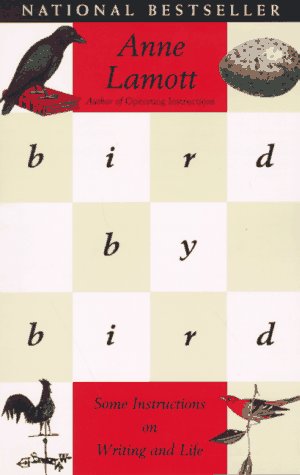
Bird by Bird by Anne Lamott

I also remember a story I know I've told elsewhere but that over and over helps me get a grip: thirty years ago, my older brother, who was ten years old at the time, was trying to get a report on birds written that he'd had three months to write, which was due the next day. We were out at our family cabin in Bolinas, and he was at the kitchen table close to tears, surrounded by binder paper and pencils and unopened books on birds, immobilized by the hugeness of the task ahead. Then my father sat down beside him, put his arm around my brother's shoulder, and said, "Bird by bird, buddy. Just take it bird by bird."

Such is the wisdom of Anne Lamott's Bird by Bird, a book on writing. It is a very good book; through a strange little quirk of fate it a much more widely read book than any of Lamott's novels, which is an irony I'm sure not lost on her.

I had to read this for my creative writing class, and, while it's fairly short on how to write--style and grammar and plot and shit like that--it is heavy on inspirational material, on why you ought to write and how to make yourself do it and how to get in the right frame of mind for a writer. If you are a writer, chances are it will make you want to write; if you are not a writer you will probably be confused by how little concrete information it offers. But that's not really what it's about. It's really more like a book written by someone enamored with books, who really loves writing and wants to share exactly what writing does for her. People with the same enamoration will relate, and Lamott's prose is simple, fluid, and at times hugely funny.

If you want to write, I recommend it--it took me only a couple of hours to read and it really rejuvenated my desire to write. I leave you with Lamott's advice on writing about your ex-spouse:

Make yourself the first wife or girlfriend, not the third wife, and do not include his offensive children, especially the red-haired twins. If you disguise this person carefully so that he cannot be recognized by the physical or professional facts of his life, you can use him in your work. And the best advice I can give you is to give him a teenie little penis so he will be less likely to come forward.

Catch-22 by Joseph Heller

"Sure, that's what I mean," Doc Daneeka said. "A little grease is what makes this world go round. One hand washes the other. Know what I mean? You scratch my back, I'll scratch yours."

Yossarian knew what he meant.

"That's not what I meant," Doc Daneeka said, as Yossarian began scratching his back. "I'm talking about co-operation. Favours. You do a favour for me, I'll do one for you. Get it?"

"Do one for me," Yossarian requested.

"Not a chance," Doc Daneeka answered.


Catch-22 is like no book I've ever read and I doubt like any book I'll ever read, and that includes the sequel, Closing Time. It has a certain kind of manic logic that props itself up, a logic that is both its form and its subject matter, that mirrors the absurdity of life and yet is something else entirely. It is sometimes hilarious and sometimes horrible and often both. I must say I am in awe of it.

The hero of Catch-22 is Yossarian, an army bombardier on the island of Pianosa. Yossarian is terrified of dying, and being a bombardier is not a good profession to have if you have a terrible fear of dying. Compounding his problems is the fact that his commanding officer, Colonel Cathcart, keeps raising the number of required missions before Yossarian can be sent home. But, of course, any sane person does have a fear of dying, and that's Yossarian's problem: If he were insane--and he goes to great lengths to prove that he is--he could be grounded and not made to fly any more missions. But if he has to ask to be grounded, and if he does, it's proof of his sanity, and so he won't be grounded. That's a hell of a catch, and in fact, the army has a name for it: Catch-22. It's the perfect example of that "manic logic" on which this novel thrives.

The book is populated with a colorful cast of B-characters, including:

-Major ------ DeCoverly, whose countenance is so frightening no one has asked him his first name. When Yossarian moves the "bomb line" on a map of Bologna so it will seem as if American forces have already triumphed and the squadron won't have to bomb the city, DeCoverly is sent to procure apartments for the enlisted men and "disappears."

-Major Major Major Major, whose name is a particularly unfunny joke perpetrated by his father and whose rank is a joke perpetrated by the military computer.

-Clevinger, who disappears in the middle of a cloud.

-Doc Daneeka, who has Yossarian put his name on flight records so he can get his flight time. When a plane that lists Doc Daneeka on its flight register flies into a mountainside, all the officers refuse to acknowledge Doc Daneeka because he's dead. His wife remarries and moves to Lansing.

-Milo Minderbinder, who volunteers for the position of mess officer. Through a number of capitalist ventures, Milo parlays the position into a national syndicate that dominates world trade. Even the Germans contract with Milo to bomb his own airfield, but he gets out of a court martial by explaining how capitalism is part of the American spirit.

The whole thing is told in a broken order that doubles back on itself over again, which is difficult to read but, ultimately, that makes sense in a novel where causality and reason are such fickle things. To add to the confusion, Heller often switches between scenes without breaking paragraph as a stylistic tool. This is a novel that requires close reading, but is also very, very rewarding. In particular, it has a dark sense of absurd humor that I think many people on this blog would find satisfying. Highly recommended.

Thursday, February 7, 2008

Art Garfunkel: A Reading Machine

I was talking about the 50 Books Project, as I am wont to do, one morning over breakfast with Dr. Peter Wood, one of the professors helping to develop the museum exhibit on which I am working. A couple of days later he sent me an article from the New Yorker about Art Garfunkel's book list. You can check out what he has read, as well as his favorites -- of which Zen and the Art of Motorcycle Maintenance is one -- at his official website.

http://www.artgarfunkel.com/library.html

Tuesday, February 5, 2008

Franny and Zooey by J. D. Salinger

Catcher in the Rye is one of my favorite books. So I figured I should probably try out some other works by Salinger. This book is split into two unequal parts. The first, entitled 'Franny' takes place mainly in a restaurant. Franny, whose name we find out later is Francis Glass, has come to visit her boyfriend, Lane, at the college he attends. Franny and Lane bicker over things of a trivial nature throughout dinner. He is somewhat pompous. She is somewhat annoyed at his pomposity. Franny seems to be slightly ill -- not touching her food, looking unusually pale, etc. She begins to describe this book that she is reading. It is about a man that is on a spiritual journey, which essentially entails repeating over and over some variation of, "Jesus, have mercy on me." Franny appears to be rather enamored with this man and his religious quest. The section ends with her fainting dead away in the restaurant and coming to on a couch, staring at the ceiling.

In the much-longer section, 'Zooey', we find out that Franny is the youngest member of the Glass children. The second youngest: Zachary, commonly referred to as Zooey. We find out more about Franny in this section than in the first. Her age. Her feeling about school. Her family life. Both Franny and Zooey feel that their eldest brothers had a detrimental effect on them. They were funnel fed all sort of esoteric knowledge as young kids, leading to their regularly appearing on the radio show, It's a Wise Child. This section take place in the span of a couple of hours at the Glass house. Zooey, a fairly accomplished 25-year-old actor living at home, is getting ready to meet someone for lunch. Franny is lying on the couch, apparently have some sort of spiritual nervous breakdown.

Franny and Zooey has very little plot, but rather driven by its true-to-life dialogue. Salinger's writing is clear, insightful, and organic. I really liked the sentence, "Zooey suddenly, sharply, turned around, without taking his foot off the window seat, and picked up, snatched up, a match folder that was on his mother's writing table."

There is a section where Zooey is talking about possibly going to France for a movie. "But I'd hate like hell to leave New York. If you must know, I hate any kind of so-called creative type who gets on any kind of ship. I don't give a goddam what his reasons are. I was born here. I went to school here. I've been run over here--twice, and on the same damn street. I have no business acting in Europe, for God's sake."

While I like what I have read of Salinger so far, I find it intriguing that he was so good at tapping into 20-something angst. After all he was in his forties when he wrote these stories.

I have been thinking about the ending of this book for quite a while now, and I don't think I am any closer to really grasping it. I have, however, come to the conclusion that my liking the book is not predicated on my fully understanding the ending.

Monday, February 4, 2008

Things Fall Apart by Chinua Achebe


I couldn't put this book down but I don't know that I like it, either. The characters and their circumstances were so alien to me that I had to know more. I suppose that's because Things Fall Apart is set in Nigeria during the 1880s and the characters are all apart of the Ibo culture. I found the anthropological type tidbits more interesting than the story line itself. While this is a work of fiction, of course, this book is arguably the most wide read dipiction of African life that has been written by an African instead of someone looking in from the outside.

Spoilers, kind of.

When the book opens, the reader is introduced to Okonkwo and his family, which consists of three wives and their children. Okonkwo was born to one of the biggest failures in his village and ended up winning his own fame first through wrestling, and then through hard work and the accumulation of yams, which was both one of the village's main dietary staples and a way to show status. Unfortunately, Okonkwo's determination is as much a flaw as it is a strength. The plot follows him as he struggles with his masculinity, upholding his reputation, incurring the wrath of the clan accidentallys, exhile, and a return to a village completely changed by Christian missionaries.


The most interesting part of the book to me was the subplot of Okonkwo's favorite child, Enzima, the girl with the spirit of a boy. Enzima is believed to be an ogbanje child, a child who is locked into a cycle where they are born, die shortly after, and are reincarnated to torture their parents with the loss of a child again and again. Enzima's mother, Ekwifi, has gone through the loss of many a child at this point and Enzima is her only surviving child. Even though Enzima is ten at the opening of the book, her frequent bouts of illness have her mother convinced the daughter she loves and spoils so much is an evil trickster out to break her heart again. Even though she is Okonkwo's favorite as well and is the only one that can calm him when his temper flares, she shares her secrets and with her mother. There are endearing scenes were Ekwifi hides Enzima so that she can eat eggs (which are their greatest delicacy) without being caught and reprimanded, ect.

The second and third sections of the book were primarily about what happened to the Ibo group when they were introduced to the white missionaries, and then the self serving District Commissioner and his government. While I believe in God, I think it's important to point out that even the most loving and well intentioned missionaries introducing monotheism to a group like this could be considered an extremely destructive act in some ways given that theheir culture was built around polytheism with a hierarchy of gods, polygamy, and agriculture. The first missionary, Mr. Brown, has a man willing to learn about their culture and compromise. The second missionary was full of wrath and heavy handed, expecting complete assimilation to his ways and beliefs immediatley. The thing that got me the most about him was that he kicked some of Mr. Brown's flock out of the church because they couldn't yet grasp the concept of the Trinity. I think that's a hard enough concept to wrap one's head around without a language barrier between you and the person doing the explaining, but for two men speaking different languages, interpreter or not, I'm sure that would be almost impossible.

I wasn't pleased with the ending, but at the same time I don't know how Okonkwo's story could have ended any other way.

Sunday, February 3, 2008

A Dog about Town by J. F. Englert

This book was the epitome of an impulse buy for me. I went to the bookstore to buy the new translation of War and Peace, but opted for a Tolstoy short story when I realized that the new War and Peace was not yet in paperback. As I was walking to the front to checkout, the cover of this book caught my eye. It was such a vivid and realistic painting of a dog in a smoking jacket, that it made me smile. These words appeared underneath the title, "Meet Randolph. A dog like any other dog -- but with a nose for murder..." I picked it up at once.

A Dog about Town is narrated by Randolph, a black lab who lives with his owner, Harry, on the Upper West Side. Randolph realizes that he is much more sentient than other animals that he meets. He doesn't know why this is, and while he may have found it intriguing at some point, he has long since stopped worrying about the origins of his advanced mental faculties. He does not talk, walk on his hind legs, or wear clothes (despite what the cover art may suggest). He does, however, read. The Times, The Post, and various magazines left out on the coffee table are all part of his diet. However, he has a particular affinity for Dante Alighieri. He alludes to, and quotes from Dante's Divine Comedy quite often. The title of one chapter is "A Diversion into Dante". While this is inherently funny, it does not lack insight. Afterall, in dog years, Randolph is somewhere in his mid-fifties.

The book opens with Harry returning from a seance at which someone died. Actually, not just someone, but the well-known writer, Lyell Overton Minskoff-Hardy. The circumstances of Overton's demise hint ever so slightly at foul play. As Harry is absentmindedly relaying details from the evening, Randolph starts to see some connections between Overton's death and the disappearance of Imogen, his first master, and girlfriend of Harry. Using his keen sense of smell, which he describes as being 100,000 times more acute than that of a man, Randolph sets about trying to solve not only the mystery of Overton's death, but of the disappearance of Imogen. Since he is "just a dog," solving this mystery entails leading Harry toward clues and steering his thinking in the right direction. This is where Englert gets especially creative.

For a murder mystery about a dog, the writing was surprisingly good. Englert has meaningful insights about life. Here is a passage where one of Harry's friends is talking about unrequited love:
I was in love. I'm still in love. Where Iris is concerned I can't see too clearly. A note of hers about a radiator leak could end with affectionately yours and I would spin for weeks, imagining a romantic breakthrough. If she forgot to punctuate, I would see something in that. It was hope that got me here. Hope that she would cross the street one day and say that she was mine. Hope that she was keeping an eye on me for all those years. But as time went on, I began to accept that she was indifferent.

Much of the book is predicated on the notion that Randolph's nose is better than Vincent Donofrio's Law & Order character. For example, "My olfactories were overwhelmed by the sharp odor of anxiety, confusion and the subtle, creeping scent of imagined guilt." I have no idea if dogs can smell "imagined guilt". To be honest, I don't really care. It worked for the purposes of the book. Another reason that A Dog about Town worked for me is that despite his detecting skills, Randolph never lost his innate canine qualities -- sleeping twelve hours a day, peeing on the sidewalk, rolling around in filth, etc.

I started reading this book on a plane to New York, and as coincidence would have it, the hotel that I stayed at was right in the midst of the area in which this book was set. I would come home from eating somewhere on Amsterdam Avenue and read about Randolph and Harry walking right past the place I just was. So that was kind of weird.

Saturday, February 2, 2008

The Subtle Knife by Philip Pullman

The Golden Compass closely followed Lyra Belacqua. I don't think there were any chapters in which she did not appear, if there were, they were few and far between. The Subtle Knife, the second book in the trilogy, does not follow suit. It opens with a fairly lengthy chapter about a young boy named Will Parry, whose mother has some serious cognitive disabilities that require him to look after her. His father, although alive, is not in the picture. It is not clear what happened to him. Will gets an elderly neighbor to watch his mom for a few days, because he "has something to do". Upon returning to his empty house, he is attacked by to men, one of whom he unwittingly kills. As he is on the run, he notices a cat acting weird and then leaping forward and simply disappearing. He approached the area where the cat was, and realizes something is not right. He steps forward, through a "window" into another world.

At the end of The Golden Compass, Lord Asriel -- whom Lyra discovers is her father -- has opened up a "bridge" between worlds. The idea is that there are many worlds that inhabit the same space -- Earth. While there are similarities among these worlds, they have major differences as well.

Will and Lyra meet in a world that is strange to the both of them, in a town called Cittagaze, a town that appears to be inhabited solely by children. It turns out that the adults have fled the town because of specters that suck the souls out of adults, but pass right over children. Lyra starts to notice some connectivity between her world, this one, and Will's. Her daemon, Pantalaimon, is comparable to what Will would describe as his soul or conscience. The elusive dust, which played such a big part in the first book, closely resembles original sin. Lyra comes to the realization that she must help Will find his father, an arctic explorer who inexplicably disappeared with his group a few years back.

The subtle knife turns out to be a implement that allows one to cut windows into other worlds. However, it chooses its owner in a rather gruesome way. The knife chooses Will, and along with Lyra they set out to find his father. My question is, if there are countless "worlds" on Earth, what controls what world one cuts into? This is never really explained, as Will and Lyra seem to stay within three or four worlds throughout the book.

Compared to the first book, this one is complex. There are many more characters, and the plot is much more complicated. Everyone always says that the Harry Potter series gets more grown-up with each book. This may be true, but the His Dark Materials trilogy easily trumps the Rowling series in this aspect. Will spends the better part of the book bleeding profusely. People die left and right, including principle characters. There is a noticeable degree of sexual tension between Lyra and Will. And it becomes apparent about halfway through the book that many of the main characters are attempting to wage a war against God himself -- referred to as The Authority. It is not clear which side of this battle Will and Lyra will fall on, but I suspect that they will join those fighting The Authority. I find this concept interesting, and rather crazy for a children's novel. I have heard that the next book, The Amber Spyglass is even darker, weirder, and more complex. I am really curious whether Pullman can finished this series in an effective and satisfying way.

Friday, February 1, 2008

The New Testament in Modern English translated by J. B. Phillips

Greetings my fellow book-bloggers! Today is the day I cease being the guy with zero books…we are actually going to celebrate here at my house later this evening.

I confess to having had some feelings that verged on resentment to Carlton’s totally unfounded claim that the Casefiles are in some way “light” reading. It is entirely out of spite that I have decided to scupper my plan to read the thrilling and often baffling adventures of Frank and Joe Hardy. There’s always next year.

J.B. Phillips spent 14 years working on what eventually became an entire translation on the New Testament in Modern English. He began translating the epistle of Colossians as a way to pass the time spent in the London underground stations during World War II air raids. As a young Anglican pastor working with young people he sensed the need for a version of scripture that was more accessible and relevant to their lives. The effect that his early work had on his youth group, combined with some encouraging words on the translations from C. S. Lewis spurred Phillips to complete his translation in 1958.

I really enjoy reading Phillips’ version. I tell people that his goal was to make scripture read as if it had been written in our time, to people like ourselves. However, he works to achieve this without sacrificing a strong adherence to what the original language text actually reads. I feel that he managed to get the mixture of modern language and literal interpretation just about right. A good translation to pick up if you are bored with the version of scripture you normally use or if you haven’t read the New Testament in awhile.