
Friday, May 11, 2007
Chihuahuas by Richard Miller and Diane Morgan

For Men Only by Jeff Feldhahn
For Women Only By Shaunti Feldhahn
Tuesday, May 8, 2007
Born on a Blue Day by Daniel Tammet
 Born on a Blue Day is a memoir of an autistic savant. I heard of Daniel Tammet a few years ago, although I don't know that I ever knew his name. I heard on the news that some guy had recited the number pi for a little over 5 hours. He had memorized and recited 22,500 digits, setting a new world record. A couple of months ago, 60 Minutes ran a special on Daniel. What makes him unique among savants is that he lacks most of the debilitating problems that savants usually have. I was extremely interested in this guy, and so I was excited to hear that he had a book coming out.
Daniel's discussions about math and how he visualizes numbers were detailed and interesting. Synesthesia, a neurological condition in which two or more sense are coupled, informs how Daniel thinks about numbers and is the key to his mathematical abilities. But these abilities are only a small part of the book.
Born on a Blue Day is written in a very straightforward manner. Because of this, there were times when it reminded me of The Curious Incident of the Dog in the Night-Time. However, there are not many linguistic flourishes. But it is quite interesting. I was intrigued by Daniel's thoughts on languages, and how he is able to learn them so quickly. He learned Icelandic, which is considered to be an extremely difficult language, in one week.
Daniel has amazing insights into his childhood, and what growing up with Asperger Syndrome meant on a day-to-day basis. I enjoyed seeing the ways in which he learned to cope with Aspergers and eventually lead a very fulfilling life.
Sunday, May 6, 2007
Water for Elephants, by Sara Gruen
 Well, it had to happen eventually. Reading as much as I have been lately, I was bound to run into a book that was a disappointment, and Water for Elephants is it. I guess spending several weeks in the New York Times bestseller list, being talks for a movie, and being selected by various book clubs is no guarantee of quality.
 Water for Elephants has a premise that I found quite interesting. Jacob Jankowski, a young man studying at Cornell to be a veterinarian, has his world turned upside down his his parents are killed in an automobile accident. Finding himself penniless, he quits school and joins a traveling circus in the Depression-era 1930s. Once in the circus, he meets all manner of madcap characters, from the ruthless uncle Al, to the half-crazy animal trainer August, to his beautiful wife Marlena, and all kinds of kooky freaks and weirdos in between. It's told from the viewpoint of Jacob, now ninety (or ninety-three), who lives in a nursing home and lives off his old memories. Sounded interesting to me, and, in fact, the first half of the book is quite riveting with its details on the practices, slang, and folklore of the traveling circus. Also, Sara Gruen is quite attractive for an author. No offense, Danielle Steele.
Unfortunately, once the main storyline begins, the book heads steadily downhill. It devolves from interesting period piece to bland soap opera fairly quickly, with one implausible action building upon another until the story reaches a climax that manages to be both unbelievable and predictable, quite a feat. And, actually, the ending to the elder Jacob's story is no more believable or satisfying. Another problem, one that doesn't become clear until the characters are all introduced, is that they all sound pretty much the same. It takes some special gift to make a ruthless ringmaster, a schizophrenic, a stripper, and a bitter dwarf sounds identical, but Gruen pulls it off with aplomb.
It's not to say that I hated the book. As I mentioned, the circus stuff was all pretty interesting, and I think there's probably a great book to be written on the topic. Unfortunately, Water for Elephants isn't it.
The Revival We Need by Oswald J. Smith
This is the first of two books I'm posting that I've read during my daily devotions, although this one fits more snugly into the category of devotional literature than The Screwtape Letters (the second).
It's not a particularly easy book to review, since, divorced from the context of devotional literature, it probably doesn't sound particularly interesting. It was written in the early 30s, and is essentially a chronicle of the author's desire to see a fresh movement of God in his church. The opening chapters of the book are a bit more general, focusing on the steps that Christians should take to ensure revival. These include the expected steps of prayer, fasting, and self-examination. There are also many quotes from the biographies of various revivalists such as Charles Finney and John Smith. The second half of the book is a collection of entries from author Oswald J. Smith's journal, detailing his own experiences following the guidelines he sets down in the first half.
As devotional literature, I found it inspiring. In addition, there is some historical interest in it as well, although if you're interested in the early revival movements in the United States, there are books that go far more in depth.
Friday, May 4, 2007
A Year in Provence by Peter Mayle
 This is good, simple travel writing. A Year in Provence is part satire, part cookbook, part narrative and part guide. Mayle and his wife moved to
 Through the open door we could hear the croaking of our resident frog, and the long, sliding song of a nightingale. We took a final glass of wine outside and looked by the light of the moon at the new lavender bed while the dogs rooted for mice in the
Mayle and his wife live in the Lubéron, a Provençal mountain range, supposedly out of the way of so much of the
He describes so well such a simple, idyllic lifestyle that I wonder, and hope against, how much change the region must have gone through in the past 18 years. But Mayle is very impersonal, and, for that reason, Bill Bryson is still my favorite travel writer. Where Bryson really helps you relate to him, and see experiences through his eyes, Mayle keeps the reader at arm’s length. The book is minimal on dialogue, at least on Mayle’s part, and relies more on observations and briefly summed up conversations. It’s a quick read, and often very humorous, as only an outsider’s perspective can be. You could probably get through it on a slow afternoon if you wanted too, and it’s definitely worth the time.
Thursday, May 3, 2007
Ant Farm by Simon Rich
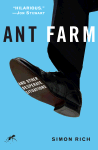 Ant Farm and other desperate situations is a collection of humorous mini-essays that Rich originally published in The New Yorker. They range from "if life were like middle school" to "sultan of brunei" to "a conversation between god and the man in the football helmet and a speedo who's always shouting things next to the a & p."
when small talk goes wrong:
--Hey, you look familiar. Have we met?
--Oh my God, I've gained so much weight that you don't even recognize me. This is the single most humiliating experience of my life. We dated for seven years.
It's really short and it's really funny. That's about all there is to it. John Stewart says it's "hilarious," so it must be. Actually, I had to force myself to stop reading it on the bus because I kept giggling and then feeling all self-conscious. It's a breeze to read and it will pick you up when you're feeling down! Also, I'm going to keep counting tiny little books as long as Nathan keeps counting his "graphic novels."
Wednesday, May 2, 2007
Buddha by Osamu Tezuka

I'm going to keep using graphic novels until I can no longer justify it with the fact that I read long novels.
This was awful. I’d heard of this series a while back, heralded as an exemplary, powerful graphic novel representation of the biography of the Buddha. Tezuka is supposed to be the father of Japanese graphic novels. If that’s true, I have no desire to read any Japanese graphic novels.
He wrote Buddha when graphic novels were still mostly a children’s medium, so it’s annoyingly juvenile. There’s a lot of humor that you’d expect from a Saturday morning cartoon. The story consisted of very loosely linked episodic plots, and only just began to talk about the Buddha. There are six more volumes that I don’t plan on reading. Just when I’d expect it to develop into a mature novel, someone would get hit in the crotch with something. A lot of stupid anachronistic jokes, like a pack of cigarettes falling from a monk’s pocket, a yeti, and a cameo appearance by the author (in doctor uniform) don’t quite make this the “insightful, amazing” work that was promised.
The only redeeming quality about the art was the few landscape scenes. These were truly impressive. For everything else, anatomy was way off, faces were amateur and inexpressive, and I’m pretty sure I’ve never seen a horse do a front flip, especially not with a rider on its back.
Bad art aside, I wondered if maybe it was the translation that made this book so bad, until I came to this wonderful piece of work:
“Look… heh, heh, we’ve been pierced through. But it’s better like this… skewered together… don’t you think, mother?”
“We’ll never be parted again… never…”
There is no language on earth that could keep that from sounding stupid.
If you promise not to tell anyone that I read this, I promise not to make you read it.
A Portrait of the Artist as a Young Man by James Joyce
 This book is largely autobiographical, and Joyce invents Stephen Dedalus, whose name I love, to play the role of himself. The name comes from the Catholic Saint Stephen and the pagan legend Dedalus. This juxtaposition perfectly characterizes, and foreshadows, a lot of the internal struggle that Dedalus goes through in the novel. He alternatively devotes himself to and draws away from what he ultimately comes to view as the narrow-mindedness of Irish-Catholicism. Though it isn’t stream of consciousness, like I’d been told, the novel mostly follows Stephen’s internal musings (in the third person), and the occasional dialogue with another, very minor, character. Stephen is the only character that really gets any room to grow in the book, and others come and go without fanfare whenever they prove useful to some point in his development.
 The story follows Dedalus from birth to age 22, usually skipping a few years between each episode. He grows up, over about 300 pages, from a schoolboy in rural
What did it mean? Was it a quaint device opening a page of some medieval book of prophecies and symbols, a hawk-like man flying sunward above the sea, a prophecy of the end he had been born to serve and had been following through the mists of childhood and boyhood, a symbol of the artist forging anew in his workshop out of the sluggish matter of the earth a new soaring impalpable imperishable being?
Dedalus struggles against Irish culture at a time when Irish nationalism was gaining popularity. He’s initially embarrassed by his people’s history, their language and their religion, which is another thing that he slowly comes to terms with. Joyce left a lot of pieces of the story to be filled in by the reader; a lot of important events in Stephen’s life are only vaguely alluded to in the narration of his train of thought. Also the reader is subjected to a miserable thirty pages of fire and brimstone sermon, and, later, another equally miserable thirty pages of philosophical discourse on the aesthetic. There’s a lot to dig through, but there’s also a lot to say about personal growth, and “finding yourself.” I’ll bet it spoke volumes to the Irish in the early 1900’s. I, unfortunately, cannot identify myself as such, but thoroughly enjoyed the book.
Note: I’d recommend this version (pictured at the top of this review), published by Penguin, with a black cover and a picture of Joyce, for its great introduction and tremendously helpful notes in the back. I, regrettably, bought the shittier version, and had to borrow a friend’s to find out what doing something “for a cod” meant (it does not mean doing something in order to get a fish, as I had previously assumed).