Showing posts with label survival. Show all posts

Wednesday, February 8, 2012

Island of the Blue Dolphins by Scott O'Dell

For a long time I stood and looked back at the Island of the Blue Dolphins. The last thing I saw of it was the high headland. I thought of Rontu lying there beneath the stones of many colors, and of Won-a-tee, wherever she was, and the little red fox that would scratch in vain at my fence, and my canoe hidden in the cave, and of all the happy days.

Island of the Blue Dolphins is a young adult novel about a young girl, Karena, who is left alone on a small island after her tribe, decimated by Aleutian fur traders, leaves for the mainland. It is, of course, a Robinson Crusoe-esque tale, which, outlandish as it sounds on paper, is actually based on the true story of a woman discovered alone on an island in the late 18th century. Unlike Karena, who narrates the novel, this real life survivor was unable to communicate with her rescuers, and so died with her island years still a mystery.

Island is a classic, but it left me a little cold. I appreciate survival stories, which is why I was interested in the first place, and I like young adult literature reasonably well, so I was a bit surprised at my neutral reaction. I can’t say exactly what was unappealing to me, but I suspect it had more to do with tone than anything. It's not really an adventure novel, like the premise leads one to suspect. Instead, it’s a thoughtful, slow-moving meditation on nature, solitude, companionship, and death.

This isn’t bad, of course—most of my favorite novels wouldn’t be described as adventure stories either—but I think I just came to the book too late to truly appreciate it for what it was. The themes it explores, while certainly worthy and meaningful, may not be extremely common in young adult fiction, but they make up the thematic material of a ridiculously large amount of adult novels. And, though it isn’t fair to compare, Island didn’t measure up to the other, more complex novels with which it shares its DNA.

Does this make it a bad book? Not at all. I didn’t dislike it, but I didn’t feel compelled to pick it back up once I put it down either. Call it unjust, ridiculous, whatever—for better or worse, Island of the Blue Dolphins is young adult literature best read by actual young adults.

Bonus: Best review on Amazon.

Tuesday, December 15, 2009

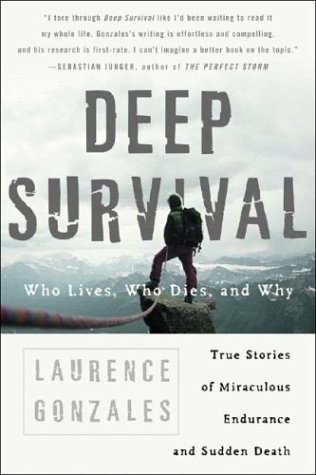
Deep Survival by Laurence Gonzales

After breaking his leg on a 20,000-foot peak in the Peru during a blizzard, Joe Simpson was given up for dead. Without food or water or a tent, he spent six days crawling off the mountain and back to camp. How did he do it?

As the skipper of a sunken yacht slipped over the side of his life raft into the Atlantic night, his four horrified crew members heard him calmly explain, "I'm going to get the car." Then they listened to his screams as he was eaten alive by sharks.

This book is pretty BAMF. You can tell just by looking at the cover - it has two subtitles in addition to the main one - "True Stories of Miraculous Endurance and Sudden Death" and "Who Lives, Who Dies, and Why." Too much much bad-ass-mother-fuckery for just one subtitle. If the two subtitles don't suck you in, the hook on the inside cover, excerpted above, certainly will. This book reminded me of paging through my grandmother's old Readers Digest magazines, looking for the story every month that featured lightning strikes or killer crocodiles. I used to eat those stories up. An entire book of those stories, compiled into one nifty volume for the pleasure of my vicarious excitement? Man eaten alive by sharks? Sign me up.

No matter that Laurence Gonzales writes like a high school newspaper reporter - replete with cursing, exclamation points, and useless adjectives like "stupid" to describe harrowing situations - the stories he tells make up for it. Mostly. There's the story of Joe Simpson described above, whose climbing partner actually cuts his belay rope and lets him fall off a mountain to save himself. And Simpson survived. There's the story of Steven Callahan, who set out to cross the Atlantic in his boat and was struck by a whale just a few days out. He spent 65 days adrift crossing the Atlantic on a life raft, catching fish and drinking 1/2 a pint of water per day until he ran into a Caribbean island on the other side. He lived too. And finally, there's the story of Gonzales' own father, who was shot down over German territory in 1944, survived having every limb broken and his nose cut off, and then survived being a POW for several months until liberation, losing over 50 pounds in the process. There are also stories about the people that didn't survive - people like the poor guy above, deluded by a sodium overload in his brain (caused by drinking seawater) into thinking he was back at the dock when he was really in the middle of the Atlantic.

Okay, Gonzales also has this rather annoying habit of inserting stories about himself into every other paragraph. Dude's done some crazy stuff. He flights plane acrobatics; he's been to Ranger school; he dives, he climbs, and he once sensed a major jet crash was imminent and got off the plane, Final Destination-style. I think he wrote this book partly as a vehicle to talk about the stuff he's already done and partly to have an excuse to do more stuff like go to Mountain Survival School and interview extreme alpinists.

The thesis of "Deep Survival" is that some people have it in them to survive and some do not. The question is largely mental, but can be affected by experience and emotional stability too. The book is broken into two parts: How Accidents Happen (systemic failures; accidents exist as a key part of any system and there is nothing to do to stop them - but you can make sure you are not involved when they happen) and Survival. The second half was definitely more engaging and interesting to me. It had all the stories I had been waiting for when I first read that glorious teaser on the inside book cover.

I'm really into disasters and survival stories, so I was willing to overlook this book's obvious flaws. If you are easily angered by overzealous writing, don't read this one.

Monday, July 20, 2009

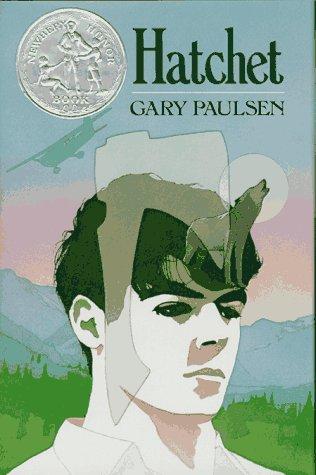
Hatchet by Gary Paulsen

Destroyed.

The word came. I would have been destroyed and torn and smashed. Driven into the rocks and destroyed.

Luck, he thought. I have luck, I had good luck there. But he knew that he was wrong. If he had had good luck his parents wouldn't have divorced because of the Secret and he wouldn't have been flying with a pilot who had a heart attack and he wouldn't be here where he had to have good luck to keep from being destroyed.

If you keep walking back from good luck, he thought, you'll come to bad luck.


I wanted to read Hatchet because I was a big fan of Dogsong, which I thought stood out as one of the best pieces of YA fiction I'd ever read. Hatchet is cut much from the same cloth: it is essentially about a boy having to survive in the wilderness, and through that survival he comes to what I suppose you could call manhood, or at least a greater understanding of himself and his world.

In Dogsong, the main character was trying to recover a way of life lost to his Eskimo kin; here in Hatchet, survival is an unwelcome necessity: Brian Robeson is on his way to visit his father in the Canadian oil fields when the pilot of the single-engine plane carrying him has a heart attack and Brian is forced to land the plane in a lake. All Brian has with him is a hatchet, with his mother--quite fortuitously, I might add--gave to him for his birthday. He also carries with him, in the metaphorical sense, a Terrible Secret that actually turns out to be a Pretty Banal Secret: He saw his mom kissing another man, which he knows (but his father does not) is the reason for his parents' impending divorce.

That causes him some added discomfort at the lake, but soon it fades into the background as Brian is forced to learn how to survive on his own--he quickly figures out how to forage for berries, and through a long, painstaking, incremental process figures out how to use the hatchet to build shelter, start a fire, catch and cook food. By the end of his ordeal, which lasts for a couple of months, Brian is a tanned, fit survival expert. It's like Survivor Man for the tween set.

There was a mystical element to Dogsong that helped it transcend its genre; Hatchet could have used something similar. What Paulsen accomplishes--a gripping YA book almost completely without dialogue--is arresting enough, but it seems awfully plain in the other novel's shadow. Its most glaring flaw is the awful subplot about Brian's parents and their divorce, which is completely useless, wisely dropped early on, and never resolved--only briefly referenced in the postscript. Still, it has a pretty solid pedigree as a YA book; but as I told Brent, don't waste your time if you haven't read Dogsong, which is its superior in every way.

Saturday, July 4, 2009

A Walk in the Woods by Bill Bryson

After finishing Into Thin Air, I needed to read something a little less harrowing. Sure, nature can be scary, but there have to be a few great pursuits that anyone with a little free time and a backpack can do, right? I picked up A Walk in the Woods because the premise sounded interesting and because Bill Bryson is a pretty amusing dude. I wasn't disappointed.


A Walk in the Woods follows Bryson and his friend Katz, an overweight, outgoing loudmouth, on their attempt to walk the entirety of the Appalachian Trail. The A.T. is a huge undertaking, 2,100 miles from Georgia to Maine, requiring 6-8 months, lots of food, and some good boots. Bryson and Katz start out as complete amateurs and end feeling like grizzled mountain men.


Although the trail itself was very interesting, some of the anecdotes not directly related were most interesting to me. For example, there's a town somewhere in the States (I can't remember which state and don't have the book handy) where, 80 years ago, a coalfire began underground. The heat caused the ground to begin cracking and collapsing, eventually turning Coalville into a vertual ghost town. The fire is still burning beneath it, and a few hearty souls still live there.


I don't really know what to say about this book. I enjoyed it and it had something of a surprise ending (SPOILER: They quit before the end of the trail), but mostly what I got out of it was an appreciation for nature and for the scale of the United States. Unlike Into Thin Air which probably put me off mountain climbing forever, A Walk in the Woods made me want to take a hike myself. Anyone want to be Katz?

Into Thin Air by Jon Krakauer

I read this book on a dare from Reinhold Messner. We were shooting the breeze one evening and he told that not only was I incapable of climbing Mt. Everest myself, I was probably incapable of even finishing a book about someone else's expedition. I took him up on this challenge, and while he was out climbing K2 for the fiftieth time, I read Into Thin Air.


I'm not a survivalist by any stretch of the imagination, but the first half of Krakauer's book, a true account of one of the most deadly ascents ever attempted on Everest, I was ready to go to base camp myself. The narrative follows Krakauer all the way from preparation until the disastrous denouement of the trip, when the majority of both parties on the mountain, including two of the most experienced climbers in the world, died as a result of an unexpected storm near the peak. There a little bit of dishy stuff, including some pretty direct criticism of some of the other climb leaders, but for the most part, Jon sticks with the narrative and the overarching theme: nature is dangerous and is not to be messed with, no matter how much experience you have.


By the time I finished reading, I'd completely lost any interest in climbing Everest myself. Messner returned from K2 and I filled him in. Of course, he just laughed. He's actually kind of a jerk. This book, however, was great. I recommend it.

Friday, December 12, 2008

The Life of Pi by Yann Martel

I have a story that will make you believe in God.

To choose doubt as a philosophy of life is akin to choosing immobility as a means of transportation.


The Life of Pi is narrated by young Piscine (“Pi”) Patel. His family flees India and its unstable politics, and heads for Canada, taking with them all the animals from their zoo. En route, a storm hits their bot and it sinks, leaving only Pi, a hyena, a zebra, an orangutan, and a huge Bengal tiger afloat on a lifeboat.


The first third of the story covers the time before Pi's family leaves, and introduces us to his interest in world religions. Although raised as a Hindu, he meets with both a Muslim Cleric and a Catholic priest and finds value in those religions as well. When confronted about the contradictions of subscribing to the three widely variant faiths, he replies, simply, “I just want to love God.”


The second third of the story covers the shipwreck and the time following, during which Pi's adventures read like some modernized version of the Odyssey, complete with his own monsters and cursed islands. These episodes are entertaining, and sometimes quite touching, but the book's real payoff (and literary aspect) comes in the last section, when Pi is rescued. He tells his story to the men, the same story that we have been reading ourselves, but his questioners do not believe him, and press him to tell them what really happened. While claiming that his original story accurately reflected events, he bows to their questioning and tells them another, far darker but more believable story and asks them to choose the one they prefer.


That, I guess, is the central question of the book, which story to choose. Rather than making the reader believe in God, The Life of Pi seeks to give a framework under which belief is reasonable. Pi's fantastical explanations of the events (if one chooses believe the second story is the more literal truth) serve as a method for him to cope with the awful things that have happened. In the same way stories about tigers and living islands allow him to look objectively at subjects like the deaths of his parents, God and religion provide a way to look at life's most elemental tragedies—mortality, illness, sadness—and see more than a series of random happenings. Whether or not such a story will really make you believe in God probably depends on how much you can buy into such an amorphous, inconcrete version of a higher power, but it's still food for thought.

Sunday, November 2, 2008

How I Live Now by Meg Rosoff


When I was younger, books sucked me in and held me in a safe place when the world around me seemed like it was about ready to burn itself down. I could live between the pages easily, an outsider watching other peoples’ lives unnoticed, while my own life buzzed around me while I read, oblivious. Since the age twelve or thirteen, though, I’ve not been able to have quite that same relationship with my reading now that my coping mechanisms have at least somewhat improved. The relationship I have with Meg Rosoff’s novel How I Live Now is the closest I’ve come to the relationship I had with the books that I loved when I was younger and hiding from reality. The book didn’t make me feel safe at all—it was quite the opposite, but I could still live inside of it. I read it in one sitting and can’t stop thinking about it now that it’s over.

How I Live Now is a crossover novel that was originally considered standard fiction but is currently also being shelved with young adult fiction. I don’t know if I agree with the inside of my copy that says it is appropriate for ages twelve and up, but what do I know about anything? The novel shook me and made me uncomfortable and took me out of my own life in a way that was terrifying. I don’t know if my middle school self could have dealt with all of the material and the way that it was handled.

If I tried to give you a plot summary of the novel, you would gather that the main character struggled with anorexia and selfishness and cynicism but went through a coming of age in the middle of a future war where the identity of The Enemy was a big question mark and no one even knew what the war was over. You would know that book dealt with incest and the breaking of the taboo in major ways. You would know that there was a touch of magic, a splattering of telepathy, a continual string of events that were either brushes with insanity or out of body experiences that happened because of love and shared consciousness. Giving you the skeleton of the novel in the form of a basic summary would not speak to how chilling the novel was or tell you that Rosoff seems as much like a witch woman as she is a gripping author.

Honestly, I don’t know what to say about the novel at all except that you should read it. As one of my other favorite authors (Mark Haddon) says on the front cover, the novel is “Magical and utterly faultless.”

My last word on this is that Rosoff’s novel is the most original work of fiction I’ve read in a long time, or maybe in my life time. What started off seeming like it would be just another book about an angry and displaced adolescent finding their way turned into something much bigger. I realize that most of you 50 bookers are probably a lot more well read than I am and have read a lot more truly significant novels (whatever that means) than I have, but I feel like this book will probably join the ranks of revered reading and that Rosoff will find her place beside the Atwoods of the literary world over time.

And that’s all I have to say about that.