
 During the time that had ensued between January and that month of March, it had been proved to Katharine Howard how well Throckmorton, the spy, voiced the men folk of their day. He had left her alone, but she seemed to feel his presence in all the air. He passed her in corridors, and she knew from his very silence that he was carrying on a fumbling game with her uncle Norfolk, and with Gardiner of Winchester. He had not induced her to play his game--but he seemed to have made her see that every man else in the world was playing a game like his. It was not, precisely, any more a world of black and white that she saw, but a world of men who did one thing in order that something very different might happen a long time afterwards.
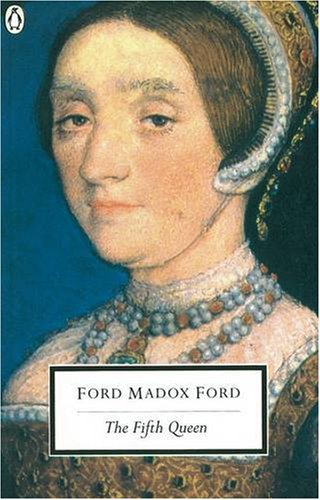
Ford Madox Ford is always good for a misleading title, so it may surprise no one that in The Fifth Queen Kataerine Howard, who will succeed Anne of Cleves as the wife of Henry VIII, never quite makes it to the throne in this, the first in Ford's trilogy. Instead it depicts something not unlike the beginning of the historical Katharine's relationship with Henry. It is true that she was first a lady-in-waiting in the King's court, but in the service of Queen Anne, not the King's daughter, Mary, and it isn't likely to be true that Henry chanced upon her on the palace grounds riding a mule and, dazzled by her beauty and wit, impressed her into that service. Nor was the historical Katharine a virulent Catholic bitterly opposed to Thomas Cromwell, the Protestant standard-bearer and Lord of the Privy Seal:
The face of a queen looked down just above his head with her eyes wide open as if she were amazed, thrusting her head from a cloud.
'Why, I have outlived three queens,' he said to himself, and his round face resignedly despised his world and his times. He had forgotten what anxiety felt like because the world was so people with blunderers and timid fools full of hatred.
Cromwell sees in Katharine an opportunity to plant a spy in the Catholic Mary's service. Katharine refuses, but quickly finds herself embroiled in the shadowy sectarian conflict that rages beyond the King's notice. She withstands the threats and manipulations not only of Cromwell and his spies but Bishop Gardiner, the country's leading Catholic, who she had idolized. She struggles to maintain her honor and honesty against the moralizing of men like Throckmorton, who may or may not be double dealing against Cromwell:
'How shall you decide what is vileness, or where will you find a virtuous man?' he asked. 'Maybe you will find some among the bones of your old Romans. Yet your Seneca, in his day, did play the villain. Or maybe some at the Court of Mahound, I know not, for I was never there. But here is a goodly world, with prizes for them that can take them...'
Katharine soon learns that everyone is after these "prizes"--that is, except the King, who seeks only the prize of her company. Henry is the most intriguing and magnetic character here: impulsive and irascible, yet truly interested in the pursuit of "right doctrine," a notion lost on men like Cromwell and Gardiner, whose beliefs seem to serve only their ambitions. Perhaps his position as king affords him that right, but it is also a position he uses to lift Katharine out of harm's way at the book's finale, realizing keenly that she is a kindred soul.
But The Fifth Queen seems ultimately like a chronicle of lost opportunities. One wonders why Ford saw the need to transmogrify the historical Katharine into a Catholic stalwart if the religious issues were going to be glossed over. The idea of a Renaissance spy novel sounds great, but the intrigue is a muddle. Everything is a muddle, actually; as an early attempt by Ford to achieve an "impressionist" style, which reproduces the world as it is experienced and seen, The Fifth Queen succeeds mostly in making the particulars of action and location very unclear. Its greatest successes are in its population of minor characters, like the womanizing teacher Magister Udal, or the aged but infamous knight Sir Rochford.
On the other hand, as the first book in a trilogy, this can only amount to a half-finished opinion. I have faith in the abilities of Ford, who is capable of sneaking up on you unawares in a way that few authors are, so I hope for more from The Privy Seal and The Fifth Queen Crowned.

