Showing posts with label The Fifth Queen. Show all posts

Monday, October 15, 2012

The Fifth Queen Crowned by Ford Madox Ford

'But to make the King,' Cranmer uttered, as if he were aghast and amazed, 'to make the King--this King who knoweth that his wife hath done no wrong--who knoweth it so well as to-night he hath proven--to make him, him, to put her away... why, the tiger is not so fall, nor the Egyptian worm preyeth not on its kind.  This is an imagination so horrible--'

'Please it be your Grace,' Lascelles said softly, 'what beast or brute hath your Grace ever seen to betray its kind as man will betray brother, son, father, or consort?'

The last book in Ford Madox Ford's Katharine Howard series (1 2), as the name suggests, opens on a scene of victory: Katharine is crowned Henry's queen, and the return of her cherished Catholicism is nigh.  How you read this development hinges probably on your religious affiliation; for me there is something unseemly about Henry's playful needling of the Archbishop Cranmer early in the book about the church's return, especially now that Thomas Cromwell, the Protestant villain of the first two books, has been put to death.  I read in the second book a more ambivalent stance than I was able to find in this one.  What are we to make of a Henry VIII who is only good to the extent that he is Catholic?

Katharine remains the series' moral center, which bodes poorly for Henry's soul, since we know that by the series' end she must be executed.  (Spoiler alert.)  I found the machinations by which Katharine is brought down to be pretty disappointing, although the intrigue was the best part of the first two books.  The death of Cromwell leaves a pretty immense gap that the ambitious knight Lascelles, a pale Cromwell substitute, fails to fill.  In The Fifth Queen Crowned, subterfuge gives way to slander: The courtiers, peeved by the Queen's power and at Lascelles' urging, gin up a lie about Katharine's infidelity with her cousin Culpepper and force Henry's hand.  In the end, she gets a pretty nice speech at the King's expense:

If I have wounded you with these my words, I do ask your pardon... I would have you wounded by the things as they are, and by what conscience you have, in your passions and your prides.  And this, I will add, that I die a Queen, but I would rather have died the wife of my cousin Culpepper or of any other simple lout that loved me as he did, without regard, without thought, and without falter.  He sold farms to buy me bread.  You would not imperil a little alliance with a little  King o' Scots to save my life.


But the book as a whole was neither as fun or nuanced as the previous two.  In the end, I stand by my judgment of the first book: that The Fifth Queen books are Ford still struggling with both what he wanted to say and how.

Tuesday, June 26, 2012

Privy Seal by Ford Madox Ford

"Why, you do love him," the Queen said.   "I have no cause so to do."

Katharine caught at one of her hands.

"Your grace," she said, "Queen and high potentate, this realm calleth out that some one person do lead the king aright.  Before God, I think I do not seek powers or temporal crowns.  Maybe it is sweet to sit in a painted gallery and be queen, but I have very little considered it; only, here is a King that crieth for the peace of God, a people that clamoureth aloud to be led back to the ways of God, a land parched for rain, swept by gales of wind and pestilences, bewailing the lost favour of God, and the Holy Church devastated that standeth between God and the realm."

I enjoyed Privy Seal more than The Fifth Queen, the first book in Ford's Katharine Howard trilogy, though it's not very different.  Probably it was simply easier to read, its characters familiar and not needing to be established, its central conflict--between the Catholic Kat and Thomas Cromwell, Lord of the Privy Seal and Protestant scion--being reproduced wholesale from the first novel.

But I think that I was looking at the entire series with unjust expectations.  I was hoping for a serious account of the Catholic-Protestant divide, which Ford delivers in The Good Soldier, but the Fifth Queen books have more modest aims.  Privy Seal, like The Fifth Queen, is primarily an adventure-and-espionage tale, pulp intrigue pasted over a 16th-Century map.  Sitting down to write a review, I even had trouble remembering--as one does with a "beach read"--what plotline was.

As best I can recall, Privy Seal opens on an England where the King's affection for Kat is an open secret.  Cromwell's worst nightmare is the dissolution of the pact between the King and the Protestant Duchy of Cleves in the Holy Roman Empire.  If the Duchy decides to throw its lot back in with the Emperor, the King's rocky marriage to Anne of Cleves becomes politically useless, and he may divorce her and marry the fiercely Catholic Kat.  Cromwell schemes to have Kat's cousin Thomas Culpepper returned from France, knowing that the impetuous Culpepper would be too stupid to conceal his amorous feelings for Kat at court, exposing her to accusations of carnal immorality.  At the same time, Kat's allies, like the double agent Throckmorton and the lusty professor Udal, scheme to keep Culpepper in France and feed misinformation about Cleves to Cromwell

For her part, Kat tries earnestly, and only partially successfully, to stay out of the fray.  She refuses to take part in the lies, and instead chooses to be straightforward with Cromwell, saying to his face, "Sir, my lord, your servants go up and down this land; sir, my lord, they ride rich men with boots of steel and do strangle the poor with gloves of iron."  And yet at times, Kat's righteousness seems like unflexibility, and perhaps an ingratitude for those that, through their subterfuge, help keep her honor intact and her head on her shoulder.  The question asked by Privy Seal and The Fifth Queen, I think, it not any thorny religious one, but purely political: Is Kat's idealism a form of wisdom, or foolishness?  These novels cannot be praised for their historical accuracy, but those of us who know what ended up happening to Kat Howard may be more clued in to the answer.

Kat's righteousness leads her to visit the Queen, Anne of Cleves, sequestered in her lonesome palace, so that Anne might relinquish her marital rights over Henry.  Ford's Anne--lonely, trapped in a foreign land, hated by an entire nation without knowing why--is the most striking in an otherwise modest novel.  "Men have handled me as they would, as if I had been a doll," she says.  It's a stark reminder that though Kat wishes to rise above the game, there is a deeper sadness in having no game to play or not, or in being a piece and not a player.

Tuesday, March 27, 2012

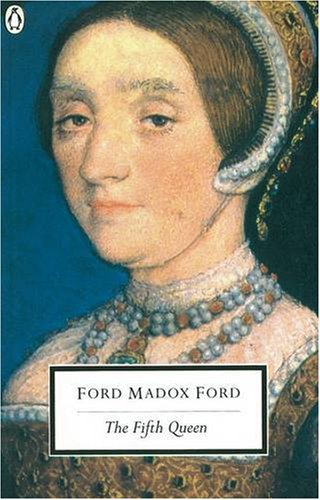
The Fifth Queen by Ford Madox Ford

During the time that had ensued between January and that month of March, it had been proved to Katharine Howard how well Throckmorton, the spy, voiced the men folk of their day. He had left her alone, but she seemed to feel his presence in all the air. He passed her in corridors, and she knew from his very silence that he was carrying on a fumbling game with her uncle Norfolk, and with Gardiner of Winchester. He had not induced her to play his game--but he seemed to have made her see that every man else in the world was playing a game like his. It was not, precisely, any more a world of black and white that she saw, but a world of men who did one thing in order that something very different might happen a long time afterwards.

Ford Madox Ford is always good for a misleading title, so it may surprise no one that in The Fifth Queen Kataerine Howard, who will succeed Anne of Cleves as the wife of Henry VIII, never quite makes it to the throne in this, the first in Ford's trilogy. Instead it depicts something not unlike the beginning of the historical Katharine's relationship with Henry. It is true that she was first a lady-in-waiting in the King's court, but in the service of Queen Anne, not the King's daughter, Mary, and it isn't likely to be true that Henry chanced upon her on the palace grounds riding a mule and, dazzled by her beauty and wit, impressed her into that service. Nor was the historical Katharine a virulent Catholic bitterly opposed to Thomas Cromwell, the Protestant standard-bearer and Lord of the Privy Seal:

The face of a queen looked down just above his head with her eyes wide open as if she were amazed, thrusting her head from a cloud.

'Why, I have outlived three queens,' he said to himself, and his round face resignedly despised his world and his times. He had forgotten what anxiety felt like because the world was so people with blunderers and timid fools full of hatred.


Cromwell sees in Katharine an opportunity to plant a spy in the Catholic Mary's service. Katharine refuses, but quickly finds herself embroiled in the shadowy sectarian conflict that rages beyond the King's notice. She withstands the threats and manipulations not only of Cromwell and his spies but Bishop Gardiner, the country's leading Catholic, who she had idolized. She struggles to maintain her honor and honesty against the moralizing of men like Throckmorton, who may or may not be double dealing against Cromwell:

'How shall you decide what is vileness, or where will you find a virtuous man?' he asked. 'Maybe you will find some among the bones of your old Romans. Yet your Seneca, in his day, did play the villain. Or maybe some at the Court of Mahound, I know not, for I was never there. But here is a goodly world, with prizes for them that can take them...'


Katharine soon learns that everyone is after these "prizes"--that is, except the King, who seeks only the prize of her company. Henry is the most intriguing and magnetic character here: impulsive and irascible, yet truly interested in the pursuit of "right doctrine," a notion lost on men like Cromwell and Gardiner, whose beliefs seem to serve only their ambitions. Perhaps his position as king affords him that right, but it is also a position he uses to lift Katharine out of harm's way at the book's finale, realizing keenly that she is a kindred soul.

But The Fifth Queen seems ultimately like a chronicle of lost opportunities. One wonders why Ford saw the need to transmogrify the historical Katharine into a Catholic stalwart if the religious issues were going to be glossed over. The idea of a Renaissance spy novel sounds great, but the intrigue is a muddle. Everything is a muddle, actually; as an early attempt by Ford to achieve an "impressionist" style, which reproduces the world as it is experienced and seen, The Fifth Queen succeeds mostly in making the particulars of action and location very unclear. Its greatest successes are in its population of minor characters, like the womanizing teacher Magister Udal, or the aged but infamous knight Sir Rochford.

On the other hand, as the first book in a trilogy, this can only amount to a half-finished opinion. I have faith in the abilities of Ford, who is capable of sneaking up on you unawares in a way that few authors are, so I hope for more from The Privy Seal and The Fifth Queen Crowned.