Showing posts with label novella. Show all posts

Thursday, March 21, 2019

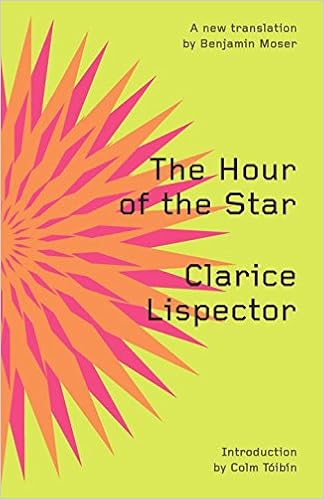
The Hour of the Star by Clarice Lispector

Wiping away her own tears she tried to sing what she heard.  But her voice was as crude and out of tune as she was.  When she heard it she started to cry.  It was the first time she'd ever cried, she didn't know she had so much water in her eyes.  She cried, blew her nose no longer knowing what she was crying about.  She wasn't crying because of the life she led: because, never having led any other, she'd accepted that with her that was just the way things were.  But I also think she was crying because, through the music, she might have guessed there were other ways of feeling, there were more delicate existences and even a certain luxury of soul.

Clarice Lispector's novella The Hour of the Star is a tough little nugget: Ostensibly, it tells the story of a poor woman named Macabea in Rio de Janeiro who lives a pretty brief and unremarkable life.  Macabea is poor, and the poverty is sort of the point.  It's the poverty not only that keeps her eating nothing but hot dogs, but also that keeps her from understanding that you might live not eating hot dogs every day.  She ends up with a bitter man named Olimpico, not dreaming that she might leave him for someone who treats her well, or even that such a man might exist; in the end, he's the one that leaves her.  In the end end she is--and I guess I'll say "spoiler alert" if anyone plans on actually tracking down this little book--she's hit by a car and dies.  As she's leaving a fortune teller.

On the way there, Lispector offers up a convincing but spare sketch of what poverty does to the human psyche.  Much of it is funny and nicely observed:

When she was a girl she'd seen a house painted pink and white with a yard where there was a well and everything.  It was good to look inside.  So her ideal became this: to have a well just for her.  But she didn't know how and so she asked Olimpico:

--Do you know if you can buy a hole?

But Macabea is only half the story, maybe less than half.  The other major character is the narrator, himself from the rural northeast of Brazil, like Macabea.  We don't know what his name is, or how he knew her, but we do know that he feels immense pressure to get her story right, to tell it convincingly.  The first thirty pages or so--and this book is only about eighty pages long--feature the narrator obsessing about his task, trying to dispel his own doubts, fretting over the success of the story he's putting off.  Lispector's style, already so elliptical, evokes similar frustration in the reader:

To draw the girl I have to get a grip on myself and to capture her soul I have to feed myself frugally with fruits and drink iced white wine because it's hot in this cubbyhole I've locked myself into and from which I'm inclined to want to see the world.  I've also had to give up sex and soccer.  Not to mention that I avoid all human contact.  Will I someday return to my former way of life?  I very much doubt it.  I now see that I forgot to mention for the time being I read nothing for fear of polluting the simplicity of my language with luxuries.  Since as I said the word has to resemble the word, my instrument.  Or am I not a writer?  Actually I'm more of an actor because with only one way to punctuate, I juggle with intonation and force another's breathing to accompany my text.

There's a whole Notes from the Underground thing going on, but the narrator isn't a misanthrope; in fact, he's a kind of humanist who can't live with the idea of not telling the story in the right way.  Buy why Macabea?  The question, maybe, is the point: why not Macabea?  Why shouldn't a poor girl, both unattractive and dim (as the narrator tells us), have her story told as faithfully as anyone else?

Beyond that, I didn't quite "get" this novella.  Its peripatetic and incomplete qualities are surely intentional, but the distance they create make me feel a little at sea.  Something closer to realism might have told me about Macabea's life, but here the story really becomes about the narrator, and the very modernist anxiety about whether or not it is impossible to put the truth into words.  Still, I think I understand why Lispector's cult has grown: there's a breathtaking bravery in the way she strings words and sentences together, not really caring if the connection is clear.  The writing itself can be staggeringly fresh, but I'm not sure it made me want to wade into that 700-page collection of her short fiction that everyone raves about.

Sunday, January 23, 2011

Walks With Men by Ann Beattie


“You see through this; understand I was too naïve, even if you factor in that I was young. The ‘80s were not a time when women had to put up with male tyrants. No woman had to fit herself around a man’s schedule. To do so was lazy, as well as demeaning. But I didn’t introspect; I didn’t ask enough questions. I expressed passivity by pretending to myself that whatever I did for Neil was charming, old-fashioned dutifulness. More embarrassing still was the fact that I let him support me, that I had delusions of becoming a major essayist (In this culture? as Neil would say).

If you think for a minute, you might guess what happened next, because clichés so often befall vain people.”

Do not be deceived by the cover—Walks With Men is no poorly written piece of chick lit. Anne Beattie, the author, teaches in UVA’s highly regarded MFA program and is an O. Henry and Pen Award-winning author. (Plus, Miranda July endorsed her on the back cover, and if that doesn’t make her acceptable for the standard indie book snob, what does?)

The main character of our novella, Jane, has recently finished her education at Harvard with honors, has become decidedly anti-establishment, and is of interest to the press because she decided to tell the school on graduation day where they could shove it—in front of God and Jimmy Carter. She has these plans to live on a farm in Vermont with her granola boyfriend Ben and his goats, but the professor that interviews her—arrogant, twice her age, and sure he has a stockpile of wisdom to dispense upon her—wins her over. They have an arrangement where she can ask him any question she likes and he must answer, as long as no one knows about their relationship. (Cue in ominous music here.) He supports her in an apartment while he writes nonfiction novels and she “works” gathering research for him and not doing much else. While their relationship seems to exist in a carefully sealed vacuum, the rest of Neil’s life does not, and the things that she does not know eventually come out and overwhelm her.

Like all men, all people, while Neil is quirky and interesting and loveable, he’s deeply flawed. The complications he tries to hide from Jane but ultimately brings into her life are many and she starts to see over time that his wisdom is limited to superficial things—where to have sex, what to do when depressed, what to do with leftovers from restaurants, how to take your drink, where to buy your scarves. How to be in a relationship without steamrolling the person you love, on the other hand, might be foreign to him. As their relationship progresses (don’t worry, no spoilers) she begins to have issues with self-importance and direction that seem to travel back directly to the fact that she has allowed Neil to take care of her for so long. Characters with strange subplots: her ex that’s high on yoga and love, her gay neighbor that’s been struggling from mental health issues left over from Vietnam, his lover who wants Jane to watch them have sex, all help her work through her loneliness and get a hold of who she is and what it is she does and doesn’t want. Jane isn’t always without her own issues, however, and we see that illustrated through her issues with her mother and closest female friend, Jan, an obvious foil without much going for her but a pointing finger.

As a female, I can appreciate a piece of writing like this for a variety of reasons—it was literary, it was accessible to me despite the fact that I’m from a different generation and mindset than her main character(mostly due to the universal relationship issues Beattie touches on), and because Beattie trusts her audience and doesn't pander to them. Beattie gives female readers the best of both worlds.

All in all, a good read.

Monday, October 11, 2010

The Metamorphosis by Franz Kafka

When Gregor Samsa woke up one morning from unsettling dreams, he found himself changed in his bed into a monstrous vermin.

In the annals of opening lines, very few can top the beginning of The Metamorphosis. How can you help but wonder what’s going on when a novel begins with its protagonist turned into a giant bug? Unfortunately, readers who are wondering what exactly is going on are likely to be disappointed. Kafka, one of the founders of absurdism, isn’t too interested in telling us how or why Gregor became a bug. This is the first Kafka I’ve read, but from what I understand, Kafka never was particularly interested in the mechanics of things. In fact, picking out what Kafka was interested in can be quite a challenge, as evinced by the size and variety of analysis his work inspires.

So, plot summary: it’s mostly up there in the opening quote. Gregor Samsa, primary provider in a household that includes his mother, father, and sister, wakes up one morning to find that he’s become something resembling a giant dung beetle. As the novel progresses (such as it does—it’s less than 100pp), his family discovers his malady and their reactions, and his coping, form the core of the narrative.

Initially, Gregor’s family, although frightened of the creature Gregor has become, try to help him. They call for the doctor, who never actually sees him, and they try to make him comfortable. The most accommodating member is his sister, and Gregor’s thankfulness for her small graces—bringing a variety of foods for him to allow him to discover what he likes, talking to him, straightening his room—form the novel’s emotional core. As time goes on, however, the family grows more and more frustrated with Gregor and the way he inconveniences their life. At the same time, Gregor becomes more and more animalistic, caring less and less about the house’s other occupants. Everything comes to a head one night when, entertaining boarders taken in to compensate for the lack of Gregor’s income, Gregor’s sister is playing her violin. The music touches Gregor’s remaining humanity, and he reveals himself to his family at an inopportune time. It’s the last straw.

The Metamorphosis is such a strange absurd piece of work that it’s difficult to know how to react to it. Parts of certainly comical enough, especially in the early going, but Kafka’s descriptions of Gregor’s bug-life are quease-inducing, and ultimately, Gregor’s story is desperately sad. Take this passage, where, in a moment of clarity, Gregor reflects on his wasted life:

In his imagination appeared again, after a long time, his boss and the manager, the chief clerk and the apprentices, the excessively spineless custodian, two or three friends from other businesses, a chambermaid from a hotel in the provinces, a loving, fleeting memory, a female cashier from a hat shop, whom he had seriously but too slowly courted—they all appeared mixed in with strangers or people he had already forgotten, but instead of helping him and his family, they were all unapproachable, and he was happy to see them disappear.

Gregor’s transformation has been interpreted as everything from a mental condition to a metaphor for transubstantiation, but upon this initial reading, what I took away was a sense of alienation. Gregor, in spite of spending his life toiling for his family, never knows them, never spends time with them, pushes everything important to some hazily-defined future, and, with his separation taken to illogical extremes, is now as irrelevant as any other bug.

I mentioned earlier that Gregor’s story is sad, and it is, but the novel itself ends on a bittersweet note: the family realizes that they now have more money than before, since they are all working. They move to a more convenient place, and they are all happy. Gregor and his horrible experience seem to fade into the background by the end of the last page. In a way, I guess, that’s the saddest part of all.

Tuesday, January 12, 2010

The Curious Case of Benjamin Button by F. Scott Fitzgerald

The past--the wild charge at the head of his men up San Juan Hill; the first years of his marriage when he worked late into the summer dusk down in the busy city for young Hildegarde whom he loved; the days before that when he sat smoking far into the night in the gloomy old Button house on Monroe Street with his grandfather-all these had faded like unsubstantial dreams from his mind as though they had never been. He did not remember.

Surely I'm not the only one who, upon seeing the trailer for The Curious Case of Benjamin Button, didn't realize it was based on a short story at all, let alone one by F. Scott Fitzgerald. Like most Americans, The Great Gatsby is the only thing I've actually read by him. A shame, really, since he's a fantastic writer, certainly one of the most economical prose stylists of all time, and Benjamin Button is a great example.

I haven't seen the movie, but I can only imagine that half of it is made up whole cloth. The novel--novella, really--is under 100 pages and has nary a wasted word. It hardly could, since it covers Benjamin's entire life from cradle to grave, although not necessarily in that order. During this time, he falls in love, carouses about town, goes to war twice, attends college, and manages to alienate his entire family, although SPOILER he wins some of them back over.

Rather than being the serious drama I expected, Benjamin Button is surprisingly light-hearted until its final third where it takes an inevitably darker turn. The story seems to turn the old adage "If only I'd known then what I know now" on its head. Benjamin Button is given a priceless gift--youth with wisdom--but, of course, he doesn't use it wisely.

Saturday, May 31, 2008

Breakfast at Tiffany's by Truman Capote

"He's all right! Aren't you, cat? Poor cat! Poor slob! Poor slob without a name! The way I see it I haven't got the right to give him one. We don't belong to each other. We just took up one day by the river. I don't want to own anything until I find a place where me and things go together. I'm not sure where that is but I know what it is like. It's like Tiffany's."

In interest of full disclosure, I must confess this: Breakfast at Tiffany's is one of my favorite romantic movies. Except for the unfortunate Mickey Rooney role (playing a particularly painful Asian stereotype), its as good as anything I've seen in the genre. I liked the film a lot : I'd never read anything by Capote : and it was very, very short.

For those unfamiliar with the story : An unnamed writer living in a tenement in New York becomes embroiled in the eccentric, over-the-top affairs of Holly Golightly, his upstairs neighbor. She brings men home almost every night, lies constantly, and holds everyone at arm's length. She's also completely irresistible to the writer, and the book(and movie)'s dynamic rests on his unrealized desire to be with her.

The film ends writer and Holly kissing in the rain, and my sentimental streak says it's one of the most effective scenes in cinema. The book's ending is sadder and more open, as Holly leaves for Brazil and leaves her cat with the writer. Personally, I prefer the movie, but both are good.

Other changes : Holly is much more sexually involved : her language is rather coarse : she's blonde. Besides that, the novella and the film are pretty similar. Capote's writing is very pleasant. it has a nice flow and fits very well with the story he's telling. Breakfast at Tiffany's feels a little slight at points, but it was a worthwhile read and I might check out more Capote in the future.