Showing posts with label Clarice Lispector. Show all posts

Thursday, December 26, 2019

Some Stories by Clarice Lispector


I would like to tell you that having passions does not mean living beautifully, but rather suffering pointlessly. That the soul was made to be guided by reason and that no one can be happy when at the mercy of the instincts. For we are animals yet we are animals disturbed by man. And if they forgive him, he is proud and demanding and never forgives their excesses.

Clarice Lispector doesn't really do narrative. At least, that's the impression I get from this slim collection of early short stories, all of which focus on one character who describes, normally in first-person, the epiphanic moment when they realize that everything in life is unimportant, or at least incomprehensible.

The centerpiece of the collection is Obsession, about a girl who, while sitting in a coffeeshop, hears two young men discussing philosophy in abstract terms. Apparently never having heard life described in anything but concrete terms, she becomes obsessed (and later involved) with one of them, Daniel. Daniel is, from all indications, a real jerk whose behavior is repeatedly justified by the narrator by his tortured existence; he disdains the physical world which he cannot escape, and lives in a world of abstractions which he can never really understand. And though the characters in this collection wrestle from time to time with God, none of them truly believe in the metaphysical, and so with Daniel--he is a Gnostic with no hope of transcendence. In modeling her life after his, the narrator finds herself in the same position, ever alone but unwilling (or unable) to return to the world of the simple and physical--she loves chocolate, which shames her; she admires her husband Jamie's simplicity, which makes he despise him. And the story ends, as it must, and as most of these do, with the protagonist alone in an incomprehensible universe.

Hope, however, hovers in the peripheries of these stories, though the protagonists never recognize it as such. Jamie, from the story above, is content with the way the world is, even when he's being mentally cuckolded by Daniel. He's perhaps the only happy person we meet, and his relentless physicality and resistance to any sort of internal analysis seem to serve as a buffer to the misery the thinking characters feel. As the excerpt that opens this review indicates, passion doesn't lead to happiness; it leads to pointless suffering.

The final story, A Couple of Drunks, points forward to... something as well, though it's not clear what it is. A woman bar hops, looking for someone, a man or a woman, who will need her, who will realize they don't deserve her, who will lend her a sense of control she can't seem to get ahold of on her own. She finally meets a divorced man whose son has an angina, and proceeds to shame him for his divorce and then, in a passage that made me laugh at its ghoulish hyperbole, describes what's liable to happen if he doesn't return to his son:

“Imagine her, eyes burning, at the child’s side. The child wheezing painfully, dying. He dies. His little head is contorted, his eyes are open, staring at the wall, obstinately. Everything is silent and the young lady doesn’t know what to do. The boy is dead and all of a sudden she has nothing to do. She collapses onto the bed, sobbing, tearing at her clothes: ‘My son, my poor son! It’s death, it’s death!’ The household rats take fright and start to race around the room. They crawl up your son’s face, still warm, gnaw at his little mouth. The woman screams and faints, for two hours. The rats visit her body too, cheerful, nimble, their tiny teeth gnawing here and there.”

She moves from this macbre fantasia to the moon and the sadness of knowing that it has shone, will shine, on those who lived before and will live after her, after she has "returned to the humus, eyeless for eternity". And the man prepares to respond and the collection ends thusly: "Suddenly, he took the toothpick from his mouth, eyes blinking, lips trembling as if about to cry, said:"

We never learn what he had to say, just like the woman will never know what happens after she dies, just like she and the other tortured, free souls in these stories will never see the climax of their passions. And yet, there's a sense that somehow in connection, in conversation, even in mutual animosity, some meaning can be found--but don't ask anyone here how.

Thursday, March 21, 2019

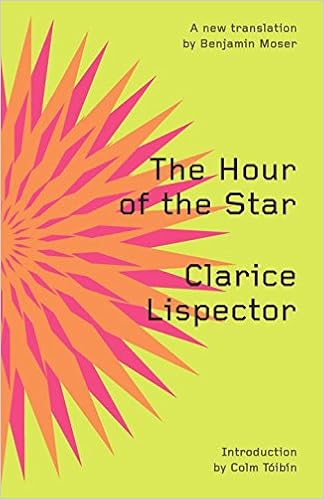
The Hour of the Star by Clarice Lispector

Wiping away her own tears she tried to sing what she heard.  But her voice was as crude and out of tune as she was.  When she heard it she started to cry.  It was the first time she'd ever cried, she didn't know she had so much water in her eyes.  She cried, blew her nose no longer knowing what she was crying about.  She wasn't crying because of the life she led: because, never having led any other, she'd accepted that with her that was just the way things were.  But I also think she was crying because, through the music, she might have guessed there were other ways of feeling, there were more delicate existences and even a certain luxury of soul.

Clarice Lispector's novella The Hour of the Star is a tough little nugget: Ostensibly, it tells the story of a poor woman named Macabea in Rio de Janeiro who lives a pretty brief and unremarkable life.  Macabea is poor, and the poverty is sort of the point.  It's the poverty not only that keeps her eating nothing but hot dogs, but also that keeps her from understanding that you might live not eating hot dogs every day.  She ends up with a bitter man named Olimpico, not dreaming that she might leave him for someone who treats her well, or even that such a man might exist; in the end, he's the one that leaves her.  In the end end she is--and I guess I'll say "spoiler alert" if anyone plans on actually tracking down this little book--she's hit by a car and dies.  As she's leaving a fortune teller.

On the way there, Lispector offers up a convincing but spare sketch of what poverty does to the human psyche.  Much of it is funny and nicely observed:

When she was a girl she'd seen a house painted pink and white with a yard where there was a well and everything.  It was good to look inside.  So her ideal became this: to have a well just for her.  But she didn't know how and so she asked Olimpico:

--Do you know if you can buy a hole?

But Macabea is only half the story, maybe less than half.  The other major character is the narrator, himself from the rural northeast of Brazil, like Macabea.  We don't know what his name is, or how he knew her, but we do know that he feels immense pressure to get her story right, to tell it convincingly.  The first thirty pages or so--and this book is only about eighty pages long--feature the narrator obsessing about his task, trying to dispel his own doubts, fretting over the success of the story he's putting off.  Lispector's style, already so elliptical, evokes similar frustration in the reader:

To draw the girl I have to get a grip on myself and to capture her soul I have to feed myself frugally with fruits and drink iced white wine because it's hot in this cubbyhole I've locked myself into and from which I'm inclined to want to see the world.  I've also had to give up sex and soccer.  Not to mention that I avoid all human contact.  Will I someday return to my former way of life?  I very much doubt it.  I now see that I forgot to mention for the time being I read nothing for fear of polluting the simplicity of my language with luxuries.  Since as I said the word has to resemble the word, my instrument.  Or am I not a writer?  Actually I'm more of an actor because with only one way to punctuate, I juggle with intonation and force another's breathing to accompany my text.

There's a whole Notes from the Underground thing going on, but the narrator isn't a misanthrope; in fact, he's a kind of humanist who can't live with the idea of not telling the story in the right way.  Buy why Macabea?  The question, maybe, is the point: why not Macabea?  Why shouldn't a poor girl, both unattractive and dim (as the narrator tells us), have her story told as faithfully as anyone else?

Beyond that, I didn't quite "get" this novella.  Its peripatetic and incomplete qualities are surely intentional, but the distance they create make me feel a little at sea.  Something closer to realism might have told me about Macabea's life, but here the story really becomes about the narrator, and the very modernist anxiety about whether or not it is impossible to put the truth into words.  Still, I think I understand why Lispector's cult has grown: there's a breathtaking bravery in the way she strings words and sentences together, not really caring if the connection is clear.  The writing itself can be staggeringly fresh, but I'm not sure it made me want to wade into that 700-page collection of her short fiction that everyone raves about.