Showing posts with label cuba. Show all posts

Saturday, October 25, 2025

Telex from Cuba by Rachel Kushner

Maybe we should have seen it coming. It takes a while to put things together. You can't always do it while it's happening to you. A week before the fire started, the rebels closed down the main highway east of Las Tunas. That meant they had control of Oriente, so much of which was owned by Americans. Us, and the American government, which ran the Nicaro nickel mine. Batista was persona non grata with the Cubans, and we were caught in the middle. Fidel and Raul, these were local boys, and I think Daddy was hoping he could reason with them.

Rachel Kushner's debut novel Telex from Cuba captures the lives of Americans living in Cuba as the civil war broke out in the 1950s. They come from all walks of life: they're rich, like K. C. Stites, whose father runs one of the plantations of the United Fruit Company, or middle-class, like Everly Lederer, whose father comes down to serve as a manager there. Even the lower classes are able to get in on the exploitation of Cuba's resources, like Allain Hatch, who finds a haven in Cuba away from the laws of the United States, where he's wanted for a killing. To these characters Kushner adds a real-life French arms runner named La Maziere, and a beautiful prostitute--conspicuously named "Rachel K"--who is reputed to be Batista's favorite, but who is really in league with Maziere and the rebels. All of these characters have their role to play in the revolution, whether rebel or victim, and all have their lives upended by the sea change that transforms Cuba.

Telex from Cuba is scrupulously researched, finely detailed, and boring. I thought it bore the hallmarks of a debut novelist's pitfalls: there's too much research, for one, not sifted through enough to give a singular impression. There are too many characters and too many points-of-view: K. C. gives a first person account, rife with patrician resentment at the loss of his birthright, but Everly, La Maziere, and many others get their turn in the third person limited seat, including about a dozen white-collar Americans and their wives whose roles in the novel I found difficult to get straight. Any one of these might have made a good novel--I thought this particularly about the irony in K. C.'s first person narration--but on the whole, they turn into a real mash. Things that ought to be huge, like the Stites' family's son Del joining the rebels, recede into the background in favor of images and symbols of dubious importance, like an abandoned Pullman railway car.

I rather enjoyed The Mars Room, which pulls some of the same point of view tricks, but without feeling overstuffed or encouraging impatience. Maybe the fact that it's mostly set in prison--a naturally confining space--helped. But this one didn't work for me.

Monday, July 11, 2022

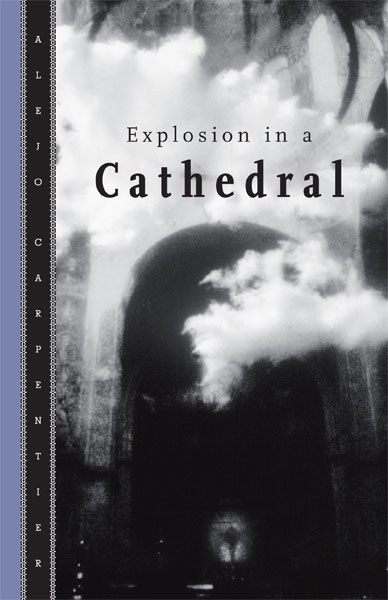
Explosion in a Cathedral by Alejandro Carpentier

Esteban suddenly stopped, stirred to the very depths, in front of the "Explosion in a Cathedral" by the anonymous Neapolitan master. In it were prefigured, so to speak, so many of the events he had experienced that he felt bewildered by the multiplicity of interpretations to which this prophetic, anti-plastic, un-painterly canvas, brought to the house by some mysterious chance, lent itself. If, in accordance with the doctrines he had once been taught, the cathedral was a symbol--the ark and the tabernacle--for his own being, then an explosion had certainly occurred there, which, although tardy and slow, had destroyed altars, images, and objects of veneration. If the cathedral was the Age, then a formidable explosion had indeed overthrown its most solid walls, and perhaps buried the very men who had built the infernal machine beneath an avalanche of debris. If the cathedral was the Church, then Esteban noticed a row of sturdy pillars remained intact, opposite those which were shattering and falling in this apocalyptic painting, as if to prophesy resilience, endurance and a reconstruction, after the days of destruction and of stars foretelling disasters had passed.

Esteban and Sofia are cousins, living in the great Havana hacienda Sofia's father left them. Essentially, they are orphans, passing their time playing games among the clutter of the dead man's life, until a French businessman arrives looking for the dead man. This man, Victor Hugues, is drawn into the children's games, their costumes and science experiments and adventure books, and for a time, he lives with them, until his warehouse in Haiti is burned. From there he returns to France, embarking upon a political career under the aegis of the Jacobins of the French Revolution, who task him with bringing the revolution to the Americas. Hugues captures the island of Guadeloupe from the British, turning it into a center of wealthy privateers, but he brings with him the first guillotine in the New World. Esteban, then Sofia, are caught up in the tumult of Hugues' revolution, its idealism, its bloodiness, and its ultimate failure.

Hugues, the central figure of Carpentiers' historical novel, was a real figure, a kind of Robespierre of the Caribbean. Guadeloupe, Surinam, French Guiana, and many other places still bear the marks of his regime. Historical novels about the French Revolution are not so hard to come by, but Explosion in a Cathedral highlights a theater of the world no less transformed than Europe, one upon which many of the same moral question and struggles played out. I was struck how both Esteban and Sofia, one after the other, become disenchanted with Hugues, one after the other, and for different reasons. The life of Esteban, arguably the book's main character, is intricately bound up with Hugues': Esteban travels to France and works for the Jacobins to spread the revolution in the Basque country before being sent to Hugues' Guadeloupe, where he's later shunted off into the service of one of the tyrant's famous privateers. Along the way he becomes disillusioned with Hugues' bloody methods. In one memorable passage, Esteban observes how Hugues condemns so many to the guillotine that only a small fraction can be killed in a night, and the rest must be summarily dispatched by pistol.

When Esteban returns, he's frustrated to find that Sofia and her brother Carlos remain enamored with the Revolution, believing wholeheartedly in its potential to transform the world, not having seen any of the blood or the back-dealing among its various Girondins and Jacobins and Thermidoreans. When Sofia's husband dies, she rushes off to Guiana to be with Hugues--for whom she has hidden a sexual ardor for years--but finds not even the bloodthirsty ideologue, but an apparatchik who doesn't even bat an eye when the Directory under an ascendant Napoleon reinstitutes slavery in France's colonies. Hugues might be the Revolution's quintessential man: he transforms himself entirely, as the world is transformed, but his transformation is from a man of cleverness and imagination to one without any scruple at all. Hugues survives the many purges and exiles of his peers because he is man of action, disinterested in the larger principles for which such action is performed. "A revolution is done," he insists, not discussed.

I thought this book was incredibly rich. I was impressed by the wonderfully detailed depictions of Havana and Guadeloupe and Cayenne, and the many other places of the Caribbean that were touched by the Revolution. (In his afterword, Carpentier claims to be one of the only people in the world to visit nearly all of the islands in the Antilles, though clearly much research was involved in making the particular colonial iterations of these places come alive.) He's especially interested in the way these places smelled, their mixtures of tar and tobacco and salted fish and leather and all sorts of other things. And Esteban's long meditation upon the strange life and environments of the Caribbean Sea seems to have echoes of the magical realism for which, in earlier works, Carpentier was known.

Explosion in a Cathedral asks: Are men like Hugues necessary for the world to grow? Without Hugues, there is no end to slavery in Guadeloupe, but then again, it's Hugues who brings it back, too. I found myself thinking about Sembene Ousmane's God Bits of Wood, another book that wonders if, for the world to change, it requires men that would otherwise be intolerable, because revolution requires intolerable things. Ousmane's Bakayoko is a man who is all ideals, and nothing else, a far cry from Hugues' man of action. But both books are meditations on the price we place on change.

Since Carpentier is Cuban, my "countries read" list is up to 66!

Monday, November 16, 2009

Our Man in Havana by Graham Greene

When he was alone Wormold unscrewed the cleaner into its various parts. Then he sat down at his desk and began to make a series of careful drawings. As he sat back and contemplated his sketches of the sprayer detached from the hose-handle of the cleaner, the needle-jet, the nozzle and the telescopic tube, he wondered: Am I perhaps going too far? He realised that he had forgotten to indicate the scale. He ruled a line and numbered it off: one inch representing three feet. Then for better measure he drew a little man two inches high below the nozzle. He dressed him neatly in a dark suit, and gave him a bowler hat and an umbrella.


Graham Greene notoriously split his oeuvre into "novels"--literary and philosophical works like The Power and the Glory and The Heart of the Matter--and pulpier "entertainments." Our Man in Havana is decidedly an entertainment twice removed: a convoluted, jokey spy thriller that isn't really a spy thriller at all.

The protagonist is an English vacuum salesman living in Cuba named Wormold, who is recruited (perhaps only because of his Englishness) by British officials to provide intelligence on the political climate in Cuba, at this time under the dominion of Fulgencio Batista. The process of spying has its natural barriers, and Wormold rarely meets with his directors, instead communicating by book code and substituting numbers for names. Wormold quickly realizes that it is far easier to submit invented intelligence than real intelligence, and even goes so far as to recruit fake "sub-agents" so that he might pocket their salary. Scandalous, it might seem, but Greene keeps the tone light and Wormold naturally meek, casting the blame on the government buffoons.

What Wormold gives them is a diagram of a dissembled vacuum cleaner, claiming that his intelligence has sighted a massive mechanical operation deep in the Cuban jungle. British intelligence, predictably, buys this hook, line, and sinker. But there are other agents in Havana, and eventually the real people "recruited" by Wormold to be his sub-agents find themselves in grave danger, and Wormold himself is the target of assassination attempts.

Our Man in Havana is, despite the persistent threat of death, deceptively sunny and makes for an absurd, almost Coenesque farce. Compared to many of Greene's other novels which have so much more philosophical and social heft, it is also almost completely forgettable. The satire isn't toothless, but neither is it toothsome. As I understand it, Castro disliked the novel because it didn't go far enough in describing the horror of Batista's Cuba, and Greene responded that the novel was really about the British, and yet that didn't stop The Heart of the Matter from vividly expressing the reality of life in sub-Saharan Africa. And neither is there much religious content: Though Wormold is an atheist and his daughter Milly is a devout Catholic, this tension comes to almost nil and is let drop like the irrelevancy that it is. Greene may have called these books "entertainments," but for this reader, they are not nearly as entertaining as those "novels," in which the suspense came from the deeply crafted pathos of their protagonists.