Showing posts with label Guadeloupe. Show all posts

Monday, July 11, 2022

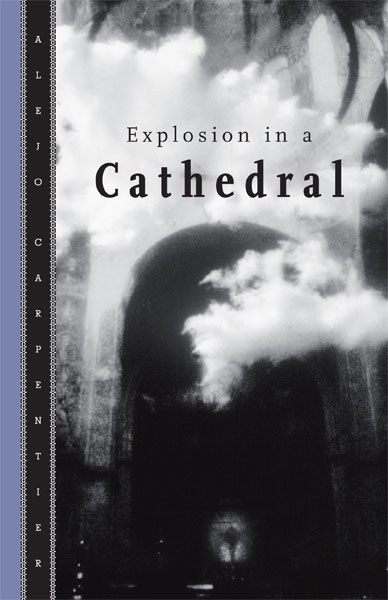
Explosion in a Cathedral by Alejandro Carpentier

Esteban suddenly stopped, stirred to the very depths, in front of the "Explosion in a Cathedral" by the anonymous Neapolitan master. In it were prefigured, so to speak, so many of the events he had experienced that he felt bewildered by the multiplicity of interpretations to which this prophetic, anti-plastic, un-painterly canvas, brought to the house by some mysterious chance, lent itself. If, in accordance with the doctrines he had once been taught, the cathedral was a symbol--the ark and the tabernacle--for his own being, then an explosion had certainly occurred there, which, although tardy and slow, had destroyed altars, images, and objects of veneration. If the cathedral was the Age, then a formidable explosion had indeed overthrown its most solid walls, and perhaps buried the very men who had built the infernal machine beneath an avalanche of debris. If the cathedral was the Church, then Esteban noticed a row of sturdy pillars remained intact, opposite those which were shattering and falling in this apocalyptic painting, as if to prophesy resilience, endurance and a reconstruction, after the days of destruction and of stars foretelling disasters had passed.

Esteban and Sofia are cousins, living in the great Havana hacienda Sofia's father left them. Essentially, they are orphans, passing their time playing games among the clutter of the dead man's life, until a French businessman arrives looking for the dead man. This man, Victor Hugues, is drawn into the children's games, their costumes and science experiments and adventure books, and for a time, he lives with them, until his warehouse in Haiti is burned. From there he returns to France, embarking upon a political career under the aegis of the Jacobins of the French Revolution, who task him with bringing the revolution to the Americas. Hugues captures the island of Guadeloupe from the British, turning it into a center of wealthy privateers, but he brings with him the first guillotine in the New World. Esteban, then Sofia, are caught up in the tumult of Hugues' revolution, its idealism, its bloodiness, and its ultimate failure.

Hugues, the central figure of Carpentiers' historical novel, was a real figure, a kind of Robespierre of the Caribbean. Guadeloupe, Surinam, French Guiana, and many other places still bear the marks of his regime. Historical novels about the French Revolution are not so hard to come by, but Explosion in a Cathedral highlights a theater of the world no less transformed than Europe, one upon which many of the same moral question and struggles played out. I was struck how both Esteban and Sofia, one after the other, become disenchanted with Hugues, one after the other, and for different reasons. The life of Esteban, arguably the book's main character, is intricately bound up with Hugues': Esteban travels to France and works for the Jacobins to spread the revolution in the Basque country before being sent to Hugues' Guadeloupe, where he's later shunted off into the service of one of the tyrant's famous privateers. Along the way he becomes disillusioned with Hugues' bloody methods. In one memorable passage, Esteban observes how Hugues condemns so many to the guillotine that only a small fraction can be killed in a night, and the rest must be summarily dispatched by pistol.

When Esteban returns, he's frustrated to find that Sofia and her brother Carlos remain enamored with the Revolution, believing wholeheartedly in its potential to transform the world, not having seen any of the blood or the back-dealing among its various Girondins and Jacobins and Thermidoreans. When Sofia's husband dies, she rushes off to Guiana to be with Hugues--for whom she has hidden a sexual ardor for years--but finds not even the bloodthirsty ideologue, but an apparatchik who doesn't even bat an eye when the Directory under an ascendant Napoleon reinstitutes slavery in France's colonies. Hugues might be the Revolution's quintessential man: he transforms himself entirely, as the world is transformed, but his transformation is from a man of cleverness and imagination to one without any scruple at all. Hugues survives the many purges and exiles of his peers because he is man of action, disinterested in the larger principles for which such action is performed. "A revolution is done," he insists, not discussed.

I thought this book was incredibly rich. I was impressed by the wonderfully detailed depictions of Havana and Guadeloupe and Cayenne, and the many other places of the Caribbean that were touched by the Revolution. (In his afterword, Carpentier claims to be one of the only people in the world to visit nearly all of the islands in the Antilles, though clearly much research was involved in making the particular colonial iterations of these places come alive.) He's especially interested in the way these places smelled, their mixtures of tar and tobacco and salted fish and leather and all sorts of other things. And Esteban's long meditation upon the strange life and environments of the Caribbean Sea seems to have echoes of the magical realism for which, in earlier works, Carpentier was known.

Explosion in a Cathedral asks: Are men like Hugues necessary for the world to grow? Without Hugues, there is no end to slavery in Guadeloupe, but then again, it's Hugues who brings it back, too. I found myself thinking about Sembene Ousmane's God Bits of Wood, another book that wonders if, for the world to change, it requires men that would otherwise be intolerable, because revolution requires intolerable things. Ousmane's Bakayoko is a man who is all ideals, and nothing else, a far cry from Hugues' man of action. But both books are meditations on the price we place on change.

Since Carpentier is Cuban, my "countries read" list is up to 66!

Wednesday, March 9, 2022

The Wondrous and Tragic Life of Ivan and Ivana by Maryse Conde

She looked Ivan straight in the eye. All the love and desire they had for each other was revealed in this look. They relived their entire life like those who have come close to death might. Ivan and Ivana therefore relived every moment from when they emerged from Simone's womb on a warm, fragrant September night right up to this gray frosty  autumn morning. Some memories lingered more than others. When they had begun to stand on their own two feet Simone would measure them against one of the house walls. For a long time they stayed the same height as each other. Then one year Ivan began to grow and within a few months he had grown taller than his sister. At the time Ivana admired in bemusement his body that stretched out beside her. What a magnificent package of muscles.

Everything goes well for Ivana Nemele. She is hard working, charming, and intelligent, well-loved by everyone, whether in her birthplace of Guadeloupe, or in Mali, where she is sent to live with her father, or in France where she eventually settles, joining the police academy. But for her twin brother Ivan, the world is not so kind: a series of stultifying jobs and run-ins with various authorities leave him marginalized and defeated. Whereas Ivana grows up to have a gentle faith in the world and those around her, Ivan becomes radicalized, first by his socialist teacher in Guadeloupe, then a radical Muslim sect in Mali. His involvement in a local militia is what pushes both him and his sister to France, where he moves farther and farther down the ranks of society, and deeper and deeper into the world of radical Islamic terrorism, toward an act of stunning violence that will pit him irrevocably against his sister.

The Wondrous and Tragic Life of Ivan and Ivana is what you might call a yarn. It skips from the Caribbean to Africa to Europe at a blistering pace, collecting and casting off minor characters in the space of paragraphs, dragging Ivan from humiliation to humiliation and catastrophe to catastrophe. How is that Ivan's experience in the world is so horrible, and Ivana's so good? Ivan and Ivana is a kind of fictional twin study, examining how social differences emerge under identical conditions. What leads one person to become radicalized, and another to join the police academy? One answer, given the precipitating conditions, must be masculinity: degrading physical labor, toxic ideas about manhood, homosexual panic, these are all part of Ivan's story. But Ivan and Ivana seems to me to suggest that much the answer is pure chance, that the geopolitical world is large and chaotic, and that it breeds unintended consequences in people, especially those at the lowest social rungs.

Through it all, Ivan and Ivana remain close, too close: they burn with a physical and romantic desire for each other. Practical Ivana sees the need to date and marry, and pushes Ivan to do the same, believing it will give him social stability, but Ivan is so caught up with his admiration and lust for Ivana that he has no eyes for anyone else. His increasing social alienation from his sister is a cycle of positive reinforcement: as he grows farther from her, he becomes more bitter, leading him into the arms of the radical imam who tells him he must have admiration only for God. Weird as it is, Ivan and Ivana's attachment works as a representation of the ways in which our most intense and treasured attachments can be undone by insidious social forces. At the end of the novel--spoiler alert--Conde makes this painfully, literally clear, when Ivana becomes the first victim of Ivan's bloody Bataclan-style shooting rampage.

My project this month is to fill out the ranks of the countries from which I have never read a book, so imagine my dismay when I discovered that Guadeloupe is not an independent nation but an overseas department of France. ("A French overseas department!" one of Ivan's associates laughs--"what is that?") No doubt the diminishment of Guadeloupean national identity--Guadeloupeans' subordination to France and their alienation from their historical and cultural kinsmen in Africa--are part of Ivan's story. So I declare this book read according to the spirit of the project, if not the letter.