Showing posts with label Neapolitan series. Show all posts

Thursday, February 18, 2021

The Story of the Lost Child by Elena Ferrante

The infant moved in my belly like rolling waters, I touched Lila's stomach, hers was moving, too. Everything was moving: the sea of fire under the crust of the earth, and the furnaces of the stars, and the planets, and the universes, and the light within the darkness and the silence in the cold. But, even now as I pondered the wave of Lila's distraught words, I felt that in me fear could not put down roots, and even the lava, the fiery stream of melting matter that I imagined inside the earthly globe, and the fear it provoked in me, settled in my mind in orderly sentences, in harmonious images, became a pavement of black stones like the streets of Naples, a pavement where I was always and no matter what the center.

At the end of Those Who Leave And Those Who Stay, the narrator Elena Greco has left her husband and two children to be with Nino Sarratore, the man with whom she has been in love since grade school. That third novel ends with upheaval, and the business of the fourth and final novel, at least at first, is to put the pieces back together: the painful separation with her husband Pietro, the sorting of their two young girls, Elsa and Dede, the making of a life with Nino. Nino, as any literate person has known since the first novel in the series, is an odious shit: he proclaims his love for Elena but refuses to break off fully from his wife, keeping Elena and her daughters in an apartment in the well-heeled district of Naples and visiting them from time to time. Elena doesn't even know that Nino is still with his wife for months, and when she finds out it is the first of several debilitating shocks. Another comes when she walks in on Nino fucking the housekeeper. Is it any surprise that later in life, as we are told in the book's latter half, becomes a successful politician?

Elena has a powerful realization: the Nino she loved is really the Nino of her grade school years, a person whose identity and being were interrupted when, years ago, he fell in love with her friend Lila. The Nino of today is quite different: "To whom, then, was I bound, and whom did I still love today?" This idea--the way personalities slip and change, the permeability of boundaries, the old question of the Argo--haunts the novel, and Lila especially. For Elena, the question is liberating; she can finally let Nino go. But we learn that for Lila this idea has always been a terror. A devastating earthquake brings it to the surface, and she admits to Elena how she has always feared the possibility of boundaries dissolving: "And so if she didn't stay alert, if she didn't pay attention, the waters would break through, a flood would rise, carrying everything off in clots of menstrual blood, in cancerous polyps, in bits of yellowish fiber."

Once things with Nino fall apart, Elena acquiesces to Lila and moves back to the old neighborhood, taking an apartment literally above her old friend. "Never had so little space separated Lila and me, not even when we were children," she writes. Of course, it's easy to see how the narrative has been leading us here, full circle, back to the entanglement with Lila that was the crucible of Elena's formative years. And the two become very tangled; Elena becomes pregnant with Nino's child at the same time that Lila becomes pregnant with the child of her longtime lover and protector, Enzo. The two girls, Imma and Tina, seem almost to reproduce the relationship between the young Elena and Lila: Tina is brilliant and charismatic while Imma is paler somehow, and utterly dependent on her friend. The two mothers become so enmeshed that the two girls seem to have two mothers; when a photographer comes to profile Elena for a magazine the caption erroneously reads: Greco with her daughter Tina. Ferrante finds a thousand other ways to smash the two families together, as when Elena's eldest daughter Dede, then her middle daughter Elsa, fall madly in love with Lila's dull son Rino.

The social world of the series, too, comes full circle: Lila has become a powerful entrepreneur in the computer business, and has used her influence to attack the stranglehold held on the neighborhood by the mafioso Solara brothers. Now that she's back in the neighborhood, Elena becomes conscripted into this conflict. She publishes exposes, at Lila's encouragement, about the brothers; they in turn gin up lawsuits against her. We are headed, we feel, for a final showdown, one that will capture the changing nature of Naples at the turn of the millennium and close the series with a grand gesture.

But it doesn't happen. Instead--spoiler alert!--avviso di spoliatore!--the trajectory of the novel is completely upended when Lila's daughter Tina disappears mysteriously off the street and is never found. Perhaps it was the Solaras; perhaps it was a bungled ransom attempt targeted at either Lila or Elena, but whatever it is, it throws a wrench into everything: the neighborhood war, the relationship between the two main characters, everything. It is Lila's fear of slippage, of disappearance, of vanishing, come true. The neighborhood war peters out with a whimper, and the focus of the novel becomes once again the relationship between the two women, but needless to say, a relationship that has been completely upended and reassembled.

I'm in awe of these novels, honestly. In my limited writing experience, creating the impression of a character who is consistent on the page is one of the most difficult things to do. The demands of plot always push people in the wrong direction. And yet here's a 1,200 page novel, essentially, where the characters are constantly surprising you, and each other, but doing it in ways that seem wholly in keeping with their personality and identity. Just as a feat of writing, it's incredible. But there's nothing else like these novels, since at least the 19th century, that so perfectly balances big and small, the social context and the individual character, nothing else that understands what it's like to be a small wheel in a big machine. Almost certainly these books are the masterpiece of the century so far.

Saturday, February 29, 2020

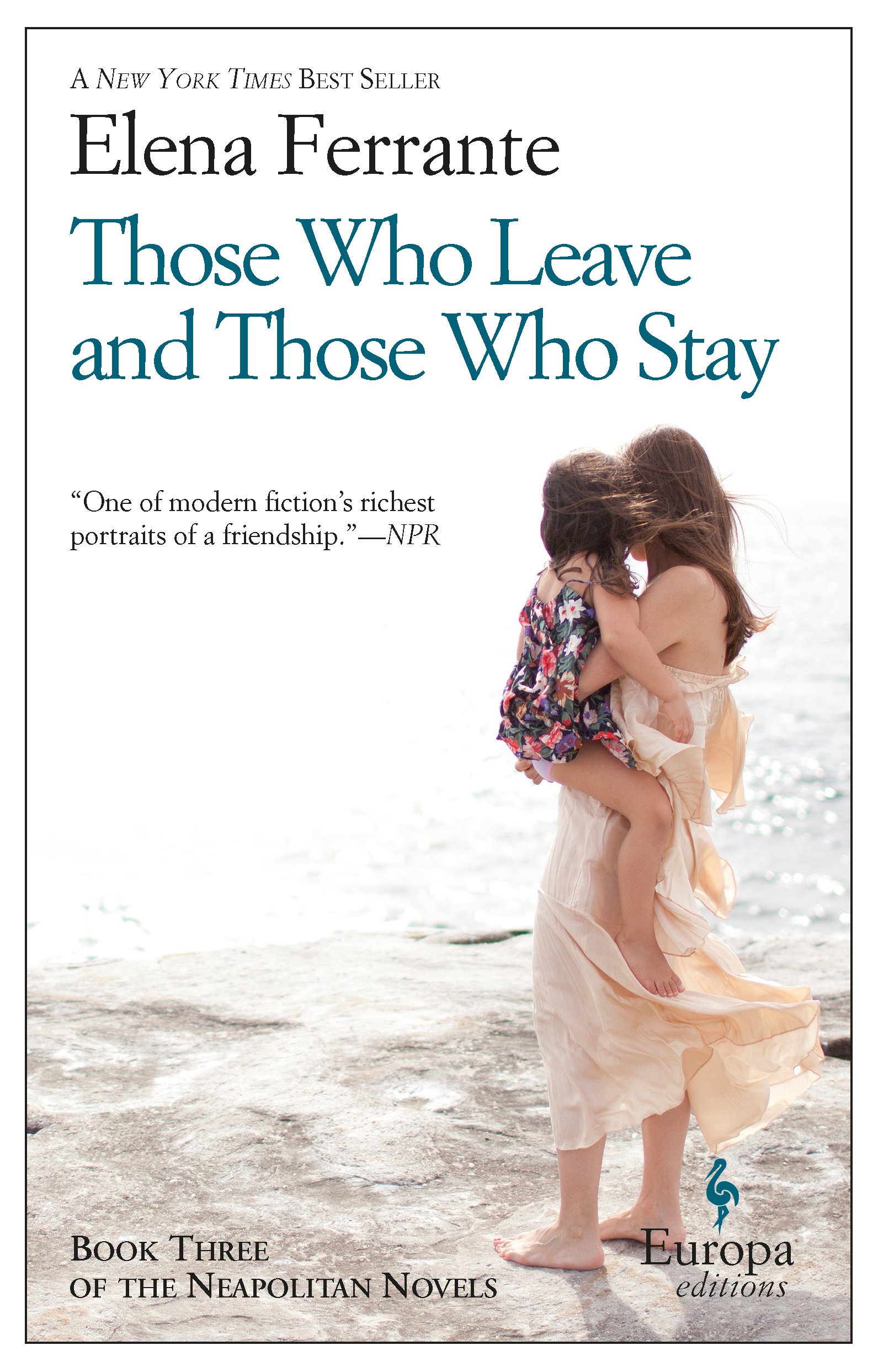
Those Who Leave and Those Who Stay by Elena Ferrante

Become.  It was a verb that had always obsessed me, but I realized it for the first time only in that situation.  I wanted to become, even though I had never known what.  And I had become, that was certain, but without an object, without a real passion, without a determined ambition.  I had wanted to become something--here was the point--only because I was afraid that Lila would become someone and I would stay behind.  My becoming was a becoming in her wake.  I had to start again to become, but for myself, as an adult, outside of her.

Those Who Leave and Those Who Stay picks up directly where its predecessor, The Story of a New Name, leaves off: the narrator, Elena, has just published a novel based on her experiences as a young girl living in Naples.  She has been catapulted to a kind of sudden fame, and she agonizes over every review, ping-ponged between elation, when they praise, and despair, when they condemn.  As it was in the second book, Elena's novel is a kind of funhouse mirror version of the Neapolitan novels themselves; it's hard not to read about the agony that being in the public eye brings Elena and and see a reflection of Ferrante, a pseudonym meant to get around exactly that kind of scrutiny.  Those critics who condemn the novel for being "risque" are condemning Elena's life itself, which has inspired it, and shaming young women's sexual development--it makes you wonder whether Ferrante's secretiveness is a way of keeping people like that at arm's length.

These books are so panoramic, so packed with event and detail, but when you take a step back, they're also so perfectly and neatly constructed.  The Story of a New Name ends with Elena triumphant and her friend Lila, in whose shadow Elena has lived, at her lowest, forced into a life of manual labor at a sausage factory.  Those Who Leave and Those Who Stay reverses the trendlines: ultimately, Lila becomes a respected expert in industrial computers, while Elena finds her literary success dwindling, and impossible to repeat.  Elena marries her boyfriend, Pietro, who turns out to be a pedant and a boor who expects Elena to care for house, home, and children so that he can focus on his academic work.  Elena has two daughters, and the life of a wife and mother squeezes the creative impulse out of her completely, producing a familiar despair.

Those Who Leave and Those Who Stay is the most political of the novels so far.  The sausage factory where Lila works becomes the focus of a battle between associated labor union-Socialist forces and anti-labor fascists.  The citizens of the "old neighborhood" fall on each side of the conflict, with Elena, Lila, Enzo, and the Communist agitator Pasquale on the left, and the sinister mafioso Solara brothers on the right.  Over and over again, Elena finds herself in the middle of internecine leftist squabbles.  The subject of these debates is always a little bit obscure, and you get the sense that Ferrante's not interested in advancing any theories of social change.

Instead, her subject is the way that all sides of these political battles--Camorrists, Socialists, petit bourgeois class traitors, students, whatever--treat women like trash.  Her old boyfriend Franco dismisses her novel as sentimental and irrelevant, not willing to understand that the lived experience of a woman at the bottom of the class hierarchy is exactly what revolution is about.  The bohemian Pasquale looks at Elena's bourgeois comfort and sees a class traitor, but he's not willing to see the way that patriarchy has diminished her.  Nino, the man whom Elena has loved secretly since the first book, leaves illegitimate children in his wake everywhere:

And so, in spite of his virtues, he was a frivolous, superficial man, an animal organism who dripped sweat and fluids and left behind, like the residue of a careless pleasure, living material conceived, nourished, shaped within female bellies.

And yet--spoiler alert--at the end of the book, Elena makes the rash choice to abandon her husband and children to be with Nino, who finally reciprocates her love.  It's a bad decision, probably a doomed one.  But who can blame her?  Will the results be worse than the slow crushing life of being Signora Airota?  The title takes on a double meaning: at first it seems to illuminate the difference between those, like Elena, who have left the old neighborhood for greener pastures, and those, like Lila, who have chosen to stay.  At the end it brings Elena and Lila back together, because they are those who left behind the suffocations and abuses of married life in the wild hope of freedom.  How that works out, I guess we'll see.

Monday, February 25, 2019

The Story of a New Name by Elena Ferrante

My friend tugged at her husband's arm with both hands.  She used all her strength, and I who knew her thoroughly felt that if she could she would have wrenched it from his body, crossed the room holding it high above her head, blood dripping in her train, and she would have used it as a club or a donkey's jawbone to crush Marcello's face with a solid blow.  Ah yes, she would have done it, and at the idea my heart pounded furiously, my throat become dry.  Then she would have dug out the eyes of both men, she would have torn the flesh from the bones of their faces, she would have bitten them.  Yes, yes, I felt I wanted that, I wanted it to happen.  An end of love and of that intolerable celebration, no embraces in a bed in Amalfi.  Immediately shatter everything and every person in the neighborhood, tear them to pieces, Lila and I, go and live far away, lightheartedly descending together all the steps of humiliation, alone, in unknown cities.

I'm just going to go head and lay a blanket spoiler warning here--I know how furious I would be if someone ruined these big honking bricks for me.  There's really nothing like a huge Tolstoyesque novel to suck you in, but so few books of this size really do; they rarely earn all that tree pulp.  I read 300 pages of this one in a car on Saturday on the way back from vacation.  At one point, the heroine, Elena Greco, writes a novel about her life to that point in a three-week fury of inspiration.  I'm pretty sure that's a little sly joke: at that point the two novels have run on for about seven hundred pages.  When does the older Elena lose her sense of economy?

My Brilliant Friend ends in the middle of the wedding of Lila (the titular friend) and Stefano Carracci, the local grocer.  The hated mafioso Marcello Solara walks in wearing the shoes that Lila designed and Stefano gave away, and it's there that the Carracci marriage effectively ends: Ferrante memorably calls Lila's wedding ring a "glittering zero."  But Lila's sudden loss of affection for her husband doesn't prevent Stefano from imposing the traditional demands of marriage: quarrels become beatings, sex becomes rape, children are demanded.  When children don't come, the neighborhood gossip holds that Lila has a kind of freakish power to psychically murder them in the womb.  More than anything, these novels are full of righteous rage about the ways that women are circumscribed by a male world.  Elena, noticing the masculinized features of Neapolitan women only a decade older, has a vision of men literally taking over women's bodies:

When did that transformation begin?  With housework?  With pregnancies?  With beatings?  Would Lila be misshapen like Nunzia?  Would Fernando leap from her delicate face, would her elegant walk become Rino's, legs wide, arms pushed out by his chest?  And would my body, too, one day be ruined by the emergence of not only my mother's body but my father's?

My Brilliant Friend is something like an exploration of how genius differs from talent; The Story of a New Name wants to show just how genius is stifled and exploded.  By the end of the novel, Lila is able to escape her marriage but at the cost of her comfort and safety.  She ends up stuffing sausages in a factory.  Meanwhile, Elena, perhaps lucky for having only talent and a more moderate beauty, ends up with something of the life she has dreamed: a university education beyond the walls of Naples, a successful novel.  And yet she cannot stop herself from wanting that flash of beauty and glamor that Lila possesses, even at her lowest.  It doesn't help that Lila embarks on an affair with the shrewd Nino, with whom Elena has been in love for years.  Is Elena's reluctance to stop the calamitous affair another sign of her own self-effacement before Lila or an accurate recognition that the couple's incendiary natures make a better match?

The novel moves almost effortlessly through time, dwelling for hundreds of pages on a single summer on the vacation island of Ischia and then gliding through years.  Ferrante punctuates the narrative with bursts of violence and shocking imagery.  Elena's boyfriend, terrified by fears of infidelity and military service, falls to the ground and begins stuffing dirt in his mouth.  In My Brilliant Friend, it's the shoes that bear all that symbolic weight; here it's a blown-up photo of Lila in her wedding dress that Stefano and the Solaras want to place in their glamorous new shoe store.  Lila asserts control over her image, her body, in the only way she knows how: by destroying it.  She insists on being allowed to amend the image if it's going to be hung, and obliterates it with modernist colors and shapes until only her eyes remain.  She self-destructs.

One of the most gratifying things about The Story of a New Name is that many of the characters from the first novel who blended together for me became much clearer.  There's dirt-eating Antonio, whose paranoia is only amplified by his time in the army.  There's the no-nonsense Enzo, whose love for Lila is sublimated into a kind of taciturn self-sacrifice.  Ada, the madwoman's daughter, craves Stefano for herself; Lila's sister-in-law Pinuccia lashes out at her husband because she can't admit she's fallen in love with someone else.  Like adults growing into themselves, these characters come alive and give the novel a Dickensian or Tolstoyan quality.  They're the main reason that the second novel might be even better than the first, although it's the troubling, neurotic, codependent relationship between Elena and Lila that anchors it.  It's amazing, in fact, that after 700+ pages, there's still enough complexity and uncertainty in this relationship to explore.

Wednesday, June 27, 2018

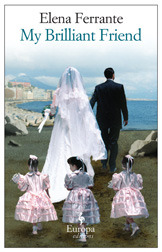
My Brilliant Friend by Elena Ferrante

I missed only Lila, Lila who didn't answer my letters.  I was afraid of what was happening to her, good or bad, in my absence.  It was an old fear, a fear that has never left me: the fear that, in losing pieces of her life, mine lost intensity and importance.  And the fact that she didn't answer emphasized that preoccupation.  However hard I tried in my letters to communicate the privilege of the days in Ischia, my river of words and her silence seemed to demonstrate that my life was splendid but uneventful, which left me time to write to her every day, while hers was dark but full.

The most surprising and satisfying moment in My Brilliant Friend, the first of Elena Ferrante's critically lauded "Neapolitan" novels, is when Lina Cerullo, the shoemaker's daughter, calls the narrator, Elena Greco, "my brilliant friend."  It surprises because over the course of the novel, you assume that the "brilliant friend" of the title is not Elena but Lina: darkly beautiful, preternaturally confident, sharply intelligent, exceptional, detached, frightening.  It's Lina who, as a child, forces Elena to face her greatest fears by dropping her doll down a sewer grate, or making her walk up to the apartment of the terrifying mafioso who runs their working-class Naples neighborhood:

Not too long before--ten days, a month, who can say, we knew nothing about time, in those days--she had treacherously taken my doll and thrown her down into a cellar.  Now we were climbing toward fear; then we had felt obliged to descend, quickly, into the unknown.  Up or down, it seemed to us that we were always going toward something terrible that had existed before us yet had always going down toward something terrible that had existed before us yet had always been waiting for us, just for us.

When Lina proves to be the most intelligent student in the school, it's Elena's admiration for her that forces her to push herself in her studies.  Eventually, Lina leaves school to work in her father's cobbler's shop, but Elena stays on.  All of her success is, in a vague but meaningful way, attributable to Lina, either borrowed from her or achieved in competition with her, or perhaps both.  Ferrante manages to take a very basic idea--jealousy toward an exceptional friend, and the way that it can be mixed with admiration and love--and build from it a detailed and convincing life.  Elena's complex feelings toward Lina strike both positive and sour notes.  It's clear that Lina drives Elena to be exceptional herself, but there is something tragic about Elena's obsessive comparison with her friend, and with others: she can't even bring herself to believe in the Trinity because she can't conceive that the three aspects of God wouldn't be hierarchically ordered.  It's an obsession that manifests itself in the repeated, desperate accounting of how Elena compares to the other students in her school, and even well after Lina leaves school, it's Lina she's always comparing herself to.

Lina's exceptionalism drives Elena to imagine a world outside the poor Naples neighborhood in which they were born.  But Lina, while exceptional, is unable to propel herself out of the orbit of the neighborhood.  It's Lina who is drawn into the petty squabbles of local boys, and attracts the interest of the tinpot tyrants who basically run the community.  The reversal of fortunes happens slowly but convincingly, so that when Lina calls Elena her "brilliant friend," it alerts you, for the first time, that it is Elena who has been able to resist the punishing effects of poverty.

Ferrante's novels--my understanding is that they really are a single novel split into four parts--are very much the "it" books of the moment.  I usually react negatively to stuff like that, because I am a snob, and descriptions of the series didn't make them seem appealing.  But there's a darker streak running through these novels that I didn't expect and that I love: a streak of poverty, and death, and intergenerational hatred, all of which is somehow incarnated in the figure of Lina.  In many ways, too, reading My Brilliant Friend reproduces the feeling of sinking your teeth into a big fat Russian novel with a bunch of characters, or George Eliot at her best.  The accolades are, in this case, well-deserved.