Showing posts with label Jane Eyre. Show all posts

Sunday, April 17, 2016

Wide Sargasso Sea by Jean Rhys

'Is it true,' she said, 'that England is like a dream?  Because one of my friends who married an Englishman wrote and told me so.  She said this place London is like a cold dark dream sometimes.  I want to wake up.'

'Well,' I answered annoyed, 'that is precisely how your beautiful island seems to me, quite unreal and like a dream.'

'But how can rivers and mountains and the sea be unreal?'

'And how can millions of people, their houses and their streets bu unreal?'

'More easily,' she said, 'much more easily.  Yes a big city must be like a dream.'

'No, this is unreal and like a dream,' I thought.

Jean Rhys' Wide Sargasso Sea presents the story of Bertha Mason--whose name is really Antoinette Cosway--the mad wife of Mr. Rochester in Jane Eyre, who is imprisoned in Rochester's attic and appears, from time to time, to light things on fire and generally make things difficult for Jane.  Bronte's depiction of Bertha can seem almost like a parody of Victorian literature, which banishes to the metaphorical attic both the victims of colonialism (think of the slaves on Thomas Bertram's plantations in Mansfield Park) and women who, unlike Jane Eyre, cannot be meek or pure.

Rhys starts by situating Antoinette in a difficult place in her native Jamaica: she is a Creole woman of both black and white descent, and therefore a kind of outsider even before she meets Rochester and is spirited away to England.  Her black neighbors treat her family with suspicion, calling them "white niggers."  In a frightening, evocative scene which the novel never is really able to reproduce, Antoinette's black neighbors burn her family's estate to the ground.  Antoinette's brother dies in the fire, and so does her parrot:

I opened my eyes, everybody was looking up and pointing at Coco on the glacis railings with his feathers alight.  He made an effort to fly down but his clipped wings failed him and he fell screeching.  He was all on fire.

The parallels to Antoinette/Bertha, who spends much of Jane Eyre setting stuff on fire and eventually dies in a conflagration of her own making, are clear.  Like Coco, Antoinette is a beautiful thing doomed to suffer at the hands of oppressive forces.  Rumors of her mother's insanity dog her all her life, but no one seems interested in recognizing this destruction as a pretty good reason to go insane.  Antoinette becomes the mad Bertha, yes, but Rhys wants us to ask why.

Rhys style is laconic, spare, and effective.  It leaves out much more than it says.  Rochester is never named, though he is the narrator of half the novel.  She has a knack for leaving out key information that makes the novel mysterious and compelling, but not particularly easy to read, despite the simplicity of its language.  The reasons for the dissolution of Antoinette and Rochester's marriage--he comes to believe that she has married him to steal his money, I think, partly thanks to a troublemaker who claims to be Antoinette's brother--are difficult to follow.

The most unforgivable thing about Wide Sargasso Sea, though, is that it makes no real attempt to reproduce the character of Mr. Rochester, whose sarcasm and megalomania are the some of the most compelling aspects of Jane Eyre.  It seems like missing the point to judge Wide Sargasso Sea by the quality and character of Jane Eyre, I know.  But it wouldn't take much tweaking to turn Rochester, who is already a quite suspicious and not quite trustworthy character, into a bitter, scheming colonialist.  He spends most of Jane Eyre running roughshod over Jane's psyche, after all.  But Rhys doesn't seem interested in Rochester, especially, even as a narrator; it's Antoinette she wants us to think about it.  That's all well and good, but why make Rochester a narrator at all?

I wonder how much one might get out of this novel if they'd never read Jane Eyre.  But I also wonder if it might not be better--and able to stand on its own considerable merits--without the ghost of Jane Eyre hovering around.

Saturday, October 16, 2010

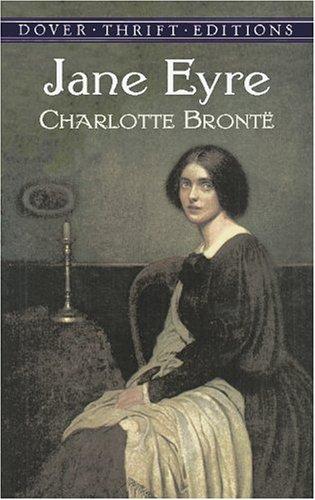
Jane Eyre by Charlotte Bronte

But what is so headstrong as youth? What so blind as inexperience? These affirmed that it was a pleasure enough to have the privilege of again looking on Mr. Rochester, whether he looked on me or not; and they added--"Hasten! hasten! be with him while you may: but a few more days or weeks at most, and you are parted with him for ever!" and then I strangled a new-born agony--a deformed thing which I could not persuade myself to own and rear--and ran on.

Jane Eyre is not so much like Austen as I had thought, though perhaps in certain superficialities. Jane fits the Emma-Elizabeth mode well enough in her wit and her strength of character, but unlike those other heroines she is all earnestness; because she writes in first person we are not permitted to admire her from a distance, and we are precluded from those wonderful Austenian ironies that Charlotte Bronte seems to have disdained.

Jane is an orphan, loathed by her adoptive aunt and shuffled off to a long and spartan childhood at a boarding school before eventually becoming the governess to a young French girl named Adele. Adele is the ward of Edward Fairfax Rochester, who is Jane Eyre's finest achievement. Chesterton calls him "primevally and supernaturally caddish," and so he is, continuously prodding Jane with deadpan jokes, half-truths, and pranks that signify a cerebral form of flirtation. Naturally, the connection between the two seems destined to triumph over their difference in station. Jane, for her part, is never so engaging or appealing as when she is in conversation with Mr. Rochester:

He chuckled; he rubbed his hands: "Oh, it is too rich to see and hear her!" he exclaimed. "Is she original? Is she piquant? I would not exchange this one little English girl for the grand Turk's whole seraglio; gazelle-eyes, houri forms and all!"

The eastern allusion bit me again: "I'll not stand you an inch in the stead of a seraglio," I said; "so don't consider me an equivalent for one; if you have a fancy for anything in that line, away with you, sir, to the bazars of Stamboul without delay; and lay out in extensive slave-purchases some of that spare cash you seem at a loss to spend satisfactorily here."

"And what will you do, Janet, while I am bargaining for so many tons of flesh and such an assortment of black eyes?"

"I'll be preparing myself to go out as a missionary to preach liberty to them that are enslaved--your harem inmates among the rest. I'll get admitted there, and I'll stir up mutiny; and you, three-tailed bashaw as you are, sir, shall in a trice find yourself fettered amongst our hands: nor will I, for one, consent to cut your bonds till you have signed a charter, the most liberal that despot ever yet conferred."


Mr. Rochester compels because Bronte has ceded to him the power of irony; he is an ironist and when she is with him, Jane, who otherwise seems nearly incapable of it, is an ironist as well. His flaws are numerous and deep: He tortures Jane by repeatedly intimating that he is to marry a local heiress--even disguising himself as a traveling gypsy fortune-teller to suggest it!--but there is no doubting that when Jane is with him she is her fullest self. The book's middle section, before the two are driven apart suddenly, contains some of the best romantic dialogue ever written:

"Because," he said, "I sometimes have a queer feeling with regard to you--especially when you are near me, as now: it is as if I had a string somewhere under my left ribs rightly and inextricably knotted to a similar string situated in the corresponding quarter of your little frame. And if that boisterous channel, and two hundred miles or so of land come broad between us, I am afraid that cord of communion will be snapt; and then I've a nervous notion I should take to bleeding inwardly."


But Mr. Rochester has a terrible secret--I won't reveal it here, but I will say it forms the basis of Jean Rhys' postcolonial novel Wide Sargasso Sea--and when it is revealed the marriage is quickly derailed. Jane escapes, nearly dying from destitution before finding respite in the home of St. John Rivers, an impossibly virtuous but unfeeling parson. This portion, and the portions before Jane meets Mr. Rochester, are appealing in their way but pale in comparison to Mr. Rochester's presence.

One peculiar thing I have noticed about the book: It has a surfeit of Johns. Jane's stepbrother is a John; her uncle and father both Johns; there is a servant named John; there is St. John Rivers; "Jane" itself is a female variant of "John." Jane Eyre is an explicitly Christian book, and I believe that the recurrence of the name John suggests that Bronte intended it as a meditation of proper servanthood. The saint in "St. John" is St. John the Baptist, whose obedience to God necessitated a life of severe self-sacrifice and who, as the Precursor, became a model for Christ and the fulfillment of God's covenant. St. John Rivers tries icily to goad Jane into marrying him and following him in his missionary work to India, but it is not in St. John's power to define the terms of Jane's faithfulness. In a way, Jane Eyre is the story of the formation of those terms; Jane rankles under the capriciousness of authority in her childhood home and at boarding school because her masters are not so good at being masters as God is, nor, for that matter, are Mr. Rochester and St. John, the novel's principal male characters. Jane has an enormous capacity for love and a servant's heart, but until the very end Bronte refuses to provide a master who is worthy of Jane's unparalleled goodness.

In that way Jane is very un-Austenian, though Mr. Rochester seems very much like he could have been transported in directly from something like Northanger Abbey. I liked Jane Eyre immensely, but I think it's worth noting that Bronte--who thought that Austen lacked a certain moral seriousness--is at her best when she is closest to Austen, and not embracing the tiresome tropes of Gothic literature.