Showing posts with label Jamaica. Show all posts

Thursday, March 1, 2018

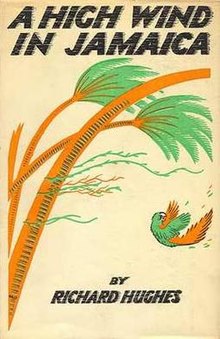
A High Wind in Jamaica by Richard Hughes

Jamaica had faded into the past.  England to which they had supposed they were going, and of which a very curious picture had formerly been built up in their minds by their parents' constant reference to it, receded again into the mists of myth.  They lived in the present, adapted themselves to it, and might have been born in a hammock and christened at a binnacle before the had been there many weeks.  They seemed to have no natural fear of heights, and the farther they were above the deck, the happier.

The Bas-Thornton children live in Jamaica with their parents, but when a terrible hurricane levels their estate, the parents decide that it's time the children were educated in England.  They send the kids off on what is to be a lengthy voyage by ship, but along the way, the ship is boarded by pirates.  The pirates take everything they can, including the kids.  They're kind of a nuisance to have upon a pirate ship--always underfoot, inventing games, chasing the pig or the monkey, making common objects into dolls, getting in the rigging, murdering captured sailors out of abject fear--but in a matter of months the impressionable children have pretty much forgotten all about their former life.

A High Wind in Jamaica is, above all things, a study in the peculiarity of children.  The pirates are an odd bunch, but they hold no candle to the eccentricities of the Bas-Thornton kids, for whom the pirate ship adventure is all mixed up with imagination and ignorance.  Hughes does a good job capturing the mental processes of kids, especially with the oldest, Emily, who idly suspects that she might be God--a clever sort of expression of the way the experience of youth is suffused with an infinite possibility that is whittled down as you become a teenager.  But he refuses to enter the consciousnesses of the younger kids, insisting that it is almost impossible:

Possibly a case might be made out that children are not human either: but I should not accept it.  Agreed that their minds are not just more ignorant and stupider than ours, but differ in kind of thinking (are mad, in fact): but one can, by an effort of will and imagination, think like a child at least in a partial degree--and even if one's success is infinitesimal it invalidates the case: while one can more think like a baby, in the smallest respect, than one can think like a bee.

Hughes walks an interesting tightrope here, capturing the life of children as well as he does while still operating at a remove from them that suggests he doesn't really know what's going on in their minds at all.

He shows us how mutable they can be, for one.  Life on a pirate ship, for a child, is no more nightmarish or weird than the productions of their own brains.  See how Emily treasures the memory of the earthquake she experienced in Jamaica as a real happening, but seems to have no recognition that being captured by pirates is something out of the ordinary.  (In fact, most of the children seem unaware that they've been captured at all, assuming that the transfer from one ship to another is just a part of the voyage they keep forgetting.)  There are more chilling--and spoilery--examples.  One of the children dies by falling from a parapet in Cuba, trying to see a fight between circus animals, and is quickly forgot by all of his siblings.  (Hughes does a good job making us forget him, too, until the end when the children are reunited with their parents, and their mother asks, "Wait, where's John?")  Somehow worse than that is the coda, when Emily, who grows close to the captain Jonsen over the voyage, in the unexamined way that children do, takes the stand in England and fails to exonerate the captain for a murder he did not commit, never realizing that she sends him to the gallows.

A High Wind in Jamaica is weird, funny, and dark, a kind of poisonous take on Peter Pan, which itself is actually quite dark.  Here it's the pirates who are the victims, locked out as they are from the impenetrable psyche of their own captives, who can't even understand that they are captive.  Unlike Peter Pan, in which growing up is frightening specter, it's childhood itself that is terrifying.

Sunday, April 17, 2016

Wide Sargasso Sea by Jean Rhys

'Is it true,' she said, 'that England is like a dream?  Because one of my friends who married an Englishman wrote and told me so.  She said this place London is like a cold dark dream sometimes.  I want to wake up.'

'Well,' I answered annoyed, 'that is precisely how your beautiful island seems to me, quite unreal and like a dream.'

'But how can rivers and mountains and the sea be unreal?'

'And how can millions of people, their houses and their streets bu unreal?'

'More easily,' she said, 'much more easily.  Yes a big city must be like a dream.'

'No, this is unreal and like a dream,' I thought.

Jean Rhys' Wide Sargasso Sea presents the story of Bertha Mason--whose name is really Antoinette Cosway--the mad wife of Mr. Rochester in Jane Eyre, who is imprisoned in Rochester's attic and appears, from time to time, to light things on fire and generally make things difficult for Jane.  Bronte's depiction of Bertha can seem almost like a parody of Victorian literature, which banishes to the metaphorical attic both the victims of colonialism (think of the slaves on Thomas Bertram's plantations in Mansfield Park) and women who, unlike Jane Eyre, cannot be meek or pure.

Rhys starts by situating Antoinette in a difficult place in her native Jamaica: she is a Creole woman of both black and white descent, and therefore a kind of outsider even before she meets Rochester and is spirited away to England.  Her black neighbors treat her family with suspicion, calling them "white niggers."  In a frightening, evocative scene which the novel never is really able to reproduce, Antoinette's black neighbors burn her family's estate to the ground.  Antoinette's brother dies in the fire, and so does her parrot:

I opened my eyes, everybody was looking up and pointing at Coco on the glacis railings with his feathers alight.  He made an effort to fly down but his clipped wings failed him and he fell screeching.  He was all on fire.

The parallels to Antoinette/Bertha, who spends much of Jane Eyre setting stuff on fire and eventually dies in a conflagration of her own making, are clear.  Like Coco, Antoinette is a beautiful thing doomed to suffer at the hands of oppressive forces.  Rumors of her mother's insanity dog her all her life, but no one seems interested in recognizing this destruction as a pretty good reason to go insane.  Antoinette becomes the mad Bertha, yes, but Rhys wants us to ask why.

Rhys style is laconic, spare, and effective.  It leaves out much more than it says.  Rochester is never named, though he is the narrator of half the novel.  She has a knack for leaving out key information that makes the novel mysterious and compelling, but not particularly easy to read, despite the simplicity of its language.  The reasons for the dissolution of Antoinette and Rochester's marriage--he comes to believe that she has married him to steal his money, I think, partly thanks to a troublemaker who claims to be Antoinette's brother--are difficult to follow.

The most unforgivable thing about Wide Sargasso Sea, though, is that it makes no real attempt to reproduce the character of Mr. Rochester, whose sarcasm and megalomania are the some of the most compelling aspects of Jane Eyre.  It seems like missing the point to judge Wide Sargasso Sea by the quality and character of Jane Eyre, I know.  But it wouldn't take much tweaking to turn Rochester, who is already a quite suspicious and not quite trustworthy character, into a bitter, scheming colonialist.  He spends most of Jane Eyre running roughshod over Jane's psyche, after all.  But Rhys doesn't seem interested in Rochester, especially, even as a narrator; it's Antoinette she wants us to think about it.  That's all well and good, but why make Rochester a narrator at all?

I wonder how much one might get out of this novel if they'd never read Jane Eyre.  But I also wonder if it might not be better--and able to stand on its own considerable merits--without the ghost of Jane Eyre hovering around.

Tuesday, April 22, 2008

Live and Let Die by Ian Fleming

Last year my friend and fellow history grad student wrote a paper about James Bond. I think it was for a class that dealt with British Empire, but I'm not sure. She read On Her Majesty's Secret Service because it was the only book in which Bond was married, From Russia with Love because it dealt with the Middle East, and Live and Let Die because it focused on Harlem and Jamaica. She concluded that beyond the obvious chauvinism, these books often had an undercurrent of xenophobia and homophobia...and even ophidiophobia. Actually, that last one may have been from her paper on Indiana Jones. Apparently she has a thing for adventurous men.

Last year I read Casino Royale, the first of the Bond series, and completely agreed with Maribeth about Bond's chauvinistic tendencies. Casino Royale was alright, nothing great. Live and Let Die, the second of the series, was much better in plot and style, and the chauvinism was not so abrasive. However, it appears that Fleming simply traded in one ism for another. Bond is not overtly racist in the book, but some of the descriptions and subtleties of language make it easy to level the charge at Fleming. At best, he was woefully ignorant about issues of race.

Let me try to quickly summarize the plot...
The British government suspects that someone has found the treasure of Bloody Morgan, a 17th Century pirate whose actions were sanctioned by the Crown because he mostly attached Spanish ships off the coast of Jamaica. A few months before Bond became involved, gold coins started turning up in Harlem. M tells Bond that they are fairly certain a mysterious Mr Big is involved with the smuggling of these coins. Bond is assigned to work with the CIA and the FBI on the case, beginning in Harlem and ending in Jamaica. His goal is to find and recover the treasure, which Britain sees as rightly theirs.

The way that Fleming depicts Harlem is amusing. It's as if he believed the black community to be completely monolithic. They all are under the thumb of Mr Big. Everyone does his bidding, above all else. And the reason for this: they think he is the zombie of Baron Samedi the Chief of the Legion of the Dead, according to Jamaican island lore. The incredibly misguided assumption is that most blacks who live in Harlem are from Jamaica, or at least believe in its spiritual practices. Of course, neither were true. Fleming's descriptions often evoke exoticism and notions of otherness. He refers to "the secret voodoo language" known only by these people and the "sixth sense of fish, of birds, of negroes." Issues such as these fall squarely into the "uninformed" category. But some of Fleming's other statements cannot be judged so lightly. Describing a bar in Harlem, he writes, "It was hot and the air was thick with smoke and the sweet, feral smell of two hundred negro bodies." Fleming likes to put the word "sweet" in unsavory situations. In Casino Royale, he wrote, "And now [Bond] knew that she was profoundly, excitingly sensual, but that the conquest of her body, because of the central privacy in her, would each time have the sweet tang of rape." At a later point in Live and Let Die, Fleming refers to some black villains as "clumsy black apes."

Besides what are very likely some of Fleming's personal shortcomings showing through in his work, his writing is fairly good. It improved dramatically from Casino Royale. And the Bond of the books is a much more interesting character than the Bond of the big screen. He has doubts, fears, pains, and experiences heartbreak. He is not simply some flippant cad. One passage that I thought was particularly good was the thoughts of Bond as he flew in a small plane to Jamaica. He was realizing just how fragile life is, how much his existence hinges on others. Bond thinks,

You are linked to the ground mechanic's careless fingers in Nassau just as you are linked to the weak head of the little man in the family saloon who mistakes the red light for the green and meets you head-on, for the first and last time, as you are motoring quietly home from some private sin. There's nothing to do about it. You start to die the moment you are born. The whole of life is cutting through the pack with death. So take it easy. Light a cigarette and be grateful you are still alive as you suck the smoke deep into your lungs. Your stars have already let you come quite a long way since you left your mother's womb and whimpered at the cold air of the world. Perhaps they'll even let you get to Jamaica tonight.

Despite some of its problems, Live and Let Die can be appreciated for its action and suspense. Fleming does a great job with both.

_______________________________

As a sidenote, this book is leaps and bounds better than the movie (surprise, surprise). Live and Let Die was the first Bond movie starring Roger Moore, who ushered in the stupid, campy era of Bond. The movie fluctuates between laughably bad and just plain bad. There are only two good things about it: Jane Seymour and the Paul McCartney & Wings song. Best Bond song ever.