I'd known what she would say, and I hated hearing her say it. At 41 I still longed to be thought of as open and good, to seem wonderfully transparent (and transparently wonderful, no doubt). It hurt to be thought of as a spook. Not because by that time it had become shameful but because it was simply wrong.
I had gone through something like this already. Many people in Paris "knew" I was gay, because for years I used to dine several times a week with my best friend, and he was gay. QED. I didn't disapprove of homosexuality, on the contrary; but how could people see me for whoever I was if they made such a basic mistake?
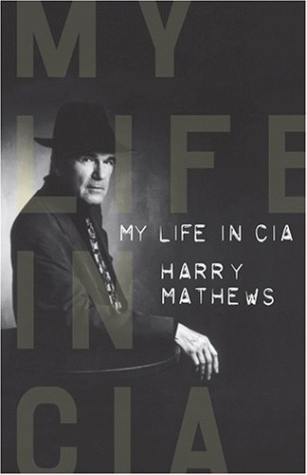
My Life in CIA is Harry Mathews' memoir, ostensibly, of a period in his life in which people believed he was an American intelligence agent working in Paris. God only knows if the real Mathews ever experienced anything like this, but if he did, it certainly didn't play out the way it happens in the novel, though its verisimilitude is bolstered with real friends of Mathews' like the French writer Georges Perec. As Mathews tells it, the rumor came out of his time spent in Laos with a friend who was an American ambassador there, and at first he claims that it caused him shame and consternation, until a friend recommended that he lean into it and make a game out of it.
For Mathews, who was associated with the formalist French literary school Oulipo, complicated "games" are what life and literature are all about, and he goes about this game in a particularly Oulipo way. Recognizing that any real CIA agent would have a job, he starts an ersatz travel company; his first job is to give a speech to group of men who have "travel-stress dyslexia" that make catching planes and trains difficult. He suggests only traveling at times that are palindromes, seeding his explanations with train times to remote Siberian nuclear sites--train times, palindromes, that's the Oulipo stuff, though here it seems rather tame compared to the complex wordplay of a novel like The Sinking of Odradek Stadium.
Anyone can see where My Life in CIA is headed, the same place that a couple dozen more straight-faced books and films head, too: Mathews gets mixed up with the real CIA, real Communists, real right-wing agitators, and eventually gets in over his head. The setup promises hijinks, and delivers: at one point Mathews is rolled up nude in a priceless Persian rug and delivered by coincidence to a banquet of violent right-wingers. At the dinner they discover he's a poet and make him play silly poetry games that force him, quite gleefully, to rhyme "jonquil" with "tronquil." It's extremely goofy. Right after that he makes love to a little person.
Women and sex are another element of the game here: Mathews' depiction of himself is a sort of James Bond-like womanizer, irresistible to women. The little person is one, but there are a half dozen other women clamoring for him, too; and three of them are named Marie-Claude. One of them, who induces Mathews into the mysteries of touchless tantric sex, has the hilarious name of "Marie-Claude Quintelpreaux," which is a very good COINTELPRO joke that I felt very smug for getting. The joke Mathews plays on himself is that, even though he has the seductive quality of a good literary spy, every single attempt made at actual fucking in the book is interrupted. That's how you end up naked in a rug.
At the heart of My Life in CIA are questions of identity: if enough people say Mathews is CIA, could that make him actually CIA? The novel is set during in the early 70's, in the hangover left by the 60's counterculture and by Vietnam, and the CIA is up to no good, getting mixed up, among other things, with Pinochet's coup d'etat in Chile. Though Mathews isn't really a CIA agent, the rise of Pinochet makes him feel guiltily implicated, and the real life bounty on his head threatens to collapse his false identity and the real one.
My Life in CIA is a lot of fun, but something about it made me feel like it could never be as fun for the reader as it is for Mathews, or maybe for poor mixed-up George Perec. There's promise in Mathews' desire to play with his own real world identity, to blur the lines of novel and memoir, but it's not like he's someone whose public persona ever mattered much in the first place, so as a postmodern experience the novel falls a little flat. But I enjoyed it all the same.
Showing posts with label Harry Mathews. Show all posts
Monday, May 25, 2020
My Life in CIA by Harry Mathews
Labels:
Harry Mathews,
My Life in CIA,
Oulipo
Sunday, June 24, 2018
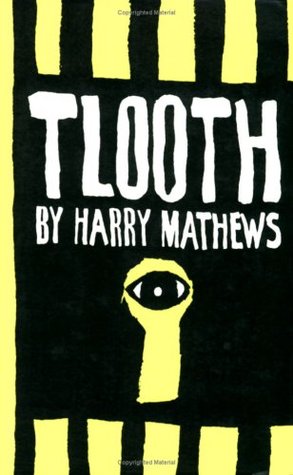
Tlooth by Harry Mathews
Sister Agnes: There is no inch in the world without God. I breathe him, the birds of heaven breathe him, fish breathe him in the deepest waters where air cannot be seen or felt, but where air is. Man walks and dies; he breathes and becomes breath--as if a dolphin flying skyward were snatched forever into a net of air.
It is the Mother Superior's turn to speak. Sipping a glass of water, she sighs, "Sister Agnes, show me your ass."
Harry Mathews' Tlooth begins in a Siberian prison camp, where the prisoners are split into "sects" based on their religious beliefs. The Defective Baptists are playing the Fideists in baseball. The narrator has secretly packed a baseball with dynamite, and is planning to use it to kill Evelyn Roak, the surgeon who accidentally, or perhaps maliciously, removed the narrator's middle two fingers, ruining a promising career as a violinist. The plan doesn't work, thanks to a wild pitch, but when Roak is released from prison, it sets off a long chase across several continents.
Like The Sinking of the Odradek Stadium, Tlooth is full of gratuitous wordplay and puzzles of all sorts. But it's not always easy to tell what is and what isn't a puzzle, something to be figured out. When the narrator's traveling band is accosted in the Eurasian steppes by a group of nomad kings who offer a kind of repetitive poem-song, is that a puzzle? Is there a solution lurking in there somewhere that makes the whole thing satisfying on a level beyond the exotic strangeness of the scene? Or is it all like the poem traced on the labyrinth of their animal-shaped derby racer (another tradition of the prison camp, like the baseball games), which leads to the same spot where it began? There's a Nabokov-like suggestion running throughout the book that the puzzles, whatever they are, are to no purpose, and that deciphering the wordplay is a kind of fool's game.
In Odradek, I didn't mind the wordplay because, even when it seemed self-referential or circuitous, it was grounded by the relationship between the two main characters, who have overcome their linguistic differences to fall in love, or so they think. The revenge narrative of Tlooth seems to offer something similar, but less successfully. Mostly, it seems to offer a set of open-ended questions. What am I supposed to make of the long digression in which the narrator pens a scene for a pornographic "blue movie?" (I did like the bit of dialogue I quoted up at top, though.) What's the point of giving most of the characters ambiguously gendered names, and only revealing that the narrator--and Roak--are female toward the very end of the novel? It certainly toys cleverly with my sense of character, and chastises me for coding the revenge plot as male. But I couldn't shake a feeling of boredom, a sense that the answer to these questions is that there is no answer. I admit that I didn't always "get" Tlooth, but neither am I sure what there is to get.
Along the way, at least, Tlooth offers up a bunch of fun little vignettes. The title comes from a moment when the protagonist sticks her foot in a prophetic bog, which tells her fortune in a gas bubble: "Tlooth." Her prison training as a dentist is what allows the protagonist to finally get her revenge. But it's a reference also to the "truth," something which the novel is not very forthcoming with, and when it does offer something like it, it's slightly off, put through the wringer of wordplay: Tlooth.
It is the Mother Superior's turn to speak. Sipping a glass of water, she sighs, "Sister Agnes, show me your ass."
Harry Mathews' Tlooth begins in a Siberian prison camp, where the prisoners are split into "sects" based on their religious beliefs. The Defective Baptists are playing the Fideists in baseball. The narrator has secretly packed a baseball with dynamite, and is planning to use it to kill Evelyn Roak, the surgeon who accidentally, or perhaps maliciously, removed the narrator's middle two fingers, ruining a promising career as a violinist. The plan doesn't work, thanks to a wild pitch, but when Roak is released from prison, it sets off a long chase across several continents.
Like The Sinking of the Odradek Stadium, Tlooth is full of gratuitous wordplay and puzzles of all sorts. But it's not always easy to tell what is and what isn't a puzzle, something to be figured out. When the narrator's traveling band is accosted in the Eurasian steppes by a group of nomad kings who offer a kind of repetitive poem-song, is that a puzzle? Is there a solution lurking in there somewhere that makes the whole thing satisfying on a level beyond the exotic strangeness of the scene? Or is it all like the poem traced on the labyrinth of their animal-shaped derby racer (another tradition of the prison camp, like the baseball games), which leads to the same spot where it began? There's a Nabokov-like suggestion running throughout the book that the puzzles, whatever they are, are to no purpose, and that deciphering the wordplay is a kind of fool's game.
In Odradek, I didn't mind the wordplay because, even when it seemed self-referential or circuitous, it was grounded by the relationship between the two main characters, who have overcome their linguistic differences to fall in love, or so they think. The revenge narrative of Tlooth seems to offer something similar, but less successfully. Mostly, it seems to offer a set of open-ended questions. What am I supposed to make of the long digression in which the narrator pens a scene for a pornographic "blue movie?" (I did like the bit of dialogue I quoted up at top, though.) What's the point of giving most of the characters ambiguously gendered names, and only revealing that the narrator--and Roak--are female toward the very end of the novel? It certainly toys cleverly with my sense of character, and chastises me for coding the revenge plot as male. But I couldn't shake a feeling of boredom, a sense that the answer to these questions is that there is no answer. I admit that I didn't always "get" Tlooth, but neither am I sure what there is to get.
Along the way, at least, Tlooth offers up a bunch of fun little vignettes. The title comes from a moment when the protagonist sticks her foot in a prophetic bog, which tells her fortune in a gas bubble: "Tlooth." Her prison training as a dentist is what allows the protagonist to finally get her revenge. But it's a reference also to the "truth," something which the novel is not very forthcoming with, and when it does offer something like it, it's slightly off, put through the wringer of wordplay: Tlooth.
Labels:
Harry Mathews,
Tlooth
Sunday, July 23, 2017
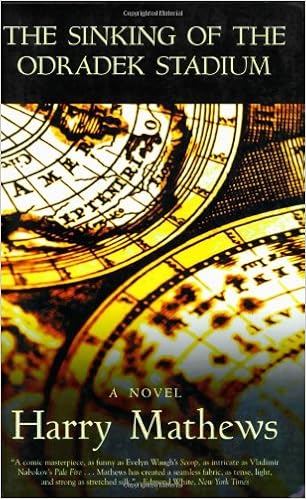
The Sinking of the Odradek Stadium by Harry Mathews
I shall reminder, and do you, that the life in time is a wheel, and one point sole of the rim touching the earth, a creature is alive but at the point, the rim's points gone by are death, the points coming are not alive, when they come the now will be dead. It shall be new creatures.
Zachary McCaltex is a librarian living in Miami; his wife Twang Panattapam, a native of the fictional Southeast Asian country of Pan-Nam, is living in Florence, Italy. The Sinking of the Odradek Stadium is composed of their letters to each other, discussing a lost Italian treasure they believe has disappeared off of the Florida coast, and how much they miss each other.
Harry Matthews was known as the only American member of Oulipo, a French writing collective whose authors set for themselves strange linguistic games. In Odradek Stadium that manifests in Twang's letters, which are a kind of pidgin-English meant to reflect a half-successful translation from the fictional language of Pan:
The mistakes, such as they are, have regularity because they come from a clearly conceived linguistic structure. Pan, you might infer, has no gerund but only infinitives; see Twang's memory of Zachary's "to-come" in her small town, rather than his coming. She mixes up "c" and "h," suggesting something about the pronunciation of Pan. Mathews uses her unfamiliar English vocabulary to make a number of small pomo jokes: she describes a radio program describing a fire as a "pogrom," rather than a program; a beautiful blue geranium becomes a "cranium."
A scheme like this would easily devolve into condescension and Orientalism, but Mathews makes Twang self-evidently intelligent and wise. From her place in Florence she is the chief researcher regarding the treasure; she uncovers the story of its inheritance bit-by-bit. She tries to recommend a kind of Buddhist wisdom to Zachary, though her zen koans tend to be lost entirely in translation. And what's more, her English gets progressively better over the course of the novel--so slowly that it's actually difficult to notice.
Even still, the main theme of the novel is how much gets lost in translation. Zachary and Twang, though they know each other better and more intimately than they do anyone else in the world, frequently misunderstand each other. A secret letter, in which Twang confesses that she knows her associates in Italy are reading her mail and so she is going to salt her letters with misinformation, gets lost in the mail, muddying the linguistic waters even more. They get so mixed up, in fact, that Zach boards a plane to Florence at the same time Twang boards one to Miami, and so they miss each other completely.
In his letters, Zachary tells the story of his induction into Florida's premier secret society, the Knights of the Spindle. He accepts in part because he wants to get close to the head of the society, who bankrolls treasure-hunting expeditions, but he's also flattered to be admitted into arcane truths (itself a kind of postmodern commentary on the theme of the accessibility of knowledge and communication). These scenes borrow their comic wildness from The Crying of Lot 49, and can be really funny. They play rec-league baseball against other secret societies, and at one point their libidinous party in their secret sewer lair is interrupted by municipal workers, who join them in their revels. The Miami of Odradek is a fanstasia of occult Carnival festivities that seem more appropriate to New Orleans, but exaggerated to riotous lengths. It's better, I'm sure, than being in the real Florida.
In the end, The Sinking of Odradek Stadium achieves the most difficult thing that a postmodern language-obsessed can achieve: it strikes an emotional chord. After their relationship seems to have utterly dissolved--Zachary, going slightly mad, loses all the hair on his body--Twang discovers the missing letter, marked return to sender, and says some very beautiful things in her newfound English:
Zachary McCaltex is a librarian living in Miami; his wife Twang Panattapam, a native of the fictional Southeast Asian country of Pan-Nam, is living in Florence, Italy. The Sinking of the Odradek Stadium is composed of their letters to each other, discussing a lost Italian treasure they believe has disappeared off of the Florida coast, and how much they miss each other.
Harry Matthews was known as the only American member of Oulipo, a French writing collective whose authors set for themselves strange linguistic games. In Odradek Stadium that manifests in Twang's letters, which are a kind of pidgin-English meant to reflect a half-successful translation from the fictional language of Pan:
I've the memry of your to-come in my town. Our dog in the under-house likes you, he make the strange woof of tendernes and sensure--then, I have interest in you. And hiss. Do not put a way your memery of the litlte money you will send. Do not think, the of-Nau things be roots, they are tirds, yet are OK if you act only little. I & you; harmnony; peace.
The mistakes, such as they are, have regularity because they come from a clearly conceived linguistic structure. Pan, you might infer, has no gerund but only infinitives; see Twang's memory of Zachary's "to-come" in her small town, rather than his coming. She mixes up "c" and "h," suggesting something about the pronunciation of Pan. Mathews uses her unfamiliar English vocabulary to make a number of small pomo jokes: she describes a radio program describing a fire as a "pogrom," rather than a program; a beautiful blue geranium becomes a "cranium."
A scheme like this would easily devolve into condescension and Orientalism, but Mathews makes Twang self-evidently intelligent and wise. From her place in Florence she is the chief researcher regarding the treasure; she uncovers the story of its inheritance bit-by-bit. She tries to recommend a kind of Buddhist wisdom to Zachary, though her zen koans tend to be lost entirely in translation. And what's more, her English gets progressively better over the course of the novel--so slowly that it's actually difficult to notice.
Even still, the main theme of the novel is how much gets lost in translation. Zachary and Twang, though they know each other better and more intimately than they do anyone else in the world, frequently misunderstand each other. A secret letter, in which Twang confesses that she knows her associates in Italy are reading her mail and so she is going to salt her letters with misinformation, gets lost in the mail, muddying the linguistic waters even more. They get so mixed up, in fact, that Zach boards a plane to Florence at the same time Twang boards one to Miami, and so they miss each other completely.
In his letters, Zachary tells the story of his induction into Florida's premier secret society, the Knights of the Spindle. He accepts in part because he wants to get close to the head of the society, who bankrolls treasure-hunting expeditions, but he's also flattered to be admitted into arcane truths (itself a kind of postmodern commentary on the theme of the accessibility of knowledge and communication). These scenes borrow their comic wildness from The Crying of Lot 49, and can be really funny. They play rec-league baseball against other secret societies, and at one point their libidinous party in their secret sewer lair is interrupted by municipal workers, who join them in their revels. The Miami of Odradek is a fanstasia of occult Carnival festivities that seem more appropriate to New Orleans, but exaggerated to riotous lengths. It's better, I'm sure, than being in the real Florida.
In the end, The Sinking of Odradek Stadium achieves the most difficult thing that a postmodern language-obsessed can achieve: it strikes an emotional chord. After their relationship seems to have utterly dissolved--Zachary, going slightly mad, loses all the hair on his body--Twang discovers the missing letter, marked return to sender, and says some very beautiful things in her newfound English:
It is as that which was tumbled is raised or what was hidden is unclosed, some yellow rose, like the right road pointed to she who was lost or a light brought into the dark for those who have eyes to see. Yes my cheeks are wet.
Subscribe to:
Posts (Atom)