Showing posts with label Dorothy Baker. Show all posts

Monday, March 30, 2020

Young Man with a Horn by Dorothy Baker

That's the story, and it could never be called a grand tragic theme; it does not depict the fall of a noble person from high to low estate--Rick Martin never got anywhere near high estate, though he did make a lot of money for a while.  But it is a story that has the ring of truth and an overtone or two.  It is the story of a number of things--of the gap between the man's musical ability and his ability to fit it to his own life; of the difference between the demands of expression and the demands of life here below; and finally of the difference between good and bad in a native American art form--jazz music.  Because there's good in this music and there's bad.  There is music that is turned out sweet in hotel ballrooms and there is music that comes right out of the genuine urge and doesn't come from money.

Dorothy Baker's Young Man with a Horn is a fictionalized version of jazz giant Bix Beiderbecke, who, while largely forgotten among Americans today, was one of the first real virtuosos of the genre in its early days, and who died tragically and mysteriously young.  Her version of Beiderbecke is Rick Martin: a wayward kid from Los Angeles who discovers an aptitude for music by fooling around with a piano in an unlocked church, and who then finds there's no room for anything else in his life.  It's a story, at least in part, about race: like Beiderbecke, Rick is welcomed into the almost entirely black world of jazz music, and his talents and passion for the music are what are able to overcome the prejudices he's inherited.

Moreover, it's a story about the gifts and poisons of genius; Rick is the best trumpet player in the world because it is the only thing he's able to fit into his life.  Baker underscores this when, in an early scene, the teenage Rick hears that the drummer in the band he adores has suddenly died of a burst appendix.  Rick's best friend Smoke, a world-class drummer in his own right, is going to inherit the job, but while Smoke is wracked with grief, Rick can only think about the band:

"When you going to start?" Rick said.  He didn't have anything to say about death; the only thing he ever had anything to say about was music.  From his own point of view as a pianist and trumpet player he could tell you whether a piece was hard or easy; in a larger sense, as a critic, he could say right off whether a thing was good or bad.  His instinctive taste was infallible within the bounds of his chosen field.  Outside of that he was deaf, dumb, and blind, even slightly halt and more or less lame.  What was death to him; what was plane geometry; what was Spanish Conversation and Composition?  He looked steadily, with appraising eye, at the late George Ward's drums.

I was surprised how different Young Man with a Horn is from Cassandra at the Wedding, a book published almost 25 years later than Young Man, and which possesses a kind of mid-century modernist air that Baker apparently had yet to develop.  In place of Cassandra's third person limited POV, Young Man with a Horn is narrated by an unidentified and unnamed narrator whose account of Rick's life is steeped in vernacular and colloquialisms.  It seems right for the novel, and by the end, the novel itself becomes kind of jazzy, taken up with elaborate counterpoints between Rick, Smoke, bandleader Jeff Williams, and the other early jazz figures that make up Rick's world.  Even Rick's brief and ill-fated marriage to an ironic and aloof woman seems to take on the forms of great jazz improvisation.  At the same time, the narrator--and Baker--are cagey about the ability of the written word to capture the feeling or sensation of music, and while Baker writes lucidly and without repetitiveness about the experience of playing music, her reticence to reach for unsatisfying metaphors or florid language is one of the book's strengths.

Like Beiderbecke, Rick is doomed to die young, a fact that the narrator warns us of from the very outset of the book.  Beiderbecke's death is somewhat of a mystery, but Rick drinks himself to death.  Alternatively, Baker suggests that what really kills him is that love of jazz, a need to play music so powerful there's no room for anything else in Rick's life, even his life itself.  The climax comes when Rick, playing on a recording behind Smoke's sister Josephine (everyone in this L.A. neighborhood seems to grow up to become a jazz virtuoso) when, for the first time in his life, he plays a bum note.  The rumor is that Rick is washed up, that he's finally exhausted his talent, but the bandleader hears something different:

They waited a minute and Jeff went on almost as if he were talking to himself: "I don't know what the hell that boy thinks a trumpet will do.  That note he was going for, that thing he was trying for--there isn't any such thing.  Not on a horn."

Rick dies because his dream has outstripped life; as the note he is imagining cannot be played, so the life he wants to live cannot be lived.  You can't live jazz and only jazz.  But jazz, as genteel and milquetoast as it seems today, strikes me as the only musical form, except for its cousin blues, that might ever have inspired anyone to believe such a thing.  No one seems to be under the impression that trap music might offer a transcendent existence, or house music, unless maybe those on molly.  Young Man with a Horn really gave me a sense of how special it was to be around jazz in those early days and what a loss it is that those days are gone.

Saturday, March 3, 2018

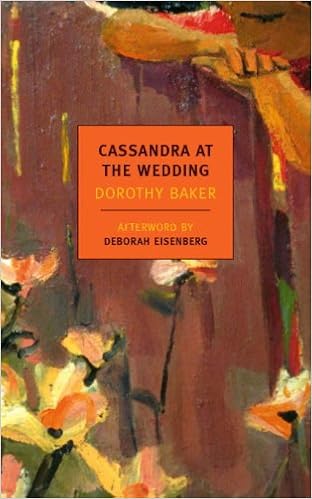
Cassandra at the Wedding by Dorothy Baker

Granny looked sad.  "I've never been able to see anything wrong with your being--"

"Don't say it," I said, "don't say that word."

"Nobody else who is one feels this way about it," gran said in the aggrieved voice she always uses for this particular conversation, the conversation about our condition, so to call it.  I'm sorry to grieve her or deny her the pleasure, but I have to make things clear, because no one of my grandmother's temperament and sensibilities can understand what it's like to be bound to a way of life like ours--a situation we inwardly glory in, but one we have to protect at every turn from the menacing mass of cliches that are thrust on us from the outside.  To be like us isn't easy, it requires a constant attention to detail.  I've thought it out; we've thought it out together.  I've tried to explain to my doctor that it's a question of working ceaselessly at being as different as possible because there must be a gap before it can be bridge.  And the bridge is the real project.

The first time we see Cassandra Edwards in Dorothy Baker's Cassandra at the Wedding, she's alone in her apartment in Berkeley, looking out over the Golden Gate Bridge.  "The sun was on it," she tells us, "and it took on something of the appeal of a bright exit sign in an auditorium that is crowded and airless and where you are listening to a lecture, as I so often do, that is in no way brilliant."  It's her alone-ness that brings on these thoughts of casual suicide; we come to find out that several months ago her identical twin sister Judith absconded to New York, leaving her with two halves of a shared piano, and coming back with a fiance.

Cassandra drives out to her family's ranch outside of Bakersfield for the wedding, which she is determined, though perhaps in a way that remains buried in her subconscious for much of the novel's first half, not to let it happen.  But the book isn't a farce; Cassandra doesn't go around plotting like she's in a sitcom.  Rather, she's convinced that her connection with her sister--the kind of fabled tie that identical twins have, and which is so perfectly rendered in this novel--will allow her to convince Judith that it's all a mistake, and the two of them are really meant to go on living together as a unit, as they've always done.

The complexity of Cassandra and Judith's relationship provides Cassandra at the Wedding with most of its tremendous energy and believeability.  Cassandra bristles at the "menacing cliches" that come along with being an identical twin, and both sisters have long resisted their bougie grandmother's encouragement that they dress alike.  It turns out that Cassandra has purchased the exact same dress for the ceremony that her sister has, a symbolic development that sends her into a psychic tailspin.  Yes, the sisters have a preternatural bond, but the bond is predicated on their difference; if they are truly identical, then one is superfluous.  And yet the other extreme--her sister's unexpected flight from her to New York and to marriage--seems equally threatening to the preservation of Cassandra's ego.  It helps that Baker's dialogue is so full of life and well-rendered.  The sisters don't speak a private language, as the common trope about identical twins goes, but they do have a shared voice.

Ultimately, what the opening foreshadows comes true: Cassandra tries to take her own life with a bottle of pills.  (I don't think that's really a spoiler--it happens smack-dab in the middle of the book.)  Baker captures Cassandra's inner voice so well; I don't think I've read an account of suicide that seems as believable as this one.  There's no high melodrama; instead, Baker depicts the suicide as an inevitability, a decision that was made before Cassandra realizes herself that she has made it.  For a moment the first-person voice jumps over to Judith--a wry suggestion, perhaps, that when one identical twin is incapacitated, the other will have to do--but I wanted to highlight this bravura passage from Cassandra's perspective.  She's recovering from the attempt, and imagining, in a still-drugged state, a wedding of her own: 

It was quick, I think--a treat deal of it but soon finished, and then, though it's not simple, or even sensible, to try to reconstruct nothingness, I believe I almost achieved it for a while--a great stretch of purest black velvet, smooth, soundless, the very piece of black velvet I'd been looking for for so long.  I can remember feeling it drop, weightless, over me, swathing and swaddling me and then becoming one with me so that there was no way to tell which was velvet and which was Cassandra.  But I never made it all the way to nowhere; there was a dogged spark of consciousness, very small, very feeble, but dogged, and it could just as well be called conscience, damn it, as consciousness, because I knew in some beating depth that I was engaged in illicit communion with the one great howling beauty of them all, and that there would have to be what there always has to be in this kind of affair--repercussions.  There would be jealousy, accusations, recriminations, the full deck of threats and noises.  I couldn't stay all night, I'd have to leave by an inconspicuous exit and try not to kick anything over on the way out, and remember to pick up my things--my bag, my lipstick, all marks of identification, including the ostentatious monogrammed items my friends are forever giving me.  Collect them and leave without lingering, because nobody will bless this union, not even granny, who will bless practically anything if you set it up right.  No chance for me and the one of my choice, my calm sweet quiet black-velvet love--no receiving line, no friends to wish us all the happiness and success in the world in our new life, which of course is the wrong world, but how would they know enough to believe I could prefer the opposite number?  How could they, when the best thing they can think of is life?  And wish you all success and happiness in it, unless they happened to be tipped off that you want to marry a bolt of black velvet and you like it that way.  Then they don't wish you anything; they shake their heads, they pity you, they say you jumped the gun.  Cassandra Edwards too her own life, because the headlong fool could not quiet down and wait for a natural cause.

That's one of those passages that really is too long to include in a review, but is so good that I just can't stop myself.  I don't know where to cut it off.  I love the black humor of Cassandra imagining that she's marrying a "bolt of black velvet," this representation of death itself.  I love the "dogged spark of consciousness."  Most of all I love the strength of Cassandra's voice, so similar to Judith's but wilder, somehow, bigger.  Cassandra's presence is so big, so real, yet so strange, it's easy to sympathize with her--of course there's no one else out there that can make a companion to it but that of her sister, and if not that, than obliteration.  It's that voice that gives Cassandra at the Wedding its power.