Tuesday, April 29, 2014

Look Homeward, Angel by Thomas Wolfe

Thus did he see first, he the hill-bound, the sky-girt, of whom the mountains were his masters, the fabulous South.  The picture of flashing field, of wood, and hill, stayed in his heart forever: lost in the dark land, he lay the night-long through within his berth, watching the shadowy and phantom South flash by, sleeping at length, and waking suddenly, to see cool lakes in Florida at dawn, standing quietly as if they had waited from eternity for this meeting; or hearing, as the train in the dark hours of morning slid into Savannah, the strange quiet voices of the men upon the station, or seeing, in pale dawn, the phantom woods, a rutted lane, a cow, a boy, a drab, dull-eyed against a cottage door, glimpsed ,at this moment of rushing time, for which all life had been aplot, to flash upon the window and be gone.

When I began Look Homeward, Angel, I was thrilled.  Wolfe's ebullient prose, knotty and tinted with a kind of Lawrence-esque mysticism, seemed like something novel and exciting.  It seemed made for some Scottish moor, but it was about my own homeland of North Carolina, and I was looking forward to seeing it afresh in passages like the one above, seeing the "fabulous" in it--as in (as I think Wolfe means) it, the stuff of fable.

But I couldn't imagine what it would be like to read prose like that for five hundred endless pages.  Whatever skills Wolfe had, they did not extend to variation of style, and he seems not ever to have realized that florid prose works best in small, impactful doses.  At first I appreciated what I thought was a sense of ironic humor interjected into the novel, as here, when the hero, Eugene Gant (a not-so-thinly-veiled Wolfe) is born:

The heir apparent had, as a matter of fact, made his debut completely equipped with all appurtenances, dependences, screws, cocks, faucets, hooks, eyes, nails, considered necessary for completeness of appearance, harmony of parts, and unity of effect in this most energetic, driving, and competitive world.  He was the most complete male in miniature, the tiny acorn from which the mighty oak must grow, the heir of all ages, the inheritor of unfulfilled renown, the child of progress, the darling of the budding Golden Age, and, what's more, Fortune and her Fairies, not content with well-nigh smothering him with the blessings of time and family, saved him up carefully until Progress was rotten-ripe with glory.

As a mock-heroic, that's damn near peerless.  But the trouble is, as I came to suspect over the course of the novel, it's not mock anything.  Wolfe wasn't ashamed of proclaiming his own genius, and extends that privilege to his stand-in here.  The novel traces young Eugene's childhood, from his birth to the time when he enrolls in the University of North Carolina at Pulpit Hill (Chapel Hill, obvi) and then goes on to Harvard.  During that time he broods, carries on abortive love affairs, broods, ponders the mysteries of the universe, and broods some more.  His relationship with his family is destructive, except for a few siblings who ultimately die
 
But Eugene never grows in any significant way, perhaps because Wolfe didn't think he needed to--though that may be uncharitable.  It is peculiar in its repetitiveness.  The epigraph sets the keywords of the novel:

Remembering speechlessly we seek the great forgotten language, the lost lane-end into heaven, a stone, a leaf, an unfound door.  Where?  When?

O lost, and by the wind grieved, ghost, come back again.

That's sort of beautiful, is it not?  But these phrases are plucked apart, reorganized, and repeated maybe twenty times in the novel until you begin to wonder what they really mean--a question for which there is no answer.  Other lines are repeated purposelessly, and odd pet words, like phthisic, perhaps to save the reader of shuffling off to the dictionary more than a couple of times.  What Lawrence used to great effect, Wolfe uses like a child wielding a new toy, without discretion or pause.

This review seems overly harsh.  The book left a bad taste in my mouth, though I did like parts of it--especially Eugene's father, W.O., an interminable drunk with a penchant for quoting Shakespeare and turning domestic squabbles into high drama.  It seems no accident that he and Eugene's mother, a cold woman with a penchant for owning real estate (clear depictions of Wolfe's parents--his mother's boarding house still stands in Asheville, NC today) are the most clearly drawn of the mishmash of characters. 

According to legend, when the novel was published, the people of Asheville--here called "Altamont"--ran Wolfe out of town for turning them into unflattering novel-stuff.  I doubt any of them actually read the whole thing.  If they had, they probably would have murdered him.

Monday, April 28, 2014

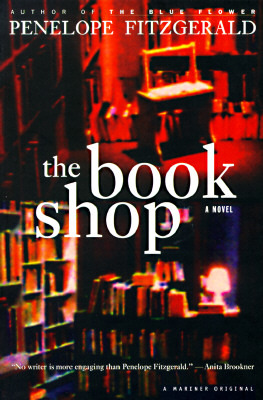
The Bookshop by Penelope Fitzgerald

British Railways delivered the copies of Lolita from Flintmarket station, twenty-five miles away.  When the carrier van arrived it drew, as usual, a ragged cheer from the bystanders.  Something new was coming to Hardborough.  Outside every public house there were parcels waiting to go out, and Raven, to save petrol, wanted a lift to the upper marshes.

Christine was aghast at the large numbers ordered.  They hadn't sold so many of one thing, not even Build Your Own Racing Dinghy.

Brent's recent post shamed me enough to get started on my own backlog of books to review.  Part of this shame is that I've been failing you, the blog-reading public--but mostly it's a shame for failing a great book like The Bookshop, which really deserves better than my warmed-over comments six weeks after I've finished.

The Bookshop is the book that gained Fitzgerald her first measure of public acclaim.  The trademarks of her later novels are here: the focus on a somewhat hermetic or fringe community, like the houseboaters of Offshore or the war-torn BBC of Human Voices; the proud and idiosyncratic hero/ine; a cast of quickly but deftly sketched characters.  The heroine here is Florence Green, who decides to open up a bookshop in Hardborough, an isolated island community.  Florence's ambitions are troubled by the seaside damp, and a poltergeist, but mostly by Hardborough's drably menacing social queen, Violet Gamart, who wants the property Florence buys for a local Arts Center.  The novel is one of modest ambitions beset by petty challenges, but Florence's steadfastness garners our admiration. 

My favorite of the minor characters population Hardborough is Christine, the ten-year old girl who Florence employs in the shop, and who approaches her job with blue-collar stolidity and a jealous possessiveness:

Christine liked to do the locking up.  At the age of ten and a half she knew, for perhaps the last time in her life, exactly how everything should be done.

The novel dwells on a long episode in which Florence mulls whether to order copies of the recently published Lolita; when she eventually does, it becomes a huge sensation in town.  I was particularly fond of this inlaid set of letters between Florence and her solicitor, responding to Violet Gamart's charges that the street activity around the Lolita display has become a public nuisance:

December 8 1959

Dear Mrs Green,
In reply to your letter of 6 December, I think we ought to abate the obstruction, by which I mean stopping the general public from assembling in the narrowest part of the High Street, before any question of an indictment arises, and I also think we should cease to offer for sale the complained-of and unduly sensational novel by Nabokov.  We cannot cite Herring v. Metropolitan Board of Works 1863 in this instance as the crowd has not assembled as the result of famine or of a shortage of necessary commodities.

Yours faithfully,
Thomas Thornton
Solicitor and Commissioner for Oaths.

December 9 1959

Dear Mr Thornton,
A good book is the precious life-blood of a master-spirit, embalmed and treasured up on purpose to a life beyond life, and as such it must surely be a necessary commodity.

Yours sincerely,
Florence Green.

December 10 1959

To: Mrs Florence Green

Dear Madam,
I can only repeat my former advice, and I may add that in my opinion, though this is a personal matter and therefore outside my terms of reference, you would do well to make a formal apology to Mrs Gamart.

Yours faithfully,

Thomas Thornton,
Solicitor and Commissioner for Oaths.

December 11 1959

Dear Mr Thornton,
Coward!

Yours sincerely,

Florence Green.

Besides being pretty funny, Fitzgerald does such a good job here of capturing these characters' voices with economy: the pedantic cowardice of the lawyer, the defiant pride of the shopowner.

To its credit, The Bookshop stops short of being inspiring; despite their enthusiasm for Lolita, the denizens of Hardborough never really rally in support of the bookshop against Violet Gamart's selfish domineering,  They patronize the shop when they want something from it, and ignore it when they don't, as they do with Florence herself.  These are people with lives of their own, with needs and ambitions equal to Florence's, and there is a bittersweet truth to the recognition that no one cares, or could ever care, about the bookshop as much as she does.  Her cold warn with Violet Gamart is, in the end, waged for relatively minor stakes.  But Fitzgerald suggests that steadfastness in your own ambitions, as private as they may be, is no small valor.

Saturday, April 26, 2014

Incendiary Girls by Kodi Scheer

So, Incendiary Girls, the second of the two short story collections I read last month, was not at all what I expected. The cover, a white horse, got me thinking I was about to read some dreamy, fluffy stuff, so imagine my surprise when Incendiary Girls turned out to be full of ruminations on the fragility of the human body, meditations on the mysteries of the afterlife, and large helping of surreal, Cronenbergian body horror.

There are two ways to look at most of the stories in Incendiary Girls. The first is as a character study of their protagonist(s) and their responses to traumatic events in their lives. The second is as horror stories where the greatest fear of all--death, of course--is writ large. But these aren’t navel-gazing internal monologues. Scheer’s characters cut open their own bodies and the bodies of others (dead and alive alike), find body parts in their bathtubs and under their beds, watch as bodies burn--in the world of Incendiary Girls, your body provides protection in the same way that the Alamo did--it keeps you safe until it doesn’t, and then you get massacred.

Although the first couple stories are good, particularly the second, about a woman who converts to Islam as part of a bargain with God to cure her cancer, the real turning point in the book is Miss Universe, which I’d like to talk a little more about.

SPOILERS FOR MISS UNIVERSE IN THE FOLLOWING PARAGRAPH

The story begins backstage at the Miss Universe pageant, as the girls are getting ready. What seems like the setup for some psychological torment quickly gets much darker, as Miss Afghanistan says the wrong thing to her fellow contestants, inadvertently convincing them that the scar on her leg is fake. To prove it, the girls hold her down and cut it off, only to decide that the skin underneath is fake, as are her toes, her fingers, her face--you see where this is going. The story ends with Miss Afghanistan turned literally inside out in a, uh, pile on the floor, as the other contestants walk out onstage.

Obviously there’s some political commentary here, which is worth unpacking, but I’d like to focus on the way that this story encapsulates a lot of the book’s M.O. Except for one story in the middle, a foray into light comedy(!), these tales are uniformly dark and mostly don’t have happy endings. They emphasize the trauma in the lives of their characters by literally tearing them apart, or, in a couple instances, turning them into something completely different, as in Primal Son, where a comic-sounding concept--human couple gives birth to a monkey--is played so straight that it becomes disturbing.

I don’t know what my final conclusion is on Incendiary Girls. I found it challenging and difficult to read at times, and I don’t know that I’d want to read it again. It was moving and off-putting at the same time. But, as bleak as it gets, Scheer ends the book with a moment of triumph. Maybe we can’t stop the world from doing what it will to our bodies, but we don’t all have to end up like Miss Afghanistan.

The Frangipani Hotel by Violet Kupersmith

The shadow of the Vietnam war hangs heavy over The Frangipani Hotel, although the war itself is rarely mentioned. However, the exodus of the Vietnamese “boat people” opens the book, as the narrator asks her grandmother to tell the story of the day she left. The story begins as you’d expect, with the grandmother on a boat, but ends with the first supernatural occurrence in the book--although, Life of Pi style, we’re not really sure, as readers to what extent this is literally what happened.

SOME SPOILERS IN THE FOLLOWING PARAGRAPH

This is not the case throughout; As alluded to above, all but one or two of the stories in The Frangipani Hotel have explicit supernatural elements. Sometimes they’re subtle, sometimes they carry the story, but they’re always there, and after the first couple stories, I found myself waiting, during the seemingly mundane moments, for the other shoe to drop. There’s the creepiest hitchhiker ever, who lives off the life and memories of others, the girl who visits Vietnam and just might have accidentally eaten her grandmother, the old men who sit in a room every night and wait for a memory from the past to knock on their door, and so it goes. There are two stories with no obviously supernatural elements, but even there, the supernal and the mundane feel as though they are separated by a thread.

I’m not at all familiar with Vietnamese folklore, but most of the stories in the collection feel like updated versions of campfire stories, universal fears made current by transposition into modern times. If the creatures and stories Kupersmith shares aren’t myths, they feel like they are. Aside from the supernatural through-line, there are other common threads pulling the collection together--remembrance of the past, acceptance of mistakes, questions of identity, the Vietnam war, of course--so these stories, in spite of their eldritch trappings, maintain their humanity.

Highly recommended.

This book was sent to me by TLC book tours, who thought that I might enjoy it. They were right, but I never would have guessed, looking at the cover. It’s a nice image, but the bright pink lettering and fluorescent pink spine seemed to indicate a much different, much more romantic type of book. I can’t help but wonder if a book that is mostly made up of supernaturally-tinged tales building on Vietnamese folklore would have been given the same cover if it were written by a man--but I digress.

Tuesday, April 22, 2014

Divergent Trilogy by Veronica Roth

In case you have been under a rock that does not have any teenagers anywhere near by, here's what you need to know about the trilogy:
"Working together, these five factions have lived in peace for many years, each contributing to a different sector of society. Abnegation has fulfilled our need for selfless leaders in government; Candor has provided us with trustworthy and sound leaders in law; Erudite has supplied us with intelligent teachers and researchers; Amity has given us understanding counselors and caretakers; and Dauntless provides us with protection from threats both within and without. But the reach of each faction is not limited to these areas. We give one another far more than can be adequately summarized. In our factions, we find meaning, we find purpose, we find life." I think of the motto I read in my Faction History textbook: Faction before blood. More than family, our factions are where we belong. Can that possibly be right?

Young adult novels seem to come in two genres lately: the Normal Kid Who Discovers a Secret World That They're Suddenly a Part Of (a la Harry Potter, Twilight, Miss Peregrine's Home for Peculiar Children) and the World Run By Suspicious Government That Teenage Hero Must Fight (a la Uglies, Hunger Games, Maze Runner) - this trilogy falls into the latter category. 

Beatrice (later changed to Tris) begins the novel as a member of the Abnegation faction. Abnegation wears grey. Abnegation takes the stairs so that other factions can take the elevator. Abnegation lives in cinder block homes without decoration. Abnegation does the service work that no one else wants to do. Abnegation is completely selfless. Abnegation members are the only people who can be trusted to have power because they are the only ones who don't want it. 

"To some the sight [of my plain neighborhood] might be gloomy, but to me [its] simplicity is comforting. The reason for the simplicity isn't disdain for uniqueness, as other factions have sometimes interpreted it. Everything - our houses, our clothes, our hairstyles - is meant to help us forget ourselves and to protect us from vanity, greed, and envy, which are just forms of selfishness. If we have little, and want for little, and we are all equal, we envy no one. I try to love it."

Couples are made within a faction and kids are raised in their faction until their 16th birthday when they take a virtual-reality-type test to determine which faction they are best suited for. The results are known only by the test giver (a stranger volunteer) and the teenager. A few days later the entire community comes together to watch teenagers pick their new factions: will they stay with their family and the faction who raised them or will they leave everything behind - including almost all contact with their parents and siblings - to join a different faction?

Beatrice's results are inconclusive - she COULD be Abnegation, Dauntless, or Erudite, but she doesn't REALLY belong in any of them. She's labelled Divergent, her tester falsifies her results, and warns her that she cannot tell anyone - ANYONE - about being Divergent which also means she can't find out what it means and why it's dangerous. She immediately eliminates Erudite as a possibility and is stuck between Dauntless and Abnegation. Of course, no one is going to read 1500 pages about providing food for the factionless (homeless) and not having strong emotions and not asking questions because they indicate curiosity which is a selfish desire and not touching or kissing while flirting, so I don't think it's a spoiler to say she decides to join the badass, tatted up, pierced, punky Dauntless. 

The first act of her initiation is to jump off a speeding train onto a rooftop - one kid refuses and chooses to become factionless, and one kid dies. The very next step is to jump several stories into a dark pit without knowing what's at the bottom. Dauntless initiation involves self defense, combat, and mental stamina (more virtual reality - except instead of having to make choices you're stuck in scenarios with your worst fears - the more scared you get, the worse it is for you) with real violence occurring. No character is safe in Veronica Roth's world - she isn't afraid to hurt, maim, or kill. If any of this is intriguing, you should absolutely read them, particularly as the pages fly by (I finished all three in less than a week). The trilogy follows Tris's discovery of what exactly it means to be Divergent and where Divergent fit into the government as a whole. A heck of a lot happens that is not worth spoiling.

Outside of the interesting premise, what makes the trilogy awesome (without saying too much about the plot) are a few things which are outstanding in their own right but also outstanding in comparison to the more recent popular young adult novels:


  • the protagonist is a real - not accidental - badass 
Bella never kills a human, not even as a baby vampire, and one of the so-called redeeming traits of Katniss is that in the first Hunger Games she doesn't *really* kill anyone in a hand-to-hand person-to-person way - she's always a step removed from the action. These are cruel government regimes; our heroes are not going to escape without getting dirty and it's selling the audience short to not give them an honest view of what are essentially war stories. Tris is trained as a combatant and acts like one which is what ANY person in her situation would have to do to survive. 
  • the protagonist isn't pretty 
I am tired of the protagonist girl who is soooo pretty, except she doesn't know it, except the really Impossibly Hot Guy does know it, and thus she gets the really Impossibly Hot Guy without being conceited or having any of the other pretty girl personality traits that no one likes in real life. Tris tells her Love Interest, "I'm not trying to be self-deprecating. I just don't get it...I'm not pretty...I'm not ugly, but I am certainly not pretty," and he responds, "Fine. You're not pretty. So? I like how you look. You're deadly smart. You're brave. And even though you found out about [that horrible thing from my past]...you aren't giving me that look." Teenagers - and screw it, all people - need to understand that we are not all supermodels AND WE WILL ALL STILL FIND PEOPLE TO LOVE US. I love that she accepts her face and is honest, and he accepts her face and is honest. 


  • the romantic relationships are healthy
There is no Bella/Edward/Jacob or Katniss/Peeta/Gale love triangle filled with unhealthy obsessions, lies, and deceptions. You know how in Twilight and the Hunger Games characters are always lying to each other for each other's benefits? And then fighting about it but accepting that the lies were okay because they stay together and keep lying? Yeah, that doesn't happen here. 

"I'm reliable. You can trust me. And you can let me be the judge of what I can handle."
"Okay. But no more lies. Not ever."
"Okay."
I feel stiff and squeezed, like my body was just forced into something too small for it. But hat's not how I want the conversation to end, so I reach for his hand.
"I'm sorry I lied to you," I say. "I really am."
"Well," he says. "I didn't mean to make you feel like I didn't respect you." 

A mature conversation about their legitimate not-over-dramatized feelings that ends with an honest apology - THIS is the kind of relationship problem solving that I want to see in my own relationship, in my students' relationships, and in my books. More of this please. But wait! Twilight is based on a toxic relationship that creates horrible depression and co-dependence, surely this book has that because it's such a popular formula, right? Wrong-o my Twihard friends. 

"If we stay together, I'll have to forgive you over and over again, and if you're still in this, you'll have to forgive me over and over again too, so forgiveness isn't the point. What I really should have been trying to figure out is whether we were still good for each other or not."

I love that these teenagers who have gone through incredibly traumatic experiences together (we're in book three at this point) have actually matured because of those experiences and are able to have an adult idea in their head of what a relationship is made up of and what the purpose of one is. Forgiveness is maybe an overstatement, but a part of a working relationship is definitely the ability to choose to let some things go. Not every incident needs to be a dramatic fight, and the more important question is always whether the relationship is still positive and healthy and productive.


I applaud Roth for creating an incredibly compelling series that breaks many of the formulas set up by the previous generation of young adult books. The fact that this series is verrrry  popular warms my heart. She gives the audience their full credit and assumes that if we're reading a book about an oppressive government regime then we are probably capable of handling the details of all the effects of that system. She also gives the characters their full credit. These teenagers have to grow up fast in this world and they do; they're not so overly mature as to be unbelievable, but she doesn't treat them like they're little kids or dumb teenagers either. They make hard decisions, they do what they think is right, sometimes they make mistakes - like we all do - and have to deal with those consequences.

This series will, however, wreck your soul. I finished the third one sobbing. I'm a crier anyway (the LEGO movie made me cry), but I haven't cried like that since the epilogue of Harry Potter. 

Sunday, March 30, 2014

The Metaphysical Club: A Story of Ideas in America by Louis Menand

For many white Americans after 1865, the abolitionists were the century's villains--not only because they were thought to have been responsible for the way, but because they and their heirs were thought to have been responsible for the humiliation of the South during Reconstruction.  They had driven a wedge into white America, and they did it because they had become infatuated with an idea.  They marched the nation to the brink of self-destruction in the name of an abstraction.  The United States in the 1890s was a society fractured along many lines: the South against the North, the West against the East, labor against capital, agriculture against industry, borrowers against lenders, people who called themselves natives against new immigrants.  In a time when the chance of another civil war did not seem remote, a philosophy that warned against the idolatry of ideas was possibly the only philosophy on which a progressive politics could have been successfully mounted.

In the late 19th century, thinkers were presented with two problems.  First, the civil war was a national tragedy: thinkers needed a philosophy that both allowed for reasonable disagreement and allowed for one side to be correct.  Second, the introduction of Darwinism threatened theological foundations.

So how to reconcile the idea of Truth with the idea of disagreement?  How to reconcile Darwinism with Christianity?

Menand's The Metaphysical Club explains how thinkers starting in the 19th century sought to answer these questions, focusing on four thinkers: Oliver Wendell Holmes, Jr., William James, Charles Pierce, and John Dewey.  The book also incorporates a large cast of side-thinkers, who make appearances along the way.

Enter pragmatism: rather than an absolute truth, truth is relative.  Instead, pragmatism preaches tolerance for other views.  Philosophical Darwinism will sort out the good ideas from the bad.  Applied, this leads to interesting practical results.  Rather than a search for truth, focus shifts to process.  The idea is that, a good process will ensure a good result.  A good, robust democracy, then, leads to a good, robust society.  It also means no more civil wars.

Of course, it also means that the minority has to be ready and willing to defer to the majority.  Such deference may seem desirable today, with an overly enthusiastic Tea Party and constant calls to end Obama-care.  However, such deference is difficult to muster in situations where the majority's will subjugates the minority (e.g., Jim Crow).  And as Menand describes it, this is why pragmatism fell out of favor: as the civil rights movement unfolded, a philosophy preaching the virtue of good process felt antiquated--faith in the process did not help if the process itself was broken.

This is a good book and worth reading for anyone interested in the U.S. intellectual climate between the civil war and the first world war.  Also worth reading for anyone interested in a primer on pragmatism, or the philosophies of Holmes, James, Pierce, or Dewey.  As someone interested in Holmes, I enjoyed the portions devoted to him especially.

Saturday, March 8, 2014

Ladies Whose Bright Eyes by Ford Madox Ford

"Surely it is pleasant," Mr Sorrell said, "but I cannot see that it is well, and pleasantness is not the whole of life."

"Is it not?" the Lady Dionissia asked wonderingly.

"No, surely not," Mr Sorrell answered.  Are there not such things as duties, ambitions, and responsibilities?"

"I do not know what those things are," she answered.  "In the spring the moles come out of the woods and the little birds sing, and we walk in the gardens and take what pleasure we can.  And then comes the winter, and shuts us up in our castles so that it is not so pleasant; but with jongleurs and ballad-singers we pass the time as well as we may.  And what is there to do?"

Ford Madox Ford wrote Ladies Whose Bright Eyes as a sort of response to Mark Twain's A Connecticut Yankee in King Arthur's Court.  Twain's time-traveling protagonist becomes a hero in the Middle Ages because he comes to it with a wealth of modern scientific knowledge that is seen as magic.  Ford's Henry Sorrell, sent back to fourteenth century England in a horrific train wreck, also has fantasies that his modernity will make him a powerful man:

"Why, good Lord," he said, "if it's the fourteenth century I can do anything.  Just think of the things I can invent!  Why, we can begin right bang off with aeroplanes.  There's no need to go through any intermediary stages.  How would you like to go flying through the air, my lady?  I've done it, and there's no reason why you shouldn't.  Why, we can terrorise every city in the world.  We could burn Paris down in a night.  They couldn't do anything--anything at all."

Of course, Sorrell, like most people in his day and ours, has no idea where to begin building an airplane.  Ford's out to mock Twain's notion that a man is wiser or more knowledgeable simply because he was born later in time, and repeatedly stresses how little Sorrell knows about the world he finds himself in.  He has no scientific knowledge to amaze with, and no historical knowledge to help him navigate his surroundings, as he shows in a long and funny riff where he tries to figure out if the fourteenth century had eggs:

He did not know much about history.  He thought eggs had been introduced into England by Sir Walter Raleigh, along with potatoes and brandy.  He did remember--the fact had somehow impressed itself on his mind because it was philological, and he had always taken an interest in the study of languages, which was a sound commercial pursuit--he remembered distinctly having read somewhere that Chaucer or Caxton, taking a voyage from the coast of Kent to Suffolk, had landed in search of eggs.

And yet, despite Ford's send-up of Sorrell as out of his league, he does somehow manage to become widely known as a worker of miracles.  This has nothing to do with his modern knowledge, as in Twain, and everything to do with his mysterious combined with dumb luck, and centers around a valuable golden cross given to him by a woman in the 20th century for transport that he refuses to let go of.  The cross--as much for its monetary value as its religious symbolism--puts Sorrell in the middle of a conflict between the mistresses of two quarreling castles, the conniving Lady Blanche and the beautiful and patient Lady Dionissia.  He pledges his fealty to one, and then, realizing his mistake, to the other.  At the same time, he becomes known as a mystic and religious healer.

Ford has Sorrell receive wisdom from his time-traveling experiences, rather than impart it.  It strains credulity a little to see the Sorrell who once thought eggs came from the Americas suddenly say this to an old knight who asks him for healing:

"Ah, gentle knight, we are in the hands of God and His little angels.  Of how much I may cure or of how little, that I cannot tell you, but I think that surely the cure under God lies more in you than in me.  For your faith will make you whole, or more, or less, according as it is great or little.  This I believe to be the truth of the very truth.  And in this way only, and in no other that I know of, do I think that you could find the fountain of youth.  But for the cross, surely take it into your hand and feel what it is like."

Sorrell's newfound appreciation of Providence is in stark contrast to modern--Ford's modern, and our own--pride about our ability to exert control over the natural world and even over ourselves.  Even though Ford's medieval denizens are particularly gullible when it comes to Sorrell's powers, Ladies Whose Bright Eyes is a serviceable rebuttal to the prevailing idea of the Middle Ages as "Dark Ages" bereft of knowledge.  

Wednesday, March 5, 2014

The New American Road Trip Mixtape by Brendan Leonard

Happily semi-rad. That's what the sticker said. I ran into this sticker and its creator, Brendan Leonard, at Red Rock Rendezvous - a rockclimbing festival outside of my own stomping grounds. The pricetag is absurdly expensive - $100 for two days of climbing where I climb every weekend? - but it's a chance to work with AAI guides for super cheap (a private guide would cost upwards of $350), and it's so much more than climbing. 

It's drinking free beer from Fat Tire, watching Steph Davis BASE jump into the festival grounds, drunken slacklining in the dark, having a dance party where everyone is wearing a puffy and a headlamp, watching a dyno bouldering competition, being surrounded by people who love doing what you love doing. I also won a totally sweet little pack in a raffle. I also bought an amazing tent off an older couple in the parking lot - that tent went with them all across America and Europe as they climbed the world, and in the two years since it has been with me to Indiana, Montana, Wyoming, Utah, and California. 

But back to the dude with the hair and the stickers. I took one and slapped it on my car having no idea what I was advertising. Semi-rad is a blog that covers everything from The Rules for Dating A Dirtbag to A Big Shout Out To Rocks to life's most important question: Do You Have the Stoke?  (For real - in my friend's group you are judged based on your Stokemeter. Randy and I have had a conversation about Billy's stoke levels - don't worry, they're high). In the two years since, I have read every article on his blog. It is also how I found my favorite podcast, The Dirtbag Diaries, which Brendan is on regularly.

Of course I was going to buy this book, and I knew I was going to love it before I even read it, and I also would probably not recommend it to you. Not because there's anything wrong with you. It's really the book. It's disjointed, illogical, unorganized, repetitive, and if I were his editor we probably wouldn't be friends anymore. It's hard to tell who people are because they are undeveloped and pop in and out of the story out of order - even if both memories come from the same time period. Nonetheless, I am totally going to gift this book to my friends. If you're a climber, hiker, backpacker, biker, camper...if you absolutely are jealous of dirtbags who live out of their car...then you'll totally dig this book (particularly if you like your climbing with some philosophy and failed relationship therapy which is how I started my climbing career). It's part Road Trip book, part Getting Over Her, part Dirtbag. 

Brendan can be totally disarmingly charming at times
"Cellulite is fine. Sweatpants are fine. You can snore, sleep with your mouth open. You can take all those moments of your life that you are not sexy, and you can multiply them all by 100 and add them together, and they disappear when I'm lying behind you and I put one hand on your hip and kiss the back of your neck."

He can also be totally hilarious
"Mountain goats love pee. Our urine is salty, and animals love salt. At high altitudes, we pee on rocks instead of plants, because mountain goats will eat pee-salted plants until an alpine meadow is barren. So I walked away from the goats because I wanted a little privacy. It was if the sound of my zipper was a dinner bell. A narrow white face, curious, popped over a ridge 20 feet from my crotch. Then another one. Jesus Christ, talk about stage fright or performance anxiety...A few months earlier, the National Park Service had advised hikers not to urinate near trials in Olympic National Park, after a mountain goat attacked and killed a 63-year-old man on a trail there. It was the only known fatal mountain goat attack int he park's history...I zipped my pants and briskly walked away. I could wait."

He spends a lot of the book asking the question
What is a life?

Is it what he's doing? Is it what his friends who are childfree but coupled and adventuring are doing? Is it what his friends who are having babies are doing? 

Unfortunately, I do think his writing is better suited to shorter essays and stories, and I think it would be stronger if it were presented as a collection of short stories with a little bit more exposition about the characters in each bit rather than details about his inner/outer life (his toothbrush is mentioned maybe four or six times - put all the toothbrush bits together in one toothbrush section of one story and be done with it!)

This book is a book to read if you want to be inspired, reset your stoke, read ramblings about love, life, and relationships from someone in their 30s, and be reminded of all the reasons you love live an outdoors life and a few reasons why you live an indoors life. I am already planning out a few routes for this summer's camping trip which will be, I hope, semi-rad. 

Hours before meeting Brendon Leonard, we enjoy a birthday toast at Red Rock Rendezvous (we have the same birthday, and it was our birthday, which we announced to every person.)

Wednesday, February 19, 2014

War Dances by Sherman Alexie

"So, like I was saying, as that owl was just about to smash into our winshield, it slanted its wings, and slanted up into the dark...And I said something like, "That was magnificent," and my girlfriend - you know what she said? She said, "I'm breaking up with you because you are not an owl."

"Yeah, it was on Okinawa, an we hit the beach, and well, it's hard to talk about it - it was the worst thing...I'm not a poet - so I don't have the words - but just think of it this way - that beach, that island - was filled with sons and fathers - men who loved and were loved - American and Japanese and Okinawan - and all of us were dying - were being killed by other sons and fathers who also loved and were loved."

I am in love with Sherman Alexie. His laughing face with his long hair flowing is one of the hand-made posters that hang up in my classroom. I teach "Indian Education" basically every year in every grade that I can get away with it. "Hey Victor" is something I say sometimes to people not named Victor when I want to have an inside joke with myself. In spite of all this, I have only read two of his books - The Lone Ranger and Tonto Fistfight in Heaven (one of the books on my comps list that was not discussed at all much to my sadness) and The Absolutely True Diary of a Part Time Indian. I recommend both of them all the time to everyone. I need more Alexie in my life, and this came to me in pristine condition from Goodwill. It is his most recent work (from 2009) and is a collection of short stories and poems.

This collection has a few different narrators, including an American Indian named George Wilson who accidentally kills a black teenager, a white senator's son, an ethnicity-free Paul Nonetheless, and Sherwin Polatkin whose surname will be familiar to anyone who has read his other works. It's great to see stories that stray from his feels-very-autobiographical works and that are still delicious and wonderful. This collection is very much focused on masculine experiences and men's relationships with their girlfriends, wives, sons, and fathers.

One line in the book gave me utter joy above all else. 

"Frankly," my doctor said. "Your brain is beautiful."

I couldn't say where I picked up the expression, but 'beautiful brain' is something that I use often enough that a student once doodled this in her warmup notebook. (That was a very accurate depiction of what I used to look like). 


If you've never read Alexie before, I would recommend one of his more popular books to start with - not because this one isn't good, but because the other two are AMAZING and much more typical of what people associate with his writing style and content. 

The Adventures of Huckleberry Finn by Mark Twain

"Everybody that wants to join has got to take an oath, and write his name in blood." . . . It swore every boy to stick to the band, and. . . if anybody done anything to any boy in the band, whichever boy was ordered to kill that person and his family must do it, and he mustn't eat and he musn't sleep till he had killed them and hacked a cross in their breasts, which was the sign of the band. And nobody that didn't belong to the band could use that mark, and if he did he must be sued; and if he done it again he must be killed. And if anybody that belonged to the band told the secrets, he must have his throat cut, and then have his carcass burnt up and the ashes scattered all around, and his name blotted off the list with blood and never mentioned again by the gang, but have a curse put on it and be forgot forever. 

Everybody said it was a real beautiful oath."


Seeing how often this novel has been reviewed on this blog (Chris's 2007 review, Brent's 2007 Review,  Chris's 2013 Review) makes me even more ashamed that I have never read this novel (or if I did, I was too young to remember). Go ahead and put on your Judgey Pants - I deserve it. An MA in Literature, an AP Lit teacher for four years, an American Lit teacher at one time and another and not read Huck Finn? The problem is that I didn't get it in high school, and my undergrad/grad classes didn't offer it (assuming probably that I had read it in high school), and as a first year American Lit teacher (who had two other subjects to teach) I was not going out of my way to read a book I had never read before just to teach it. There are just so many books....However! My freshies have the option of choosing this as a companion novel for To Kill a Mockingbird and my juniors also have the option of choosing this if they are unwilling/unable to get more contemporary American Lit (their other options include Alexie, Chabon, Tan, Egan, etc), so I really needed to read it.

When I began, my first thought was "Really? It's the n-word that is the MOST offensive thing and the reason why kids shouldn't read this book?" 


(Siderant: a student who is not my student found a slightly cut down version of this article by a Harvard Law professor on the n-word and was very offended that I was teaching it. I found out because they complained to their teacher. The teacher pointed out to the student that my MLA citation showed my source as being The Journal of Blacks In Higher Education and that such a journal would probably NOT print anything that was racist. I actually did white out the 'igger' for every word not in a quote because I found it to be a bit much; I hand-wrote a note at the top saying that although I didn't feel I had a right to change the author's diction, I did feel like it was acceptable to leave the blank space to give students the space to determine their own feelings on the word. I feel like this student's knee-jerk reaction - that any paper that has the n-word on it must be racist and any teacher who passes out any papers with the n-word on it must be racist - to be so depressing because it showcases how adults can have the same knee-jerk reaction about a book - that any book with the n-word in it must be racist.)


Needless to say, I found the alcoholic father and the child abuse to be a much more compelling reason to keep this out of children's hands. "He chased me round and round the place with a clasp-knife, calling me the Angel of Death, and saying he would kill me...By and by I got the old split-bottom chair and clumb up as easy as I could, not to make any noise, and got down the gun. I slipped the ramrod down it to make sure it was loaded, and then I laid it across the turnip-barrel, pointing towards pap, and sat down behind it to wait for him to stir. And how slow and still the time did drag along." Here we have a 12 year old pointing a loaded gun as his drunk father because he is rightfully afraid for his life...and the n-word is what we are all concerned about? It makes me sick the way Americans don't even notice violence but will get all up in arms for a word (or any kind of sexuality). My grandfather (who was himself an abusive alcoholic) gave my older brother beautiful copies of Tom Sawyer and Huck Finn when he was in elementary school, and in retrospect I really can't imagine what he was thinking.


As a former teacher of wayward youths, I immediately fell in love with Huck. He's had such a shit time at life because of circumstances totally beyond his control, and my heart really went out to him. I found his journey to be fun and funny and sweet and heartbreaking, and I really just wanted to be the older-but-not-a-parent mentor figure for him. His narrative presence is often beautiful ("And how slow and still the time did drag along" - come on! he builds a slow and still sentence that is so lovely). His struggle to develop a morality when everything around him is a complete moral paradox is at times baffling because I'm so far removed from his reality, but considering the setting I don't actually find it problematic when Huck thinks things like: "Here was this nigger, which I had as good as helped to run away, coming right out flat-footed and saying he would steal his children - children that belonged to a man I didn't even know; a man that hadn't ever done me no harm." 


What made me crazy throughout the book though was Huck's hero worship of Tom Sawyer. Tom Sawyer would have done it better, more elegantly, more interestingly, smarter, blah blah blah. His self esteem is so low that all of his endeavors have to be measured up to (and fall short of) the great Tom Sawyer. Huck can never measure up to his smarter, richer, better off friend who wants to slum it and play at scary situations and violence because he has had the luxury of not having to actually deal with scary situations and violence. 


When actual Tom Sawyer shows up, I started to really dislike the book. Tom Sawyer is a monstrous teen of the worst kind. Scientific American has an interesting article about the psychology behind why Huck Finn turns into such a terrible person at the end, and it does a solid job of explaining Huck's actions (TLDR: peer pressure and awareness of low social status as well as Jim's role as a parental figure that needs to be rebelled against), but it also just reminded me why I don't teach middle schoolers. They're evil, and Huck is one of them even if he's not in school. He will probably be a kid I'll love in high school, but I can't stand the meanness of those 8th grade boys, and I hope that Huck grows up to realize that even in 8th grade he was a better man than Tom will ever be. 

As for Jim, how can you not love Jim? I do. I love every brave moment he has: running away, trusting a kid, taking care of that kid, not telling him what he saw in the ship, standing up to Huck and telling him when he's being a dick, trusting other slaves to pass information to Huck. All of these things could mean a return to slavery at best, lynching and mutilation at worst. Every time he does one of these things, I see the images of every lynching photo I have ever seen floating before Jim's eyes and him deciding to do it anyway. The power of that is moving. It's also heartbreaking to see his continued failure to find freedom. "Yes; en I's rich now, come to look at it. I owns myself, and I's wuth eight hund'd dollars. I wisht I had de money, I wouldn' want no mo'."

Because I love Jim so much, it's hard to forgive Huck, even if Jim does. I am completely okay with him being a more loving person than I am.