Saturday, September 29, 2007

Harry Potter and the Deathly Hallows by J. K. Rowling

The Harry Potter books are extremely plot-driven. While Rowling’s writing is not bad, it is fairly utilitarian. That being said, her generally straightforward prose allows for some of the smoothest (and enjoyable) reading I have ever experienced. But ease of reading is only one of my criteria for determining how much I like a book. For example, Lolita was just a little over 300 pages, but took me nearly three weeks to finish. The writing was dense, with complex allusions and clever turns of phrase. On the other hand, I read The Goblet of Fire (700 some odd pages) in one day. I liked Goblet, but it doesn’t hold a candle to Lolita.

So, I was somewhat surprised when Rowling’s writing caught my attention on more than one occasion in The Deathly Hallows, the seventh and final chapter in the Potter saga. There were many instances where I thought Rowling showed a depth that she had not previously exhibited.

There was a good deal of exposition that had to be done in order for this book to make sense. After all, Rowling had a lot of loose ends to tie up. I don’t want to ruin the series for anyone by giving away too many plot points. I will say that I thought the epilogue was generally unnecessary. Some of what was established in the epilogue would no doubt have already been imagined by the readers. But I liked the book, and the series—The Order of the Phoenix is clearly the worst of the books. That’s all I’ll say. So, if you have any desire to read these books you should do so now, before some moron spoils the series for you by telling you how things end.

Friday, September 28, 2007

The Adventures of Huckleberry Finn by Mark Twain

Below is an honest-to-god real-life post on my Children's Lit class' Huckleberry Finn message board. The context: In order to escape his abusive father, Huck waits until he leaves their cabin, kills a pig and spills the blood all over, and then drags a heavy sack of rocks to the river in order to give the impression that he has been murdered and dumped in the water. Then he runs away.

Does anyone find the part of the book in "I fool Pap and get way," completely disturbing!!?? As a person reading The Adventures of Huckleberry Finn for the first time, I was completely in shock when I became aware of this gruesome plan. I hate to dwell on the repeated violence in these novels so much, but I wonder how we can consider books with such vulgarity "classics." Moreover, the fact that we categorize this book as a children's novel is also appalling. In my opinion, I (let alone children), shouldn't be exposed to things like "I fetched the pig in, and took him back nearly to the table and hacked into his throat with the ax, and laid him down on the ground to bleed." Couldn't Twain have simply said that he used the pig to fake his death? Was all of this detail necessary? Or, is it needed to show Huck's cleverness? Personally, I believe that Twain should have listened to his wife on this one and edited this graphic animal abuse part out.


Oh. my. god. I can't even begin to comprehend what goes on in this girl's mind. Huck Finn is a book that contains around thirteen corpses, including children, and some are fairly gruesome. And this girl is worried about the pig? Talk about missing the point. The sad thing is, when I went to recitation to talk about this book today, this probably wasn't the stupidest thing that anyone said. I hope nobody from that class reads this.

On a more substantive level, this girl unwittingly stumbles into an interesting question: Is Huck Finn children's literature? It certainly comes out of a genre of boy adventure tales that would appeal to young males, and was marketed that way. Moreover, it is the sequel to a book in Tom Sawyer that in many ways epitomized that genre and lacks many of the darker and more complex themes of Huck Finn. This fascinates me--imagine if after Are You There God? It's Me, Margaret Judy Blume wrote a book in which Margaret's best friend was forced to deal with the brutality of death and human cruelty while pondering the complex ethics of American race relations. If Tom Sawyer is a children's book, Huck Finn is what happens to children's books who are abused and grow up to be serial murderers.

This is the fourth time I've read Huck Finn. If you ask me, it's the greatest book ever produced in this country--its plot is perfectly constructed, its two main characters, Huck and N-Word Jim, are two of the most convincing and sympathetic characters in all of modern English fiction, and at its heart it deals with something quintessentially American: the post-Civil War struggle of America to deal with the abject shame of slavery and incorporate freed blacks into society. Its status as one of the most banned books in American history only increases its importance: It was first banned from the Concord Public Library in 1885--thanks to a push from none other than Louisa May Alcott--for concerns not very different from those above (though Alcott was more concerned about the deaths of, you know, people>), and today the prevalence of the n-word makes it a popular target.

This is wholesale ridiculousness, because outside of maybe Uncle Tom's Cabin there is no greater affirmation of the humanity of the black man in 19th century literature than this novel. When Huck and Jim move down the Mississippi on their raft, it is almost as if they inhabit a "Green World" in which the standards of society no longer apply and barriers are removed. Consequently, after a struggle with his own conscience, Huck comes to realize what we already know about Jim: He is intelligent, loyal, loving, and paternalistic. In a book in which every adult seems to be cruel (Pap, the Duke and Dauphin) or foolish (The Grangerfords, Shepherdsons, and Phelps), the one true noble character is Jim, who cares so strongly for Huck.

Is Huck Finn children's literature? Certainly today it is still read by children--though I know that many parents instead steer their child for Tom Sawyer as it lacks the controversy--and certainly it is steeped in the genre expectations of children's literature. But I think what is wonderful about Huck Finn is that it can be read by persons of any age or race and still be affecting; it simply is a book that transcends those kind of labels.

I know that Brent hasn't read Huck Finn, which strikes me as weird. I tried not to give away too much in case there's anyone else who hasn't read it--because if you haven't, it should be the next book you read. Really.

Little Women by Louisa May Alcott

JOEY: Ah, now Rach, these ah, these little women.

RACHEL: Yeah.

JOEY: How little are they? I mean, are they like scary little?


The above quote is from an episode of
Friends. I liked that episode more than I liked Little Women, which for the most part is pretty boring.

Little Women is about four sisters, Jo, Meg, Amy, and Beth, who live with their mother while their father is away fighting the civil war. It follows the trajectory of their lives from prepubescence to adulthood, ending ultimately in three marriages and one death (I'm not going to tell you which one. Though you could watch Friends and find out).

There's a lot I like about Little Women--especially the character of impudent, tomboyish Jo, who according to general consensus is a direct analog to Alcott herself, right down to her struggles over whether to write popular and lucrative potboilers (as Alcott herself did under assumed names) or genuine and heartfelt, but less profitable, books. The overall arc of the book is nicely put together, and does what few books do well in following an ensemble cast of characters whose personalities develop and evolve over time without losing sight of any of them.

But that arc also means this children's book has to be five hundred freaking pages long, and it's just not that interesting. The first part is especially grating, in which the young sisters are forever getting valuable life lessons from "Marmee" about hard work, proper thinking, and sisterly love. Gradually, the mimetic overcomes the didactic, but it takes a long freaking time.

Thursday, September 27, 2007

The Wind Up Bird Chronicle by Haruki Marukami

Well, this book was strange.


It follows a man, whose name I can't remember because it's Japanese, through several months of his life, during which his marriage disintegrates, he meets a young girl who is obsessed with death, he loses his cat, he has psychic sex with a girl who fluctuates between constant pain and complete numbness, he develops the ability to suck bad things out of people's heads, and he learns that his brother in law has the ability to go inside women and split them in half... or something.


This book was really confusing.


There's a section where a man is tied down and skinned alive by a man named, appropriately, Boris the Manskinner. We learn this from an old army veteran whose past seems to parallel the life of our hero. We also learn that Boris eventually took over the prison camp in which he was originally interned, and that he cannot be killed.


So, this was sort of an odd twist.


Our hero spends several days in the bottom of a well, until the walls of the well turn into Jell-O and he pushes through them to some spirit hotel where he somehow kills his brother in law. You might expect that everything would tie together at some point, but that doesn't really happen.


This book was pretty good, if you can believe that.

Tuesday, September 25, 2007

Casino Royale by Ian Fleming

Ian Fleming wrote Casino Royale, the first of the Bond novels, when he was 52 years old. At that time, Fleming had retired from the British Navy, and was living at his estate, Goldeneye, in Jamaica. I wasn’t sure what to expect from the book. Many of the movies have a campy, comic-book feel to them—Xray glasses, jetpacks, villains with weird powers/ailments, etc.—and I was wondering how much of this came from the books and how much of it was simply created for the movies.

The character that Fleming created is dark and rather cold (props to Timothy Dalton). The Bond that we know from the movies is nothing if not a male chauvinist, and he is the same in the books. I’ll give you an example. Bond has just found out that he must work with a woman on his assignment, and this is his response: “He sighed. Women were for recreation. On a job, they got in the way and fogged things up with sex and hurt feelings and all the emotional baggage they carried around. One had to look out for them and take care of them.” But at other points in the novel, Bond’s feelings about women are borderline misogynistic. Perhaps the best (or worst, depending on how you look at it) example of this comes toward the end of the book. “And now [Bond] knew that she was profoundly, excitingly sensual, but that the conquest of her body, because of the central privacy in her, would each time have the sweet tang of rape.” Double O, no he didn’t! It is the word “sweet” that makes this sentence so creepily offensive. Without it, the statement would be a little weird, but not nearly as cringe inducing as it is in its current form.

One could make the argument that Fleming simply created a character that is misogynistic, which in no way implies that Fleming condones this kind of thinking. After all, Nabokov created Humbert Humbert; Salinger created Holden Caufield. As I see it, the difference is that Fleming consciously constructed a smooth, debonair, character—one that would be idolized and prized for his coolness. Bonds misogynistic tendencies are not presented as a character fault, but simply as another part of his persona, just like his black hair, crisp suits, and luck as a gambler.

Casino Royale was very much plot driven, but there was more character development than I expected there to be. As for the relation between the book and the movie, Le Chiffre does torture Bond in the same way that the character did in the movie, but he does not cry blood from one eye. Bond is cold and exhibits none of the witticisms so characteristic of his silver-screen counterpart. The charming, charismatic Bond, and the over-the-top villains appear to be creations of the Broccoli brothers.

Casino Royale is different enough from the Bond films, that being a fan of the movies will have little bearing on whether you will like this book. It was a very easy read. After finishing it I had no strong desire to continue the series. Although, I may read another at some point to see how Fleming develops his James Bond character.

Sunday, September 23, 2007

Harry Potter and the Half-Blood Prince by J. K. Rowling

After The Order of the Phoenix, I was hoping that the next Harry Potter book would be better…much better. The Half-Blood Prince did exactly what Phoenix did not: start off with a bang and maintain that energy throughout. The book opens with the Minister of Magic meeting with the Prime Minister—the Muggle Minister, if you will. This was a great way to begin the book. Rowling is able to quickly let readers know that Voldemort has been wreaking havoc on the non-magic world—as well as the wizarding world—and she is able to do so in an interesting way.

As Harry and company return to Hogwarts, things have changed. The threat that Voldemort poses is much more immediate. The students are constantly getting news of people that have ‘disappeared’, some of them relatives of Hogwarts students. And there is fear that despite all of its defenses, Hogwarts may not be impervious to attacks by Voldemort and his Death Eaters.

In potions class, Harry gets a used textbook with notes, shortcuts, and spells scribbled in the margins by its previous owner, the Half-Blood Prince. (Ladies and gentlemen, we have a title.) These spells appear to be of the prince’s own creation, and some of them involve darker magic than Harry is used to.

With the help of Dumbledore, Harry begins to find out pertinent information about Voldemort’s past. Horcruxes, y’all! Horcruxes. I am glad that I don’t have to wait for a year to read the next one.

Mere Christianity by C. S. Lewis

The contents of this book were originally presented as a multiple-part radio series. C. S. Lewis, who served in World War I and was an air raid warden during World War II, was asked to give a series of broadcasts on Christian faith. These broadcasts came during the blitzkreig, when Great Britain was attacked on almost a nightly basis by German bombers. Incidentally, the blitz played a pivotal part in The Lion, the Witch and the Wardrobe.
In the preface to Mere Christianity, Lewis states, “The reader should be warned that I offer no help to anyone who is hesitating between two Christian denominations.” This sentence tells the reader a lot about the book. It also describes why I liked Mere Christianity as much as I did.

Having grown up in a thoroughly conservative Christian environment, I am painfully aware of the misplaced importance that many Christians put on issues that have almost no bearing on what it means to be a Christian. Lewis is not concerned with the differences between denominations. His topic is much larger in scope. His goal is to answer questions, such as “What is Christianity?”, and “What are the major tenets of the religion?”. In other words, “What must one believe to be a Christian?”. I find this infinitely more interesting than squabbles over the importance of prayer or the debate over works and faith. Many of the questions that Lewis poses are questions that I have asked at some point.

Lewis approaches his topic logically, employing illuminating, and often witty, illustrations. He begins with the universe, arguing that Christianity provides answers to the many questions posed by the universe. Each successive chapter flows logically from the previous one. Of course, Lewis ends up concluding that Christianity is the salve to the aches and pains of the world. But he does not do so by being flippantly dismissive of other religious beliefs. In fact he says, “If you are a Christian you do not have to believe that all the other religions are simply wrong all through.”

Lewis tells his reader that he is writing from the perspective of a layman, emphasizing that Mere Christianity is a collection of what he has come to know about Christianity. But he does not place undue importance on what he has to say. At one point he tells his readers, “If this chapter has not meant anything to you, or you have not found it helpful, drop it. Do not give it another thought.” I find this kind of candor refreshing.

Thursday, September 20, 2007

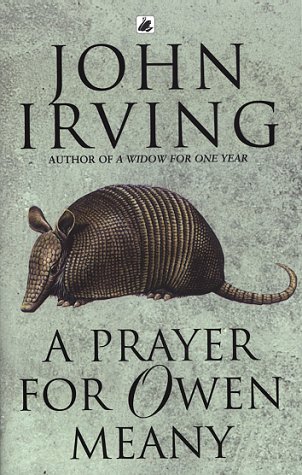
A Prayer for Owen Meany by John Irving

Carlton recommended this book to me, and prefaced it by saying that it was probably on of his top five books of all time. That's a lot of pressure when you're staring a new book, but, while I don't think Owen Meany will be making my top 5 anytime soon, it was a very funny, entertaining book.

The basic story (which I'm sure Carlton summarized in his earlier review), revolves around the narrator, John, a rather spineless, uncharismatic kid who, throughout the course of the novel, seems to derive most of his identity from his association with Owen Meany, a strange, short kid with a “ruined voice” and an unshakable faith in the mysterious ways of God.


The book opens with John confessing that he believes in God today because of Owen Meany, and the remainder of the book shows why this is so. It's made up of seven sections (which I hesitate to call chapters because of their length) which are told in chronological order. The book follows John and Owen from elementary school through their late teens.


I mostly enjoyed Prayer. The characters were likable and believable, the plot was interesting, and the religious aspects were all handled very well. My only complaint was that parts of the book, particularly when the older John is speaking, sometimes read like polemics against Ronald Reagan and American foreign policy in general. There's nothing inherently wrong with that, I don't think. After all, an author can write about whatever sentiments he wants, but in context of the entire story, the political asides were a) jarring and b) somewhat dating, since John is supposed to be writing from the present day.


Still, these complaints are fairly minor, and I enjoyed Prayer. I'd like to check out some of Irving's other work, although his books are long enough to make them slightly time prohibitive.

Thursday, September 13, 2007

Harry Potter and the Order of the Phoenix by J. K. Rowling

I found most of this book incredibly tedious. While I had trouble putting down the first four Harry Potter books, it was rare that I read more than fifty pages of The Order of the Phoenix at a time. The first half of the book was actually rather boring. An inordinate amount of time was spent on the Order of the Phoenix headquarters, the Black family house, where Sirius was hiding out. Harry et al did a lot of cleaning while at the headquarters. Please, Mrs. Rowling, tell me more.

Some important stuff happened in the first 500 pages of this book, but there is a lot of filler, as well. With the help of a good editor, a lot could have easily been cut from the first of the book. This would have been a welcome improvement considering that the book is nearly 900 pages long.

Further reason for my disliking this book is that Harry Potter is kind of a dick…to everyone. Even after the book starts to pick up. He is still such a pissy little bugger. The last 150 pages of the book are much better, but do little to make up for what came before them. Compared to the previous book, The Goblet of Fire, book five was a let down.

Amsterdam by Ian McEwan

This is the second book I've read by Ian McEwan, the first being the excellent Atonement, and frankly, it was a little disappointing. It was about 1/3 the length of Atonement. This, fortunately, meant that it only took a few hours to read.


It's not that Amsterdam is a terrible book, but, as I read in some Amazon review, it's the sort of book that wins prizes. The characters are cold, distant and unlikable. The most likable character in the book is the elusive Molly Vernon, elusive because, at the outset, she's dead, and the book opens on her funeral. The rest of the cast are a trio of uniformly unlikable cads: Julian Garmony, a foreign secretary with ambitions of becoming prime minister, Vernon Halliday, a newspaper editor, and Clive Linley, the UK's preeminent composer at the time in which the novel is set.


These three men have a lot in common. All three are self absorbed, were lovers of Molly's at one point, and none of them (with the possible exception of Garmony) have much in the way of redeeming attributes. Of course, likable characters aren't always a necessity for a book to be involving and interesting: witness Lolita's Humbert Humbert, Catcher in the Rye's Holden Caufield, The Great Gatsby's Gatsby. The thing is, in those works, the characters' prickly demeanors worked as part of a larger character study. In Amsterdam, McEwan seems to want to tackle a lot of tough topics, lost love, fear of death, ambition, and jealousy, but his characters are so irredeemable as to strip all poignancy from their dilemmas. Take, for instance, Linley, who (SPOILERS) remorselessly allows a woman to be raped so that he doesn't lose the melody running through his head, or Halliday, who is utterly willing to destroy Garmony's life mostly out of spite and jealousy over a long dead relationship.


There are powerful themes at work here, and Amsterdam's denoument in, well, Amsterdam, is somewhat effective despite my inability to really care what happened to Halliday and Linley. Maybe that was the point, and Amsterdam is more than a fairly shallow tragedy, but aside from taking up an evening, it was mostly disappointing.