Monday, August 27, 2007

The Wednesday Wars by Gary D. Schmidt

“When gods die, they die hard. It's not like they fade away, or grow old, or fall asleep. They die in fire and pain, and when they come out of you, they leave your guts burned. it hurts more than anything you can talk about. And maybe worst of all is you're not sure if there will ever be another god to fill their place. Or if you'd ever want another god to fill their place. You don't want fire to go out inside you twice.”

This was one of my favorite passages from the book. However, it doesn't really fit with the rest of this review. I just thought I would share it.

I thought I knew what I wanted to say about this book. But as I thought more about it, it became less clear. Initially, I felt that the first half of the book was great – funny, witting, creative. As compared to the last half which was a little more somber. But I have come to the conclusion that the two halves worked well in concert.

The books begins, “Of all the kids in seventh grade at Camillo Junior High, there was one kid that Mrs. Baker hated with heat whiter than the sun. Me.” The “me” is Holling Hoodhood (a downright Nabokovian name), who thinks that his homeroom teacher has it in for him because he is a Presbyterian. This means that every Wednesday, when all the other kids in his class go either to temple or mass – depending on which side of town they are from – Holling remains at the school, meaning that the teacher has to figure out what to do with him. After a wide range of chores, she finally settles on making him read Shakespeare.

Each chapter focuses on one month out of the school year, complete with mean teachers, trips to the principal’s office, surly playground bullies, and revenge meted out with snowballs. If Bill Watterson had lacked the ability to draw, he would have written something like The Wednesday Wars.

The last half of the book gives the first half of the book some meaning and importance. The last few chapters also make it evident that Holling has grown up quite a lot in less than a year. Although portions of the book are a little over the top, most of it smacks with the realism of growing up in the 1960s. The day-to-day stories of Holling’s life are framed by the Vietnam War, the Civil Rights Movement, the threat of nuclear war, and somewhat serious – although not that unusual – family problems.

I wonder how much of this book is autobiographical. Schmidt did grow up on Long Island during the 60s. Regardless, The Wednesday Wars was definitely worth the read.

Sunday, August 26, 2007

Harry Potter and the Goblet of Fire

I really liked The Prisoner of Azkaban, but The Goblet of Fire is my favorite of the series so far. I was told many times that each book was going to get darker as the series went along. This becomes evident by the fourth book.

Besides being notably darker, The Goblet of Fire is unique because it breaks from the established formula of the first three books. You know: Harry Potter's muggle relatives are horrible people. Harry loves going back to Hogwarts. Something is up at Hogwarts. Harry, Ron, and Hermione suspect they know who is responsible. They turn out to be wrong and the culprit is someone you don't expect. Instead, Rowling introduces the Quidditch World Cup, the Triwizard Tournament, and a couple of new and interesting characters. The Goblet of Fire is also the first book of the series that doesn't tie up all of its loose ends. I am guessing that books five and six will follow suit.

Mountain Man Dance Moves by the editors of McSweeney's

It's a book of lists. I wasn't going to include it as part of the fifty books project but then realized it's too funny not to share. Here are a couple of the lists:


THINGS THIS CITY WAS BUILT ON BESIDES ROCK 'N' ROLL
by Eric March

Navajo burial ground

Twelve billion tons of reinforced concrete and steel

Government-protected wetlands

Drunken dare

Waterlogged corpses of Irish immigrants

Previous bizzaro underground version of this city


ADJECTIVES RARELY USED BY WINE TASTERS
by Adam Koford

Chunky

Supercharged

Pondy

Wine-a-licious

Alcoholy

I'm pretty sure that second one is one of Nathan's favorites. For more McSweeney's lists, check out their website. For an intelligent review entirely unlike my own listen to what NPR has to say here.

Saturday, August 25, 2007

Grimm's Fairy Tales by Jacob and Wilhelm Grimm


So I picked this one up because I've always heard that the original fairy tales by the Grimm brothers were actually violent and bloody stories. It turns out that's just a rumor. Take the description of Little Red Riding Hood being eaten by the Big Bad Wolf for example. This is all they have to say on the subject, "No sooner did the wolf say that than he jumped out of bed and gobbled up poor Little Red Cap." That's it. Where's the gore? There's no mention of the wolf using his abnormally large teeth to rip the flesh off of the poor girl's body bit by bit, no account of him ripping out her still beating heart, or even the slightest hint of the pool of blood that would have obviously been spilled. I mean come on!

What makes matters worse is that Penguin decided not to even include Little Red Riding Hood, in this collection at all. I had to get it online. And they went so far to put here face on the cover. Talk about false advertisement.

I will say that a couple of the stories were kind of entertaining. The one about the little elves that make shoes for the old cobbler before he wakes up is a great one. And to the Grimms' credit, they didn't actually create any of these stories. They're all old tales from the oral tradition in Germany. I guess it is somewhat of a linguistic accomplishment or something.

Dubliners by James Joyce

This collection of short stories really didn't impress me. Maybe it's just that it's so old, or maybe I don't really understand Ireland that much. Everything was dull. Lots of descriptions of dreary weather, and talk about dreary weather, and really poor attempts at socializing... pretty standard Victorian stuff.

Maybe I could have appreciated it more had I read it in an English Lit class and had it explained to me, but I somehow doubt it. My advice: steer clear unless your and English major and you like this sort of thing.

Thursday, August 23, 2007

Harry Potter and the Prisoner of Azkaban

When people found out that I had started reading the Harry Potter books, they kept telling me that the series really takes off with the third book – that things really get started with The Prisoner of Azkaban. Well, everyone was right. This was leaps and bounds better than the first two, which were both pretty good. The main difference was that Azkaban felt like less of a kid's book.
Harry starts to find out more about his parents and his past in general in the third installment of Rowling’s series. Rowling also spends less time describing the wonderful world she has created, and a little more time developing her characters, which is good, considering that most of the new characters will no doubt be around for a while.

So I have read three of these books so far, and my main complaint is that Rowling starts each book as though her readers are almost completely unfamiliar with the series and its characters. Guess what? By the third book, I know how Quidditch is played, and that Mr. Dursley is fat. I just started The Goblet of Fire, and Rowling doesn’t do it quite as much. I am hoping it will stop altogether.

Beside that rant about something rather minor, I really have enjoyed these books.

Tuesday, August 21, 2007

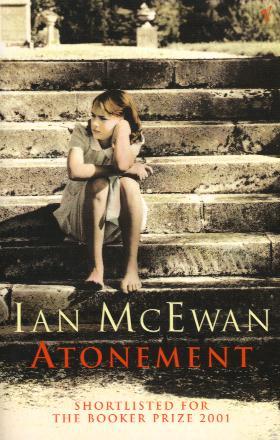
Atonement by Ian McEwan

I had such unreasonable expectations for Atonement that I'm almost disappointed it's not the best book I've read all year--though it is, safe to say, very good.

Some books are good because of their plot, and some because of their style; few, I think, boast both. The style of Atonement might be perfect for someone who likes a lot of James, Austen, or Auden, who are sort of reference points for the book though it takes place in the 1930's, but to me it was a little dry--but it's also one of the most intense books I think I've ever read.

In the early 1930's, 13-year old Briony Tallis, a girl with a very active imagination and a jones to become a serious writer, is witness to a series of events that she does not understand: a scene in which her sister emerges from a fountain in her underwear while the son of the family housekeeper stands by, a mistakenly sent letter, an illicit moment in a library. But Briony, the conceiver of plots, feels compelled to connect these events into a narrative which leads to a misunderstanding so great it threatens to ruin the lives of two people. I wish that I could say more, and were this a book I really didn't expect anyone to read, I would elucidate, but I think everyone here would probably enjoy Atonement, and I don't want to ruin it for anyone if they should choose to read it. But what happens in the first, longer section of the book possesses both the convincing detail of realism and the dread of inevitable doom, and it's very affecting.

The book has three other sections, one set in 1939 as the British Army retreats through France to the port of Dunkirk, one set in the same period that follows Briony as a nurse--trying to "atone" for the horrendous misunderstanding of four years previous--and a fourth set in 1999 that reveals that the book is actually of Briony's creation, as a way of atoning and coping with the events of her childhood. It is somehow both enormously sad and reassuring. The final three sections, however, seem somehow less consequential than the first, as lagging after the novel's true climax. Not to say that McEwan ought to have ended it after the first section, but in parts the final three seem brief and perfunctory, and too little attention is given to Briony's realization of her mistake and the ensuing, eponymous atonement.

A movie has been made of this book and will be released in December starring James McAvoy and Keira Knightley. It's directed by the same guy who directed Pride and Prejudice, so it should be very good.

We are better than most people

1 in 4 people say they read no books last year.

Sunday, August 19, 2007

Harry Potter and the Chamber of Secrets

Harry Potter is a good wizard.
Voldemort is an evil wizard.
Hilarious hijinks ensue.

This book is a little longer and quite a bit darker than the first. As a result, I liked it better.

Saturday, August 18, 2007

Lolita by Valdimir Nabokov

Note: I am not qualified to talk intelligently about this book.

This book has a stigma attached to it. Most people don’t really know anything about it (until recently I would have had to include myself) and assume that it is nothing more than glorified pornography. Believe me I got some weird looks while reading this. Just sitting on a bench at a children’s playground, wearing my long trench coat, with my puppy by my side, and my sign that announced “Free Candy.” People can be so judgmental.

Lolita is written from the perspective of Humbert Humbert—a pseudonym taken by the man who is telling this story. He recounts in the form of a diary/confession his experiences with Dolores Haze (aka Lolita). The very first lines of the book provide a good summation of his feelings for the girl: “Lolita, light of my life, fire of my loins. My sin, my soul. Lo-lee-ta: the tip of the tongue taking a trip of three steps down the palate to tap, at three on the teeth. Lo. Lee. Ta.” Later, Humbert provides an unflattering description of himself: “I am lanky, big-boned, wooly-chested Humbert Humbert, with thick black eyebrows and a queer accent, and a cesspool of rotting monsters behind my slow boyish smile.”

There is obviously a sexual nature to this novel, but Lolita refrains from being lurid. Just as a good murder mystery is more that just page after page of morbid descriptions of people being killed, Lolita is about more than just one taboo sexual experience after another. While Humbert is really a horrible person, he is also human. I often felt sorry for him.

Lolita is one of the best books that I have ever read. Nabokov’s mastery of the English language is phenomenal. I can’t begin to describe how excellent the writing was from beginning to end. He is exceptionally witty. I laughed aloud much more that I thought I would (which was never). Although I don’t know much about Nabokov, I can safely say that the man is a genius, and that much of his writing would have gone over my head, completely unnoticed, if it were not for this addition. Lolita is full of puns and allusions ranging from literature to history to zoology. And that is just scratching the surface.

While this annotated addition was helpful in some ways, it was quite burdensome at times. For example, it took me much longer to read this book than it should have because I was always flipping to the back to read an annotation. Even worse, some of the annotations gave away future plot points. The first time this happened I stopped reading the annotations nearly altogether. Highly annoying.

The introduction by the book’s annotator, Alfred Appel, Jr., becomes extremely pretentious quite quickly. I did finish it, but besides the biographical information about Nabokov and description of how Lolita was first published, I found the 51-page introduction unbelievably tedious. This edition would be perfect for someone who was already familiar with Lolita and wanted additional insights. However, The Annotated Lolita should be avoided by one who is reading the novel for the first time.

Check out Christopher’s review of Lolita, and Brent’s review of Lolita.