
Muse, tell me how he wandered and was lost
when he had wrecked the holy town of Troy,
and where he went, and who he met, the pain
he suffered in the storms at sea, and how
he worked to save his life and bring his men
back home.
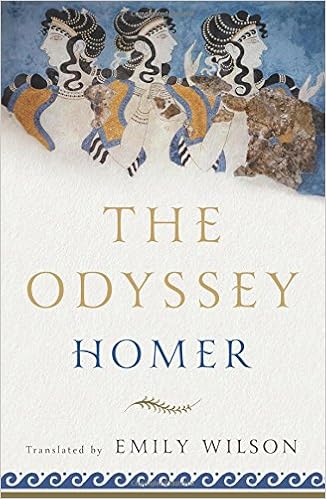
In the first book of The Odyssey, Telemachus tells his mother not to criticize the bard for singing stories about his father, now more than twenty years gone from Ithaca: "You must know / the newest song is always praised the most." So it is with Emily Wilson's new translation of The Odyssey, the first ever by a woman in the English language. Somewhere (I can't find it!) she says that each generation must produce its own translation, because a translation is as much about the contemporary world as it is about Homer's, and by that standard, Wilson's translation is very good indeed. It avoids the elevated language of former translations, that sought--wrongly, she thinks--to elevate the story also, choosing the simple language that reflects the simple vocabulary of the Greek and speaks with a simplified voice to the modern reader.
Compare the different versions of the opening line. "Sing in me, Muse, and through me tell the story / of that man skilled in all ways of contending," writes Robert Fitzgerald. Lattimore calls him a "man of many ways." Fagles, "the man of twists and turns." Fitzgerald's is a big clod of a sentence, but the other two perhaps get more to the heart of the Greek word, yet it's Wilson's rendering--Odysseus is a "complicated man"--that brings to life something essential about Odysseus' character. Yes, he's cunning, but his cunning does not always coincide with wisdom, and sometimes Odysseus' character shocks or alienates us. His boasts to the cyclops Polyphemus are clever, but they end in the death of all his men. At the end of the poem, he shows less mercy than he might. He kills women, he kills the parents of the suitors. Jonathan Shay saw in Odysseus a Vietnam veteran who can't leave the world of the battle behind, and lashes out at innocents--a complicated man. And maybe it's a stretch, but Wilson's translation seems quite appropriate for our moment, in which we are meditating daily on what exactly we should do with the complicated men in our lives.
Wilson's translation reminds us that The Odyssey, though it's about a king, favored by the gods, is in many ways the story of ordinary people. Unlike the Iliad, it sees and illustrates the lives of slaves, servants, sailors--and women, who even when exceptional are aligned with the ordinary hearth. It also makes for breezier reading. There are certain parts of this story I think I glossed over, having read both Fitzgerald and Fagles, that now appear clearly because of Wilson's lucid poetry. There's a whole B-plot where Telemachus picks up a prophet hiding on the shores of Ithaca and invites him into the household. I think I pretty much missed that every other time I read it.
Sometimes the plainspokenness becomes silly, like when Athena gives Odysseus a "tote bag." I miss some of the more poetic jolts, like when Fitzgerald says, "Of mortal creatures, all that breathe and move, / earth bears none frailer than mankind." Wilson writes, "Of all the creatures / that live and breathe and creep on earth, we humans / are weakest." Plainer, yes, but more prosaic. Much of the poetry gets thrown into high relief--especially Homer's metaphors and descriptions--but some of it gets lost, too.
Mostly, it's great. I envy people like Brent, who never had to read anything else. This ought to be the translation that's used in every school, for a generation, at least. Because, like Wilson notes, translations are a product of their own time as much as they are a document of antiquity, and it's hard to get students to appreciate the weird wonder of stepping into ancient Greece when they have to pass through the language of Victorian England, or early 20th-century Oxbridge. The next generation will have to make their own, but for this one, it's true that the "newest song" is most worthy of praise.

