Showing posts with label gene wolfe. Show all posts

Saturday, June 25, 2022

The Citadel of the Autarch by Gene Wolfe

You that read this, who have never, perhaps, possessed more than a single consciousness, cannot know what it is to have two or three, much less hundreds. They lived in me and were joyful, each in his own way, to find they had new life. The dead Autarch, whose face I had seen in scarlet ruin a few moments before, now lived again. My eyes and hands were his, I knew the work of the hives of the bees of the House Absolute and the sacredness of them, who steer by the sun and fetch gold of Urth's fertility. I knew his course to the Phoenix Throne, and to the stars, and back. His mind was mine and filled mine with lore whose existence I had never suspected and with the knowledge other minds had brought to this. The phenomenal world seemed dim and vague as a picture sketched in sand over which an errant wind veered and moaned. I could not have concentrated on it if I had wished to, and I had no such wish.

The Citadel of the Autarch is the final book in Gene Wolf's Book of the New Sun series, about the torturer Severian living in a distant future in which the sun is dying. We know, from the first book, that Severian has somehow risen to the office of the Autarch, the leader of the immense leader of the southern part of the world; Citadel tells this final part of the story, though a reader expecting a more traditional story of sword-and-shield conquest, or even of recognizable cause-and-effect logic, might find themselves disappointed. At the end of the third book, The Sword of the Lictor, Severian has discovered that a race of hideous aliens called hierodules has a vested interest in raising him to the office, and that the office holds more than earthly power: by raising him to the level of Autarch, they hope that Severian will be the one who brings the New Sun to the world, reversing the planet's inevitable decline and death.

I felt, a little, that The Sword of the Lictor was strangely ordinary among the Book of the New Sun novels; and speculated that the final book would be stranger and quicker in pace. It was strange to see, then, that most of the first third of The Citadel of the Autarch, finds Severian languishing in a field hospital among the soldiers fighting the Autarch's war against the northern Ascians. Severian passes the time hear listening to stories by several of the prisoners, who have asked him to judge their quality--Wolfe seems to really love a story-within-a-story. The most memorable of these is by a captured Ascian, whose race has been taught only to speak in a combination of a few thousand stock phrases extolling the virtues of their ruling leadership. And yet, the Ascian tells a whole story this way, relying on interpretation by a woman who has learned to understand what lies behind what is said. As Severian notes, most of us only speak with a limited number of phrases and sentences we have picked up from somewhere else; but the paucity of our language conceals a great depth of feeling and experience.

After leaving the hospital, the novel picks up pace, sending Severian off into the battlefield. One of the most memorable moments is Severian's mission to the Last House, a difficult-to-find place where every floor exists at a different point in time. As Severian looks out from the top floor over a sheet of ice--one possible future for his world--the resident, Ash, explains that he has been sent to monitor the past. Time travelers are a big motif in these novels; Severian's android friend Jonas is one, and so are the 20th-century tourists who appear as if ghosts in the Botanic Gardens of the series' first novel. The alien hierodules, and the mysterious figures they represent, can do it, too. And yet all this time travel has not dimmed the urgency of the mission of bringing forth the New Sun; still the common destiny of humanity, and the promise of rebirth, governs the whole logic of the series.

The final sections of the novel are about Severian's ascent to the office of Autarch. The old Autarch, whom Severian met in an earlier novel disguised as a lower official in his own great house, rescues Severian from the war and is badly wounded in the process. Before he dies, he insists that Severian drink from a vial around his neck and drink a little of his blood, which will incorporate his own consciousness into Severian's. This process is reminiscent of the ritual of the alzabo from the second book, by which Severian eats the flesh of his former love Thecla and takes her consciousness in him. But the Autarch, as Severian will be, is the end point of such a process repeated thousands of times, and contains thousands of consciousnesses. Part of Severian's role as Autarch and hero of the New Sun is to take on all these consciousnesses, the literal embodiment of his burden.

The Catholic Wolfe called Severian a "Christian" figure, pointedly distinct from a "Christian figure." It's interesting to think about the way that Severian's role as the Autarch is a kind of Christian story in spirit. As the novel closes, Severian is planning on attempting a vague test administered by the alien hierodules that will either end with the coming of the New Sun or Severian's castration; these images of rebirth and renewal seem deeply rooted in Christian mysteries. And Severian's accretion of consciousness seems to me not so different from Christian ideas of the Holy Spirit, or the language inherent in the term "Son of Man." And of course, you can't forget that in a literal sense, all these people are dead, and Severian offers them an incarnation and rebirth. For Severian to succeed is for the multitude to succeed. In this way, The Book of the New Sun subverts the kind of "chosen one" narratives familiar from fantasy novels, that raise one special figure above the others. One might wonder: "Why Severian?" But in some sense this question becomes moot as Severian becomes a vessel for many people.

I'm sad for this series to be over for me. It has the kind of intense imaginativeness and creativity that I'm always hoping to find in a science fiction book, and which I feel like I rarely find. I'm more convinced now than I was when I started it that these books are true classics, works that expand the notion of what not only genre literature can be, but literature full stop. And I have a greater appreciation for the prose, which touches on the parodic, but is capable of great subtlety and power. (I remember seeing on Twitter that someone said they stopped reading the first book after ten pages because the writing was so bad; I really think that person Did Not Get It.) And though it's a shame to think this story is over, I'm looking forward to checking out some of the other novels that Wolfe wrote set in the same universe.

Saturday, February 27, 2021

The Sword of the Lictor by Gene Wolfe

I had not thought, when I began this record of my life, to reveal any of the secrets of our guild that were imparted to me by Master Palaemon and Master Gurloes just before I was elevated, at the feast of Holy Katharine, to the rank of journeyman. But I will tell one now, because what I did that night on Lake Diuturna cannot be understood without understanding it. And the secret is only that we torturers obey. In all the lofty order of the body politic, the pyramid of lives that is immensely taller than any material tower, taller than the Bell Keep, taller than the Wall of Nessus, taller than Mount Typhon, a pyramid that stretches from the Autarch on the Phoenix Throne to the most humble clerk grubbing for the most dishonorable trader--a creature lower than the lowest beggar--we are the only sound stone. No one truly obeys unless he will do the unthinkable in obedience; no one will do the unthinkable save we.

Gene Wolfe's Book of the New Sun series isn't one of those fantasy series that has a map on the first page. There are many strange places, but there is no orienting yourself in it, or dispelling the mystery of these places with a name and icon. Severian, the torturer protagonist, keeps moving north, but north into a land that is increasingly unfamiliar, and as he moves he sometimes seems to move in time as well as space. That is how the Claw of the Conciliator, the magical gem he picks up in the first book, seems to work, after all, raising the dead by bending time to the point of their life. And if the prophecies are true, the arrival of the messianic figure known as the "New Sun"--the sun on this version of Earth is dim and dying--will bring the past and future together. The New Sun, it seems, might be Severian itself, and how can that kind of journey be placed on a map?

At the beginning of The Sword of the Lictor, the third novel in the series, Severian is stationed at the city of Thrax. He's been more or less exiled here after illegally providing clemency to a woman in the first book, and yet he has great authority. As the head of the Vincula (the "House of Chains") he presides over an immense fortress of criminals in need of torture and execution, and applies himself with cleverness and industry to the task. His beloved companion Dorcas is in town as well, and though Severian tells her he will break his oath to the guild and marry her, seeing his work up close has left her disgusted and disconsolate. To make matters worse, there is a creature stalking the town, burning people alive, a creature called the Salamander, and it may be looking for Severian himself. But old habits die hard and when Severian once again frees a woman he has been commanded to kill, he must escape Thrax and go on the run again.

The goal of Severian's journey is, as it has been, to return the Claw to the Pelerines, the nomadic order of women who are its keepers. Once again he encounters many strange monsters and obstacles on the way, all of which show the terrific range of Wolfe's imagination--and which, if I may so myself, really make most fantasy novels look stodgy and dull. He fights the alzabo, a creature who speaks with the voice of those it has eaten, begging their family members to join it in the alzabo's jaws. He climbs an enormous mountain shaped like an ancient ruler of Urth, only to find that the Claw has, unbeknownst to him, resurrected the ruler, now with two heads instead of one, who intends to reconquer what he has lost. He is rescued from captors by a band of people who live on islands that float in a lake and battles an army of phantasms made of fog.

And yet, compared to the second novel, The Claw of the Conciliator, The Sword of the Lictor seems almost conventional at times. There's nothing so weirdly genre-bending as the script of the play that forms the climax of that novel, for example. There are few strange visions of our own time, as occurs in the first novel. And the eerie suggestions that perhaps Severian has made the whole story up in his head are few and far between here. The story is weird, but the novel itself is recognizable as fantasy; it hits the same climactic and emotional notes. It is, at heart, an adventure. I read somewhere that Wolfe intended the series to last for three novels and then had to split the final book into two; my guess is the fourth novel increases the strangeness factor considerably.

One thing that sets The Sword of the Lictor apart from the first two novels is that Severian goes through his adventure almost entirely alone. He leaves Dorcas behind, who can't bear to be with him. His loyal friend Jonas (who turned out to be a robot, if I'm remembering correctly) is long since gone. Several new companions seem to pop up, but each only lasts a short while in Severian's company: Typhon, the former ruler, for one, and a little boy whose name is also Severian, who Severian the elder nearly adopts as his own son. But at the end of the novel, Severian is once again alone; and not only that, he is forced to fight his old companions Baldanders and Dr. Talos. Before this final battle he meets with a group of "cacogens," terribly mythical many-eyed figures, who turn out to be aliens of some kind, who take a concerted interest in him. These aliens know, it seems, that Severian is on a path to become the New Sun and reenergize the dying world, but The Sword of the Lictor shows convincingly that it's a path Severian will have to walk alone.

Thursday, March 26, 2020

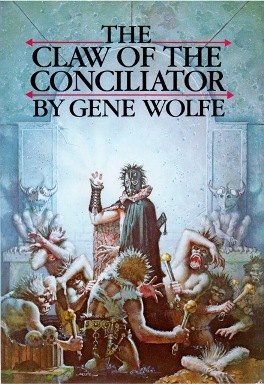
The Claw of the Conciliator by Gene Wolfe

Here I pause again, having taken you, reader, from town to town--from the little mining village of Saltus to the desolate stone town whose very name had long ago been lost among the whirling years.  Saltus was for me the gateway to the world beyond the City Imperishable.  So too, the stone town was a gateway, a gateway to the mountains I had glimpsed through its ruined arches.  For a long way thereafter, I was to journey among their gorges and fastnesses, their blind eyes and brooding faces.

Here I pause.  If you wish to walk no farther with me, reader, I do not blame you.  It is no easy road.

The Claw of the Conciliator is the second book in Gene Wolfe's Book of the New Sun tetralogy, following the torturer Severian as he continues his journey away from the Citadel of his upbringing toward--well, what exactly?  At one point he tells us of his various missions, each of which seems to be of vital importance, but which strain against each other not just for him, but the reader, making it difficult to read the book as a quest narrative like you expect: he wants to make his way to Thrax, the city where he's supposedly posted as a torturer after having been exiled from the Citadel; he wants to find and protect Dorcas, the waif-like girl who appeared in a lake; he wants to serve the rebel Vodalus, who fights the ruling Autarch; he wants to return the all-powerful healing crystal known as the Claw of the Conciliator to the religious order who guards it.  Along the way, here are some of the things he encounters:

A cave full of aggressive glowing aps-people.  An ancient giant who seeks to control Urth, and wants to seduce Severian to live at the bottom of the sea.  Flying bat-like creatures made of night that burrow into your body for warmth, and that separate into two creatures when you cut them with your sword.  A robot who's been grafted with flesh and organs.  (Not, significantly, a person who's been grafted with robotics.)  The House Absolute, seat of the Autarch, which turns out to be build entirely underground.  The Second House, a--well--second house built in secret around the House Absolute, full of mysterious and hidden passageways.  Hideous cacogens, disguised as human beings, but who really have thousands of eyes laid out like a pinecone.  A secret ceremony in which he is invited to ingest the flesh of his dead love Thecla, after which her memories continue to live on him.

...And a lot of other stuff, besides.  Looking at the list, you get the impression that The Book of the New Sun is a particularly inventive but also fairly formulaic fantasy series.  But what makes Claw of the Conciliator, like The Shadow of the Torturer, so engaging is the sense I get that it's not really interested in being a fantasy or science fiction book at all, and that the whole thing is a kind of papier mache facade that's concealing another kind of book entirely, or perhaps nothing at all.  More than once, Wolfe pauses the narrative to include another kind of genre entirely: first a book of legends, then a script for a play that Severian performs, which is so mind-boggling that it reminded me of nothing more than Faust.

Everything comes at you whip-fast, introducing new characters and ideas and then undoing or recontextualizing them in a way that makes the reader's footing supremely unsure.  No sooner does Severian meet the rebel Vodalus in the woods and agree to carry a message to a spy in the House Absolute than the spy turns out to be the Autarch himself.  Is the rebellion just a red herring?  If so, what's the "real story" here?  Is it about the giants that live in the sea who want to exert dominion on the land, or are they a red herring, too?  Maybe every herring here is red.

Again, Wolfe suggests that the world of Urth may be a figment: in The Shadow of the Torturer, interlopers from our own time appear on a kind of safari.  Here, Severian's friend Jonas suggests that he comes from a different place and time, and is perhaps thousands of years old.  In a room of mirrors in the House Absolute he disappears--presumably, having known how to return to our own era, perhaps slipping through time, but perhaps because Urth itself is a fiction or a metafiction.

I feel like I haven't entirely captured just how strange these books are.  Talking about them makes them seem ordinary, but they outstrip the capacity of my language to really capture, and that's part of what makes them so uneasy and unsettling.  The quest continues, but it's almost like the book, and the very nature of its book-ness, is falling apart, and I have a hard time imagining these qualities intensifying for two more novels.

Saturday, April 13, 2019

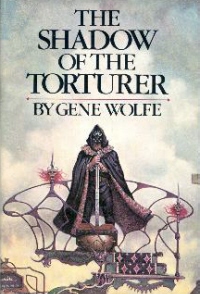
The Shadow of the Torturer by Gene Wolfe

Justice is a high thing, and that night, when I lay beside Dorcas listening to the rain, I was young, so that I desired high things only.  That, I think, was why I so desired that our guild regain the position and regard it had once possessed.  (And I still desired that, even then, when I had been cast out of it.)  Perhaps it was for the same reason that the love of living things, which I had felt so strongly as a child, had declined until it was hardly more than a memory, when I found poor Triskele bleeding outside the Bear Tower.  Life, after all, is not a high thing, and in many ways is the reverse of purity.  I am wise now, if not much older, and I know it is better to have all things, high and low, than to have the high only.

Severian is a journeyman in the Guild of the Torturers in the Citadel of Nessus.  His guild is widely loathed; torturers rarely leave the Matachin Tower where they are stationed because they are suspected, spit upon, distrusted.  But still, they are a necessary part of the fabric of life in Nessus, the executives of justice who carry out the will of the mysterious Autarch who rules somewhere from his house in the northern wilderness.  For that reason, Severian is committed to the torturer's life, even as a raid early in his life by the rebel Vodalus suggests that justice has other forms and functionaries.  That is, until he shows mercy to a high-born, beautiful, and intelligent captive named Thecla who is caught up somehow in the Autarch's campaign against Vodalus, and is expelled from the tower.  He's not quite stripped of his membership in the guild--like bureaucrats in our world, they shy away from controversy and disrepute--but he is sent to serve as an executioner in a remote town.

The torture that is prescribed for Thecla is a machine called "the revolutionary."  After a painful shock, it turns Thecla's body against her.  She tells Severian that she cannot stop her own fingers from clawing at her eyelids, and he tells her she will eventually tear her own eyelids from her sockets.  That kind of grotesque ingenuity is characteristic of The Shadow of the Torturer, which is as imaginative at worldbuilding as any fantasy or science fiction novel I've ever read.  The citadel, with its innumerable towers and lost rooms, reminds me most of the castle in the Gormenghast novels.  But it's halfway through the book, when Severian begins his journey away from the Citadel, that Wolfe's imagination really launches into high gear.  Severian doesn't get far, not even out of the city: he gets challenged to a strange kind of duel in which the weapons are poisonous flowers.  Along the way, a woman appears mysteriously out of a lake where corpses are buried and becomes his companion.  Shit gets weird.  Wolfe never seems to stop worldbuilding; each new chapter brings some kind of strange new element to be accommodated into our understanding of the world.  Since Severian hasn't traveled much outside his tower, however, it allows us to experience these things for the first time with him also.

We intuit, eventually, that Severian's Earth ("Urth") is a far-future version of our own in which the sun has begun to die and the world seems to be expiring.  Attempts to bring back the older world have filled it with prehistoric animals--smilodons and ancient horses--but it's still dying.  In a gallery of paintings, he sees a picture of the moon landing:

The picture he was cleaning showed an armored figure standing in a desolate landscape.  It had no weapon, but held a staff bearing a strange, stiff banner.  The visor of this figure's helmet was entirely of gold, without eye slits or ventilation; in its polished surface the deathly desert could be seen in reflection, and nothing more.

Later on, however, deep in the city's botanic gardens (he's there to collect his deadly flower) he encounters a pair named Robert and Marie who clearly have come from our world, or our era, and who see him as a kind of demonic spirit that they've summoned by accident.  It's a weird moment that's barely explored, but it throws our understanding of Severian's Urth off balance: is it the future?  Or perhaps another dimension?  On top of all of that, Severian has a number of visions that may be real or may be signs of increasing mental instability.  The Shadow of the Torturer is a book that loves the worldbuilding impulse of fantasy fiction, but looks on what it's made with a suspicious eye.

The novel ends with Severian at last, in the company of a flimflam doctor and an idiot giant, leaving the gates of the city.  It seems to end in the middle of Severian's journey, without resolution, but what kind of resolution can you expect?  The novel is gripping (despite what Brent felt), but it's also shaggy, and its weirdness and ambiguities make Severian's arc uncertain.  There is no quest, no sense that, Frodo-like, Severian must learn to find courage and defeat some evil.  It is entirely possible that Severian himself is the evil that must be vanquished.  But it's the novel's refusal to adhere to traditional fantasy narratives and archetypes that make it so appealing, and I had to exert a lot of willpower not to immediately crack open the next novel in the quartet.

Sunday, September 9, 2007

Shadow of the Torturer by Gene Wolfe

Shadow of the Torturer is the first volume of The Book of the New Sun, a fantasy/sci-fi quadrilogy that is generally considered to be one of the best. The main character is a former Torturer named Severian who is exiled from his guild after extending mercy unbecoming a torturer to a woman in his care. True, “Extending mercy” basically just means hat he killed her in a slightly less painful way, but torturers are, as you might expect, a bunch of hard cases.

Well, when I first started this book, I was pretty excited about it. The buzz I'd read had been almost all positive, the concept sounded very interesting and full of potential, and the writing itself was fairly appealing... at least when I first started the book.

The first section, where we learn about the torturer's guild and Severian's life in there, is pretty cool. Unfortunately, once he gets kicked out, the pace of the book, already pretty slow, grinds nearly to a halt, as Severian has several adventures in which nothing really happens. I'm all for slow books, and I'm all for setup, but between the copius amounts of both, Shadow of the Torturer just wore me down. It doesn't help that the print size in this book is absolutely miniscule.

So anyway, I only read this book, and I'm not I'll finish the series. I'm sure it's great for some people, but not for me. I need more lasers in my sci fi.