
"But a monster still lived, and meant revenge/She'd brooded her loss, misery had brewed/In her heart, that female horror, Grendel's/Mother, living in the murky cold lake/Assigned her since Cain had killed his only/Brother, slain his father's son/With an angry sword. God drove him off,/Outlawed him to the dry and barren desert,/And branded him with a murderer's mark. And he bore/A race of fiends accursed like their father [. . .]"
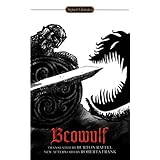
This wasn't the first book I intended to read, much less review this year. I had hoped to start with Demons, but my student teaching assignment had other plans. As I re-read Beowulf in preparation for the beginning of the new semester in a couple of weeks, a review began to form in my head. I began to read my old high school copy, the much touted Seamus Heaney translation, then found out my class would be using the older Burton Raffel translation. For the sake of this review, I find this just fantastic. I love translated literature and I love comparing translations from different writers and the effect the different styles and wording have on the reader.
Like most, I truly admire the Seamus Heaney translation. It is masterful, it is literary, it employs techniques that exhaust me just imagining the effort required to remember and effectively use them for an entire epic poem. Raffel's translation, on the other hand, is much easier to read. Not only do I still appreciate the action of the story, I feel like I'm sitting around the fire in a mead-hall listening to a king's favorite storyteller extol the feats of a great warrior.
I was gripped anew by the fight between Beowulf and Grendel, the underwater fight with Grendel's mother, and the pain of the Geats surrounding the funeral pyre of their King. The story itself is familiar to a modern reader, both because many of us have read it, and in that much of it has been used in huge numbers of stories since then: dragons, monsters, fate, fame, kings, treasure and revenge. It employs all of the elements of an epic poem in the most barebones way possible: in just over 3000 lines (about 125 pages, compared to 500 pages for The Odyssey) our hero goes on a quest, defeats a monster, journeys to the underworld to defeat yet another monster, returns home victorious and lauded by all, then faces a final challenge at the end of his life. This final challenge claims his life, but he still defeats the ancient evil that has been buried deep within the earth. In one of the most moving of literary passages, he is lauded and mourned by his people as the flames of his funeral pyre swallowed his body and riches.
There are elements of written oral traditions that I find difficult to read - namely, the tangents. The stories of the greatness of Hrothgar and Beowulf's ancestors, the warning inherent in the tale of Siegmund and his pride in his own great deeds. While I had trouble leaving off and picking up the main story around the shorter stories within it, I appreciated how the poet used those tales to give weight to the tradition of storytelling in this tradition. Overall, for sheer literary technique I would recommend Heaney's translation, the way that he tries to stick to the format of the Anglo-Saxon poet is impressive and commendable. For a first introduction to Beowulf or for pure enjoyment of the story rather than the craft of it, I would recommend Raffel's translation. If you're as much of a language nerd as I am, pick up both and compare.


