Showing posts with label Stanley Fish. Show all posts

Wednesday, May 14, 2014

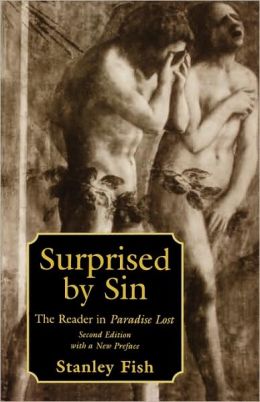
Surprised by Sin by Stanley Fish

I've been taking a class on Milton (who is great--I never knew!) and, of course, that involves reading Paradise Lost, one of English's longest and most persnickety poems.  The story, if you're a godless heathen, is Genesis: Adam and Eve enjoy some good times in the Garden of Eden, before a very bitter fallen angel named Satan infiltrates it and convinces them to eat the fruit from the only tree God's told them not to touch.  Things after that pretty much suck.

>One of the aspects of Paradise Lost people have been trying for centuries to figure out is this: Why is Satan the most compelling character?  He's the one that gets all the poetry, the fancy rhetoric, the courage and the devil-may-care attitude.  Here he is, talking to Beezlebub in Hell:
Is this the Region, this the Soil, the Clime,
Said then the lost Arch Angel, this the seat
That we must change for Heav'n, this mournful gloom
For that celestial light? Be it so, since hee
Who now is Sovran can dispose and bid
What shall be right: fardest from him is best
Whom reason hath equald, force hath made supream
Above his equals. Farewel happy Fields
Where Joy for ever dwells: Hail horrours, hail
Infernal world, and thou profoundest Hell
Receive thy new Possessor: One who brings
A mind not to be chang'd by Place or Time.
The mind is its own place, and in it self
Can make a Heav'n of Hell, a Hell of Heav'n.

Badass! God, by contrast, comes off as a self-righteous, authoritarian prude.  Why would Milton make Satan look so awesome and God look so bad?  William Blake famously said that Milton was "of the Devil's party without knowing it."  Could it be that the righteous Puritan Milton really was more emotionally invested in his artistic depiction of the devil?

Fish replies to these claims with a breathless piece of Reader-Response criticism.  He argues that Satan's seductiveness is part of the design of the poem; we are supposed to be attracted by Satan because that's his M.O.  We respond to his lies, his rhetoric, his sublimity on an internal level, and then must face the cognitive dissonance of our intense attraction to Satan.  That, Fish argues, is the way we learn to cast our gaze inward on our own fallen nature.  If we are dissatisfied with God's language, well, as Milton reminds us in On Reformation: "The very essence of truth is plainness and brightness; the darkness and crookedness is our own."

I find this a very compelling way of reading the poem, and perfectly in accord with the kind of poetry Milton writes elsewhere (though I admit I am not quite yet an expert).  Some critics have derided this image of God as a disciplinary schoolmarm, but I think those critics--and to some extent Fish--discount the way in which the poet himself is entangled in this process, having to endure the same education that we are.  Paradise Lost is not very interesting if you regard Milton as an uptight jackass (like Robert Graves did) who is constantly bringing the ruler down on the reader's fingers; but as the introspection of a blind, defeated, and utterly broken man, it's something different all together.  

I'm going to post a longer review, of course, on Paradise Lost, which is a great poem, though perhaps not what the Kindle Generation wants or feels they need.  When I do, I'll share more thoughts about the best way to read the poem, but to be sure, they will be closely modeled after Fish's reading.

Monday, April 15, 2013

"A groom must expect matrimonial pandemonium / When his spouse finds he's given her cubic zirconium."

Kenji Yoshimo discusses the criticism of Justice J. Michael Eakin's use of the above couplet in his dissent in the case of Porreco v. Porreco.  In general, Yoshimo disapproves, but concedes that the distinction between law and poetry is not cut-and-dry:

But like every generalization, the idea that law is a serious business while literature is an ornamental pastime has some important exceptions.   Given a culture that seeks to drive a wedge between law and literature, we should not expect legal poems to declare themselves as such.   This is not, however, the same thing as saying such poems do not exist.  

The most famous poem in law is the Miranda warning.   More people can recite this quatrain than can recite the Gettysburg address, much less a quatrain from most poets who were intentionally writing quatrains, like the quite catchy Alexander Pope. The broad dissemination of the warning in our culture through television and film has not just given it force, but affected its Constitutional stature.

Three thoughts:

First, I'm saddened by Yoshimo's premise that literature is an "ornamental pastime."  I think he's right, if you substitute the word "poetry" for "literature," and not because I believe that poetry is by nature nothing more than decorative or aesthetic, but because that is probably a fairly accurate description of poetry as it functions in America today.  Novelists, I think, can still claim to be about something far more serious and socially valuable, but the poet is so marginalized it's hard to imagine one claiming a part in the broader political or social debate without laughing.  ("Say, did you hear what Louise Gluck said about immigration reform?")

Secondly, I really love Yoshimo's description of the Miranda warning as a poem.  Here's how I'd do the enjambment:

You have the right to
remain silent
anything you say
or do
may be used against you
in a court of law
Finally, Yoshimo quotes from Robert Cover's 1986 essay that differentiates literature and law because the latter "deal[s] pain and death."  The suggestion is that the stakes are simply too high to play literary games with.   I'd suggest that that is more or less the right distinction; that the problem blurring the line between literature and law is that literature relies too often on purposeful ambiguities and ironies that make interpretation difficult, while the purpose of law is to eliminate those ambiguities as much as possible.  Yet to think of them as obviously distinct is to ignore the way in which law necessitates interpretation, and the way in which interpreting a legal text is not so different from a literary one.  (Stanley Fish has made a career out of mining this overlap, and Justice Scalia's recent book makes this point right in the subtitle.)

Yet I think implicit in Yoshimo's critique, as well as Cover's, is the distinction between texts that do something--here, something as serious as "pain and death"--and texts that do not.  I'm suspicious of this attitude because, a.) I think it's false (all texts are meant to "do something"), b.) I think it neuters the power of literature, reducing it to being "ornamental" and not just describing it that way, and c.) ignoring the fact that law is explicitly textual and without force in and of itself does us no favors.  To put it another way, the great difference in the power of a legal poem and a literary one is that no one puts in you in handcuffs while they read the latter.

Yoshimo ends his discussion by noting that "The Greeks embodied law-like mores in poetry to ensure their broad dissemination in an oral culture."  Sure, but Yoshimo is still thinking of law and poetry as essentially separate activities in a way that might have been lost on an ancient Greek.  He does, however, remind us that there was once a time in which poetry did have the kind of illocutionary power that's lost to it now.

Can poetry deal "pain and death" today?  This might be a logical leap, but Yoshimo's article made me think of Robert Oppenheimer, who commented on successfully detonating an atomic bomb with a passage from the Bhagavad Gita, which is, of course, a poem: "Now I am become Death, the destroyer of worlds."

I assume that if Justice Eakin had said something like that, nobody would have batted an eye.  Maybe next time he should avoid the silly, three-syllable feminine rhyme.

P.S. I am not a lawyer, but some of you (Billy, Randy, Kunal...) are--what did you think about Yoshimo's piece?

Thursday, February 17, 2011

How to Read a Sentence by Stanley Fish

"Some people are bird watchers," Stanley Fish tells us in the introduction to How to Read a Sentence, "others are celebrity watchers; still others are flora and fauna watchers. I belong to the tribe of sentence watchers." He is a sentence fetishist, determined not only to make us aware of the sublimity of the well-written sentence, but to deconstruct it for us so we might make our own. Fish, as a professor of law, has faculties finely tuned for this business.

Grammar and sentence-making, Fish says, are being taught in entirely the wrong way in our schools. Rote memorization of parts of speech (What the hell is a gerund, an English teacher at my school asked today) is ineffective and confusing. Instead, we must come to understand sentences as logical constructions made of forms, commonsense relationships between words and phrases that we more or less know intuitively. The key is imitation. For example, he takes this sentence by John Updike, about Ted Williams' home run in his last at bat in Fenway:

It was in the books while it was still in the sky.

...and dissects the way that "while" provides the "fulcrum of the sentence," and that on either side of that fulcrum are different registers (one literal, one less so) that must be reconciled, and then notes that we too can imitate this:

Here is my (relatively feeble) attempt: "It was in my stomach before it was off the shelf."

...and that by this imitation we may not create a masterpiece, but we expand our own ability to express the thoughts which are most vital to us.

It is unclear to me exactly who this book is written for--it seems most appealing to other sentence fetishists, who probably don't need Fish to explain much to them, though it offers some appeal in the way a trainspotter might be fascinated by watching a locomotive being repaired. It seems unlikely that anyone will go through the kind of exercises that Fish recommends, unless, of course, he or she happens to be a student in Fish's freshman comp class at Florida International. Probably its most appropriate audience is folks like me, sentence fetishists charged with the grammatical tutelage of America's future. (I would say also you, Danny, were it not true that you hate sentences.)

All told, the most fascinating aspect of How to Read a Sentence is the catalogue of great sentences that Fish marshals for his tinkering. I am pleased to say that Fish includes quite a bit from The Good Soldier, "nearly every sentence of which merits a place in this book." In a recent contest on Slate, Fish judged the best of reader-submitted sentences, of which I am pretty fond of this one, from the Bible:

Then Amnon hated her with very great hatred; so that the hatred with which he hated her was greater than the love with which he had loved her. (2 Samuel 13:15, RSV)

And without further ado, here is, while not My List of Greatest Sentences, perhaps My List of Greatest Sentences That I Chanced Upon While Leafing Through my Bookshelf for This Review:

Updike, describing the way men “bump” into women in Rabbit, Run:

Either they give, like a plant, or scrape, like a stone.

Ford, in The Good Soldier:

But still, she listened to you and took in what you said, which, since the record of humanity is a record of sorrows, was, as a rule, something sad.

Forster, talking about newlyweds in A Room with a View:

Ah! it was worth while; it was the great joy that they had expected, and countless little joys of which they had never dreamt.

Austen, being snarky in Persuasion:

The real circumstances of this pathetic piece of family history were, that the Musgroves had had the ill fortune to lose him before he reached his twentieth year; that he had been sent to sea, because he was stupid and unmanageable on shore; that he had been very little cared for at any time by his family, though quite as much as he deserved; seldom heard of, and scarcely at all regretted, when the intelligence of his death abroad had worked its way to Uppercross, two years before.

What are your favorites?