Showing posts with label Northern Ireland. Show all posts

Monday, August 10, 2026

Little Constructions by Anna Burns

Do you know this syndrome? Do you have it? I'll tell you. You're having a hard time, say, because something not very nice once happened to you. It was a big thing, and although it's supposed to be over, in your body and in your head and from the way you now look out on the world, it's not bloody over, it's still bloody going on. Or maybe it wasn't a big thing. Maybe it was a series of little things, most of them below the level of police CAD reference number material, but if you add them together, plus feather in the timescale, they amount to one hell of a cumulative assault.

But poor you. It's too late. By now you're infantilised. By now you've lost your language. By now you're no longer capable of speaking about what happened, for didn't you try and try and nobody could hear? You're left swinging to one extreme therefore, which is clutching on to reluctant people, babbling incoherencies, or else sitting alone at your kitchen table, driven into silence, unable to tune into anything at all.

That's because of evil. That's what evil does.

Little Constructions opens with Jetty Doe, a member of Belfast's notorious Doe crime family, barging into a gun shop and demanding a gun. She takes with her a handful of the wrong ammo--buckshot for Kalashnikov--and heads off to shoot her lover, the husband of her sister, crime lord John Doe. This sets of a series of events that reverberate not just in the future but somehow in the past, beginning with the complete dissolution of the gunshop owner, Tom Spaders, still reeling from being mugged by a group of children seven years before. From there we're introduced to all the members of the Doe family, who are named like Duggars: there's Jetty, of course, but also Jotty, and Julie, and JanetJoshuatine, and JerryJudges and Joe and Johnjoe, and so on, and so on. Not all of them are literally Does, and those that are literally Does occupy a vague place in the family hierarchy. Who is a sister, and who is a wife? Who is a daugher? And what happens when all these roles get mixed up?

Anna Burns' first novel shares certain recognizable qualities with her breakout book, Milkman, as well as another book of hers I enjoyed, No Bones. All are about the ways that a climate of constant violence can warp the brain and prevent one from seeing things as they really are. Little Constructions attempts to make that point even more severely than the other two, by presenting a kind of impossible-to-follow shaggy story, moving backward and forward from the point of Jetty storming the gunshop, filling in details, going on digressions, casting doubt on those details, etc., etc. It has a number of unforgettable images and ideas: John Doe's son hiding in the suit of armor as John assaults his daughter; the many, many coffins that Doe buries, each time claiming (persuading even himself, perhaps) that he's burying a beloved family member. Though these images touch on political and sectarian violence in Belfast, it seems clear that Doe is just a petty criminal, and yet that has given him a kind of nobility that has driven him and the rest of his family crazy, like a bunch of Habsburgs.

I enjoyed Little Constructions for a little while. It has a manic energy I really enjoyed, and I was fascinated by the bodiless "I" that Burns employs as a narrator. Is it a bystander? A ghost? One of those fantastical constructions that the Does use to justify and smooth over the contradictions of their insane lives? But in the end, it was just too confusing. I can barely explain what happens in the book's second half, and what I can explain, I certainly can't put in order. (Is the big blow-up that happens at the end a day after Jetty storms the gunshop? Or years later? And who exactly ends up dead?) It's all intentional, of course; Burns is trying hard to keep you from finding your footing in this topsy-turvy world. But I felt that it was those other, later books where she managed to find a better balance of realism and hysteria.

Saturday, June 8, 2024

No Bones by Anna Burns

A few bare bones: this sister was called Amelia, she was seventeen, she never ate any food, suffered constant tummy aches, didn't understand why and was outrageously, sexually tin. She came in the door with that arm-swinging vigour all six-stone hunger-strikers are very keen on--or at least while on one of their extraordinary highs. So it could be said she was happy till that moment. Catching sight of her relatives however, she stopped being happy, stopped swinging her arms and her high dissipated in an instant.

The neighborhood of Ardoyne is one of the hardest hit by the three decades called, in Belfast and Northern Ireland, the Troubles. A teenager Amelia stops on the street to make out with a young man, and as soon as she leaves him, a car full of Protestants snatches him an executes him. A British cousin, having visited Amelia's family with open arms just a few years before, makes the mistake of repeating the visit, and finds himself murdered by his own family. Deaths pile up on themselves so quickly that they are quickly forgotten: "Everyone said wasn't it terrible, wasn't it a waste, wouldn't it always be remembered? But it wouldn't. And it wasn't. Everything got eclipsed, always got eclipsed, by the next, most recent, violent death."

No Bones is, like Anna Burns' subsequent and Booker-winning novel Milkman, about the ways that human psychology curdles in an environment of constant violence. The people of Ardoyne live in a state of constant denial and obfuscation; to live among the daily deaths requires them not to look too squarely at what's going on. It forces them to minimize the significance of violence; though one moment they may be cry about the wasted lives, their existence forces them to move on quickly as if this were a normal kind of life. It forces them to become inward, closed-off, and provincial. In the novel's final story, Amelia, having grown up and spent some time in London, comes back home and suggests that her old friends hire a car and take a holiday, an idea so strange and foreign to their understanding that they can barely understand what it is she's suggesting. (This story resolves in a clever way: instead of being "opened up" by the outside world, the friends find themselves on a ferry to a small island town off the Northern Irish coast, where the residents assume they are Protestants, or outsiders at any rate, and try to bully them off the island. What reforms their understanding, then, is coming face-to-face with a community as warped and defensive as their own.)

I was impressed by No Bones. It doesn't have the power of Milkman, which seems to me to take many of the same elements of No Bones and focuses them into a work with a singular nature. No Bones, by contrast, is organized as a series of stories, in some of which Amelia is the central character, or even the narrator, and others in which she appears at the margins. This method, on the other hand, allows Burns to play around with some of the more experimental elements of the novel, as with a story from the perspective of Vincent, a "mad" local whose viewpoint shifts between fantasy and reality in a way that I found really skillful and effective. Amelia herself is a kind of "madwoman," mentally warped by her community and a lifelong battle with anorexia; in one story she's in a mental clinic, imagining her brother--a crass and violent man who gets mixed up with the IRA--as a kind of beetle-like creature munching on her own flesh. Of course, it's just this kind of madness that gives Amelia the outsider's perspective she needs to see through the insanity of the way things are done in Ardoyne--only a madwoman could conceive of a plan as crazy as renting a car and going to the seaside.

Saturday, March 9, 2019

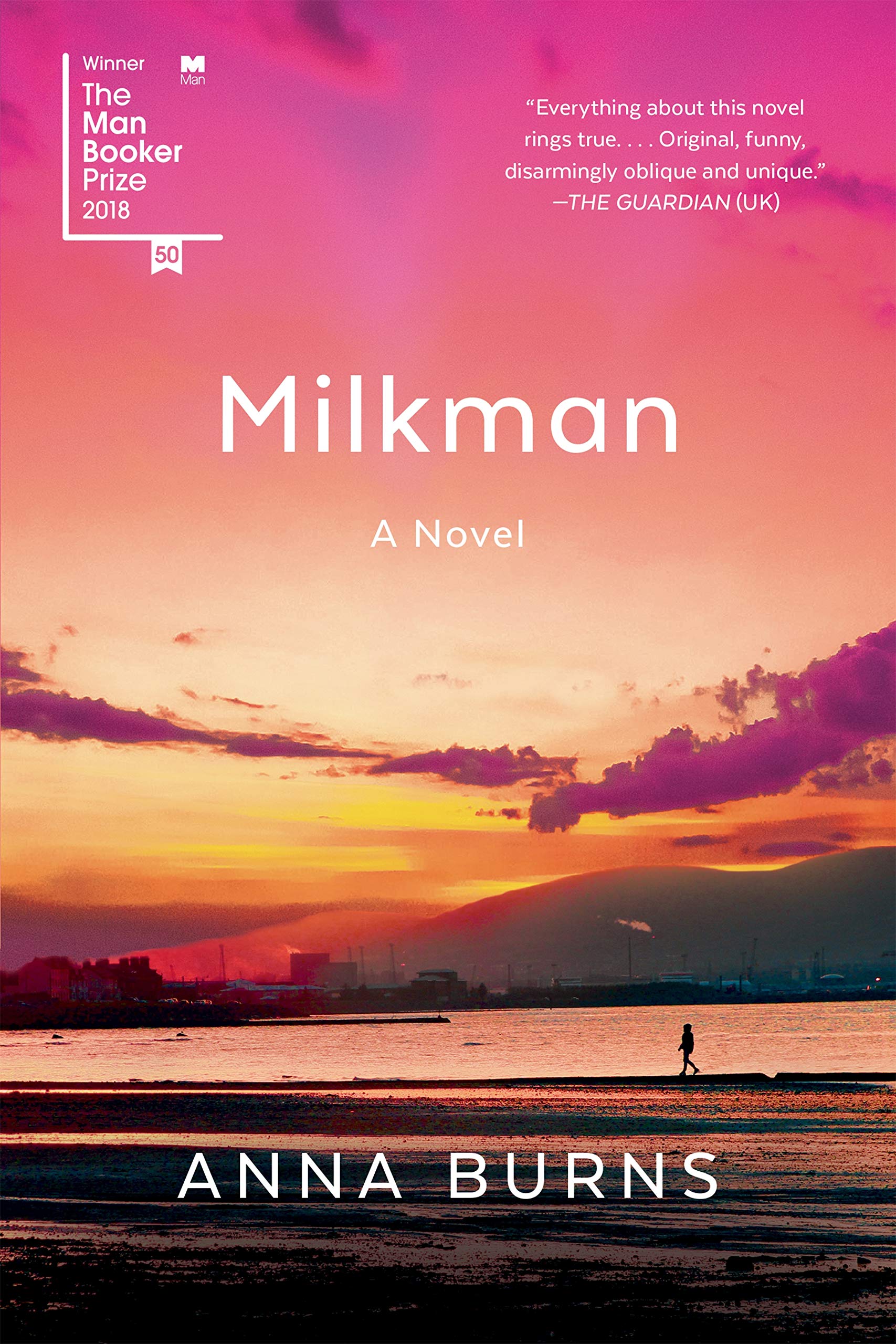
Milkman by Anna Burns

The day Somebody McSomebody put a gun to my breast and called me a cat and threatened to shoot me was the same day the milkman died.  He had been shot by one of the state hit squads and I did not care about the shooting of this man.  Others did care though, and some were those who, in the parlance, 'knew me to see but not to speak to' and I was being talked about because there was a rumour started by them, or more likely by first brother-in-law, that I had been having an affair with this milkman and that I was eighteen and he was forty-one.  I knew his age, but not because he got shot and it was given by the media, but because there had been talk of this, for months before the shooting, by these people of the rumour, that forty-one and eighteen was disgusting, that twenty-three years' difference was disgusting, that he was married and not to be fooled by me for there was plenty of quiet, unnoticeable people who took a bit of watching.  It had been my fault too, it seemed, this affair with the milkman.  But I had not been having an affair with the milkman.  I did not like the milkman and had been frightened and confused by his pursuing and attempting an affair with me.

Twice in a week, middle sister, the protagonist of Anna Burns' novel is invited to see a sunset.  This, to her, is strange--it's not something do, watching the sun go down.  Once, she's invited by maybe-boyfriend, and once by her French teacher, who is trying to get her entire class to see what they stubbornly refuse to see.  The sky is blue, the class insists, even though they know it can also be "black (the night sky) and white (cloudy)," but as middle sister says, "It was the convention not to admit it, not to accept detail for this type of detail would mean choice and choice would mean responsibility and what if we failed in our responsibility?  Failed too, in the interrogation of the consequence of seeing more than we could cope with?"  The sunset stands in here for everything her Catholic community in Northern Ireland refuses to see, to cope with, to find the language for.  And yet, the sky is all sorts of colors when you really look at it.

Milkman is a novel about the way that community, especially at times of intense violence and sectarian division, controls and determines the way we see and think.  This is reflected in Burns' funny choice not to give any of the characters names: Middle sister, maybe-boyfriend, first brother, third brother, Somebody McSomebody, milkman, the real milkman, also known as the man who didn't love anybody.  There is an official list of permitted names, middle sister explains, meant to keep "renouncers" from giving their kids names from "over the water," and in the end it's easier just to not name anything at all for fear of reprisal.  Middle sister, for her part, is known for her peculiar habit of reading while walking, another way of turning one's face from the facts.  It's always a nineteenth century novel, we're told, because she "did not like the twentieth century at all."

Rumor, too, is a way of forcing the world to cohere to acceptable modes of being.  The action of the novel is sparked by the milkman, a famed renouncer paramilitant who takes a sudden sexual interest in middle sister.  He appears suddenly and without warning, sometimes with cronies and sometimes alone, sometimes on foot and sometimes in his white van.  Rumor and gossip transform stalking into an affair, and an affair with a paramilitant is a dangerous thing to pursue.  Milkman is the story of how these rumors destabilize middle sister's life, throwing a wrench in her relationship with maybe-boyfriend, her mother, her community, and in her own conception of herself.

There is the frightening suggestion that the narrative of the community can overcome someone's own story about herself, reduce her to nothingness.  This fear is circumscribed by violence, and not just the historically particular violence of Northern Ireland but the everyday violence that men impose on women.  The way that rumor threatens to overpower middle sister is reproduced here, in this country, all the time, by the powers of rape culture.  I agree with Chloe, who writes that it's frustrating to watch middle sister let "rumors build and swirl around her," but how many women women in our place and time lack the language or the trust to clearly articulate what it is that menaces them also?

For all that, the novel is incredibly funny and engaging.  It has itself a kind of garrulous gossipy quality to it, and I can't think of many books that do a better job matching theme and voice.  The sentences are long, digressive, redundant, oblique, but all those qualities suggest just how difficult it is to come right to the point and see what's in front of one's face.  "The truth was dawning on me of how terrifying it was not to be numb," middle sister explains, "but to be aware, to have facts, retain facts, be present, be adult."  And despite that it retains a kind of fresh and exuberant language that really propels the book forward.

It ends weirdly, well after the milkman's death--that's not a spoiler, it's in the first line of the book--but all that violence and gossip continue well after he's gone.  We get the violent confrontation we were expecting, but not between middle sister and the milkman, but between middle sister and Somebody McSomebody, a nothing punk who only pretends to be a paramilitant.  His attack is weak, scuttled, but it's a testament to the power of narratives to outlive those who create them, and we come to understand that things are not going to go back to "normal" for middle sister.  But maybe, Burns suggests, she might be a little more aware about what is so strange about normal, and how much more there is to see in the world.