Showing posts with label Nella Larsen. Show all posts

Sunday, October 4, 2026

Passing by Nella Larsen

She was caught between two allegiances, different, yet the same. Herself. Her race. Race! The thing that bound and suffocated her. Whatever steps she took, or if she took none at all, something would be crushed. A person or the race. Clare, herself, or the race. Or, it might be, all three. Nothing, she imagined, was ever more completely sardonic.

I'm going to teach Passing again this year--Song of Solomon, a book I love, turned out to be just too dang long. So I needed to reread it. But this will be a short review, because I don't have all that much to say about it. Unlike The Great Gatsby, a book I don't have any special love for but find something new in each time I re-read it, Larsen's Passing seems to have little in the way of surprises. Which is itself a little surprising, because as a book it is rich with ambiguities: racial, sexual, what have you. But the ambiguities each time are the same.

One thought I did have as I was reading this is that, while Passing has a lot to say to us about modern day ideologies around race, it actually depicts a world that has vanished. Passing, as I understand it, was extremely common in the early 20th century, sometimes in the all-or-nothing way that Clare Kendry passes as white in the novel, and sometimes in the casual way that Irene is seen to be passing at the Drayton Hotel at the beginning of the novel. (In fact, what Irene is doing is so casual in that scene she fails to mention it until she faces the possibility that Clare, who she mistakes for a white stranger, has clocked her, and she'll be thrown out of the hotel.) There simply isn't any analog to that universe today. Which I think actually makes Passing more interesting, because it offers a glimpse into an ecosystem that could only exist under Jim Crow.

It also makes me think that when Clare accuses white people of being stupid--she explains to her novelist friend that a white person could never pass as black, hello Rachel Dolezal, because black people are too savvy for it--they must have been really stupid. Which is to say that race as an idea operates entirely on ignorance, relying on the fact that unstated assumptions remain unstated. If it were ever all dragged into the light, Passing seems to suggest, something would fall apart. "If I could explain" Clare Kendry, Irene's husband Brian says at one point, "I'd know what race is." But who really wants to know?

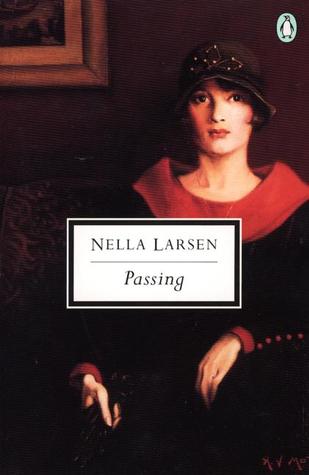
Tuesday, August 29, 2017

Passing by Nella Larsen

Security.  Was it just a word?  If not, then was it only be the sacrifice of other things, happiness, love, or some wild ecstasy that she had never known, that it could be obtained?  And did too much striving, too much faith in safety and permanence, unfit one for these other things?

It's estimated that hundreds of thousands of black Americans in the first few decades of the 20th century "passed"--that is, they took advantage of their light skin and mixed heritage to pass for white.  Nella Larsen's Passing is a novel about the allure that passing presents, and the consequences it exacts.  Clare Kendry has been passing for white for decades, ever since the death of her father, a poor janitor, and is even married to a man who crows about his pride in his unblemished white heritage.  He jokingly and unsuspectingly calls her "Nig," because she's growing darker as she grows older.

Clare is alluring; men fall for her, both black and white.  Is she alluring because her actions are transgressive, or does her willingness to transgress racial barriers come from the special quality of her daring?  Clare's foil is the protagonist Irene, a well-off Harlem woman, once a friend of Clare's in high school.  They chance upon each other when Irene herself is engaged in a kind of passing herself, dining at an upscale Chicago restaurant knowing that no one will question her racial identity:

Absurd!  Impossible!  White people were so stupid about such things for all that they usually asserted that they were able to tell; and by the most ridiculous means, finger-nails, palms of hands, shapes of ears, teeth, and other equally silly rot.  They always took her for an Italian, a Spaniard, a Mexican, or a gipsy.  Never, when she was alone, had they even remotely seemed to suspect that she was a Negro.

Ironically, Irene's ability to "pass" in Chicago before returning to her life in Harlem among blacks makes her freer, in a way, than Clare, who has come to see her white life as a kind of prison she can't escape.  She begins to insinuate herself into her old friend's life so that she might vicariously return to the black communities she left behind long ago.

The drama in Passing is largely sexual and psychological.  Clare thinks of herself as a prisoner, but Irene fears Clare's transgressive nature and convinces herself that her unhappy husband has fallen in love with Clare.  Some critics (the intro to this copy says) find a repressed homosexual desire in Irene's anxiety over Clare; I find that plausible but not totally necessary.  Clare's passing has positioned her at the exotic edge of both whiteness and blackness; I read Irene's obsession as a fear borne out of her own committed domesticity.  All this comes to a head when Clare's husband shows up to a party to confront her with his discovery about her racial identity, and she falls--or is pushed--out the window.  Larsen allows Clare's death to be ambiguous: did she kill herself, because she realized she no longer had a place in the world, white or black?  Or was she pushed?  And if so, was it her white husband or her black friend?  The ambiguity serves to underscore the precarious positioning of the "passing" woman, threatened on both sides by expulsion and rejection.

Passing is very slim, and stuffed with minor characters whose uselessness undermine the elegance of the central narrative.  Irene's conflict with her husband is underexplained and unconvincing, even as her obsession and anxiety over Clare makes perfect sense.  It reminded me most of the kind of Wharton novel where rich women--Irene and Clare are well-off black women, rare birds in fiction--come to see their social situations as confining, though perhaps with more reason than those Wharton women.