Showing posts with label Mary Gaitskill. Show all posts

Sunday, September 8, 2024

Because They Wanted To by Mary Gaitskill

He said he had never really thought about her sexually. He said he had to spend a lot of time getting to know a person before he had sex. He said this was all very unexpected and he needed to digest it. He asked if she would like to see a movie with him next week. She understood his words. She understood the sentiments that would seem, at least, to lie behind his words. But she felt something beneath those words that she didn't understand. She said she didn't want to see a movie. She said that if they got to know each other, they probably wouldn't want to have sex. She told him that if she'd waited to get to know people before having sex, she'd probably still be a virgin. She didn't understand what moved beneath her own words. It seemed too big to be chipped off in word form, but it didn't matter' she kept talking until the dentist stepped forward and embraced her.

Is it OK to say that I find relationships, and dating especially, to be a particularly boring subject for fiction? The relationships in Mary Gaitskill's short story collection Because They Wanted To are incipient, short-lived, doomed. The central theme seems to be the difficulty of true communication between people, the complicated back-and-forth of desire and revulsion that occurs when two people collide in intimacy for the first time. A woman dating an older man, a woman dating a younger man, a woman dating a woman. The protagonist goes out with someone despite misgivings, misgivings they don't quite understand, as they don't understand the desire. Sex ultimately complicates things even more; a desire for roleplay and debasement always ends up crossing a line: in one scene, a woman throws a hunk of non-consensual tapioca pudding at her lover's genitals. To Gaitskill's credit, she does all of these scenes very well, and the push-and-pull of desire and cruelty is well done, but on the whole the subject seems sort of television-tedious to me. Maybe it's my stage of life; maybe it's being married.

The stories became most interesting, I think, when they dealt with the thornier issues of consent and even rape. In one story, "The Girl on the Plane," the narrator strikes up a conversation with a younger woman who reminds him of an old friend. The old friend long nursed a crush on the narrator, which was not reciprocated, until she submitted to a drunken gangbang, in which the narrator ends up, to her--what? joy? surprise?--taking part. The woman on the plane opens up about her alcoholism, he reciprocates by admitting he took part in a rape. Was it really a rape? Or was the idea of the rape a fiction they engaged in, something titillating, that perhaps had the benefit of giving them both they wanted--for the girl, the guy, and for the guy, a way to have his cake and his cruelty, too? (The woman on the plane, of course, stops talking to him immediately.) Another story deals with a couple whose transgressive sexual habits include fantasies of control and domination, but where do the rape fantasies end and actual rapes begin? It's a difficult topic, and requires a great deal of writerly calibration; the ambiguity holds, and the stories never collapse into certainty or simplicity.

I think my favorite of them, though, is one of the most straightforward, the first story, "Tiny, Smiling Daddy," written from the perspective of a man who learns that his daughter has written an essay about him in a popular magazine. He spends the story fuming, resentful of his daughter; before he reads the article, he is sure that she has been unfair to him, and describes a kind of happy, safe childhood in which she grew up to be sullen and rebellious. Such things happen. Only at the story's end, when we are still unsure about how seriously to take his claims, does he recall the time when he said to her: "You're a lesbian? Fine... You mean nothing to me. You walk out that door, it doesn't matter. And if you come back in, I'm going to spit on your face." It's a pretty simple story, really, an old trick, the first-person POV that we're not sure whether we can trust, but it works really well here.

Sunday, November 20, 2022

Two Girls, Fat and Thin by Mary Gaitskill

I felt locked out of my own fat body, as if I were a disembodied set of impulses and electrical discharges, disconnected rage and fear, something like what real humans feel in abandoned houses and call "ghosts." I remembered my father on top of me, mashing my lungs, making my breath smaller and tighter until it barely existed, opening my body with his fingers, infecting me with his smells, his sounds, grinding his skin on mine until it came off as a powder and and filtered into m pores, spewing his deepest poison onto my skin where it was subtly absorbed into my blood and cells and came out in my sweat, my urine and shit, even my voice and words. I felt so saturated by his liquid stench, I didn't even think to wash it off when he left.

Dorothy Never is a fat woman in her middle age. Justine Shade is young and thin, and beginning a career in independent journalism. Both of them are victims of sexual abuse--Dorothy in particular, at the hands of her father, for many years--and the kind of sexual bullying that, while it might not rise to the level of rape, women are subjected to from the earliest moments of their childhood. They are radically different women, both physically and temperamentally, but they are drawn together when Justine decides to write an article about Anna Granite, a semi-Randian novelist and philosopher in whose inner circle Dorothy once moved. 

One of the most interesting things about Two Girls, Fat and Thin is the way that it writes about Granite's philosophy,  Definitism, without ever really defining or outlining it. Gaitskill gives the impression of a total philosophy without really having to write one: it's a belief that centers the individual, and the sanctity of their will; power and self-gratification are lionized; squishy modernist ideas about subjectivity are loathed. Though Dorothy denies it to Justine, it is certainly a right-wing philosophy, but one which clearly appeals to the abused and the victimized. "Every loneliness," Granite writes in one of her books, in a line that appeals deeply to the tortured Dorothy, "is a pinnacle." For Dorothy, Definitism gives her the confidence to cut her abusive father out of her life, and to forge a life of her own.

Justine takes what might seem to be an opposite tack: sexual masochism. As she works on the Anna Granite story, she meets a serpentine young bruiser at a bar who invites her deeper and deeper into fantasies of domination: being tied up, whipped, urinated on. In a way, the two women represent different responses to being victimized: a flight toward power and a flight toward submission. But these are more malleable categories than they might seem. As Justine notes, the strong heroines of Granite's books often find themselves yearning to be controlled and dominated. And it is Justine who, in her childhood, reacted to the unwelcome prodding of young boys by abusing a young girl herself.

I don't know if Two Girls, Fat and Thin totally worked. It sets up a relationship, even a collision, between the two women, that it can't really deliver on, choosing instead to keep the pair siloed in long life histories until the very end. The Granite stuff is dealt with obliquely, in a way that feels skilled but sort of hollow. Shadows of Veronica are here--there's something in the way that Dorothy, like Veronica, works in NYC at night, like a ghost of a person--but the book is fuller, more florid, more satirical, without any of Veronica's chilly cool. But I did find a lot to admire in how boldly and plainly it deals with abuse.

Friday, August 28, 2020

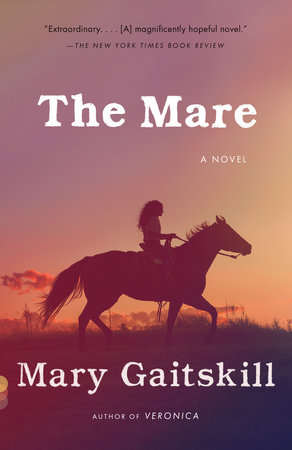
The Mare by Mary Gaitskill

What effect could it have on Velvet, all that coming at her and not knowing what it was about? She was poor, she lived in a shit neighborhood, and when she talked about her mother, there was something in her voice that made me think of a shadow on the wall in a horror movie. The woman's voice on the phone confirmed the feeling: She sounded abusive, half crazy. The girl had need, big need. I could feel it under her certainty and diffidence. And here was Ginger with her need, looking at Velvet with shining eyes, calling her "princess," and tucking her in at night. It seemed an unstable mix of things, combustible, a promise that could not be kept.

Velveteen Vargas is an eleven-year old Dominican girl living in Crown Heights, Brooklyn. As part of a program called "Fresh Air," she is sent to stay for two weeks with a white couple living in New York's Hudson Valley. Paul and Ginger, the couple, are childless, and while Paul is skeptical of the program, Ginger devotes herself with abandon to caring for Velvet. When Ginger takes Velvet to the stables next door, Velvet begins a passionate love affair with horse riding, focusing especially on a horse she calls "my mare," but who has the unfortunate name of "Fugly Girl." Velvet grows close to Ginger, and spends years traveling back and forth between Dutchess County and Crown Heights, but she has to keep her riding secret from her tempestuous, abusive mother, Silvia.

I did not like The Mare. It took a long time, but by the end of the novel I was convinced by the young Velvet's voice, which mixes uneasily at times with Gaitskill's steely metaphors, but which ultimately was able to conjure up the reality of an eleven-, twelve-, and then thirteen-year old. But to me, the novel was never able to get escape velocity from the two narrative black holes that threaten it: the cheesiness of the conceit, and the white savior narrative.

It's cheesy: a disadvantaged youth from the big city discovers her love of horse riding? It sounds like a movie on ABC Family. In several ways, Gaitskill leans into the cheese by drawing forced parallels between Velvet's abusive upbringing and the raising of horses. "Abuse," one of the trainers tells Velvet, "is when you don't just hit once, but over and over. I've seen people do things like beat a yearling to the ground 'cause it reared up 'cause it was young." Then there's "Fugly Girl," the horse no one wanted--is there any doubt that this horse will lead Velvet to a victory in the final competition that is the book's climax? Especially when Velvet decides "her mare" is really named "Fiery Girl?"

The other black hole is much deadlier. Although Gaitskill--and Ginger--are well aware of the racial implications of a white woman becoming a surrogate mother to a Dominican girl who already has a mother, that awareness, to me, never rescues The Mare from being a white savior narrative. Gaitskill is immensely talented and cautious, and makes both Ginger and Silvia complicated characters. Gaitskill doesn't fall into the trap of believing that Silvia must be abusive or loving toward Velvet; the truth, as it always is, is that Silvia both loves her daughter and abuses her mightily. And of course, we get to know all about the life Silvia has led, from neglect in the D.R. to poverty in the U.S., and the way it informs her relationship with Velvet. It's a testament to Gaitskill that the character is convincing and sympathetic, but in the end, that didn't seem to me to be enough. This is still a novel about a dark-skinned kid whose life finds direction and meaning when she's introduced to a white woman.

The Mare was a disappointment because I was really taken with Gaitskill's dreamy New York City novel Veronica. I can see elements of that novel, especially on the level of each individual sentence--Gaitskill is a great writer of sentences--here, but something gets lost in the size and scope of it, and the frenetic skipping between narrators. I can imagine a novel I'd have liked to read, one in which Velvet gets to stand alone as the narrator; but is that a novel Gaitskill could get away with?

Monday, April 15, 2019

Veronica by Mary Gaitskill

The music turned the corner of a darkly baubled wall.  I imagined Veronica alone in the dark, waiting for the brute that stalked her to show itself in full.  I imagined her horror at the small eruptions of death on her body--the sores, infections, rashes, yeast, and liquid shit.  I imagined her holed up in the part of herself where all was still orderly and clean, insistently maintaining the propriety and congruence that had enabled her to get through the senselessly disordered world, and that was slowly being taken from her.

Even more than the others, I wanted to tell her this.  I wanted her to know that even though she was dying, she was still included in the story told by the music.  That she wasn't completely and brutally alone.  The music raised its lamp and illuminated its own dark interior.  I will tell her, I thought.  I will remember and I will tell her.


Alison is not old, but not young, and she is sick: defaced by hepatitis, and carrying around an old injury that makes it difficult to clean windows.  Once she was a model, drawn to a world that both rewarded and punished her for her beauty.  In her accounting, she is alternately cherished and abused by photographers and editors, who speak about her as if she's not in the room.  At times she seems like an it girl, more beautiful than anyone in the room, but in other times the jobs are thin and the world rejects her.

During one of these famine times she meets Veronica, another temp working nights as a proofreader.  Veronica is older and ugly, but she has a charisma and glamor all her own: a stubborn unwillingness to bend to popular opinion, a love for shabbiness, a bisexual boyfriend who comes and goes.  Something about her embodies the New York of the 80's even more than the world of modeling and nightclubs that is a beacon for Alison; in another book that might make her a cliche but here she has a kind of vitality that makes us understand what Alison sees in her.  Veronica's glamor, unlike Alison's, is not mediated by men, her ugliness sets her free.  They form an unlikely friendship that is both cemented and challenged when Veronica begins to succumb to AIDS.

The connection between the present and the past in Veronica is highly silly.  We watch Alison trudge through rain, wash windows, play with the children of friends, and ultimately, climb a mountain somewhere in the East Bay to look over the San Francisco skyline.  It's one of those books where a memory lurks around every bend, waiting to pounce: "I look outside and see a little budding tree, its slim black body shining with rain.  Joyous and intelligent, like a fresh girl, the earth all new to its slender, seeking roots.  I think of Trisha, erect and seeking with sparkling eyes."  Do you hear that, Trisha?  You're the tree.  As Alison climbs the mountain, there are more trees, more nature, breathing its transcendental health, and like Alison we climb for no other reason than we know there's a vista, an epiphany, at the top.

But the writing in Veronica is so good that you might never notice how weirdly constructed it is, or how the narrative stalls for pages and pages until the title character comes into full view.  It's luminous in the way that a lot of prose never is, despite the claims of book reviews, full of light and sharp-edged shadows.  Among other things, Gaitskill really knows how to talk about popular music, which I have always found few people do well.  Here's Gaitskill's description of Karen Carpenter:

...the most popular singer was a girl with a tiny stick body and a large deferential head, who sang in a delicious lilt of white lace and promises and longing to be close.  When she shut herself up in her closet and starved herself to death, people were shocked.  But starvation was in her voice all along.  That was the poignancy of it.  A sweet voice locked in a dark place, but focused entirely on the tiny strip of light coming under the door.

What makes it work so well is that Gaitskill refused to tell us exactly who she's talking about.  If we don't know, then maybe the book isn't for us; but if we do we get to see Karen in a new light.  The book, which goes out looking for the spirit of the Bad Old Days in New York City, might have easily fallen into a mash of cultural signifiers; as it is, it's like hearing Karen Carpenter for the first time.  And Gaitskill can do it just as easily for Michael Jackson as for Rigoletto.

Music becomes a symbol of passion without words: the love and connection that Alison feels for Veronica, but can never quite articulate.  It's music in its Dionysian mode, per Nietzsche (sorry), the pure emotion that connects souls.  It's the ineffable grief, too, of the AIDS epidemic, and the only way to fully articulate the size of its loss.


What is Veronica, to Alison?  A harrowing vision of her future self?  That's how the book seems to set it up, at first: the bright young model should have looked better, and seen.  But love will not be reduced to self-regard; Veronica's value is not in the way she reflects Alison but the friendship they build, as weird as it is, outside of the boundaries of social order and good taste.  Probably, the only real friendships are the ones that are weird.  I am not sure that the novel earns its vista, its epiphany at the top of the mountain.  But the climb is worth it: it evoked strong sympathies in me, despite a setting and plot that I expected to feel worn-out.