Fiction seeks out truth. Granted, it seeks a poetic kind of truth, universals not easily translatable into moral codes. But part of our interest as we read is in learning how the world works; how the conflicts we share with the writer and all other human beings can be resolved, if at all; what values we can affirm, and, in general, what the moral risks are. The writer who can't distinguish truth truth from a peanut-butter sandwich can never write good fiction. What he affirms we deny, throwing away his book in indignation; or if he affirms nothing, not even our oneness in sad or comic helplessness, and insists that he's perfectly right to do so, we confute him by closing his book. Some bad men write good books, admittedly, but the reason is that when they're writing they're better men than when they beat their wives and children. When he writes, the man of impetuous bad character has time to reconsider. The fictional process helps him say what he might not have said that same night in the tavern.
I just started teaching Creative Writing this year, and it's been a real mixed bag. I decided to start with poetry, and for some students, the results were terrific. Many were already accomplished poets, but the best moments are when mediocre or unpracticed young writers stumble through experiment and practice into arresting lines or stanzas. Others have such a disinterest in poetry I think I may have lost them, though I hope that our upcoming unit writing short fiction will help them reengage with writing.
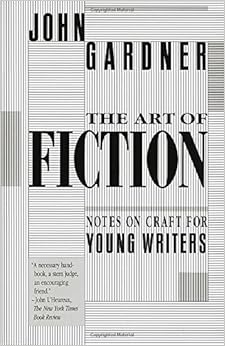
To that end, I've been reading some books on writing like John Gardner's The Art of Fiction and Ann Lamott's Bird by Bird. Lamott's book is mostly inspirational, an encouragement to writing in the face of all the things that discourage it. Gardner's is more of a survey of the nature of fiction, and neither are exactly practical. These books all struggle, I think, because of how difficult it is to speak to each writer at their particular moment; a lot of Gardner's advice seemed obvious to me, and much of it seemed very strange.
The Art of Fiction has a whiff of mothballs to it: For one, Gardner is pretty devoted to the most traditional notion of fiction as an imitation of life and dismissive, even as he claims he isn't, of the kind of "metafiction" that has preoccupied the postmodernists of the past seventy-odd years. He claims, perhaps rightly, that only those who have mastered fiction are able to write self-conscious metafiction effectively, but you get the sense that he thinks it's probably a mistake, and has little notion of why those writers find metafiction the only possible mode in their particular historical moment. Elsewhere, there's the unfortunate patina of chauvinism, as when he throws up his hands at the sad fact that the English language prioritizes male pronouns. He describes as brilliant a treatment of a student's novel he had heard, in which a Native American scholar unwittingly takes a position in an "Indian Studies" department--as in, East Indian--and has to muddle through pretending to be from Delhi, or something. In a more general way, his insistence that fiction relies most importantly on the accumulation of details that make you feel as if you were really somewhere else seems shortsighted and of another time.
But it's worth embracing, to an extent, the tradition articulated by Gardner here, and not forgetting why those narratives have been so powerful in the first place. His chapters on crafting individual sentences are exceedingly useful, and would probably help a lot of today's writers whose popular blandness seems like a flaw on the most fundamental level. Most useful to me were the series of exercises in the back of the book, many of which I'm definitely going to use: "Describe a lake as seen by a young man who has just committed murder. Do not mention the murder." Now, that's fun, and I have an inkling it will be a satisfying exercise for a bunch of high schoolers whose idea of fiction always operates at the highest pitch of drama. But we'll see.
Showing posts with label John Gardner. Show all posts
Saturday, November 18, 2017
The Art of Fiction by John Gardner
Labels:
John Gardner,
The Art of Fiction,
writing
Sunday, August 16, 2015
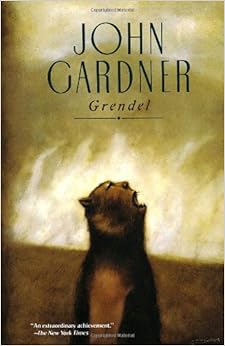
Grendel by John Gardner
The dragon tipped up his great tusked head, stretched his neck, sighed fire. "Ah, Grendel!" he said. He seemed that instant almost to rise to pity. "You improve them, my boy! Can't you see that yourself? You stimulate them! You make them think and scheme. You drive them to poetry, science, religion, all that makes them what they are for as long as they last. You are, so to speak, the brute existent by which they learn to define themselves. The exile, captivity, death they shrink from--the blunt facts of their mortality, their abandonment--that's what you make them recognize, embrace! You are mankind, or man's condition: inseparable as the mountain-climber and the mountain. If you withdraw, you'll instantly be replaced. Brute existents, you know, are a dime a dozen. No sentimental trash, then. If man's the irrelevance that interests you, stick with him! Scare him to glory! It's all the same in the end, matter and motion, simple or complex. No difference, finally. Death, transfiguration. Ashes to ashes and slime to slime, amen."
Something about epics like Beowulf doesn't seem coherent in the modern world. We're no longer able to take our heroes without a grain of salt, and we're often more amenable to sympathize with our villains. Think of every "We're not so different, you and I" speech given by a comic book bad guy, or the way that science fiction moves like to conclude with some variation of the idea that we were the monster all along. In a way, Grendel is the version of Beowulf we want and deserve, one that looks through the eyes of the monster.
Gardner's Grendel is a vicious monster, but a self-aware one. He has no interaction with anyone but his mute, inscrutable mother, and his brief interactions with humans emphasize his monstrousness. He tells the reader that he is neither "proud nor ashamed" of being what he is, yet he calls himself a "[p]ointless, ridiculous monster crouched in the shadows, stinking of dead men, murdered children, martyred cows." His isolation makes him an ideal observer: from the forest he watches King Hrothgar consolidate his power through violence and hollow ideas of honor and loyalty. He sees the way the singer-storyteller of Hrothgar's meadhall fashions the truth into a kind of useful falsity:
Beowulf tells us that Grendel's persecution of Hrothgar is predicate on his envy at hearing the songs of glory that are sung in the meadhall. Grendel is true to that point, but the songs become a stand-in for a host of human creative activity: literature, religion, science. Grendel, on the other hand, is an embodiment of Sartrean existentialism, a figure of complete nihilism intent on wrecking the pretensions of human civilization. Gardner invents a scene in which Grendel--at the bottom of his cavern, or perhaps in a dream--is coached in existentialism by the rapacious dragon that makes up Beowulf's final episode. These ideas aren't easy or comfortable for Grendel, but they manage to give him a sense of purpose in purposelessness, a kind of meaning predicated on meaninglessness.
"The stranger" is Beowulf, who doesn't appear until the novel's very end. Beowulf kills Grendel, as in the epic, by severing his arm, something which Grendel chalks up to mere accident. But as he has Grendel pinned, he forces him to sing a song about the very wall he's shoved against. Is it an indicator of the limits of Grendel's philosophy? Or does it merely suggest that in the end, the "brute existent" of death and nothingness make civilization the only recourse? What's cool about Grendel is that it takes one of the very oldest English texts and turns it into something very modern, which resonates with the philosophical problems that plagued the 20th century.
Something about epics like Beowulf doesn't seem coherent in the modern world. We're no longer able to take our heroes without a grain of salt, and we're often more amenable to sympathize with our villains. Think of every "We're not so different, you and I" speech given by a comic book bad guy, or the way that science fiction moves like to conclude with some variation of the idea that we were the monster all along. In a way, Grendel is the version of Beowulf we want and deserve, one that looks through the eyes of the monster.
Gardner's Grendel is a vicious monster, but a self-aware one. He has no interaction with anyone but his mute, inscrutable mother, and his brief interactions with humans emphasize his monstrousness. He tells the reader that he is neither "proud nor ashamed" of being what he is, yet he calls himself a "[p]ointless, ridiculous monster crouched in the shadows, stinking of dead men, murdered children, martyred cows." His isolation makes him an ideal observer: from the forest he watches King Hrothgar consolidate his power through violence and hollow ideas of honor and loyalty. He sees the way the singer-storyteller of Hrothgar's meadhall fashions the truth into a kind of useful falsity:
What was he? The man had changed the world, had torn up the past by its thick, gnarled roots and had transmuted it, and they, who knew the truth, remembered it his way--and so did I.
Beowulf tells us that Grendel's persecution of Hrothgar is predicate on his envy at hearing the songs of glory that are sung in the meadhall. Grendel is true to that point, but the songs become a stand-in for a host of human creative activity: literature, religion, science. Grendel, on the other hand, is an embodiment of Sartrean existentialism, a figure of complete nihilism intent on wrecking the pretensions of human civilization. Gardner invents a scene in which Grendel--at the bottom of his cavern, or perhaps in a dream--is coached in existentialism by the rapacious dragon that makes up Beowulf's final episode. These ideas aren't easy or comfortable for Grendel, but they manage to give him a sense of purpose in purposelessness, a kind of meaning predicated on meaninglessness.
All order, I've come to understand, is theoretical, unreal--a harmless, sensible, smiling mask men slide between the two great, dark realities, the self and the world--two snake-pits. The watchful mind lies, cunning and swift, about the dark blood's lust, lies and lies and lies until, weary of talk, the watchman sleeps. Then sudden and swift the enemy strikes from nowhere, the cavernous heart. Violence is truth, as the crazy old peasant told Hrothulf. But the old fool only half grasped what he said. He had never conversed with a dragon. And the stranger?
"The stranger" is Beowulf, who doesn't appear until the novel's very end. Beowulf kills Grendel, as in the epic, by severing his arm, something which Grendel chalks up to mere accident. But as he has Grendel pinned, he forces him to sing a song about the very wall he's shoved against. Is it an indicator of the limits of Grendel's philosophy? Or does it merely suggest that in the end, the "brute existent" of death and nothingness make civilization the only recourse? What's cool about Grendel is that it takes one of the very oldest English texts and turns it into something very modern, which resonates with the philosophical problems that plagued the 20th century.
Labels:
Beowulf,
Grendel,
John Gardner
Subscribe to:
Posts (Atom)