With the aurora borealis flaming coldly overhead, or the stars leaping in the frost dance, and the land numb and frozen under its pall of snow, this song of the huskies might have been the defiance of life, only it was pitched in minor key, with long-drawn wailings and half-sobs, and was more the pleading of life, the articulate travail of existence. It was an old song, old as the breed itself--one of the first songs of the younger world in a day when songs were sad. It was invested with the woe of unnumbered generations, this plaint by which Buck was so strangely stirred. When he moaned and sobbed, it was with the old pain of his wild fathers, and the fear and mystery of the cold and dark that was to them fear and mystery. And that he should be stirred by it marked the completeness with which he harked back through the ages of fire and roof to the raw beginnings of life in the howling ages.
The Call of the Wild is a story about a dog. That, with its brevity and simplicity, have made it into a children's book, but you might not want to read it to your children. It seems overly hostile to the kind of socialization that young adult novels pretend not to favor but really enforce--ideas of finding yourself and your own place in the world. The Call of the Wild is about finding a place outside of the world--the civilized one, at least--and pursuing isolation while communing with forces that are primeval and nearly vanished.
Buck the husky grows up in luxurious circumstances in California, but finds himself kidnapped and sold to gold rushers in Alaska who need sled dogs. This, according to the prologue by Gary Paulsen, was a typical practice, because the demand was so high that dognappers thousands of miles away from gold country were needed to supply it. Buck struggles at first, as you might expect, to his harsh new circumstances: sleeping in the snow, feuding with other, more hardened dogs, catching wild food, dealing with hunger. But what Buck endures awakens an innate spirit buried within him by the pampering forces of civilization. He becomes intensely competitive and bloodthirsty, and soon becomes the most accomplished, even renowned, sled dog in the Alaska territory.
London clearly has a deep and abiding regard for the rough-and-tumble gold rushers. The most miserable thing that Buck endures is not the elements, but a pair of effete urban brothers who dream of making it rich but who have no idea of how to operate a sled team. Ultimately, their foolishness does them in, and they fall--with ten dogs--under broken ice, because they have no understanding of, or relationship with, the harsh landscape that surrounds them. Buck himself is the distillation of the pioneering spirit that London wants to praise: tough, headstrong, a little savage.
London describes Buck's progression as a kind of regression back through history, reaching back to the "raw beginnings of life in the howling ages." The civilized present is juxtaposed against the caveman past, and found wanting. The novel ends when Buck joins a pack of wolves, his long-ago ancestors, before eventually striking out on his own as if the image of the first dog that ever existed. London allows himself to dip into a kind of mysticism that seems silly. Can we take a published writer seriously when he extols the virtues of a time before printing, or writing, or even language? But its appeal is still powerful, and offers a compelling vision in opposition to the anemic weariness of modern life.
Showing posts with label Jack London. Show all posts
Friday, February 6, 2015
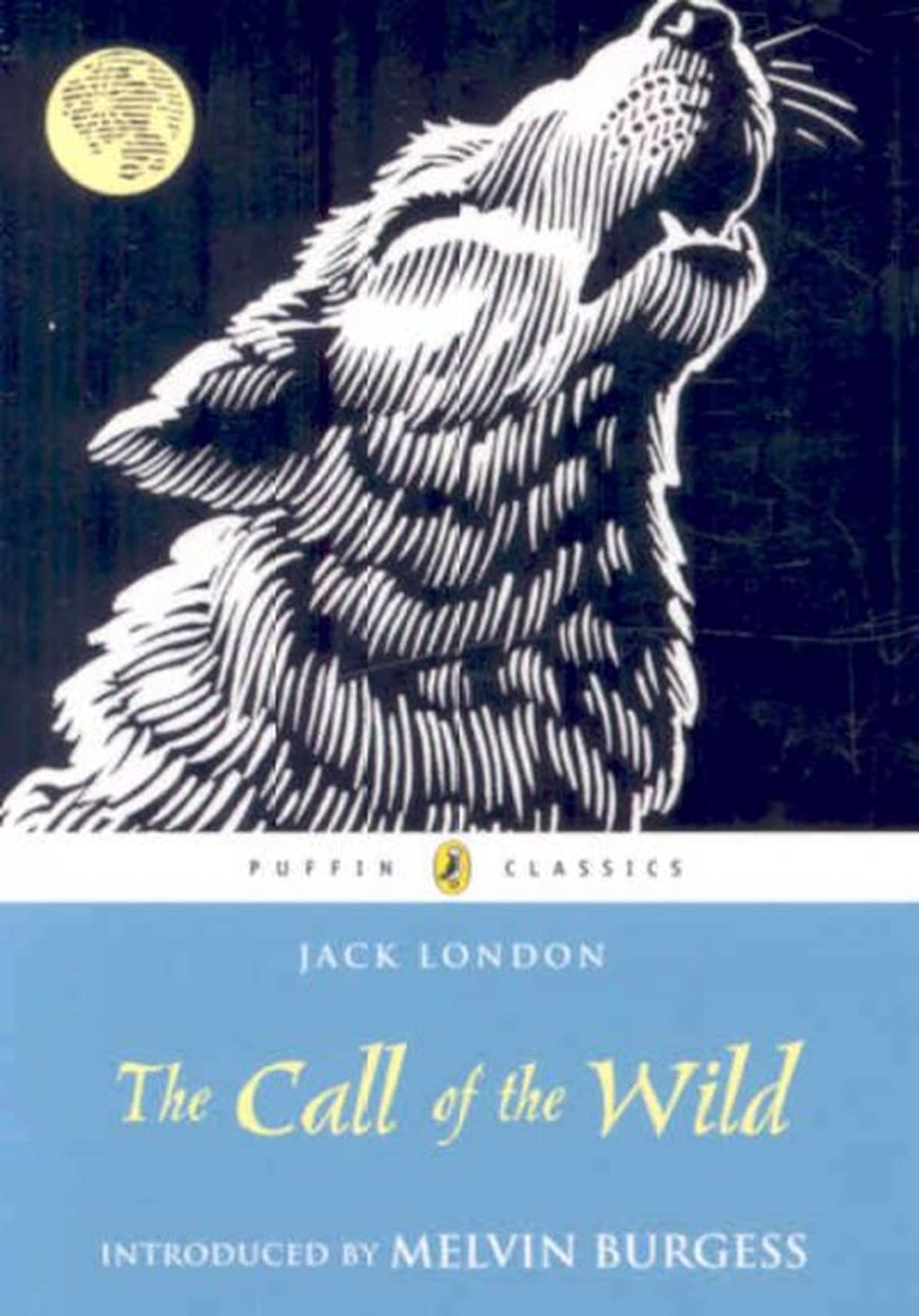
The Call of the Wild by Jack London
Labels:
dogs,
Jack London,
The Call of the Wild
Thursday, March 27, 2008
The Call of the Wild by Jack London
I was under the impression that my mom read this book to us when we were little kids, but after reading it I am certain that that was not the case. It would have scarred our little animal-loving minds for life. My brother and sister and I were into anything that anthropomorphized animals. Disney was at the top of our list.I don't know this for sure, but I would guess that London did not intend this to be a work of young adult fiction. The Call of the Wild is infused with a gritty realism -- dogs tearing the throats out of other dogs and even humans, men beating dogs to death, people not bathing...need I go on? I imagine that over time his works fell into the young adult category because his stories appealed to the young, especially boys. I, for one, was obsessed with White Fang, another London novel, when I was little. Here again, I am not for sure that I ever actually read it.
The Call of the Wild is the story of Buck, a mix between a St. Bernard and a Scotch shepherd dog. During the height of the Klondike gold rush, Buck is taken away from his home in sunny California by an unscrupulous man who worked for Buck's owners. This man ships Buck up to Seattle, where he is bought by two French-Canadian men who run mail through the Yukon. This brings me to my main criticism of this work. London is horrible at vernacular. Take this bit of dialogue, "'Nevaire such a dog as dat Buck!' he cried. 'No, nevaire! Heem worth one t'ousan' dollair, by Gar! Eh? Wot you say, Perrault?'" This gets really annoying quite fast. And London is not even consistent, at times Francois can pronounce the "th" sounds and at other times he cannot, such as when "these" is rendered "t'ees".
Buck moves from owner to owner, as he treks back and forth across the Yukon and other northern territories. As you can pick up from the title, the story is basically the education, or perhaps the re-education, of Buck in the ways of his ancestors. However, this book could also be read as a hero story.
I picked up this edition at a used book store in New Orleans (it's not the one pictured at the top of this post). It came with Bâtard, a story that was meant to be a companion piece to The Call of the Wild. This short story was unbelievably dark and gruesome, further solidifying my belief that London never intended his work to be read solely by kids. What was weird and annoying about this edition was that it had the most patronizing endnotes in the world. There was only ninteen of them and there was no rhyme or reason to what got an endnote. At one point London used the phrase "Alpine proportions" and there was an endnote to explained that this was London's way of saying that there was a lot.
Labels:
adventure,
Jack London
Subscribe to:
Posts (Atom)