Showing posts with label Guatemala. Show all posts

Saturday, September 20, 2025

Men of Maize by Miguel Angel Asturias

Maize should be planted as they used to plant it, as they still do, to give the family its grub, and not for business. Maize is sustenance, it allows you to get by, more than get by. You show me a rich maizegrower, Hilario. It seems crazy, but we're all worse off. There've been times in my house when we ain't even had money for candles. It's the folk who own chocolate trees, cattle, orchards, beehives, who are rich. Small-town rich folk, maybe, but rich for all that, ain't so very bad being the biggest fish in a small pool. Now the Indians used to have all those things, as well as the maize that forms our daily bread. They did things in a small way, if you like, but they had all they needed, they weren't greedy like us because now, Hilario, greed has become a way of life to us. You just take maize itself: poverty sown and harvested until the very earth is worn out...

Miguel Angel Asturias' "Modernist Epic of the Guatemalan Indians" begins with a poor Indian named Gaspar Ilom waking from a disturbing dream: a voice deprecating him for not doing more to defend his land and his people from the rapacious mestizos who would exploit both for commercial farming. "Gaspar Ilom," the voice says, "lets them steal the sleep from the eyes of the land of Ilom... Gaspar Ilom lets them hack away the eyelids of the land of Ilom with axes... Gaspar Ilom lets them scorch the leafy eyelashes of the land of Ilom with fires that turn the moon to furious red..." Gaspar leads a group of Indians in rebellion against the planters, but is defeated by their military might. First they try to poison him, but he washes the poison away in the river. When he emerges to find that his people have been decimated, he returns to the river to drown, but all is not lost: this story passes immediately into a myth that inspires the poor Indians of Guatemala.

The world of Men of Maize is one in which myths and men live contemporaneously, rather than in a distant or imagined past. Take, for example, the story of Goyo Yic, the blind man whose wife--rescued by him from the slaughter of Gaspar's band perhaps a decade or two earlier--has left him. He wanders desperately looking for her, seeking her voice, enduring desperately a painful cure for his blindness, and seeking her on a ridge that will become named for her, Maria Tecuna Ridge. When, later, the wife of Señor Nicho abandons him as well, he has already absorbed his contemporary's story as a myth. All women who leave their husbands have become, without the intervening years of mythmaking or history, tecuns. Señor Nicho's despair leads him to abandon his post as the postman (lol), much to the dismay of the people of the towns who rely on him for the facilitation of business and the exchange of money. He discovers that he is one of those who has a second animal self, a coyote, and in this guise he meets the "fairy wizards" who once watched over the defeat of Gaspar Ilom. In exchange for a glimpse of the mythical world behind the world, they force him to burn his sack of mail.

The "Men of Maize" are both the Indians and their mestizo oppressors, despite the difference in the way they plant: the Indians are sustenance farmers who live in relationship with the earth, while the mestizos clear cut the Guatemalan forests with its teeming wildlife in order to plant large commercial farms. This difference is at the heart of Asturias' epic, which pits the forces of capitalism and economic production against simple folkways. An old story, perhaps, but I was really struck by how richly Asturias evokes the lush Guatemalan jungle using the language of Latin American modernism. The novel is often complicated and difficult, though it is also at times funny and homespun, as with the depictions of the Indian towns and their inhabitants. One of my favorite bits was when Goyo Yic, having restored his sight, falls in with a friend who intends to transport and sell a big barrel of liquor. They establish strict ground rules that anyone who wants a drink will have to pay for it--no freebies--with the result that the two friends pass back and forth the same handful of coins, thus drinking the whole barrel and growing no richer.

This is a dense, dense, dense, rich novel. The number of footnotes on the first page alone (20!) made me laugh. Perhaps following them more closely, or knowing more about the myth and iconography of Guatemala, would have made Men of Maize a more legible and perhaps more enjoyable experience. But I was captivated enough by the strange music of it, and its jungle of images, its poor Indians and coyote-men and tecun women and fairy wizards. 

With the addition of Guatemala, my "Countries Read" list is up to 112! If I continue on reading one new country a month as I have been, it'll take me about six more years.

Tuesday, November 17, 2015

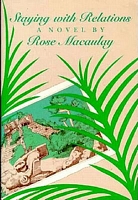
Staying with Relations by Rose Macaulay

As she trotted round the room in the arms of Adrian, Catherine felt again the comic strangeness of this handful of modern western persons tripping with their ordered steps to mechanical music round a rococo ballroom erected on a Spanish monastery, on an Indian palace, in the heart of the primeval forests.  Round the villa jungle creatures prowled and roared, Indians and Spaniards and half-breeds slept and waked, and a strange stone army crowded up against the house, Maya gods, sixteenth century Spanish missionaries and saints, and eighteenth century beings in togas or cocked hats.

But it was not really stranger than anything else, thought Catherine.  All the world is strange.  Strange looks passed from eye to eye, strange touches, strange half-phrases.

Rose Macaulay's Staying with Relations emerges from the same Anglo fascination with the non-Anglo world as The Towers of Trebizond, which was my favorite surprise read of last year.  Like that novel, Relations skewers the provincialism of the English traveler, who skips halfway round the world to drink the same tea, read the same books, and talk to the same white people as in London; trading only the Turkey of Trebizond for Guatemala.  In that way both books are comedies, but they simultaneously recognize that the obsession with travel emerges from something near horror; we are fascinated by the Other but terrified to embrace it.  The alienation of the traveler, for Macaulay, is a stand-in for all kinds of alienation: from others, from ourselves, from God.

Catherine, a young popular novelist goes to visit her aunt, uncle, and cousins in Guatemala, where they live in the renovated hacienda of the Imperial Spanish.  Guatemala is a wild place; the jungle is dotted with Spanish ruins that speak of Nature's power over Western civilization.  Her uncle is a dilettante archaeologist, constantly poking around his own residence for the mysteries it might contain.  Her cousins are blithe, cultured, and utterly bored by Guatemala.  The jungle's threatening nature becomes suddenly literal when Catherine's cousin Isie is kidnapped by native Guatemalans in return for a mysterious "treasure" which the hacienda may or may not contain.  Until this point the book seems like little more than a bland travelogue; once the kidnapping is proved to be a ruse by an untrustworthy white friend, the novel veers again, as Catherine and her cousins pursue the culprit through Mexico.

The villain had to be white in the end.  It's okay, in the latter half of the twentieth century, to write about white heroes in a non-white world, but the only permissible subtext is we were the monsters all along.  That's probably a fair standard, and as Conrad proved, even that is enough to save your narrative from being morally questionable.  For Macaulay, the perfidy of the white neighbor shows that we cannot trust each other, because we do not know each other.  Even the relations of the title, are, in the end, unknown to us.  Catherine, who is known as a novelist with an eye for character, is constantly misjudging her own family--surprised that this one is having an affair, or that that one isn't, etc.:

Catherine thought, perhaps if we travel together, I shall get to know them at last, for so far I have been all wrong, and they have turned out different to what I thought.  How is one to know what people are like?  I wonder what Julia would say.  Perhaps one can never know; perhaps people are uncapturable, and slip away like water from one's hand, changing all the time. 
But still, as a novelist of human character, she felt that she must try to understand it.  After all, there it is; people must be like something, if only one can discover what.  How does one penetrate through the idea that they give of themselves into the elusive spirit behind?  Can it be that one never can do that?

The Guatemalan jungle becomes, rather than merely a symbol of unknowability, a source of misdirection for human bewilderment.  In the end, the jungle is what it is; it is other people who contain mysteries.  Conrad's error was that he mixed up people and the jungle; the Londoner, the African, and the jungle were each as inscrutable, and possibly evil, as the other.  It's only the Londoner he expected to surprise you.  The native Guatemalans turn out to be as banal and ordinary as anyone else, but even banality proves not to be penetrable.  As Catherine notes, "All is strange."