Showing posts with label Antarctica. Show all posts

Sunday, February 25, 2024

White by Marie Darrieussecq

Fleeting moments of density in our mass cause laughter to ring out haphazardly. It does not take much to hold us here, in this zone, it does not take much at all. Vacillating, yet perpetual. Solid as ice. In the perpetual whiteness where nothing ever happens, the White Project forgotten. In the whiteness that suits us. Several mythologies situate us here: sometimes we are the dead, or those who are still moving. Above all, we avoid being counted. Of course, we can drift up to the surface of the planet, like an atmospheric phenomenon, El Nino or La Nina, but if the Earth holds us, then Antarctica is our... what? Our anchorage? Leave that to the sailors. Our territory? Leave that to the animals, the seals, whales and penguins. Our field? For the gardeners. Our empire, our realm? For others still. Our country? What a joke. Marshland is for the will-o'-the-wisp, lava for trolls, forest for elves; but the South Pole is our identity, like the sea for the melancholic, the chaise-longue for the consumptive, or an empty room for the amnesiac. We would set down this equation: that Antarctica is to Geography what our bodies are to History. And we would add that for this season (as they put it) we shall certainly be drawn to floating around the White Project. Perhaps even more than usual.

Two people arrive at a research base at the South Pole. One is Peter Thomson, an Icelandic heating engineer, whose job is to keep the generator running and the heat on. The other is Edmee Blanco, a French woman living in Houston, who is the radio operator--the base's link to the outside world. Slowly, at a pace that matches the changelessness of the white continent's days, they are drawn together. Perhaps because they sense that the other has, like them, come to Antarctica to escape some unbearable aspect of their lives. For Peter, it is his racial ambiguity that has made him an outcast all his life among the pale Icelanders. For Edmee, it's a terrible murder to which she is only tenuously connected, though perhaps being tenuously connected to a murder is even more difficult than being directly implicated. These stories unfold in Darrieussecq's narrative with a strange dilatoriness; at first they seem so random--the kind of thing a scriptwriter might throw in to give a character roundness--but by the end of the novel, they feel convincing. And yet, on the white continent, these stories feel strangely irrelevant--as no doubt Edmee and Peter are hoping.

I've never read a book like White. (Isn't it amazing how, after fifteen years and thousands of books, you can still find yourself saying a thing like that?) Darrieussecq's descriptions of Antarctica are the book's greatest pleasure, not just in a physical sense but a metaphysical one. For her, as for Edmee and Peter, Antarctica is a place that is both peripheral and central, a spot that is blank both on the map and in life, a "white patch pierced by a metal rod at the bottom of the luminous globe." Nothing grows here, and yet is the "place where the winds are born." Its emptiness and impenetrability are its chief qualities, but as one researcher explains, if you extract a miles-long core from the ice--as the White Project attempts to do--you can read the record of all of human history, ancient eruptions as well as ash from the World Trade Center. White unfolds very slowly, and barely seems to have a plot at all--the long arrival, then the quiet dalliance between Peter and Edmee, and then at last a generator failure that brings the project to ruin--but on a metaphysical level, the continent is constantly unfolding its mystery.

One of the strangest things about White: it's narrated by ghosts. They are not the ghosts of former explorers, though they describe themselves as playing among Robert Falcon Scott's dead horses; they're not the ghosts of people at all. What they are is never clear, though as Darrieussecq explains, they are to history what Antarctica is to Geography. I suppose that means fundamentally inscrutable or unexplainable. They gather around Peter and Edmee, watching and describing, agglutinizing like memories or a thoughts which have no real physical ability to affect anything, but which are still somehow quite powerful. If Peter and Edmee believe that, by running to the farthest point of the globe, they are running from the ghosts of their own lives, they might be surprised to find that there are ghosts even there that cannot be avoided. It's a strange and bold authorial move, but it fits, somehow, the white continent's strangeness and its allure.

White is, among other things, a novel about failure. Set in a near-future, the White Project researchers are overshadowed by the first manmade mission to Mars. (The connection between these two kinds of pioneers is explicit, though the Mars mission is more well-known because it contains seeds of progress and hope--a way out of the earth. The White Project, by contrast, is an unpleasant reminder that even the Earth has its secret and unknown places.) Like the White Project, the Mars mission is doomed to failure: the Antarctic researchers, like everyone else, see the lander tip over on its door, trapping the astronauts in their own tomb. We'll remember this image when the Antarctic researchers are huddled in their own emergency pod, waiting to be rescued. But for Edmee and Peter, whose affair is over nearly as soon as it's begun, it's a warning that escape is not possible, not in the stars, and not in the white continent, where the winds are born.

Sunday, January 3, 2021

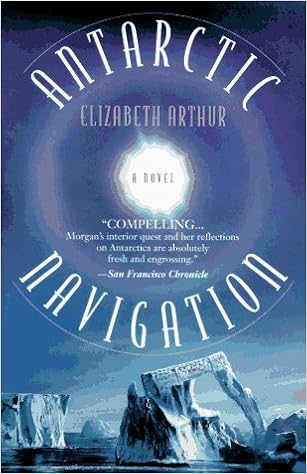
Antarctic Navigation by Elizabeth Arthur

So here I was. My core body temperature was dropping; it was about zero, with a stiff wind blowing; I had a compound fracture and was severely snow-blind. It was late summer in the Antarctic, we were four hundred fifty miles from Framheim, and we didn't even have an HF radio. Moreover, even if we had, there would have been no way for our companions back at Cape Evans to assist us in any way that would matter much. For the moment, I was lying on my side, my tiny feet dangling over the lip of a crevasse, peering through slit eyes at the ice of the world's largest glacier. My country had just gone to war, my lover had left the Antarctic, and my life had just been saved by a man whom I had betrayed and lied to. If I could have thought anything at that instant, I would have thought that though there were many compass bearings, there was finally, in life, only one direction, and that was downwards.

Morgan Lamont dreams of Antarctica. A series of events in her childhood have produced this dream in here: being a child and sledding too far out in the Colorado foothills and making her way back on her own; seeing an intriguing sculpture by Robert Falcon Scott's widow Kathleen in her mother's art book. She becomes obsessed with Scott in particular, the "loser" in the competition to reach the South Pole, who not only was beaten there by Roald Amundsen, but who died on Ross Ice Shelf when a storm prevented his team from reaching their base on the Antarctic coast. But it's Scott, not Amundsen, who attracts Morgan's admiration, because while Amundsen was willing to do whatever it takes to reach the pole first, Scott was a kinder, gentler kind of explorer, one whose failure has often been attributed to his unwillingness to kill his sled dogs. Morgan's dream is to recreate Scott's expedition and prove that it could be done the way Scott imagined it.

Antarctic Navigation is a long novel. I'm trying to be better about how the length of novels affects my impression of them; I spend too much time thinking about how a novel ought to be: it ought to be longer, it ought to be shorter, whatever. But the size and scope of Antarctic Navigation surely come out of an experience of personal magnitude for author Elizabeth Arthur, who was the first laureate of the United States Antarctic Program's writer and artist residency. Can you imagine: six weeks at McMurdo Station in Antarctica, with no responsibility other than getting inspired? In her afterword, Arthur claims that her depiction of McMurdo--a fascistic outpost and a particularly American blight on the last great frontier--is not based on her experience there, but you can't help but wonder if the folks at the USAP felt like they didn't quite get the PR bump they were expecting. (It can't have been too bad, the program for 20+ years, up until the present moment, when COVID budget cuts seem to have threatened it.)

Most of Antarctic Navigation takes place in the regular, continental United States, faithfully recounting Morgan's childhood and the development of her interest in the Antarctic: her parents' troubled marriage, her sadistic scientist stepfather she calls "Dr. Jim," her aimless drift through a postgraduate education in history. Morgan grows up, makes friends, and you can pick up pretty quickly that each friend will be someone who takes part on the Ninety South Expedition to recreate Scott's footsteps. How lucky she was to have a friend who won the Iditarod, and a boyfriend who seems to be specially tuned to the magnetic poles of the earth! It reminded me of The Sparrow, another novel where a group of friends turn out to be just the right set of folks to make a journey to a newfound alien civilization, but here it seemed charming, rather than implausible, and rooted in the strength of Morgan as a character. Morgan's sudden discovery that she has a millionaire grandfather willing to bankroll the expedition is the silliest part, but Arthur does a good job of encouraging you not to squint too hard.

The journey, when it's finally underway, is a hell of an undertaking. It means living on the ice for two years, setting up an expedition base and living there through the Arctic winter so they'll be ready to journey out as soon as spring hits. The journey itself involves setting several enormous "depots" of supplies and food for the return journey, and sending a smaller team out from each depot. Arthur's descriptions of the Antarctic landscape are detailed and (I assume) faithfully rendered, though they lack some of the sense of alienness and wonder that I got from William T. Vollmann's Artic novel, The Rifles.

Arthur is more interested in Antarctica as a way to explore big ideas about science, about history, about geopolitics. The Ninety South expedition begins just before the outbreak of the Gulf War, which seems like a strange reference point, but one which Arthur makes much of: Morgan's interest in Antarctica is, at least in part, an attraction to a landscape that's been unspoiled by human greed and war. But as she learns at McMurdo, where oil spills and pollution are unpleasant truths, even this last frontier already bears the pressure of human evils. She has come to think of Scott as someone who sets out to the pole not to conquer, but to atone for what the British did to the world in the 19th and early 20th centuries; only once on the ice does she realize that as an American--and the beneficiary of her grandfather's lucrative contract with the Navy--that she is more like them than she thought.

The best part of the novel is right where you'd think it would be: when the expedition, having reached the South Pole and turned back to the coast, begins to go wrong. Disasters befall Morgan, one after the other, each one mostly the result of her own misjudgments, and she comes perilously close to imitating her idol Robert Falcon Scott's ignominious death as well. She survives (not a spoiler, I think, when you realize the book is written in the first person), but only by letting go of the idea that the expedition is her dream alone but something shared by the friends and loved ones in her expeditionary group, and with humanity at large. That sounds cheesy, but Arthur manages to make it convincing. Like Antarctica itself, Antarctic Navigation is enormous and daunting, but offers an opportunity for deep reflection on our place in the world.