Sunday, November 22, 2020


Behold the Dreamers
by Imbolo Mbue


I was surprised to learn that this novel won a PEN/Faulkner Award.  I enjoyed it, but was not exactly impressed.  It is in the category of novel that is worthwhile because it conveys a slice of the world I was not fully aware of.  The prose is serviceable but never something you want to dwell on, and there were times in this plot-centered story that I skimmed the prose, anxious to find out what was about to happen.


Jende Jonga and his wife are immigrants from Cameroon.  Jende has stayed beyond the limits of his three-month visa, and has concocted a story about his in-laws trying to kill him to get asylum.  In fact, his in-laws did have him thrown in prison when he and Neni fell in love, but now that he has brought Neni and their child to America, they are more forgiving.  I found it disconcerting that Jende was so obviously trying to game the system, especially since the immigration situation stays in the background for much of the novel.   The characters in the novel do not have neatly packaged morals, but what is meant to be complex sometimes comes across as contradictory.  Aside from his immigration plans, Jende is portrayed as a moral and honest man.


That honesty is important to his employer.   In the early pages of the novel, Jende is hired as a chauffer for Clark Edwards, an important executive in Lehmann Brothers.  The novel is set in 2007 and 2008, so Clark’s job gets increasingly tense, just before it disappears.  Clark works long hours, goes to meetings all over New York and frequently talks about important business on his cell phone.  It is important that Jende learn to be discreet and the two men develop a close bond of trust.


That bond becomes more important as we get to know Clark’s wife, Cindy, a fiercely loyal and devoted mother who handles the stress of parenting with drugs and wine.  Neni gets occasional work as a housekeeper in the Edwards home – sometimes in the luxury Manhattan apartment, and sometimes at their home in the Hamptons.  Their children, Vince (who drops out of law school to pursue enlightenment in India early in the novel) and  Mighty (an insecure nine-year old), quickly bond with the Jonga family and for a time we have the trope of the happy working class family of color, unburdened by the stresses that haunt the wealthy white family.


Soon, Neni is hiding details of Cindy’s drugs and drinking from Clark, while Jende is covering for Clark’s frequent trips to a brothel.   When Cindy discovers Jende has been lying to her about her husband’s itinerary, she forces Clark to fire him.  The Jongas happiness is endangered – without work, Jende will not be able to keep the family in America.


At this point in the book the strength of the characterization is seriously undermined.  Jende, who has been an understanding if somewhat old-fashioned husband, becomes an outright dictatorial sexist.  Neni, who had been caring, highly moral and concerned with Cindy’s health and her family’s happiness, suddenly blackmails Cindy to get enough cash to pay for immigration lawyers.  Cindy had seemed stable but now crashes into full-blown junkie-dysfunction.  Clark survives the collapse of Lehmann to work for Barclays, but never wakes up to take care of his family. 


While he had been willing to do anything to stay in America, Jende suddenly gives up on his plan to get asylum.  The novel ends with Cindy’s suicide and the Jongas returning to Cameroon.


The idea of planting an immigrant narrator as witness to the Lehmann collapse is intriguing, but Mboe does not do much with it.  Jende stays distant from the workings of the collapse and it ends up having little effect on the Edwards family – unless we accept the notion that the stress of the collapse sent Clark into the arms of a sex worker 4 or 5 times a week and that his infidelity drove Cindy to drugs.  


The immigrant perspective is well-handled as we toggle from Jende’s point of view to Neni’s.  Their differing perspectives and stresses round out the portrait of the community, though that portrait remains underdeveloped in spots.  This is a novel that I was prepared to genuinely like at the three-quarter mark, but the ending felt more like an attempt to cut tings off than to conclude the story of these characters.


Dorothea Lange. A Life Beyond Limits. By Linda Gordon


There will always be a need to be reminded that beauty can be found in unlikely places, that we must learn to see beyond the limits of the conventional and the expected.  Such indelible images mean more, not less, if we understand how they came to exist.  They were produced not by a faultless genius would could remain above the wounds, failings, and the sins that afflict the rest of us, but by a fallible and hardworking woman.  They were produced also by the historical times she lived in, times optimistic and pessimistic, times that honored generous, compassionate and respectful impulses of Americans and times that encouraged the closed, fearful, and intolerant.  Lange’s photographs will always evoke the best of American democracy.


Dorothea Lange is one of America’s most important and influential artists.  She just had her second large retrospective at MOMA and is universally recognized as one of the sources of documentary photography in America.  She is the rare artist that can be said to have had an effect on public policy.  


My favorite form of non-fiction is the “Life and Times” biography – the kind of book that explores the history of a time period through the life of one person, placing the subject in context, but also viewing the context through the life of the subject.  Robert Caro’s The Powerbroker and Taylor Branch’s America in the King Years are among my favorite examples.  Though perhaps less sweeping in its accomplishment, Linda Gordon’s life of Dorothea Lange is an excellent example of this balance of history and biography.


Foremost, this is an excellent biography of a fascinating person.  Lange was born into a prosperous middle-class family in Hoboken New Jersey in 1895 – when Hoboken was a shipping and manufacturing power of its own.  Her father, Henry Nutzhorn, was a lawyer and investment banker, and her early childhood was idyllic.  However, things changed rapidly.  Dorothea contracted polio at 7 and nearly died.  She was left with a badly maimed leg and walked with a severe and uncomfortable limp for the rest of her life.   A few years later, her father committed some crime – probably embezzling money from clients – and went into hiding.  Though he continued to supply child-support and kept track of his children, he lived under another name in Brooklyn and left Dorothea with a profound sense of embarrassment.  As an adult she adapted her mother’s maiden name, Lange .  Gordon occasionally plumbs this situation for psychological insights into Lange’s life and work, but never pushes it too far.


These early tragedies left Dorothea with a deep need for independence.  She would never be someone who relied on others, waited for perfect opportunities, or blamed circumstances for her situation.  Though obviously very bright, she was at best a mediocre student.  Both her mother and her teachers were frustrated by this – Gordon even turns up evidence that a teacher cheated for her to get her through a class in high school.


Lange decides she wants to be a photographer while still in high school, before she had ever held a camera.  She had spent long afternoons during her adolescence wandering the streets of Manhattan when she should have been in class, and had developed a love of simply seeing things.  At her mother’s insistence, she enrolled in New York College for the Training of Teachers (later to become Teachers College) to get a practical career.  There, John Dewey – 

true to his philosophy of active learning – had hired a progressive photographer, Arthur Gente, to teach art history and photography to the mostly female student body.  Gente was unusual in his openness to female accomplishment and recognized in Lange a talented and energetic pupil.  For her part, Lange learned the basics of photography and dropped out.


She began to apprentice for a number of photographers in New York.  These were men who ran portrait studios and needed female assistants to help with everything from clerical work and posing subjects to taking care of equipment and handling film and developing prints.  Within a few months, Lange had enough knowledge of both photography and running a studio to work independently.  She left New York with a high school friend with a plan to travel the world, with the idea that if she ran out of money, she could get a part time job as a photographer’s assistant virtually anywhere in the world.


When they were robbed in San Francisco, the pair ran out of money sooner than they anticipated.  Lange again worked for several studios, including some that catered to the posh of San Francisco’s upper classes. In this work she learned important lessons about the technical aspects of photography, and the basics of posing and composition, but she also learned how to deal with people who might be demanding of the outcome or nervous about the whole experience.  Later, she would be well known for her ability to coax nervous people on the streets into posing for her.


By 1920, she was among the leading portrait photographers in San Francisco, prosperous and popular – her studio doubled as a salon for the San Francisco bohemian community.  She married Maynard Dixon, who was then a famous western artist, a bit of a cowboy who painted western scenes and revered the mythologized Native American image.  He was twenty-five years her senior and had a teenaged daughter from a previous marriage. 


This marriage shifted Lange’s life and career in a number of ways.  While it enhanced her reputation as an artist and a bohemian – they became the it-couple of San Francisco – it also shifted her life towards the domestic.  Dixon was a professional painter and refused to work a day job even during periods when his paintings brought in little money, so Lange’s income was important to the small family.  But Dixon was otherwise a man of his generation and did little to maintain a household.  His first wife was an alcoholic, so his daughter, Consie, came to live with him and Lange, but he did little parenting and Lange became the full-time caretaker for this rebellious young woman.  In addition, Lange and Dixon had two children of their own, and Dixon was frequently absent for long periods of time painting or simply camping in the desert.


This life as a working mother lasted for the rest of Lange’s life.  Her marriage to Dixon slowly dissolved as he began to have affairs.  Lange would take on parenting duties with the children of her second husband, Paul Taylor, who was only marginally more involved in the domestic life than Dixon had been.


Lange had always been drawn to left wing politics, but it had become important to her photography early in the Depression.  She responded to the drastic reduction in her studio business by wandering the streets of San Francisco (much as she had once wandered the streets of New York) with her camera.  She was drawn to groups of men at bread lines and soup kitchens and the clusters of men on street corners looking for work.  Her 1932 photograph, White Angel Breadline, came to represent the damage the Depression had done to men’s spirits and gave Lange her first national exposure.  She soon began to supplement her studio work with government contracts.  While working for the New Deal, she met Paul Taylor.


Taylor was an important figure in California’s history, in part because of his association with Lange.  In fact, their association was both a loving and loyal marriage and a central career move.  She met Taylor when she was hired as a photographer to document the work of Unemployed Exchange Programs of the New Deal.  Gordon stresses how complementary their working styles were and how much they learned from each other.  Taylor was an academic economist before the Depression, but his work in economics was far more social than that of most economists.  Part sociologist, Taylor believed that the study of economics should focus on field work, getting out and seeing what the actual economic lives of people were like.  Since 1927, he had been on leave from UC Berkeley, working for the Social Science Research Council on a study of migrant workers in California.  By the early 1930s, he was America’s leading agricultural economist, and the only one with a focus on agricultural labor.


At this point, Gordon gives an excellent introduction to the politics and policies of the New Deal agricultural programs.  We get a capsule history of the WPA, the Farm Security Administration, and the key work of Roy Stryker’s photography division of the FSA. For much of the late 1930s, Lange and Taylor are travelling together – up and down the length of the west coast, through Arizona and New Mexico, and into the Deep South, investigating and documenting the lives of farm workers and the effects of the Dust Bowl and the Depression generally.    Gordon concentrates on the problems and failures of these programs, which makes sense because both Taylor and Lange were continually frustrated that they did not go far enough, were suffused with racism and needed to be greatly expanded.  In this history, the New Deal was less a revolutionary shift in government activity than a badly compromised attempt to work around the power of the large landowners that dominated politics.  


Gordon provides an excellent analysis of how Lange’s experience as a portrait photographer influenced her work – both in terms of how she approached people and made them comfortable around her and how she chose subjects to photograph.  While other FSA photographers – Ansel Adams, Margaret Bourke-White and Walker Evans come to mind – concentrated on the farms, housing and environment, Lange’s best work always documented the people.  She was especially adept at capturing relationships, with many photographs of families, but also subtle portraits of racism and power relations.  One of the key features of Lange’s work is that she often captioned her photos with exact quotes from the person photographed.  It was a common and deceptive practice of “educated” photographers to invent quotes for their “uneducated” subjects.  Lange never made up quotes from subjects and took great care to quote them accurately.  Gordon provides an excellent history and analysis of Lange’s most famous photograph, Migrant Mother, including the controversies that have bubbled up around the photo from time to time.  One detail of this photograph that was new to me is that the woman portrayed, Florence Thompson, was Native American – her father was Cherokee while her stepfather was Choctaw. 


Most of Lange’s most famous work dates from these years of working with Taylor, and nearly all of it was done for the government.  While this limited her income, because she never owned the rights to her photos, it helped build her reputation because this work has been in the public domain all along.  Migrant Mother is ubiquitous, though Lange has never made any money off it.  


When WWII broke out, Lange’s government work changed.  As the most prominent government photographer on the west coast, she was hired to document the relocation of Japanese Americans to concentration camps.  Gordon wonders about this hiring, since both Lange and Taylor had been vocal about their disagreement with the policy before the hiring.  Taylor had been particularly explicit and active in denouncing its racism.  Lange spent more than a year photographing Japanese American communities before the relocation, the process of moving, the physical conditions of the camps and the lives the relocated built there.  These photographs were highly critical of the camps, but had no effect on the public perception of this episode because after years of work and thousands of photographs, the army impounded her work.  It only became available recently.  Gordon has edited a collection of those photos and her history of the entire program is brief but excellent.


Lange’s life and work after the war was dominated by health problems.  Long term effects of polio affected her heart and energy level.  She had developed severe esophageal ulcers.  Gordon speculates that this was in part from the stress of working under very difficult conditions while raising a family of 6 children and step-children.  In this case, the burdens of sexism are quite physical and Lange is debilitated for much of her last two decades – though she still completes a number of projects for Life Magazine and other publications. 


In 1965, she is given a career retrospective by the Museum of Modern Art in New York.  She was only the 6th photographer to be given such a show, and the first woman.  She was also diagnosed with inoperable esophageal cancer.  She spent a good deal of the year reviewing her work over the decades and putting together the show.  She completed the work but died before it opened.


Lange was an important artist because of how powerfully she encountered the social and historical issues of her day.  Linda Gordon has honored that career with a biography that explores Lange within her social and historical context, and produced a full life and an excellent history.


Friday, November 20, 2020

Homemade Love by J. California Cooper

Life is really something too, cause you can stand stark raving still and life will still happen to you. It's gonna spill over and touch you no matter where you are! Always full of lessons. Everywhere! All you got to do is look around you if you got enough sense to see! I hear people say they so bored with life. Ain't nothing but a fool that ain't got nothing to do in this here world. My Aunt Ellen, who I'm going to tell you about, always said, "Life is like tryin to swim to the top of the rain some time!"

One of my favorite stories to read with my senior fiction writing students is J. California Cooper's blackly comic story "The Watcher." The narrator of the story is a sour old woman who keeps her nose in everybody's business, even while her son is dying of an overdose and her daughter nearly dying of a self-administered abortion under her own roof. The story gets its humor and power from the voice of the woman herself, who narrates her own story, oblivious to her own hypocrisy:

Use to be a big ole fat sloppy woman live cross the street went to my church. She had a different man in her house with her every month! She got mad at me for tellin the minister on her bout all them men! Now, I'm doin my duty and she got mad! I told her somebody had to be the pillar of the community and if it had to be me, so be it! She said I was the pill of the community and a lotta other things, but I told the minister that too and pretty soon she was movin away. Good! I like a clean community!

Reading the rest of the collection, titled Homemade Love, had the effect of diluting the power of "The Watcher" for me. Most of the pleasure of the story relies in the faithfully rendered voice, but while none of the other various narrators of Homemade Love are as blinkered as the Watcher, they all seem to partake in the same voice. The exclamation points I thought were an expression of the woman's melodramatic point of view turn out, for example, to be in common use, and appear as something else: a mark, maybe, of earnestness among those who have not "learned" to be sparing with them.

Although Cooper's stories really have only one voice, it's a powerful voice. It's a voice steeped in the African-American dialect of rural areas, a voice that belongs to people in poverty and other difficult circumstances but who have earned a kind of folk wisdom. They tell stories about love, as the collection's title suggests: about bad marriages that are abandoned for good ones, and the virtue of choosing a husband and wife for their character rather than their looks or money. "He a little plump, hair almost gone on top," the narrator of "Down That Lonesome Road says about her husband, "but so am I plump." In "Living," an old man decides he's had enough of life in the country, leaving his wife of decades to go live in the city, where he ends up in the hospital every time he tries to venture out. Eventually, he comes back home to his wife's loving arms, having learned the lesson that's at the core of Homemade Love: the things we think we desire most are never as fulfilling as a steady home.

These stories are funny. "The Watcher" especially, but I appreciated the moment, too, in "Down That Lonesome Road" when a lonely woman ventures by accident into a sex shop, where she's overwhelmed by the array of sex toys she hadn't even known existed. She buys one, out of befuddled desperation, but when she gets it home, she doesn't know what to do with it: she buries it under the chicken coop, and when at last she gets married--there's no substitute, after all, for the real thing--she decides never to tell her husband that it's there.

Reading them in a row, these stories can get a little cloying: that's why I appreciated "Swingers and Squares," narrated by a woman who lets her family crumble because she's devoted to a life of drink and fun, and who looks down on those whose lives are stable and family-focused, unable to understand their peace of mind. It's the closest the collection comes to the ferocious humor of "The Watcher" again. But the earnestness of the other stories buttresses real wisdom and emotional power, both of which are made reliable by the power of the narrator's voices. When they are at their best, the stories in Homemade Love feel like a conversation with a wise and beloved old family member, whose advice you'd ignore at your own peril.

Monday, November 16, 2020

Orient Express by Graham Greene

Because his future had an almost certain limit, he began to dwell, as he was not accustomed to do, on the past. There had been a time when a clear conscience could be bought at the price of a moment's shame "since my last confession I have done this or that." If, he thought with longing and a little bitterness, I could get back my purity of motive so easily, I should be a fool not to take the chance of forgiveness; I have no conviction that there is anyone to forgive. He came near to sneering at his last belief: Shall I go and confess my sins to the treasurer of the Social-Democratic party, to the third-class passengers? The priest's face turned away, the raised fingers, the whisper of a dead tongue, seemed to him suddenly as beautiful, as infinitely desirable and as hopelessly lost as youth and first love in the corner of the viaduct wall.

Orient Express was Graham Greene's first big success, a popular novel about political intrigue on the famed train running from Ostend to Istanbul. Funny, though, how its success must have been dwarfed by Agatha Christie's Murder on the Orient Express, which came out two years later and at the same time as the film adaptation of Greene's novel. Greene originally titled his book Stamboul Train; I'm not sure about the timing but it's hard not to wonder if the filmmakers, and those who subsequently titled the novel's American edition, were hoping to piggyback off Christie's success. A comparison between the two might be instructive: though Greene considered Orient Express an "entertainment," without the weightiness of some of his later, more serious novels, I think you'd be hard pressed to say that it is quite as "entertaining" as Christie. There's murder and bloodshed on this train, but they don't quite lend themselves to the cathartic crime-and-solution two-step of a satisfying mystery novel. In Greene's version, only a few--and not necessarily the reader--are privileged enough to arrive at their intended destination.

As you might expect, Orient Express is about people from all walks of life, gathered on a train. There's Carleton Myatt, a Jewish businessman, dealing in currants, who is preoccupied with the possibility that he is being cheated by his agent in Istanbul. There's Coral Musker, who is traveling to Istanbul to join a chorus line; Myatt gifts her his own first-class berth when she faints suddenly in the corridor. There's Josef Grunlich, who has just shot and killed a man during a robbery when he boards in secret at Vienna--one of the sensible things about the way Greene structures the novel is that people are always getting on and off the train, you know, as people do, instead of being "stuck" on it in the classic mystery setup. There's Dr. Richard John, who is really a Serbian Communist named Dr. Richard Czinner, who is headed secretly back to Belgrade to stand trial for a past attempt at revolution. Czinner's return is spoiled by a journalist named Mabel Warren, a really ugly sort of character: not only are her journalistic methods unscrupulous, but she's also a drunk and a predatory lesbian who's enraged by the desertion of her beautiful "partner." (This character is not Greene's finest moment, I think.)

"Entertainment" or not, the politics of Orient Express are subtly radical. Czinner forms the novel's moral spine: he knows he is returning to face certain death in Belgrade, and his thoughts are the thoughts of a dying man, reckoning up the sum of his successes and failures. Czinner's revolution has been twice scuttled, but he goes to affirming his own convictions by suffering at the hand of the despised state. It's Czinner, too, who occupies the role of the lapsed Catholic that appears in nearly all of Greene's novels. Greene writes that Czinner had "blown that candle out with his own breath, telling himself that God was a fiction invented by the rich to keep the poor content," but when faced with failure and death, he longs for the return of a belief that will shape his sacrifice into a meaning that still eludes it.

It's Myatt who is Czinner's foil: although he is dogged throughout the novel by casual anti-Semitism, Myatt's life is organized around capital. He gives his bunk, and eventually his first-class ticket, to Coral, who is inwardly ravaged by the question of what she owes him in return. Myatt and Coral seem to genuinely like each other, but their budding relationship is troubled by Myatt's gift. When Coral says "I love you," after giving herself--and her virginity!--to Myatt, how much of that is genuine love, and how much is predicated on his promise to give her a place to live in Istanbul? She doesn't know, and neither does Myatt: capital and capitalism, Greene suggests, present an insurmountable barrier to human connection.

I've never read Murder on the Orient Express. I assume Christie, for the sake of narrative unity, keeps the action pretty focused on the train itself, and doesn't let anyone off. But the climax of Orient Express comes in the Serbian border town of Subotica, where military officials--thanks to Mabel's morning article, which reaches Belgrade before the train can--have orders to seize Czinner. Their dragnet scrapes up Josef and Coral, too, separating her from Myatt, and providing the dramatic setup for the novel's final push. Coral gets an opportunity to absorb Czinner's moral clarity, freed from the complications of capital; Myatt gets a chance--though not necessarily a successful one--to perform an act of heroism that will be a gift to Coral of more than monetary value.

It's clear to me that Greene's work got better than age, and if anything, even more cynical about the operations of European capitalism and imperialism. Czinner stands out as a character here, but stands out also as a prototype for more interesting and complicated apostates, fewer good men trying to understand their own goodness and more bad men who do good things despite all their best efforts. Still, Orient Express is a much deeper and more thoughtful book than Greene seemed to believe it was.

Wednesday, November 11, 2020

Labrador by Kathryn Davis

The snow fell faster and faster outside, encasing us all. In Labrador, Willie, the snow sometimes rises in drifts so high that a person can walk up to the bell in the church steeple and set it ringing with their hand. In Labrador there is always too much of something or none of it at all. Jacques Cartier called it "the land God gave to Cain." For my part, I think of it as your kingdom--the kingdom of the queenly Willie, whose neck I would have broken gladly, had it not been so fragile.

When I picked up Kathryn Davis' novel Labrador I expected--quite reasonably, I think, based on the synopsis on the back of the book--a realist sort of novel about a young girl who travels to Labrador with her grandfather to escape a complicated relationship with her older sister. I've always had a predilection for novels about the Canadian far north, where people live improbably, and while this is an improbable novel, that synopsis of it isn't really worth much. I didn't expect the lyrical and metaphorical intensity of the narrator, a teenager named Kathleen, and I didn't expect so much of the story to be about a literal angel named Rogni who speaks with her:

So I entered the language of the angels, the dangerous territory through which quills shot--where the heart of a human child is most vulnerable. A wing folded around me; I was bound in by pinions, the hooks and barbs of enormous feathers; the other wing rose and fell, beating a dark chord, and we flew, higher, through the thick yellow rapture of souls stewing in heaven's pot. An then there was the silver and judgmental silence.

"Look, Kathleen," said Rogni, pointing to where I could see myself standing on a silver and empty plateau under a silver sky. "An event is taking shape here," he said, "if only you know how to recognize it."

Is Rogni real? Probably not. He's probably a manifestation of Kathleen's intense devotion to Willie, a white-hot and inexplicable love for her more graceful and admired sister that is undermined by Willie's capriciousness and cruelty, and the way that Willie, as older siblings inevitably do, wanders away from their shared imaginings as small children. Rogni attaches himself to Kathleen but he, too, loves Willie, and seems to want to use Kathleen to get closer to her. But Labrador is written in such a way that the question really doesn't matter, like really effective narratives, it has its own logic upon which the world outside its pages is unable to intrude.

"Fantasies," Willie tells Kathleen, "are supposed to give you what you want. They're not supposed to make you jealous." But Willie, like real world logic, has it all backwards; though Rogni may be a story Kathleen is telling herself, he also suggests that he is the one writing the story of Willie and Kathleen: the love that creates the world, rather than being the part of creation. The reader might well ask, "Is Kathleen real?"

Into this family, which is completed by a pair of unhappy and quarrelsome parents, Kathleen's grandfather appears. He has been living in Labrador, in the far north city of Nain, since abandoning his wife several years back, and neither Kathleen nor Willie has ever met him. The grandfather is the first person ever to take a shine to Kathleen, rather than Willie, and Kathleen begins to see returning with him to Labrador as an escape from her crippling love.

Labrador begins as an idea and becomes a place, and the sudden shift is so powerful that the narrative style changes; while most of the book is in the first person, written to Willie from Kathleen's perspective, the section "Labrador" is in the third person, holding Kathleen perhaps at arm's length. Kathleen's fantasies about what Labrador might mean for her seem close to fulfillment; she meets and falls for an Inuit boy named Jobie, for instance. But a boat trip and a sudden storm put their lives in danger, and the grandfather--who, honestly, she seems to have met just a moment ago in narrative time--is suddenly face to face with a very real polar bear.  Davis wants us to know just how real:

It was a real bear filled with the breath of this world, putrid and immense, its tongue a grayish pink, its teeth crusty with green sediment. Believe me when I tell you it was not a story bear; not a legend bear; not a bear preparing to shuck off its skin and reveal itself to the youngest sister as a suitor--the prince, at last, static as paradise and requiring only admiration.

In this way Davis, as she does throughout the novel, blurs the line between the mythical and the real. Perhaps Kathleen is a story told by an angel; perhaps Labrador is an idea only, but an idea is as deadly as anything else and has its own consequences. The failure of Kathleen's brief Labrador trip forces her back home, to deal with Willie once and for all, to find a way to control the story of the two sisters herself.

Every year I discover a couple of "surprise" novels: books that seem to come out of nowhere and floor me with with their beauty or their brilliance. I picked this book up at a used bookstore in Rockport, Maine, for no other reason than I like reading about Canada, and I had a vague sense that the author's name was familiar. (It's possible I was thinking of Lydia Davis.) Labrador is so shimmeringly weird, so tremendously written, to have found my way to it feels like an amazing stroke of luck. A gift, maybe, from a guardian angel.

Tuesday, November 10, 2020


Apeirogon by Colum McCann


A bony structure at the bottom of the trachea – the syrinx – is integral to the voice box of birds.  With its surrounding air sac, the syrinx resonates to sound waves created by membranes along which the bird forces air.  The pitch of the song is created when the bird shifts the tension on the membranes.  The volume is controlled by the force of the exhalation.


The bird can control two sides of the trachea independently so that some species can produce two distinct notes at once.


A hybrid of fiction and non-fiction, Apeirogon is a wonderful example of form and content working to reinforce each other.  An apeirogon is a geometrical shape of infinite, countable sides.  McCann uses this idea – of infinite points of view – and the model of the Arabian classic, One Thousand and One Nights to explore the stories of Bassam Aramin, a Palestinian Muslim, and Rami Elhanan, an Israeli Jew, each of whom has lost a child to the conflict over the Occupied territories.


Bassam and Rami are real – they are members of Combatants for Peace, an organization made up of people who have fought on either side of the Palestinian/Israeli conflict and now call for an end to hostilities on both sides.  They are also members of The Parents Circle, an organization for families that have lost children to the violence of the conflict.  Most importantly, they are close friends who work together to stop the conflict.  


In 1997, Rami’s daughter Smadar was killed by a suicide bomber on a crowded street in downtown Jerusalem while coming home from school.  Ten years later, Bassam’s daughter, Abir, was killed by a rubber bullet fired by an Israeli soldier while she was coming out of a candy store.  McCann narrates their stories repeatedly, moving back and forth through time, focusing now on the incidents themselves, now on Bassam’s grief, now on Rami’s decision to attend the Parents Circle, returning always to the way the two men have turned their grief and anger into non-violent advocacy for peace, travelling around Israel and Europe telling their stories, usually together, one after the other.  Bassam takes up studying the Holocaust, Rami travels through the occupied territories clandestinely to attend meetings in areas that as an Israeli are closed to him.


The story is structured in 1001 very short chapters – sometimes only a sentence long, rarely more than a page or two.  Blended with these fragments of narrative are other non-fiction segments.  Early on, we get several chapters focused on the migratory birds that travel across Israel in their journey from Africa to Europe.  Birds become a metaphor – their tenacity, their frailty, their songs – come to enhance our feel for the work of Bassam and Rami.  The metaphor feels as real as the rest of the text – it is not that McCann is doing much to build their figurative associations, it is more that he points out that birds are metaphors.  There are similar motifs regarding horses, the Dead Sea, the early exploration of the Dead Sea.  There are chapters devoted to music, with John Cage getting special attention.  The construction, burning and reconstruction of the minibar of Saladin gets explained in several chapters.


While these details may seem obtuse or intellectual, they do not read that way.  The book manages to be a page turner, with the unfolding tale of Smadar and Abir, Bassam and Rami giving emotional heft to what is a subtle and detailed examination of Jerusalem, Israel and Palestine.  The book may be too long – perhaps 1001 chapters is more than we needed to get the point.  The arc is so loose that one could almost pick up anywhere and read the chapters in random order.  However, I am not sure this is criticism – I suspect someone who picked through the book and read a few chapters from different sections would be compelled to return.  A thousand and one may be too many of these little bits of narrative, but I read them all and went back and read some of them again.


I am not sure I have ever spent even a few minutes thinking of or talking about the conflict between Israel and Palestine without focusing on who is right and who is wrong, assigning blame, predicting victory or defeat.  Apeirogon gave me hours of focus on that tragedy as tragedy, with an eye to the notion that attempting to find blame is, perhaps, what is at fault.


The Woman in White by Wilkie Collins

There, in the middle of the broad, bright high-road--there, as if it had that moment sprung out of the earth or dropped from the haven--stood the figure of a solitary Woman, dressed from head to foot in white garments; her face bent in grave inquiry on mine, her hand pointing to the dark cloud over London, as I faced her.

I was too seriously startled by the suddenness with which this extraordinary apparition stood before me, in the dead of night and in that lonely place, to ask what she wanted. The strange woman spoke first.

'Is that the road to London?' she said.

The more things change, the more they stay the same: it is possible to trace in Wilkie Collins' The Woman in White the origins of all the hackish novels they sell on stands in airports, novels like The Da Vinci Code, with their outrageous secrets and puzzle box plots. These novels engage the reader by unfolding a central mystery, layer by layer, withheld at intervals, and the plot is subordinated to the contrivances needed to keep the mystery from unfolding all at once: a character with the required knowledge is killed, or perhaps is just a woman, who swoons or becomes gravely ill and too delirious to share what it is she knows. The dignifying effects of time give The Woman in White a sense of respectability; but it's hard not to imagine that "serious" readers turned their noses up at the coincidences, the exaggerated melodramatics. Popular novels have a way of congealing into "classics," but The Woman in White is probably best read as what it was to the Victorians: a silly, shaggy mystery story.

The plot is hard to describe without unpeeling too many of the mysterious layers. Walter Hartwright, meets a mysterious woman dressed in white, trying to find her way into the heart of London. The woman, who turns out to have escaped from a lunatic asylum, makes foreboding allusions to Limmeridge House in Cumberland, where Hartwright is about to take a position. At Limmeridge House, Hartwright falls in love with one of a pair of sisters, Laura Fairlie, but she has promised her now-dead father to marry a baronet named Sir Percival Glyde. But an anonymous letter, clearly sent by the "woman in white," suggests that Sir Percival is not to be trusted, and sure enough, once the two are marreid, Sir Percival--along with his flamboyant Italian co-conspirator Count Fosco, whose grandiloquent malice is the best thing in the book--sets to work conniving away Laura's fortune. Oh, did I mention that Laura and the woman in white look almost exactly alike?

The Woman in White is cleverly arranged in a series of first-person narratives that enable its mysteries to unfold piece by piece. The first and third sections are mostly narrated by Hartwright, who is conveniently shuffled off to Central America in the middle to allow Sir Percival and Count Fosco to work their dastardly plans on Laura and her sister Marian, who narrates most of the middle section. But other narratives crowd the margins, by servants, lawyers, and doctors, each of whom offers a piece of the larger puzzle. 

Like I said, The Woman in White can seem very modern: it's not hard to imagine Dan Brown or, oh, Lee Child, or Janet Evanovich, or whoever those people are, from employing the same strategies. But it's a Victorian novel with Victorian anxieties, first and foremost the legal subordination of women to men. Laura marries because of her father's, then her uncle's wishes, and as Sir Percival's wife she is threatened primarily by his legal guardianship of her. Much of the drama of the book's middle revolves over whether Laura will or will not consent to give her signature to a legal document which Sir Percival hasn't allowed her to read. It's tempting to see the book as essentially feminist, critical as it is of Sir Percival's outsized power, but then again, Collins imports Hartwright again at the end--in his likeness as the husband that should have been--not to offer a radical version of women's liberation, but an encouragement for men to act as better shepherds.

There's the anxiety, too, around identity and rank: Laura, for instance, is captured and placed in the asylum under the name of Anne Catherick, the woman in white, because of their extreme likeness. (I'm no expert, but I think there's something here about the increasing reliance on law, on paperwork and signatures and things like that, to organize society: who are we when we rely on documents to affirm our identity?) This anxiety extends to questions of rank and status: what does it mean to be a baronet, anyway? Is it about money? (Sir Percival has none.) Is it about the way you are seen in the community? (Sir Percival is widely hated.) Again, is it about having your name written down in the social register? (And what of the marriage register that Hartwright suspects has forged Sir Percival's birthright?) For a Victorian, The Woman in White must have captured the drama that surrounded identity in a world that was rapidly industrializing and changing in all sorts of ways.

For a modern reader (me), it's just a lot of fun. There's swooning ladies, complicated identity-swapping, a burning church, clandestine letters, poisons, secret societies--The Woman in White is stuffed with so much of that stuff that even Dan Brown would think it's too much, I think. But maybe in 100 years or so we'll be reading his works with a different eye, too.

Sunday, November 1, 2020

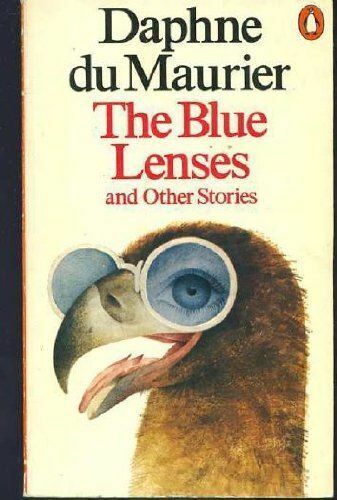
The Blue Lenses and Other Stories by Daphne du Maurier

Marda West continued walking down the street. She turned right, and left, and right again, and in the distance she saw the lights of Oxford Street. She began to hurry. The friendly traffic drew her like a magnet, the distant lights, the distant men and women. When she came to Oxford Street se paused, wondering of a sudden where she should go, whom she could ask for refuge. And it came to her once again that there was no one, no one at all; because the couple passing her now, a toad's head on a short black body clutching a panther's arm, could give her no protection, and the policeman standing at the corner was a baboon, the woman talking to him a little prinked-up pig. No one was human, no one was safe, the man a pace or two behind her was like Jim, another vulture. There were vultures on the pavement opposite. Coming towards her, laughing, was a jackal.

I could have sworn Daphne du Maurier's story "The Blue Lenses" was the basis for an episode of Twilight Zone, but that doesn't actually seem to be true. It's a shame, because it would have been perfect: a woman undergoes surgery to save her sight, leaving blind in the hospital for weeks. When eventually the gauze is removed and she is fitted with the special new glasses she'll need to see, she discovers that everyone in the hospital has an animal's head. Her doctor is a terrier, her nurse a cow. Like the greatest episodes of that show, the protagonist of "The Blue Lenses" endures a series of slow stages of increasing horror: first, she assumes it must be a tasteless practical joke. Once she can no longer deny the truth, the hammer falls: her fiance appears at her bedside with a vulture's head.

"The Blue Lenses" works so perfectly because it draws on a fear we have all experienced: the fear that, despite what they say, the people in our life do not care about us. The protagonist Marda and her fiance Jim have arranged for one of the hospital's nurses, Nurse Ansel, to spend a week at their home as a private caregiver during Marda's convalescence, but Nurse Ansel proves to have a snake's head. Without saying so explicitly--which, honestly, is one of the sharpest things about this story--Du Maurier insinuates to the reader that Jim and Ansel have conspired behind Marda's back to steal her money and run off together. Marda can turn nowhere to assuage this betrayal because the entire world is secretly a zoo; anyone on the street might be a vulture or a jackal looking to steal and kill. Marda sees once and for all what we all may have suspected, that the world is a hostile place and we are alone in it.

The title story excepted, the two strongest stories in this collection avoid the supernatural: In "The Alibi," a man decides to choose a house at random and murder whoever answers the door. He pretends to be an artist looking for a spare room, and takes the alibi so far--buying canvases and paints--that he actually does become invested in the art he is making, only to find himself accused of the murder he'd forgotten to commit when the tenant kills herself. In "Ganymede," a classical scholar falls for a 15-year old waiter in Venice, sublimating his pedophilia, transforming it into a fantasy that the young boy is the title cupbearer to Zeus. The boy's uncle sees his desire and insinuates himself into the man's life--with deadly results!

It's hard not to ruin those stories because they rely on third-act twists, both of which imagine what happens when our darkest impulses are allowed to escape our control and set loose in the world. For Du Maurier these dark desires are both uncontrollable and self-defeating; we really can't help destroying ourselves.

The other stories in the collection are a mixed bag of genre experiments. Stories like "The Pool," about a girl who imagines (?) a utopian world inside a garden pool at her grandmother's, and "The Chamois," about a woman whose husband is obsessed with hunting a rare species of European mountain goat, seemed to rely more on atmosphere and vague insinuations than the sharp insights of Du Maurier's best work. "The Menace" is a pretty pointless tale about what might happen if you could record emotional intensity on film, and how an old actor's career might be threatened if he had to be rather than act.

The worst of these, though, is "The Archduchess," a story I found morally and politically dubious as well as narratively flat. "The Archduchess" tells the story of the country of Ronda, a tiny European principality run by a succession of Archdukes who control the secret of permanent youth. The Rondese are entirely satisfied until a pair of agitators--a factory owner and a newspaperman--stir up rebellious sentiment with their propaganda, provoking the Rondese to storm the palace gates and kill the Archduke. When Ronda is just another democracy among the democracies of Europe, its mystique is punctured and the Rondese become as disillusioned as the rest of the modern peoples of the world.

I would say I don't understand this story, but I'm afraid I do: it's a bit of anti-democratic agitprop as delusional as anything published by the evil newspaperman. Industry (fair enough) and the media (uh-oh) are the enemy and monarchy the ideal state. The grievance that the Archduke had been keeping the secret of permanent youth to himself (which is true!) is a manufactured one, and the Rondese open themselves to suffering when they are hoodwinked by ideas of egalitarianism. Does that sound like a shitty bit of royalist politics? Well, it's also very boring!

It's tempting to make a connection between "The Archduchess" and the title story: do the blue lenses show the truth about a world that is so hostile and dangerous only a benevolent monarch can keep order? Is Du Maurier's outlook, with its fear of human nature, essentially a conservative one? I don't really know anything about Du Maurier's politics outside of her fiction, but I think it's possible that the best horror fiction is essentially reactionary, and Du Maurier may fit neatly into that. Regardless, "The Blue Lenses" is one of her best, and it was a great Halloween read for me this year.

Wednesday, October 28, 2020

The Tree of Man by Patrick White

At the time Stan Parker was torn between the images of gold and ebony and his own calm life of flesh. He did not wish to take his hat from the peg and say, Well, so long, I'm off to see foreign places. This did not bring the sweat to the backs of his knees. He had a subtler longing. It was as if the beauty of the world has risen in a sleep, in the crowded wooden room, and he could almost take it in his hands. All words that he had never expressed might suddenly be spoken. He had in him great words of love and beauty, below the surface, if they could be found.

But all he said was, again, 'The Gold Coast, eh?' And reached for the bottle.

"The soul remains anchored," Patrick White writes in The Tree of Man. "It is a balloon tied to a branch of bones. Still, it will tug nobly." Life, real life, is an event that happens within, not without. It's for this reason that people are not really admitted into each other's lives, which are inaccessible, even people on the most intimate terms, like a husband and wife, like Stan and Amy Parker, the two protagonists of the novel. The novel begins when Stan inherits a piece of property in the Australian bush, on which he builds a rudimentary home to bring his new bride. Both Stan and Amy are what you might call "simple" people, and they live a "simple" life, but a complex life rages within them that they are unable to share with each other, or their children. Our lives, White says--I'm remembering here, because I've lost the page--do no join, only touch.

That seems sad, and it is, but in White's novels, the mysterious and incommunicable life within is also that which is susceptible to visions. It's that life that touches God. It's there, for instance, in the piece of crimson stained glass, held by little boy rescued by Stan from a flood, who saves it to look through and see the world transformed, and then disappears. It's there when Stan saves a rich and beautiful woman from a burning house--the flood and the fire being both symbols that link the raw bush to Eden, symbols of God's destructive power as well as his obscure guidance.

The most White-like symbol of all is a series of grotesque paintings, done by the husband of the postmistress, who reveals them to Amy only after he has hanged himself. The postmistress' husband is a cousin to Alf Dubbo, the aboriginal painter who is one of the title characters of White's novel Riders in the Chariot, whose art is an attempt at recording the moment of divine vision. The paintings are grotesque: a brutalized Christ, a naked woman, but they reveal to Amy the divine in simple things, too, as White shows with what I think is dry humor: "So also a bottle can express love. She had never before seen a bottle of adequate beauty. This one tempted her to love her neighbour."

Do the paintings work? Do they communicate the ineffable? The man's suicide may be a clue. But they are attempts, at least, of the kind that the Parkers fail to make over and over. Amy tries to make a gift of a blank notebook to her dissolute son, Ray, then to Stan, and then to her grandson--also Ray--but each of them is unable to think of anything to write. Stan, a farmer of few words, feels that he has "great words of love and beauty" in him, and yet the notebook remains blank, even to the end of the novel. It's no wonder that his children and their children can't find the words either, but there is something poetic in the getting and raising of children, too, a propagation of the "green shoots" in the title "tree of man."

There's always something uniquely sad about novels that stretch the bulk of a character's whole life. They confirm, I think, what we sometimes suspect or fear: that life is shorter than we realize, and perhaps adds up to less. (If you can fit a life between the covers of a book, what is it, really?) Children ease that worry a little, which is what makes it so difficult for Stan and Amy to grapple with Ray's bitterness and criminality. Toward the end of his life, reflecting on how poorly Ray has turned out, Stan says what might be the most poignant line in the whole book: "What else are we intended to do if we have failed in this?" (He conveniently forgets that the Parkers also have a daughter, Thelma.)

But White suggests that the last stages of life really may offer the vision that Stan and each in his or her own individual soul have been searching for. When an evangelist comes by the house to convert Stan in his failing age, Stan spits on the earth and says about the spittle, "There is God." The evangelist takes this as an insult, but it's not: what Stan has recognized is that God is in that life within, the "balloon tied to a branch of bones."


The Guarded Gate:  BigotryEugenics, and the Law That Kept Two Generations of Jews, Italians and Other European Immigrants Out of America by Daniel Okrent


We like to say that we are a nation of immigrants and liberals treat Trump’s cruelty, his cages and his wall, as an anomaly, an attack on America’s tradition of welcoming outsiders.  In The Guarded Gate, Daniel Okrent, a journalist and historian, puts the lie to that line of thinking.  It tells the story of how anti-immigration activists partnered with eugenicists in the first third of the 20th century to pass the most comprehensive and effective ban on immigration in American history, the Johnson-Reed Act of 1924.


There has, of course, rarely been truly free immigration to the United States.  Even before Asian immigration is barred by the Chinese Exclusion Act of 1882, Asians are widely discriminated against in employment and housing, as well as being denied the chance to become citizens and prevented from serving on juries.  But in 1894, the Immigration Restriction League is formed in Boston to lobby for an end to all immigration.  Of course, this movement is acting in response to changes to the demographic makeup of the immigrants.  Northern Europeans are coming less often, while Jews and Italians, and Southern and Eastern Europeans more generally become the majority of the passengers on ships that pour into New York, Boston and every port on the East Coast.  This history is well known, but Okrent does a formidable job of highlighting the basic racism of the anti-immigration movement.  They are attempting, in the words of the head of the Census Bureau, to keep out “beaten men from beaten races.”


At the same time that Henry Cabot Lodge and others are working to cut off immigration, Charles Davenport gets funding from the Carnegie Institute to set up a lab at Cold Spring Harbor on Long Island to study the relationship between genetics and human development.  Davenport is an openly racist crackpot who sets out to prove that virtually all human character traits are genetically – and therefore ethnically – based.  The shallow nature of Davenport’s “research” is itself shocking.  He develops a list of 3,500 character traits that go beyond physical details like hair color, eye color, height and bone density, to include things like the ability to arrange flowers, forgetfulness, emotional frigidity, geniality, honesty, criminality, short-temperedness Through brief interviews conducted by college girls who volunteer, he claims to trace these character traits across generations, relying on details like someone’s memory of their long-dead grandparents.  His work conveniently finds negative traits are prevalent in the very groups of immigrants that the IRL and others are trying to keep out.


The story of their partnership, its victory on immigration and the at least partial defeat and discrediting of eugenics is long and involved.  What seems most pressing is the number of familiar and respected names that are in one way or another, at one time or another, supportive of both eugenics and racist immigration restrictions.  A short list would include The New York Times and their owners the Sulzburgers, Teddy, Franklin and Eleanor Roosevelt, John D. Rockefeller, George Eastman, Edgar Lee Masters and Maxwell Perkins.   Perkins, for example, not only edits the novels of Hemingway, Fitzgerald and Wolfe, but edits several of the many prominent books that promote eugenics and racialized science, including Lothrop Stoddard’s The Rising Tide of Color, which Fitzgerald mocks in The Great Gatsby.  His publishing company, Scribners, is associated with eugenics for more than a generation.


In fairness, for many of these boldfaced names, the association with eugenics is brief and somewhat youthful.  The Roosevelts, for example, are brought up in a world where racial hierarchy is assumed and all three of them come to reject it and embrace a broader view of humanity.  


However, Cold Spring Harbor has for a century been one of America’s leading research laboratories and has supported the work of 8 Nobel Prize winners.  Yet for its first quarter century it was the main engine behind the scientific justification of racism.  Its primary funder, Margaret Harriman, was a key figure of New York society and the father of Governor Averill Harriman (and the donor of the land that became Harriman State Park).  Margaret Sanger may not have been a true believer in racism, but as eugenicists support family planning, she supports policies that call for sterilization of undesirables. Perhaps more shocking, the Museum of Natural History was run by one of eugenics chief voices, Fairfield Osborne, and for some 40 years was essentially the headquarters for the eugenics movement.  On more than one occasion, Osborne closes the museum and removes regular displays to host international conferences devoted to ideas that would later be admired, and copied, by Nazi Germany, including the forced sterilization of undesirable genetic types.  Carl Brigham, who developed early intelligence testing and the forerunner to the SAT, was also a committed eugenicist (for a time – in the 1930s he disavowed much of his early work).


Some of the power of the movement is lost when immigration is cut off in 1924 by the Johnson-Reed Act. That law sets strict quotas for each nation, limiting their immigration to a small fraction of what it had been in the past.  The law further reduces the influx of certain nationalities by basing these qutoas on the census of 1890, before the tide of immigration drastically shifted to Italy and Eastern Europe.  However, it is the rise of Nazi Germany and the advent of World War II that more fully discredits eugenics.  Even then, change comes largely because the heads of the two important institutions, the Cold Spring Harbor Lab and the Museum of Natural History are forced to retire and are replaced by more qualified scientists.  Much of the damage is already done and Okrent concludes by discussing how the Johnson-Reed Act prevented Jews from escaping the Holocaust.


Some of the “science” described here is comical.  Madison Grant, who is the key mover behind the development of the New York Zoological society and the Bronx Zoo, spends some time twisting logic and evidence out of shape to establish that there are several races within Europe – chiefly the Nordic, the Alpine and the Mediterranean, that the Nordic is superior to the others.  That is merely shocking.  It becomes more comical when the existence of outstanding figures from non-Nordic countries must be explained.  Nordics pop up in unusual places – according to eugenisists,  Jesus, Christopher Columbus, Dante and Leonardo DaVinci are all clearly Nordic.


Of course, much of this rings relevant today.  “beaten men from beaten races” is more elegant than “shithole countries,” but the effect is the same.  The denial of science is the same.  In the not too distant future, the periods of relatively open immigration, the stories of Ellis Island and the Statue of Liberty, the burst of new immigration of the last 30 years, may seem like incongruous interludes in our history of restriction and racism.


Okrent is a lively and smooth writer.  He has done an admirable job of taking scholarly-level research and packaging it in a popular history that virtually anyone can read.  His style is marred at times by a love of drama – he likes to hint at famous names for a paragraph or two before shocking the reader with a practiced reveal.  He is also overly concerned with convincing the reader that he condemns the ideas and practices he is describing.  While scholarly neutrality would be abhorrent given the topics he discusses, we do not need to be reminded quite so often that these men are dangerous and ignorant.  The first half of the book is less dramatic, as the early ideology of immigration restriction and of eugenics are spelled out.  It is with the start of WWI and the immense increase in nationalism it causes that the story takes off and Okrent’s writing quirks become less frequent and less annoying.