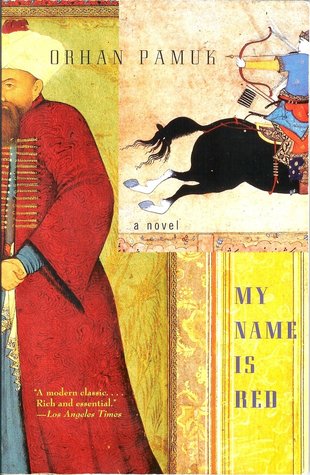
"...Allah created this earthly realm so that, above all, it might be seen. Afterward, He provided us with words so we might share and discuss with one another what we've seen. We mistakenly assumed that these stories arose out of words and that illustrations were painted in service of these stories. Quite to the contrary, painting is the act of seeking out Allah's memories and seeing the world as he sees the world."
Orhan Pamuk's My Name is Red is, at its simplest, a murder-mystery: someone has murdered Elegant Effendi, one of the miniaturist illustrators tasked by the Ottoman Sultan to illustrate a great book which will be given as a present to the Venetian Doge. Pamuk puts us in the point of view of the murdered miniaturist, who narrates the unpleasantness of his death, and then, in the next chapter, the point of view of the murderer. (Cannily, of course, not telling us who he is.)
There are chapters from the point of view of the protagonist, Black, charged by his Uncle with finding the murderer; there are chapters from the point of view of his beloved, the beautiful Shekure; there are chapters from the point of view of multiple ancillary characters, and even a few of the illustrations themselves. ("I don't want to be a tree," a drawing of a tree tells us, "I want to be its meaning.") There are even, as the title suggests, chapters from the point of view of colors.
Both the murderer and his victim tell us that the murder was sparked by an anxiety about the propriety, under Islamic law and theology, of the book, and perhaps of illustration itself. My Name is Red grapples with the relationship between God and art, under the often iconoclastic framework of Islam. Is it a sin to depict the world realistically, as the Frankish painters do? Is it hubris to paint, as the old masters do, through memory and repetition, trying to reproduce the world as it is seen in the eyes of Allah? There is much talk about what it means to draw a horse, and whether to draw a horse that one sees, or the horse that Allah has imagined.
I love that kind of stuff, and, for me, what was most interesting about My Name is Red was being forced to think about in a religious context that is ultimately foreign to me. There are iconoclastic traditions in Christianity, too, and plenty of books that deal with them, but only Islam could provide the framework for this book. Pamuk mines from Islamic tradition innumerable stories which are told in the illuminated manuscripts the miniaturists create, new to me, but certainly as familiar to his own audience as Abraham and Isaac, or Jacob and Esau are to me. I liked being pushed outside of my comfort zone in that way.
Showing posts with label turkey. Show all posts
Thursday, December 31, 2015
My Name is Red by Orhan Pamuk
Labels:
islam,
My Name is Red,
Orhan Pamuk,
turkey
Tuesday, January 15, 2013
The Towers of Trebizond by Rose Macaulay
He left me, and I stayed there and the rail, looking at the bitter Black Sea and its steep forested shores by which the Argonauts had sailed and where presently Trebizond would be seen, that corner of a lost empire, defeated and gone under so long ago that now she scarcely new or remembered lost Byzantium, having grown unworthy of it, blind and deaf and not caring any more, not even believing, and perhaps that was the ultimate hell. Presently I should come to it; already I was on the way. It would be a refuge, that agnosticism into which I was slipping down.
Mid-century Turkey, as described in The Towers of Trebizond, hardly qualifies as a foreign country for Westerners: you can't throw a stone without hitting a well-heeled Brit writing his "Turkey book," or a BBC crew filming a television program, or even Billy Graham on a missionary tour. The protagonist Laurie travels to Turkey with her Aunt Dot, who has two goals: to write her own Turkey book and to aid Muslim women by converting them to Anglicism, though she rarely makes headway in either. With them is the Father Hugh Chantry-Pigg, an "ancient bigot" whose name perfectly captures the kind of religious boorishness he exemplifies. Also, a camel.
Aunt Dot's earnestness and Father Chantry-Pigg's obliviousness might otherwise make for a darkly tragic novel of culture clash, but Macaulay's light touch ensures that the setup remains comic and harmless:
It also contains one of my new favorite sentences:
Yet The Towers of Trebizond is heavily invested in questions of personal faith and social religion. Laurie, coming from a stolidly Anglican family, is carrying on an adulterous relationship with a married man which has led her away from the Church:
Turkey seems like an awfully odd place to set a story about one woman's struggle with her specifically English religion, but it provides an isolation for Laurie that is crucial to her self-reflection. Moreover, Macaulay draws an explicit link between Laurie's faith and the Orthodox Christianity that has disappeared from Turkey, only to be found in the form of ruins. I particularly like this exchange, in which she talks with a Turkish convert to Anglicism who is thinking of converting back to Islam for her lover:
I love the control Macaulay exhibits in this passage, carrying us along rapidly as if on the hurricane of love, yet her prose is brilliantly clear. And I appreciate this attitude, because I think we are bombarded constantly with the idea that love between two people is stronger and more valuable than any belief or other facet of human experience. It can be a destructive force, too; it binds us to another flawed person, after all. No wonder that it blindsides us so frequently with agony. And yet it is hard to escape from under, as Laurie knows. Macaulay has a way of making everything seem ironic or insincere, but I think that these words are genuine.
Eventually, Aunt Dot and Father Chantry-Pigg abscond into Russia to convert the Soviets and Laurie has to travel around Turkey on her own. The farcical elements of the book recede without them, though I did laugh at the bit in which Laurie, having mistook the phrase in her Turkish phrasebook for "I don't speak Turkish," accidentally asks everyone she meets to "telephone Mr. Yorum," until a real Mr. Yorum appears at a hotel and they share a very confused dinner.
The end of the book caught me completely by surprise. It seems, like I've said, like a harmless tale, one in which even getting killed by a shark is played for a joke and not for pathos. Yet the ending is incongruous and deeply sad, in a way that is somehow more sad because the book is exceedingly not. It was, for me, one of "the times when you wake suddenly up, and the fog breaks, and right and wrong loom through it, sharp and clear like peaks of rock, and you are on the wrong peak and know that, unless you can manage to leave it now, you may be marooned there for life and ever after."
Mid-century Turkey, as described in The Towers of Trebizond, hardly qualifies as a foreign country for Westerners: you can't throw a stone without hitting a well-heeled Brit writing his "Turkey book," or a BBC crew filming a television program, or even Billy Graham on a missionary tour. The protagonist Laurie travels to Turkey with her Aunt Dot, who has two goals: to write her own Turkey book and to aid Muslim women by converting them to Anglicism, though she rarely makes headway in either. With them is the Father Hugh Chantry-Pigg, an "ancient bigot" whose name perfectly captures the kind of religious boorishness he exemplifies. Also, a camel.
Aunt Dot's earnestness and Father Chantry-Pigg's obliviousness might otherwise make for a darkly tragic novel of culture clash, but Macaulay's light touch ensures that the setup remains comic and harmless:
But first it was to be the eastern end of the Black Sea, and we were to sail in a ship that took camels and plan our campaign from Istanbul.
"Constantinople," said Father Chantry-Pigg, who did not accept the Turkish conquest.
"Byzantium," said I, not accepting the Roman one.
Aunt Dot, who accepted facts, said, "How many of our friends are in Turkey just now?"
"A lot," I said. "They are all writing their Turkey books..."
It also contains one of my new favorite sentences:
Then he stopped laughing, and said in the voice one uses when a friend has been killed by a shark, "You heard about poor Charles?"
Yet The Towers of Trebizond is heavily invested in questions of personal faith and social religion. Laurie, coming from a stolidly Anglican family, is carrying on an adulterous relationship with a married man which has led her away from the Church:
I was agnostic through school and university, then, at twenty-three, took up with the Church again; but the Church met its Waterloo a few years later when I took up with adultery; (curious how we always seem to see Waterloo from the French angle and count it as a defeat) and this adultery lasted on and on...
Turkey seems like an awfully odd place to set a story about one woman's struggle with her specifically English religion, but it provides an isolation for Laurie that is crucial to her self-reflection. Moreover, Macaulay draws an explicit link between Laurie's faith and the Orthodox Christianity that has disappeared from Turkey, only to be found in the form of ruins. I particularly like this exchange, in which she talks with a Turkish convert to Anglicism who is thinking of converting back to Islam for her lover:
She sighed as she ate her yoghourt. I thought how sad it was, all this progress and patriotism and marching on and conquering the realms of culture, yet love rising up to spoil all and hold one back, and what was the Christian Church and what was Islam against this that submerged the human race and always had? It had submerged Anthony and Cleopatra, and Abelard and Heloise, and Lancelot and Guinevere, and Paolo and Francesca, and Romeo and Juliet, and Charles Parnell and Faust, and Oscar Wilde and me, and Halide and her Moslem man, and countless millions more. It kept me outside the Church, and might drive Halide out of it, it was the greatest force, and drove like a hurricane, shattering everything in its way, no one had a chance against it, the only thing was to go with it, because it always won.
I love the control Macaulay exhibits in this passage, carrying us along rapidly as if on the hurricane of love, yet her prose is brilliantly clear. And I appreciate this attitude, because I think we are bombarded constantly with the idea that love between two people is stronger and more valuable than any belief or other facet of human experience. It can be a destructive force, too; it binds us to another flawed person, after all. No wonder that it blindsides us so frequently with agony. And yet it is hard to escape from under, as Laurie knows. Macaulay has a way of making everything seem ironic or insincere, but I think that these words are genuine.
Eventually, Aunt Dot and Father Chantry-Pigg abscond into Russia to convert the Soviets and Laurie has to travel around Turkey on her own. The farcical elements of the book recede without them, though I did laugh at the bit in which Laurie, having mistook the phrase in her Turkish phrasebook for "I don't speak Turkish," accidentally asks everyone she meets to "telephone Mr. Yorum," until a real Mr. Yorum appears at a hotel and they share a very confused dinner.
The end of the book caught me completely by surprise. It seems, like I've said, like a harmless tale, one in which even getting killed by a shark is played for a joke and not for pathos. Yet the ending is incongruous and deeply sad, in a way that is somehow more sad because the book is exceedingly not. It was, for me, one of "the times when you wake suddenly up, and the fog breaks, and right and wrong loom through it, sharp and clear like peaks of rock, and you are on the wrong peak and know that, unless you can manage to leave it now, you may be marooned there for life and ever after."
Labels:
Rose Macaulay,
The Towers of Trebizond,
turkey
Sunday, August 2, 2009
Count Belisarius by Robert Graves
Belisarius was far too respectful a subject to argue with his Emperor that he had never done him any evil; and swallowed the reproach. It was his view that so long as a man acted uprightly and according to his own conscience such insults could not harm him. There is a Christian saying, that to forgive your enemy and to return good for evil is like heaping coals of fire upon his head. Justinian's hair was constantly being singed by the warmth of Belisarius's unexampled services... Time after time, Belisarius accomplished the seemingly impossible, and Justinian felt more and more humiliated to stand so heavily in his debt. I shall have more to write upon this head before I have done.A little historical background: It is common enough knowledge that in the 4th Century AD Rome was besieged by foreign invaders, eventually deposing the last Roman Emperor in 476 and launching the world into what we now know of as the Dark Ages. This is only a half-truth, though. At the time, the Roman Empire was split into two parts, the Western Empire, with its capital at Rome, and the Eastern Empire, with its capital at Constantinople. While the Western Empire was supplanted by barbarian control, the Eastern Empire continued for another 1000 years, twice as long as the "Roman Empire," its citizens all the while calling themselves Romans.
For much of this century-long period, the Eastern Roman Empire, which we usually call the Byzantine Empire, was confined to Asia Minor, modern-day Turkey. But for a brief period under the reign of Justinian, the Empire stretched its holdings to Greece, Italy, Spain, and North Africa: almost the sie of the original Roman Empire. A lot of the responsibility for conquering those areas fell on Belisarius, a legendary general in Justinian's service.
In Count Belisarius, as he did for the Emperor Claudius in I, Claudius and Claudius the God, Robert Graves turns a historical figure into a pretty compelling fictitious character. Belisarius' feats as a general are pretty incredible: beating the Persians, the Vandals in Africa, and the Goths in Italy without ever losing a major battle.
One of his more interesting accomplishments is the put-down of the Nika riots in Constantinople. Apparently, in this time, there were two major chariot racing factions in the Empire, the Blues and the Greens. These people took chariot racing so seriously that not only were these factions about sports, but they even controlled local politics, acting as odd surrogates for political parties, but also having some of the traits of street gangs. A riot between these two factions (named after the Greek word "nika!" or "win!") broke out in the stadium which almost cost Justinian the Emperorship until Belisarius bribed the Blues to leave and then massacred the Greens.
The strange thing about Belisarius' story is that time and time again, Justinian, partly because he was jealous of Belisarius' success and partly because he was worried that Belisarius would try to have himself crowned Emperor in Constantinople or King in Italy, treated Belisarius like shit. Belisarius was under constant scrutiny, maligned by his subordinate officers and repeatedly charged with sedition. Ultimately (this isn't really a spoiler since it's FROM HISTORY) one of these charges stuck and Justinian happily had Belisarius' fortune stolen from him and his eyes put out, reducing him to a blind beggar. All the while, Belisarius had never once quarreled with the Emperor or disobeyed him.
At first I though that compared to Graves' depiction of Claudius, Belisarius came off a little flat, and maybe he does. But I think that there is something really interesting going on--apparently the division between the Blues and Greens was so deep that they each took sides on the prevailing religious question at the time, which was an argument about the nature of Christ, whether he had dual natures (the Orthodox Blue position) or just one (the "Monophysite" Green position). Graves does a good job of making these arguments seem very academic and petty. What it took the entire book for me to realize was that Graves was setting up Belisarius as a living, breathing model of Christ--being the single selfless man in the world, enduring unending abuse from everyone around him, while the rest of the Empire argues violently about an essentially meaningless dogmatic question.
I think for many people this review was probably really boring. If that's true, I wouldn't recommend this book to you. However, I did like it quite a bit, so if you're a fan of historical fiction I think you should check it out. Though I would read I, Claudius first.
Labels:
belisarius,
byzantine empire,
christianity,
historical fiction,
jesus,
robert graves,
turkey
Subscribe to:
Posts (Atom)