Showing posts with label gormenghast. Show all posts

Friday, August 14, 2020

Titus Groan by Mervyn Peake

Titus Groan: A host of eerie eccentrics | Fantasy Literature: Fantasy and  Science Fiction Book and Audiobook Reviews

Drear ritual turned its wheel. The ferment of the heart, within these walls, was mocked by every length of sleeping shadow. The passions, no greater than candle flames, flickered in Time's yawn, for Gormenghast, huge and adumbrate, out-crumbles all.

I've been meaning to re-read Mervyn Peake's neo-Gothic classic Titus Groan for a long time. My memory is that I was bored by it the first time I read it, but that the sequel--Gormenghast--made me think more kindly on it. For whatever reason, it seems to me that our cultural landscape keeps getting more and more inundated with fantasy narratives, but Peake's weird, baroque novels still haven't gotten the second look they should.

One funny thing I realized about the first two books in the series is that their names really ought to be switched. Titus Groan extends from the birth of the title character till he's invested with power after his father's death, at about one year old. The most he ever does in the novel is cry and forebodingly drop a ceremonial stone into a lake. In Gormenghast he comes into his own, battling the ambitious Steerpike for control of the castle, but it's Titus Groan that's really about the castle itself: a hulking, city-sized place, much of which is closed off or completely falling apart.

The first thirty pages of Titus Groan show more ingenuity and creativity, I think, than eighteen hours of The Witcher or whatever. There's a room full of nothing but white cats, a tower of murderous owls, and a room that holds only the roots of en enormous tree that extends laterally out of the side of the castle; this room is the haunt of the power-hungry identical twins Cora and Clarice. The lord of Gormenghast, Sepulchrave, the Earl of Groan, lives his days miserably, following the regimen laid out by the master of ritual, Sourdust. The rituals are scrupulously followed because they are the Groans' ancient power, but they are nonsensical, comprising tasks like climbing the stairs in the Tower of Flints three times and leaving three successive cups of wine in a windowsill. The tedium of ritual mirrors the castle's crumbling facade; it too exists only for itself without purpose and without attention, and those who live in it turn a blind eye to the way time strips the castle of its grandeur. Meanwhile, the head gardener polishes all the apples in the orchard.

For all the bigness of the castle--I think only a deep-pocketed studio like HBO could really do it justice, if anyone ever tried--life in it seems cramped and circumscribed. When the novel opens, all the servants in the castle are in revelry over the birth of Titus, but for long stretches it seems as if no one lives in the castle but a half dozen major characters, each of whom is entirely turned inward. For Lord Sepulchrave, it's his books; for his wife the Countess, her birds and cats; for their daughter Fuchsia, the musty and crowded attic where she goes to be alone. Even when they talk to each other, these characters hardly seem to hear each other.

But despite this narrow view, I came to read it the second time as a novel with interesting things to say about class. Titus Groan opens in the "Hall of Bright Carvings," a room full of beautiful wooden statues created by the Dwellers, who live in shanty-like huts outside the castle walls. The Dwellers spend all year carving these statues to be judged by the Earl, who chooses three to remain in the Hall, and the rest are burned. But no one ever visits the Hall; its curator lives basically in happy isolation. Like the rest of the castle's rituals, the ritual of the Bright Carvings goes on meaninglessly because it is so old, and yet the carvers devote their lifetimes to it. The castle relies on the immiseration of thousands, and yet it provides no meaning or comfort for Sepulchrave or anyone else.

It's in this context that Steerpike, the ambitious kitchen boy, appears. Steerpike, disgusted at the idea of working for the corpulent and cruel cook, Swelter, insinuates himself into court, seducing Fuchsia and manipulating the twins into burning down the Gormenghast library so he can "save" everyone. At the end of the novel, Steerpike has become the apprentice to the master of ritual, though a class upstart like he is can only master ritual in order to destroy it. There's some indication (affirmed in Gormenghast, I'm sure) that Titus is a foil to Steerpike, as the young earl who drops the ceremonial stone in the water, indicating that he's come to shake up the ossified state of things at Gormenghast. Without reading the next novel again--which I will, eventually--it's interesting to me that these two characters are set up to be so similar, but it's Titus with his noble blood whose distruption is formulated as heroism, and the upstart Steerpike who is made the villain.

I see again why I had trouble with the novel the first time around. Unlike Game of Thrones, a franchise where things really happen, Titus Groan is ponderous and slow. Peake makes great use of the setting--I have remembered for years the awful scene of Sepulchrave climbing into the Tower of Flints to let himself be devoured by owls--but the action itself is slow, focused on the minute movement of eyes, feet, lips, hands. And the language itself is as overwrought as the 19th century Gothic novels by which it's inspired. It's luscious and campy, but perhaps not for the impatient. George R. R. Martin fans might find it a little too glacial for their tastes (even as they're entering the second decade of waiting for the next installation) but to me, its rewards are much finer.

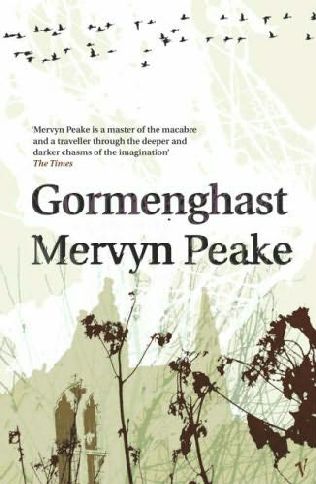
Saturday, April 4, 2009

Gormenghast by Mervyn Peake

Titus the seventy-seventh. Heir to a crumbling summit: to a sea of nettles: to an empire of red rust: to rituals' footprints ankle-deep in stone.

Gormenghast.

Withdrawn and ruinous it broods in umbra: the immemorial masonry: the towers, the tracts. Is all corroding? No. Through an avenue of spires a zephyr floats; a bird whistles; a freshet bears away from a choked river. Deep in a fist of stone a doll's hand wriggles, warm rebellious on the frozen palm. A shadow shifts its length. A spider stirs...

And darkness winds between the characters.


It occurred to me upon re-reading my review of the first book in this trilogy, Titus Groan, that either my review seems more negative than I truly felt or I have warmed up to the book considerably since I read it. In retrospect my complaints seem a little pedantic, and I would argue to myself that the series' flaws are well compensated by its virtues: an endless exhibition of creativity and ingenuity, and an obliquely poetic sense of description. Comparing Peake's books to Harry Potter, I remarked that they lack Rowling's "affability"; now I wonder why a book as unique as this would need to be affable.

So let's consider this a fresh slate, and let me explain what I do enjoy about these books:

In the first book, Titus Groan, Titus is recently born to the Earl and Countess of Gormenghast, a vast castle at the foot of Gormenghast mountain. As a baby, he doesn't do much, but there is no doubt that he will be an important figure for the castle; as the only heir to the Earl he will inherit all of the castle and its ancient system of ritual. Ironically, it is Titus who is the main character of Gormenghast, but the castle fills the central role in Titus Groan. It is many miles across, and houses untold thousands; there are parts of it that haven't been seen by human eyes in decades. Titus, aged 11 and feeling a bit of wanderlust, strolls into one such part of the castle in Gormenghast that is overrun by nature:

There had once been a great casement facing upon this terrace. It was gone. Neither broken glass nor iron nor rotten wood was anywhere to be seen. Beneath the moss and ground creepers it may be that there were other and deeper layers, rotten with antiquity; but where the long window had stood the hollow darkness of a hall remained. It opened its unprotected mouth midway along the pavement's inner verge. On either side of this cavernous opening, widely separated, were the raw holes in the stonework that were once the supporting windows. The hall itself was solemn with herons. It was there they bred and tended their young. Preponderately a heronry, yet there were recesses a nd niches in which by sacredness of custom the egrets and bitterns congregated.


I have complained that Rowling doesn't have the chops to provide the sense of awe and wonder that Hogwarts deserves; in fact she wastes very little ink on describing it at all. Peake succeeds in that, and the various rooms and hallways of Gormenghast provide some of the books' most captivating passages. Like Hogwarts, it is riddled with secret passageways and bizarre corners; one of my favorites is the tallest part of the castle, the Tower of Flints, where the Death Owls live who pick into oblivion anyone condemnded to death. Elsewhere it is a labyrinth of chambers, attics, roofs, and quadrangles.

The passage about the herons provides subtle commentary on the state of the castle, which, like its inhabitants, has a troubled soul: the egrets and bitterns gather "by sacredness of custom," as the castle itself is guided by thousands of pages of rituals which determine the operation of every event in the castle. All these rituals are kept by an old man named Barquentine, the Master of Ritual; and Peake suggests that this is where the real power in the castle lies. Many of these rituals involve Titus, who, as a baby at the end of the first book, unceremoniously drops the symbols of ritual into a lake, foreshadowing his rejection of the castle's antiquated laws as a teenager. But the castle is crumbling in places, and has let the herons in with nature. Ritual cannot keep it alive forever.

The most interesting character, however, is Steerpike, who in Titus Groan is depicted as a handsome and serious youth who, through a campaign of deceit, manages to work his way up from kitchen boy to Barquentine's assistant, making him heir to the position of Master of Ritual. Steerpike lusts after power, but it is a cold lust; he has infinite patience and works cleverly over the progressing years to procure positions of increasing power. We find out at the beginning of Gormenghast that he has faked the deaths of Cora and Clarice, the deceased Earl's moron sisters, and shut them up in an unfrequented part of the castle telling them that he is protecting them from a rash of "Weasel Plague," but we know that when they become too complicated to keep alive he will murder them without pity. He has no remorse, and indeed no emotions beyond a determined and robotic drive for power.

He is, in a word, badass. Here is a passage I liked that I think does his character justice:

The sun was blocked away. For a few minutes the shadow disappeared like the evil dream of some sleeper who on waking finds the substance of his nightmare standing beside his bed -- for Steerpike was there, turning the corners, threading the mazes, gliding down slopes of stone or flights of rotten wood. And yet it was strange that with all the vibrancy that lay packed within the margins of his frame, yet his shadow when it reappeared reaffirmed its self-sufficiency and richness as a scabbard for malignity. Why should this be -- why with certain slender proportions and certain tricks of movement should a sense of darkness be evoked? Shadows more terrible and grotesque than Steerpike's gave no such feeling. They moved across their walls bloated or spidery with a comparative innocence. It was as though a shadow had a heart -- a heart where blood was drawn from the margins of a world of less substance than air. A world of darkness whose very existence depended upon its enemy, the light.


Peake's writing has such richness, such evocativeness that really brings out the strangeness of the world he has created. There is no magic, and no races other than humans, but this must be fantasy because it feels so very fantastic; there is no mistaking Gormenghast for a castle of medieval Europe. In fact, I think it makes "real" fantasy books look rather bland by comparison.

The BBC did a miniseries called Gormenghast that conflated both books; Jonathan Rhys-Meyers played Steerpike, which I think is a perfect casting choice. But I can't decide if I'd like to see it, because I think that it might ruin a lot of the images in my head. What it really needs is a big, multi-film Peter Jackson epic. I'd totally watch that.

Saturday, June 21, 2008

Titus Groan by Mervyn Peake

Titus Groan covers a year in the life of its eponymous protagonist, but the strange thing is that it's the first year of his life. When the book opens, the wife of the Earl of the great castle of Gormenghast has just given birth to the Earl's heir, Titus. The earldom that Titus will inherit is a strange one, comprised of a colossal, labyrinthine castle filled with strange rooms and secret passageways, and the peasants' hut-like dwellings that cling like barnacles to the castle's side--but no one in the castle really thinks about them too often, so who cares?

Titus doesn't do a whole lot but eat and poop, so the burden of being the main character in Titus Groan falls to Steerpike, an ambitious young man whose career in the castle begins in the kitchen, but through a calculated scheme of flattery and manipulation increases his standing with the Earl and his family.

I have seen the Gormenghast trilogy mentioned in various sources to be a more deserving compliment to the Harry Potter books; supposedly laden with the same fantastic charms but with more literary merit. This isn't far off; though there is no magic in the world of Gormenghast, the whimsically named characters--like Flay, Swelter, and Dr. Prunesquallor--and the inventiveness of the castle--which, to name one example, contains a room filled floor to ceiling with the painted roots of a giant tree--are certainly Rowlingesque.

But while Peake seems to have an easier time using language to build his world than Rowling, Titus Groan lacks some of the affability of the Potter series. Of the ensemble cast, only two characters attract any real interest or exhibit any likeability--the well-employed Steerpike, and the criminally underused Fuschia, daughter of the Earl. Perhaps this aspect of the series improves in the next book, in which Titus will be older--but I have not yet decided if I'm going to get that far.