Showing posts with label don delillo. Show all posts

Friday, May 16, 2025

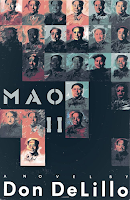
Mao II by Don DeLillo

"There's a curious knot that binds novelists and terrorists. In the West we become famous effigies as our books lose the power to shape and influence. Do you ask your writers how they feel about this? Years ago I used to think it was possible for a novelist to alter the inner life of the culture. Now bomb-makers and gunmen have taken that territory. They make raids on human consciousness. What writers used to do before we were all incorporated."

Mao II opens with a mass wedding at Yankee Stadium among the followers of the Reverend Moon. The Moonies seem like a strange historical footnote to us now, but in DeLillo's version, they are the key to much of the 21st century--the age of the crowd. In the scene, two cynical middle-aged parents search for their daughter among a thousand brides, griping and sniping at each other, blaming each other for their daughter's mad choice. When the slippery point-of-view finds, as the parents cannot, the daughter in the crowd, she is on the cusp of ecstasy. Her new husband is another face in the crowd, a handsome-enough Korean, but what really matters is not just that the two are united, but they all are united, under the aegis of the Reverend Moon. In the crowd, they participate in him, they become a whole.

It seems a little like it has nothing to do with the rest of the book, which is about a reclusive writer named Bill Gray. More Pynchon than DeLillo, Gray lives with his loyal assistant Scott and his young paramour Karen, who is also Scott's paramour--and the woman getting married at Yankee Stadium. Their precarious stability is interrupted by the arrival of a photographer, who is meant to take the first pictures of Bill in many years. This is the beginning of Bill's reintroduction to the wider world, and the next step is a strange one: his publisher asks him to perform a public reading of the work of a poet who's recently been captured by terrorists in Lebanon. Bill agrees (why?), but the spurious logic of the reading is quickly supplanted by another, which leads Bill closer and closer to Beirut and to taking place, symbolically or perhaps literally, the place of the captive.

What does the Reverend Moon have to do with terrorism? What does it have to do with Ayatollah Khomeini, or Chairman Mao, who appears in the novel only in the form of Warhol's titular silkscreen, a face repeated again and again, in many shades. What interests DeLillo is the crowd, the mass, as in the literal bolus of humanity that grows ever wider and larger, and as in mass media, which envelops into the crowd even those who are not physically present. I was struck by the paragraph above, in which Bill tells the photographer that there is a similarity between novelists and terrorists: both are crowd-workers, stoking the primeval subconscious, working into a mass movement. For DeLillo, the end of the 20th century is marked by the turn from culture to violence, or violence as culture. It's a prescient book, not least because the scenes in New York City seem to be stalked by the presence of the twin towers, twenty years before they reached the heights of their symbolic synthesis with mass terror.

Here's what really interested me about Mao II: the second half, as Bill moves ever closer toward Beirut, operates on a plane of logic than only DeLillo can really make work. It's not dream logic, or even symbolic logic; it's the logic of the crowd, which moves toward an expression of unity. Bill, injured and sick, seems to take on the qualities of the dimly-viewed captive the closer he gets. His movement is mirrored by that of Karen, who, in Bill's absence, has taken up with a homeless tent camp in New York's Tompkins Square Park. Karen, we understand, has returned from isolation with Bill into her true home, the crowd. Tompkins Square is another Yankee Stadium. But there's a resonance, too, with what Bill is experiencing, moving toward and through a disorder that is not really disorder, that has an underlying logic that can only be expressed in the crowd.

"It's like Beirut," Karen overhears people saying about the city's growing disorder. She hears it so much it becomes like a chant, a mantra. And as Bill moves toward the actual Beirut, it makes one wonder what Beirut really is. Is it a place? Or it something larger, an expression of the crowd that can expand and contract and take in a community half a world a way? That's the logic of terrorism, isn't it, to open up the circle of suffering, the circle of consciousness, to take in those who would rather stay outside of it? I was really fascinated by these sections, which contain some of (from what I have read) DeLillo's most abstract but deeply compelling writing.

Wednesday, April 10, 2024

Falling Man by Don DeLillo

Every time she saw a videotape of the plans she moved a finger toward the power button on the remote. Then she kept watching. The second plane coming out of that ice blue sky, this was the footage that entered the body, that seemed to run beneath her skin, the fleeting spirit that carried lives and histories, theirs and hers, everyone's, into some other distance, out beyond the towers.

The skies she retained in memory were dramas of cloud and sea storm, or the electric sheen before summer thunder in the city, always belonging to the energies of sheer weather, of what was out there, air masses, water vapor, westerlies. This was different, a clear sky that carried human terror in those streaking aircraft, first one, then the other, the force of men's intent. He watched with her. Every helpless desperation set against the sky, human voices crying to God and how awful to imagine this, God's name on the tongues of killers and victims both, first one plane and then the other, the one that was nearly cartoon human, with flashing eyes and teeth, the second plane, the south tower.

Who else but DeLillo could write a novel about 9/11? In a way, he wrote one already with White Noise, the ultimate novel about disaster and mass destruction in modern America, a novel about how, even faced with the bare physical fact of our own destruction we are too wrapped up in the images and signs to really see. As television has failed to enable Jack to accept his own mortality--incarnated as a tower of black smoke--so television, and our primitive computers, failed to enable us to understand the crushing force of history. Even those who experienced it firsthand, like Keith in Falling Man, must live with the long life of the image, the video, the photograph, always keenly aware of the ways in which it does not quite match the horror that was not quite legible, even in the moment. 

Keith is a businessman who worked on a high floor of the first tower; after he escapes it he hitches a ride to the apartment where his estranged wife and son are living. His arrival is necessitated by circumstance--his downtown apartment is dangerous--but it also harkens to, perhaps, a rekindling of their relationship. That would be the easy story, and it's kind of DeLillo's, too, though he's too canny a writer to make it that simple. Keith comes back, but he's transformed, part of him has been left behind. He's carrying a briefcase that's not his own; when he returns it to the woman who does own it, they strike up a brief affair predicated on those stories about the falling tower which neither of them can share with anyone else. 

In the weeks and months after "that fateful day," people in the city begin to see a street performer called the "Falling Man", who hangs from a harness in the position of the famous photograph of a man plummeting to his death from the height of the tower's top floor. What's the man's intention with this? In a way, it reminded me of the Guilty Remnant from The Leftovers, whose gruesome antics are meant to remind people of the horrors they'd rather forget. But the man never speaks for himself. He's only an image; the image. Images are signs and portents, but they never speak for themselves, only within the eye of the beholder. This is, I think, something that sets DeLillo apart from some of his peers. Whereas a guy like Pynchon suggests that signs have no meaning, have become space for pure play, in DeLillo everything seems meaningful, though meaning itself is elusive. Keith's wife Lianne notes that "Keith stopped shaving for a time, whatever that means. Everything seemed to mean something. Their lives were in transition and she looked for signs." The Falling Man is another piece of, in the words of White Noise, "psychic data," of "waves and radiation," and the baffling inexpression of his image is only an emblem of the larger inexpression that is the attack.

What I thought was best about Falling Man, and most DeLillo, is the way that Keith and Lianne's son Justin interprets the events. He and a couple of neighbor kids invent a kind of mythos around the event: they search the sky with binoculars for planes, which they believe will return--there's a kind of cargo cult element to it--and finish the job, not understanding that the towers have already fallen. Their cult fixates on a figure called "Bill Lawton," who only belatedly Lianne and Keith discover is their mishearing of Bin Laden. Who can say whether their understanding, their ordering and sense, is any truer than ours?:

They talked to him. They tried to make gentle sense. She couldn't locate the menace she felt, listening to him. His repositioning of events frightened her in an unaccountable way. He was making something better than it really was, the towers still standing, but the time reversal, the darkness of the final thrust, how better becomes worse, these were the elements of a failed fairy tale, eerie enough but without coherence. It was the fairy tale children tell, not the one they listen to, devised by adults, and she changed the subject to Utah. Ski trails and blue skies.

The riskiest choice, perhaps, are three brief interludes written from the perspective of the attackers. These sections could have gone very wrong--through cultural chauvinism, poor research, whatever. Just look at how Updike biffed that book Terrorist that everyone hated. But DeLillo makes it work by keeping the language simple, and focusing on the ways that the attackers are themselves not so different from the people whom they target, having found in an apocalyptic form of Islam a kind of code or key to understanding the world. The final section in which--spoiler alert, I guess, if you've never heard of 9/11--the viewpoint attacker crashes into the tower and the point-of-view leaps into Keith is one of the most audacious things DeLillo's ever done. 

I have a vague sense that this book was not well-received when it came out. Even in 2007, I wonder if we were ready for a book like it. I think time will show that it's among DeLillo's best, because it speaks powerfully to our century's most pivotal moment. It's probably the most written-about day of our lifetimes, if not longer, and yet I think we are still struggling to understand what it meant, or what it means to say "what it meant." No one but DeLillo, I think, could speak so clearly about the anxieties, the mysteries, the interpretations, the images, that have agglomerated around it.

Saturday, June 17, 2023

The Names by Don DeLillo

It was as thought the sky and not the earth offered ultimate support, the only purchase that mattered. He studied the shapes. What was it about the letter-shapes that struck his soul with the force of a tribal mystery? The looped bands, scything curves, the sense of a sacred architecture. What did he almost understand? The mystery of alphabets, the contact with death and oneself, one's other self, all made stonebound with a mallet and chisel. A geography, a gesture of the prayerful hand. He saw the madness, even, the scriptural rage that was present in the lettering, the madness of priests who ruled that members of the menial caste were to have their ear filled with molten lead if they listened to a recitation of the Vedas. It was in those shapes, the secret aspect, the priestly, the aloof, the cruel.

James Axton is a "risk analyst": he travels from city to city--Beirut, Istanbul, Dhaka--turning the threat of political disorder into data for multinational corporations. For the time being, he is centered in Athens, because his ex-wife Kathryn has developed a sudden penchant for archaeological digs and has taken their son, Tap, to a remote island in the Peloponnese. Like many divorced people, James wavers between an intense desire for his ex-wife and a vicious resentment. In the mountains near the dig, a mysterious murder occurs, an old man chosen seemingly at random, but struck down with a pick into which has been carved his own initials. The murder is traced back to a secretive and foreign cult.

The old man is not the first to be killed in this way, nor the last. These strange murders form the background of DeLillo's The Names, and Axton becomes obsessed with them. He's not the only one--he's outpaced in this obsession by the archaeologist and dig director, and an old filmmaker friend who wants to put the murderous cult on camera--but his job affords him a unique opportunity to travel the world learning more about them. It's Axton who discovers the chilling--and strangely mundane--key to the murders: the victims are chosen because they have the same initials as the place in which they were killed.

It's so stupid, so goofy, that only DeLillo could pull it off, quite frankly. And yet The Names is much less funny, and more ponderous, than White Noise, which would be DeLillo's next novel and big breakthrough. If White Noise is a thoroughly modern novel, about the increasingly fraudulent world of soundbites and advertisements in which we find ourselves, The Names is a pointedly ancient novel. The Americans who congregate in Athens are drawn to it as a doorway to the East, to civilizations and religions that promise older, truer ways of knowing and being. The archaeologist becomes obsessed not with merely digging up ancient objects, but ancient alphabets, under the hope, perhaps, that they might be closer to the reality of things. 

But there are deep similarities between The Names and White Noise, too: in White Noise, DeLillo suggests that the entire edifice of modern culture--the television, the movies, the postcards, the radio, the tabloids--exist to stave off the knowledge and fear of death. In The Names, he suggests that this process is not only a modern one, but much older, stretching back to the invention of words and alphabets which seek to describe, and just control, the nature of the world. The actions of the murderous cult, it turns out, are meant to alert us to the absurdity of attempt. By making the alphabet itself the logic of their murders, make "the system equal to the terror" it is meant to control.

The Names is fairly well-regarded, I think, among those who read DeLillo's books. It's not hard to see why; it's tremendously weird and full of small, strange DeLillian moments. I loved Axton's son Tap, a precocious kid still naive enough to believe that mastering knowledge is the same as mastering the world. (He makes an interesting foil to Jack's son Heinrich in White Noise, who has concluded that there is no such thing as true knowledge.) But having White Noise on the brain while I was reading The Names didn't do it any favors. The story itself struck me as rather motionless, and the murder part was a much smaller part of the novel than I anticipated. What was the rest of it? Some churning combativeness with Kathryn, and a lot of talky dinners with friends and associates under the shadow of the Parthenon. The most interesting and promising section comes toward the middle, when Axton and Tap drive up into the primeval Greek mountains, and in which Axton comes face to face with a member of the cult. But in the end, it's the archaeologist who has the last and final encounter with them, and the story is told, deflatingly, second-hand. There's something very DeLillo about that--maybe things only happen in life second-handedly--but I don't know that it worked for me.

Tuesday, February 1, 2022

White Noise by Don DeLillo

The enormous dark mass moved like some death ship in a Norse legend, escorted across the night by armored creatures with spiral wings. We weren't sure how to react. It was a terrible thing to see, so close, so low, packed with chlorides, benzines, phenols, hydrocarbons, or whatever the precise toxic content. But it was also spectacular, part of the grandness of a sweeping event, like the vivid scene in the switching yard or the people trudging across the snowy overpass with children, food, belongings, a tragic army of the dispossessed. Our fear was accompanied by a sense of awe that bordered on the religious. It is surely possible to be awed by the thing that threatens your life, to see it as a cosmic force, so much larger than yourself, more powerful, created by elemental and willful rhythms.

As Jack Gladney and his family move slowly through traffic, having been ordered to evacuate their homes after the accidental release of a black cloud of toxic chemicals, he looks into a furniture store and sees families inside shopping. He marvels for a moment at how different their understanding is than his own. Who's to say whose reaction is the right one? Which of them has the correct information and the correct analysis? Now, it's been at least fifteen years since I last read White Noise, which I know because there's no review for it on this blog. But it seemed almost serendipitous to me to pick this novel up again at this particular point in time: who hasn't had the experience, during the COVID pandemic, of looking into a crowded bar or restaurant and thinking, What the fuck are those people doing? Oh, right: there are lots of people who are in the bar looking out. They have different information, a different analysis.

I'd like to write about this more at length sometime, but I was struck by how much "The Airborne Toxic Event," the middle section of White Noise, resonates with the world during COVID. The crisis is different, but the reactions are the same: the fear, the need for decisive authority, the safety of information. White Noise is, perhaps more than anything, a book about information. See how Jack's friend Murray, a visiting professor at the same college, sits for hours with Jack's children watching television, saying that it's full of data. But data that suggests what? Jack is awash in information, but to what end? Every few pages, he overhears a fragment of a sentence from the television or radio shorn from context, useless. In the end, even the body becomes a site of information generation, as Jack becomes increasingly paranoid about the "seed of death" the Toxic Event has apparently planted in his body. He searches himself for symptoms, wondering if, when he feels them, they are invented or real. He asks, "Is a symptom a sign, or the thing itself?" Anyone who has opened the pickle jar to test their sense of smell or wondered about their scratchy throat these past few years must recognize that feeling. There is so much information, from within and without, but nothing can be discerned.

The final section of the novel, "Dylarama," is about the one thing that is certain: death. Discovering that his wife Babette has been taking part in an underground clinical trial for a pill that promises to rid one of the fear of death, he becomes desperate to track down the shady pillmaker who supplied it. I found this section as terrifying as I did fifteen-plus years ago, maybe more so, given that I'm fifteen years closer to my own death. You can't do anything about dying, and what White Noise suggests is that you can't do anything about the fear of death, either. The Information Age provides no answers, and neither does modern consumer culture, although it does provide a very funny scene where Jack approaches a kind of ecstasy by going on a shopping binge.

White Noise is funny. It's way funnier than it has any right to be, being so bleak. I loved the conversations Jack has with his family, each awash in its own kind of misinformation, whether about "Sunny Muslims," which are confused with Korean "Moonies," or the "sun's corolla." Perhaps more than any other writer--including Pynchon, who tries harder--DeLillo understands the absurdity endemic to life in America's late era, its foolish jargon, its inherent falseness and insincerity. Time hasn't dulled the acerbic nature of the novel at all; though it was published too early to reflect the true "Information Age," it seems almost prophetic in it vision of an America awash in bits and bytes of useless knowledge, contextless words and images. What's most remarkable about White Noise, though, is not how perfectly it captures a particularly timely spirit, but how something timeless--that fear of death--is revealed beneath all the--well, "white noise." White Noise might be the most hypermodern novel, but it's also one that paradoxically understands that some things never change, that there is something fundamental, even primeval, in human nature that cannot be changed.

Tuesday, February 5, 2019

Libra by Don DeLillo

Six point nine seconds of heat and light.  Let's call a meeting to analyze the blur.  Let's devote our lives to understanding this moment, separating the elements of each crowded second.  We will build theories that gleam like jade idols, intriguing systems of assumption, four-faced, graceful.  We will follow the bullet trajectories backwards to the lives that occupy the shadows, actual men who moan in their dreams.

Few events in modern history capture our attention like the assassination of JFK.

Ugh.  I look at that sentence, and it seems so obviously tedious, so tediously obvious.  The tediousness of it is part of its truth.  We've never really been able to look away from the Zapruder film, from the central mystery of it.  The truth of it is probably very banal: a Communist sympathizer with means and opportunity.  And yet we can't stop ourselves from spinning conspiracies about it, from making conjectures about grassy knolls and phantom bullets, not only because we want to make sense of it but because want a certain kind of sense from it.  We want it to be a conspiracy because it will make the murder meaningful, rather than pathetic.  As one character in Don DeLillo's Libra says, "Destiny is larger than facts or events.  It is something to believe in outside the ordinary borders of the senses, with God so distant from our lives."  We want JFK's death to be destiny.

Libra is about that search for destiny as it is about the assassination itself.  The same impulses that drove Lee Harvey Oswald to shoot Kennedy are the same ones that keep our attention on the act.  DeLillo's version of the killing, which traces "the bullet trajectories backwards" to Oswald's childhood, is both scrupulously faithful and entirely fantastical.  All the fringe figures are here, including guys I've never heard of like George de Mohrenschildt and David Ferrie, plus Oswald's Russian wife Marina and his mother Marguerite.  But DeLillo speculates that it was elements in the CIA that spurred Oswald to do it, embarrassed by the fiasco at Bay of Pigs and wanting to push public opinion toward a more forceful confrontation with Castro and Cuba.  They plan a near miss of Kennedy, but there are factions within factions and control over Oswald and the other shooters (yes, on the grassy knoll) is quickly lost.

Libra is, before anything else, a convincing biographical portrait of Oswald.  DeLillo, who I don't think is a particularly strong character writer, really does a great job of humanizing Oswald, from his childhood in Brooklyn and New Orleans to his military service in Japan and his defection to the USSR.  Oswald is a man on the margins, a poor white kid who never quite catches a break, and who turns to Marxism as a way of finding his own place in the world.  He is obsessed with secret names: Trotsky's name was Bronstein, Lenin's was Ulyanov; he too, expects a new name when he becomes a Marxist hero.  In this way he's not unlike the CIA ops, who have secret names for their projects that conceal even more secret, truer names.  This similarity is one of the book's fundamental ironies, and the reason why the fervently pro-Castro Oswald ends up enlisted in an anti-Castro project.

He obsesses also over his place in history, which he feels forever outside of.  Marxism is a way of understanding history, of course, with its certitude about the progression from late capitalism to worker's revolution. "He was a man in history now," he thinks when he's at last able to defect, but the Soviets can't provide him a sense of historical significance any more than America can.  Oswald's not alone in that, of course; that feeling of being outside history is really what Libra is about.  It's why we focus on the assassination, which seems like a moment of such great importance that it gathers history into a critical point, and if only we can understand it thoroughly we might find ourselves in history also.

White Noise is about this, too, but more satirically.  It's why Jack Gladney specializes in "Hitler Studies," hoping to pin down a certain moment, or man, of history, but that novel argues that the balkanization of academia moves us farther away from an understanding of history at large.  Here it's the CIA that experiences that balkanization, with its various factions moving within and apart from each other.  The bureaucrats who want to control history, forcing the U.S. into action in Cuba, find that it slips easily out of their grasp.  One thread follows a CIA bureaucrat named Branch, who's tasked with analyzing every scrap of information about the JFK assassination.  That knowledge, we understand, will be locked away in a box somewhere, even if the task were not an impossible one.  No, DeLillo says, history is impossible to track, and perhaps doesn't really describe the forces that work on human events:

"Think of two parallel lines," he said.  "One is the life of Lee H. Oswald.  One is the conspiracy to kill the President.  What bridges the space between them?  What make a connection inevitable?  There is a third line.  It comes out of dreams, visions, intuitions, prayers, out of the deepest levels of the self.  It's not generated by cause and effect like the other two lines.  It's a line that cuts across causality, cuts across time.  It has no history that we can recognize or understand.  But it forces a connection.  It puts a man on the path of his destiny."

I know that reading books close to each other can force all sorts of connections, but I was really amazed by how similar Libra is to Tree of SmokeThe factions within the CIA in the former are directly analogous to the factions within the military that Colonel Sands exploits in the latter; both see history as an intractable problem about the flow of information; both want to dramatize what it's like to be a figure at the mercy of that problem.  Even the language is similar, lurching toward abstraction, though Johnson's vocabulary seems to be borrowed from the mystic while DeLillo's is borrowed from the bureaucrat, or the systems analyst.  DeLillo is finely attuned to the deadness of American language, and it's ability to stultify and cripple.  I was surprised by how fluidly he captures the idiom of folks like Oswald's mom or Jack Ruby, both of whom are comic and sad.

What do we know in the end?  Well, we know that it's not really Oswald that killed Kennedy; it's one of the shooters on the grassy knoll.  But after 450 pages it's not really any easier to say why Oswald did it.  Somehow it remains overdetermined: He was manipulated; he was a true believer; it was his destiny.  Libra settles nothing, but it does tell us that nothing will ever be settled.

Monday, June 16, 2014

The Body Artist by Don DeLillo

Take the risk.  Believe what you see and hear.  It's the pulse of every secret intimation you've ever felt around the edges of your life.

Lauren Hartke is renting a beach house on an isolated stretch of coast on what I can only assume is New England with her husband, the famous director, Rey Robles.  She's still there when he drives back to their Manhattan apartment to shoot himself, leaving her alone in the little rented cottage.

But she isn't alone--she soon discovers that a squatter has been living in the attic, a strange, damaged man whom she calls Mr. Tuttle.  His speech is inscrutable, made of clipped, imitated phrases:

He knew what a chair is called and a window and wall but not the tape recorder, although he knew how to turn it off, and not, it seemed, who is mother was or where she might be found.

"If there is another language you speak," she told him, "Say some words."

"Say some words."

"Say some words.  Doesn't matter if I can't understand."

"Say some words to say some words."

"All right.  Be a Zen master, you little creep."

Lauren extends her stay in the house, partly to live in the suspension from ordinary life it provides, and partly because of her fascination, and sense of responsibility for, Mr. Tuttle.  She forms a theory that he lives outside of time, experiencing it, as the Trafalmadorians do, all at once; a theory supported when he predicts days ahead of time the words she will use when she breaks a glass on the floor.  When he begins to speak in imitation of her dead husband, DeLillo suggests that he isn't merely recalling something that he overheard, but accessing a present that is absent for Lauren--linking her to an existence in which Rey is alive and, in a sense, cannot die.

Strangely, The Body Artist echoed something I've been writing about for my master's thesis on Paradise Lost: the idea that God lives in that eternal present, like Mr. Tuttle and the Trafalmadorians, and that intimacy with God can help assuage the inevitably painful experience of linear time.  Mr. Tuttle does that, I think, for Lauren, but aloofly and imperfectly.  Partly, I think my familiarity with that idea is what made the book fail to resonate with me.  But also, DeLillo's prose has a way of being chilly and distant that mutes the power of Lauren's grief, and the novel whiffs on the opportunity to communicate the stakes involved in a liberation from the human experience of time.

Lauren is the "body artist" of the title--something of a performance artist, an interpretive dancer, or even a human sculpture.  Mr. Tuttle, ultimately, fails to provide her any meaningful connection to her husband beyond a few scraps of his speech, uncannily imitated.  But he provides inspiration for her final piece, described by DeLillo in the form of a newspaper review, in which she finds her own power of imitation:

Then she does something that makes me freeze in my seat.  She switches to another voice.  It is his voice, the naked man's, spooky as a woodwind in your closet.  Not taped but live.  Not lip-sync'd but real.  It is speaking to me and I search my friend's face but I don't quite see her.  I'm not sure what she's doing.  I can almost believe she is equipped with male genitals, as in the piece, prosthetic of course, and maybe an Ace bandage in flesh-tone to bleep out her breasts, with a sprinkle of chest hair posted on.  Or she has trained her upper body to deflate and her lower body to sprout.  Don't put it past her.

The imitation--or perhaps embodiment--is of Mr. Tuttle.  Lauren may not live beyond time, as he does, but she can use the power of her art to access another time, another place, another body.  The prose is not quite successful--I find that convincing descriptions of genius in other arts rarely are.  But it seems a fitting conclusion, that having been left alone, abandoned, left behind, Lauren is able to find solace in the multiplicity ("I contain multitudes!") of herself.

Saturday, May 29, 2010

Point Omega by Don DeLillo

We drove in silence behind a motorboat being towed by a black pickup. I thought of his remarks about matter and being, those long nights on the deck, half smashed, he and I, transcendence, paroxysm, the end of human consciousness. It seemed so much dead echo now. Point omega. A million years away. The omega point has narrowed, here and now, to the point of a knife as it enters a body. All the man’s grand themes funneled down the local grief, one body, out there somewhere, or not.

Spoilers.

I realized while thinking about this review that I’ve read more DeLillo books than any other author since the Fifty Books Project started. It seems strange now that I disliked DeLillo’s abstracted, distant prose and stylized dialog, but there it is. Now, I consider him one of my favorite authors even though I’ve disliked about as many of his books as I’ve liked. DeLillo, at the best of times, is only marginally interested in plot. Libra is the only book of his I’ve read that’s even slightly plot-driven, and even his characters, as enigmatic and interesting as they can be, generally aren’t the driving force in his books. Instead, it seems to me, liking or disliking DeLillo as an author comes down to appreciating his primary themes—the disconnection of the modern man and the difficulty or impossibility of reconnecting, the absurdity of everyday life, the vapidity of consumerism, etc—and his prose. DeLillo is, hands down, one the best stylists I’ve ever read and it’s that quality that makes even his mediocre novels, like The Body Artist, interesting to me.

Point Omega
, his most recent book, certainly falls closer to The Body Artist than Libra. It reads almost like two novellas, one nested inside the other, with no clear connection between the two. In the first, titled Anonymity, an unidentified man stands in the Museum of Modern Art in New York, and watches a display called 24 Hour Psycho. This exhibit, which actually exists in real life, consists of a projection screen, viewable from both sides, playing Alfred Hitchcock’s Psycho, slowed down so it plays through once every 24 hours. The man visits the exhibit every day and marvels at how changing the presentation changes the entire feel of the film, making each moment as banal as the last. In the second, postmodern documentarian Jim Finley travels to the middle of the California desert to film ex-Iraq War consultant Richard Elster. Things are uneventful until Elster’s daughter Jessica shows up, sent by her mother in an attempt to end her relationship with the mysterious Dennis. Circumstances change, however, when Jessica disappears, leaving behind all her possessions and sapping both Jim’s will to make the film and Elster’s will to live. The books ends by completing the story in the first section, such as it is: the unnamed man meets a mysterious woman, they discuss the film, and then leave. The only connection between the two stories is the exhibit itself—while trying to convince him to participate in his film, Jim takes Elster to see 24 Hour Psycho.

Man, this book was abstract. Jessica’s disappearance is the closest thing to a plot development in the entire novel, and even it occurs only during the last 20 pages of the second section and is barely explained at all. We (and Jim and Elster) never discover what happened. Possibilities are thrown out—lost in the woods, suicide, elopement with Dennis—but no evidence is given to weight one over the other. Much like The Body Artist, virtually all conclusions that can be drawn are equally valid, not that DeLillo had ever been particularly didactic. The themes are right there in the title and the excerpt above: the omega point is a term that describes the maximum level of complexity toward wich the universe seems to be evolving, but DeLillo seems to say that focusing on the advancement toward complexity isn’t as significant as the little moments—hence the fascination with Psycho when it’s broken down into its simplest bits, and the de-emphasis on creating the documentary once Jessica disappears. These ideas are hardly seamless, but on the whole, it makes sense to me. At a little over 100 pages, Point Omega is never particularly dull, thanks to DeLillo’s language, but it’s as stripped down as DeLillo gets, and sometimes feels a little unnecessary. At his best, DeLillo revels in complexity. I'd like to see him heading back in that direction.

Thursday, November 13, 2008

Cosmopolis by Don DeLillo

We declare that the splendor of the world has been enriched by a new beauty: the beauty of speed. A racing automobile with its bonnet adorned with great tubes like serpents with explosive breath ... a roaring motor car which seems to run on machine-gun fire, is more beautiful than the Victory of Samothrace.

--"The Futurist Manifesto," F.T. Marinetti

Beneath the data strips, or tickers, there were fixed digits marking the time in the major cities of the world. He knew what she was thinking. Never mind the speed that makes it hard to follow what passes before the eye. The speed is the point. Never mind the urgent and endless replenishment, the way data dissolves at one end of the series just as it takes shape at the other. This is the point, the thrust, the future.

--Cosmopolis,
Don DeLillo

It struck me while reading Cosmopolis that perhaps if Marinetti, the founder of the Italian mindfuck philosophy that was Futurism, were alive today he would love this book. Marinetti wrote his manifesto in 1909, not long after the invention of the automobile, and one can only imagine what he would say if he could see today's cars, which make the racecars of one hundred years ago look tortoise-slow.

On the other hand, it may not be the automobiles which capture his imagination. In Cosmopolis, Don DeLillo places his anti-hero, multi-billionaire Eric Packer, in an automobile, one of the world's finest stretch limousines, but the power and speed of the vehicle is wasted in the novel-length crawl across the width of gridlocked Manhattan. It takes Packer an entire day (and novel) to accomplish his goal, which is to drive crosstown and get a haircut. On this interminable journey he is an observer to a presidential motorcade, a rapper's funeral, and a violent process, and a participant in a small handful of sexual escapades. All this traveling at what must be a fraction of a mile per hour!

But that is not to say that the limousine does not embody Marinetti's love of speed--though the limousine may be nearly stationary, it is the conduit through which Packer can monitor all facets of his global finance empire, through which information moves at speeds which would give Marinetti wet dreams.

In fact, information in Cosmopolis moves so quickly that it surpasses even real time. Take the security monitor inside the limousine, for instance, that shows Eric his actions a split second before he even commits them. Cosmopolis is a messy, sprawling novel (even at a slim 200 pp.) but I think that it can be whittled down to this idea, that in our modern era we live on the edge of precipice so razor-thin that we are in danger of falling off.

The Futurists wished to destroy the museums, which they considered graveyards; true art, they felt, must be continually and violently replenished and started anew. Cosmopolis seems to argue that we live in the Futurists' ideal world, that the tides of progress have moved on without us, past all human control. Packer's other mission during his limo ride, besides the haircut, is to pursue a bet against the yen, which despite his best efforts, rises impossibly. By the end of the novel, in a matter of hours, Packer is penniless. This, DeLillo says, is our reality: fortunes amassed and lost in afternoons, and getting faster all the time. As Marinetti says, "Time and Space died yesterday." And as the things that Marinetti cherished--the automobiles, the guns--seem almost antiquated to us, so Cosmopolis forces us to face our own hurtling toward obsolescence.

I think perhaps that Marinetti was born one hundred years too late. Cosmopolis is the ultimate Futurist novel, but also quintessentially 21st-century; it is so cutting-edge that it edges beyond even postmodernity. But this also nurtures, and perhaps necessitates, its biggest flaw: a severe lack of humanity. The awesome James Wood, writing for the New Republic, notes that "Eric is really no more than a vessel for theory; he is given not thoughts but meta-thoughts." How true. Here is a novel with much to say, but at times seems so drunk on its ideas that it forgets that ideas are only as relevant as the people they impact.

I struggled with this--after all, isn't this the point of it all, that the human being has become as passe as the Sony Walkman? But I remember DeLillo's White Noise, a novel that managed to break through the ominous haze of turn-of-the-century paranoia and find two people simply scared shitless of dying. Where White Noise had power, Cosmopolis has portentousness.

And besides, isn't the Futurist ideal fundamentally flawed? I recall a conversation I once had with an Italian professor of mine who noted that though the Futurists believed that mankind would become more and more like the technology they created in the automobile, in truth la macchina e stata humanizata--the automobile has become humanized. Though DeLillo taps into an essential modern fear about technology run amok, the fact is that our creations are becoming more and more like us instead of the other way around. Though we may feel obsolete, it cannot be ignored that those feelings are ours; our machines and software have no opinion.

DeLillo comes around toward the end of the novel, when Packer, in a plot point I've neglected to mention, comes face to face with a would-be assassin. Face-to-face with the barrel of a gun, Packer recalls that he'd "always wanted to become quantum dust, transcending his body mass, the soft tissue over the bones, the muscle and fat. The idea was to live outside the given limits, in a chip, on a disk, as data, in a radiant spin, a consciousness saved from void."

There, confronting death like the protagonists of White Noise, Packer comes to realize from what stuff he really is made:

The things that made him who he was could hardly be identified much less converted to data... So much come and gone, this is who he was, the lost taste of milk licked from his mother's breast, the stuff he sneezes when he sneezes, this is him, and how a person becomes the reflection he sees in a dusty window when he walks by. He'd come to know himself, untranslatably, through his pain... His hard-gotten grip on the world, material things, great things, his memories true and false, the vague malaise of winter twilights, untransferable, the pale nights when his identity flattens for lack of sleep, the small wart he feels on his thigh every time he showers, all him, and how the soap he uses, the smell and the feel of the concave bar make him who he is because he names the fragrance, amandine, and the hang of his cock, untransferable, and his strangely achy knee, the click in his knee when he bends it, all him, and so much else that's not convertible to some high sublime, the technology of mind-without-end.

Thursday, December 27, 2007

Underworld by Don DeLillo

"They had the rear of the bus to themselves on the ride back, the motor right below them, heat beating up, and they dozed on each other's shoulders, faces sun-tight and eyes stinging slightly, tired, hungry, happy, the bus belching heat below them."

"I long for the days of disorder. I want them back the days when I was alive on the earth, rippling in the quick of my skin, heedless and real. I was dumb-muscled and angry and real. That is what I long for, the breach of peace, the days of disarray when I walked real streets and did things slap-bang and felt angry and ready all the time, a danger to others and a distant mystery to myself."

If you require a strong, linear plot to propel you through a novel, then Don DeLillio's massive tome about Cold War America isn't for you. If you like endings that time up everything neatly, or where all the loose ends are tied together into a nice braid, this probably isn't the book you should pick up. If Hemmingway is your favorite author, well, the excerpts at the top of the review should tell you all you need to know.

If you've enjoyed DeLillo in the past and you like sprawling, epic novels, you owe it to yourself to check out Underworld. Ostensibly tied together by the movement from person to person of the home-run ball from "The Shot Heard Around the World." Within its path are the lives of dozens of characters, the main one of which, Nick Shay, has a secret that forms what tension exists in the book. The book isn't intended, however as a thriller. It's a slow moving slice-of-life about paranoia, death, religion, growing old, America, the Cold War, and the latter half of this century. I personally found it hard to put down, and I have to say that the prose is some of the most beautiful I've ever read. There's a passage near the end of the book that describes a landfill in such a tragic, nostalgic way that it almost gives me chills. That takes some skill.

The book is 827 pages long, but despite that, felt a lot shorter than Cosmopolis, one of the other two DeLillo novels I read this year. Underworld also eschews DeLillo's usual trademark of keeping a safe emotional distance from his characters, choosing instead to relate their inner turmoil through incomplete sentences, awkward pauses, strange guestures, and every other tool at his disposal. This book was recently chosen as runner-up for the best work of American fiction in the last 25 years. I would say it deserves those accolades. It was a challenging book, and it ends my 50 with a bang.

Wednesday, October 17, 2007

Cosmopolis by Don DeLillo

I would say that Cosmopolis is the strangest book I've read this year with the possible exception of The Wind Up Bird Chronicle. It follows a day in the life of Eric Somethingortheother, an extremely wealthy stock picker in the near future. He's so powerful that when the Yen makes an unexpected rally, his faulty recommendation nearly cause a market crash. He spends most of the day in his cork-lined car (it doesn't keep the noise out, but the lining is the point) watching things on televsion that seem more real to him than real life. All he wants is a haircut, but a political assasination, a funeral for a rapper, and shooting for a bizarre movie impede his progress.


This is the second book of DeLillo's that I've read, and I found it rather difficult intially. The first half of the book is so strange that it's offputting, particularly an episode that involves a Eric receiving a prostate exam while talking to his sweaty coworker. At some point during the conversation, the look at each other and have a mutual, uh, climax. It's really bizarre in a way that even the rest of the book is not. Still, the themes are familiar ones for postmodern literature. The equation of the trivial and the personal to the same level of importance, the growing distance between people (comically illustrated by Eric's inability to recognize his wife immediately as he runs into her throughout the day).


Portions of the book are brilliantly written and even somewhat moving, such as the funeral for the rapper. Other parts, like the prostate exam, are offputtingly bizarre. Still others are confusing and probably laden with symbolic significance that I'm incapable of picking up on, such as the running theme of assasinations. (In the book, there is one actual assasination, one attack by the “pie assasin,” a man who throws pies at celebrities, and the repeated atempts on Eric's life). The end of the book is appropriately bizarre and oddly satisfying, but I can't really recommend this book to hardly anyone. Read White Noise or Underworld instead. Both are beter and more accessible than Cosmopolis.