Showing posts with label climate change. Show all posts

Saturday, September 9, 2023

The Next Great Migration by Sonia Shah

Among migrants, Homo sapiens is king. And yet we have little consensus on why we move around the way we do. The findings of continuous migrations throughout our deep past have upended the idea that we moved only once in the past, attracted by empty lands, but have left the central question intact: Why? Why venture into the oxygen-starved Tibetan plateau or set off on outrigger canoes into the waves of the Pacific? Why leave the comforting certainties of life in Africa, where food and water and other resources abound to this day?

Just the other day, New York mayor Eric Adams declared that migrants, which the city has struggled to house and provide for, could "destroy the city forever." His words were roundly praised by neo-Nazis and white supremacists, and run-of-the-mill Republicans rushed to wag their fingers: even progressives are starting to realize that immigrants are a destructive force, invading our homes and mutilating our way of life. The rhetoric is shocking, but it's also tedious, because people have been saying exactly the same kind of thing for centuries, before New York was New Amsterdam. We are so familiar of this language of "invasion," as if people who want to live among us are actually conquerors, or perhaps viruses, but according to Sonia Shah's The Next Great Migration: The Beauty and Terror of Life on the Move, such language is rooted in the mistaken assumption that our borders mark static places that contain natural populations which "belong there."

Much of The Next Great Migration is devoted to an intellectual history of migration, both human and animal, starting with Carl Linnaeus, whose system of binomial nomenclature reflected a belief that animals are rooted to the specific environments in which he found them. It's impossible to read these chapters without marveling at just how stupid we've been for so long. We used to think that birds spent the winter underground, until a stork showed up in Germany with an African arrow through its neck--in the spring of 1822. What Shah does really well is trace an intellectual history that shows how anti-immigration ideology is inextricable from scientific racism. The conviction of Linnaeus and others that animals don't move, when applied to human beings, long enabled the belief that migration is an unnatural act undertaken by the malicious or the desperate, and would result racial hybridization and the loss of genetic white superiority. These ideas show up again in later maniacs, like eugenicist Madison Grant and overpopulation hawks like Thomas Malthus and Paul Ehrlich, and Shah shows pretty convincingly that they represent an ideological chain that goes all the way to modern-day goblins like Stephen Miller.

What archaeological and genetic evidence really shows, Shah explains, is that migration is a fundamental part of being human. The longstanding belief that modern populations are the descendants of ancient populations that did not move, or moved in brief spurts and never again, is totally backward: the world populations that exist today are the result of millennia spent moving in every direction and by any means. Ancient humans moved over long distances and across difficult barriers, across mountain ranges and immense seas, peopling, for instance, the islands of the Pacific long before mainstream thinkers thought such intentional seafaring was even possible. (And evidence keeps accumulating even since the publication of The Next Great Migration in 2020: a set of footprints at White Sands National Park strongly suggests that humans arrived in North America long before the opening of the Bering Land Bridge.)

What is so remarkable about The Next Great Migration, I think, is that it addresses the scientific racists--who are still quite numerous and influential--on their own terms. It would be easy enough to reject Linnaean claims that human beings make up discrete populations whose survival is threatened by easy migration by saying that human beings are not like other animals, but Shah situates the human capacity for migration specifically in the context of plant and animal movement. The implications of this rebound against not only immigration restrictionists but invasion biologists: movement is a crucial part of the ecological history of plants and animals as much as it is human beings, and our ideologies about "invasive species" may do no better representing the truth about ecosystems than ideologies about invasive human beings.

For Shah's presumably leftish audience, this has to be the most difficult part of the book to accept. But Shah is really persuasive in saying that what you accept about humans you have to accept about plants and animals as well. Just as immigration restrictionists--and Eric Adams--exaggerate the potential harms of migration and minimize the potential benefits, so we ignore that movement replenishes biodiversity. Even some of the most maligned invasives, like zebra mussels, turn out to be excellent at filtering and cleaning the water of the Great Lakes. All of that is not to say that we should ignore the risks of introduced species--especially in more self-contained ecosystems like Pacific islands--but that a smarter approach might be more discerning about what the risks really are, and from which species. It might be one that understands that plants and animals have always moved around the globe, even without the help of human beings, and it might jettison the creepy language and assumptions of the GOP.

It's hard to ignore the silent term in the title: The Next Great [Climate Change] Migration. The next century promises to be one in which the world changes, ecologically and politically, faster than ever before. To face it, Shah suggests, we'll need to let go of stale ideas. We will have to decide what it means for a plant to be "native" in an ecosystem that has gone from having a continental climate to a subtropical one. We will also have to figure out how accommodate the millions of people who will be on the move, doing what humans have always done, but perhaps in even greater numbers and a faster pace. Will we welcome them with a place to sleep, or razor wire? Will we fear them as destroyers or welcome them as neighbors? 

Friday, October 8, 2021

Harrow by Joy Williams

Hope no longer found a place to dwell. Even the insects felt it gone. The colt, the cub, the calf, the stones that would be precious jewels deep within the earth. The flowers who, as Wordsworth knew, enjoyed the air they breathed, were aware of nothing but hope's absence. Something definitely had gone wrong. Even the dead were dismayed.

Dystopian fiction is having a moment. Where once it was the story of state power run amok--the old anxieties of the Cold War imagined at an accelerated pitch--today's dystopias are all ecological disasters, climate fiction: cli-fi. As the possibility of mitigating the advent of climate change grows dimmer, these books ask us to imagine a world that is both unimaginable and certain. In Lydia Millet's A Children's Bible, for example, storm and disease separate children from their irresponsible parents, sundering a reckless past from a burdened future.

But Millet's book feels underwhelming because as the future becomes depleted old modes of narrative feel false. If you can't write poetry after Auschwitz, can you write a novel before the death of the Earth? As Joy Williams puts it in her new novel Harrow--the only book I've read that really captures the bewildering horror of climatological crisis--"The old dear stories of possibility. No one wanted them anymore, but nothing had replaced them."

Harrow's heroine is Khristen, who, her mother tells her, died briefly as a baby before returning to life. Khristen's father doubts this belief, as does Khristen and everyone else, but the belief clings to her and shapes her life. She holds the key to living through the age of apocalypse, maybe, having ultimately recovered from death. As the ten-year old judge Jeffrey describes her: "As an interesting case she could anticipate no present moment, she possessed only the future, which she was still powerless to change."  In contrast to Khristen are the small band of elderly eco-terrorists--with whom Khristen resides after her school closes and her mother disappears--living in a ruined motel at the edge of a black lake. These elderly folks are all past and no futurity, and they dither about not making good on their plans to blow up factories and murder pharma profiteers because on some level they understand that the gestures are futile and empty. Alice, the budding eco-terrorist from Williams' The Quick and the Dead might age into such a person.

These elderlies are anomalous, of a past world; though we might expect the exacerbation of ecological collapse to radicalize most people, Williams unnervingly suggests the opposite might occur: people decide that nature has betrayed them and hasten its demise, treasuring plastic, cutting down the last few trees for committing the offense of simply being alive so long. The elderlies are essentially, symbolically, literally too late; strategy does not matter because apocalypse cannot be converted:

The owls lay fuddled and miserably starving in their hollows--their home, darkness had been taken from them. The very earth had been pressed to chalk, to clay, as through a mangle. The wolves, the bears, the great fish (which he had never seen) gone, even the harmless snakes and frogs of his childhood. If someone claimed he'd seen an eagle, he would not be taken seriously. The possibility of seeing an angel or a witch on a broomstick would be treated with more polite agnosticism. The fouling of the nest was all but complete, the birthright smashed.

Harrow is recognizably a Joy Williams novel: no one else is as capable at making every line glitter, or as incapable of writing a sentence that is boring. ("The spider brings the web out of herself and then lives in it. Remarkable.") But Harrow is not like The Quick and the Dead, which at the very least takes place in the swimming pools and arroyos of something resembling a very real Arizona. Scenes and images in Harrow are completely disconnected from each other and realism has been abolished. It seems like an attempt to discover a narratological mode that matches the nature of the crisis. Whether it is successful seems almost beside the point: strategy doesn't matter, etc., etc.

The middle of it sags a little bit when the focus pulls away from Kristen and onto the elderlies, but the ending is wonderfully cryptic and intense: a little boy named Jeffrey Khristen meets at the hotel becomes, as he has always wanted, a judge in a nearby courthouse. The cases that come in front of him have nothing to answer for but their entire lives, and though Jeffrey denies the simplicity of the accusation, he feels a little like an image of God. Should we be comforted or terrified that the "judgment" part of the End of Days has not been forgotten? When Khristen comes before him, he becomes fascinated with her, the "interesting case." He senses that there is something different in her, that maybe there is a way of being in this new world, of dying, and then living on.

Saturday, July 10, 2021

A Children's Bible by Lydia Millet

Before the storm we'd caught sight of the parents' screens sometimes, snagged their devices when we needed a quick fix. Gotten flashes of TV through a doorway. But these days we mostly had what was in front of us, the cottage and the barn and long grass in the fields. Long and short, tussocks and bare patches. Topography. We had the wood of the walls and fences, the metal of the parked cars with their near-empty gas tanks.

We had the corners of buildings and the slope of the hills, the line of the treetops. The more time passed, the more any flat image began to seem odd and less than real. Uncanny delicate surfaces. Had we always had them?

We'd had so many pictures. Pictures just everywhere, every hour, minute, or second.

But now they were foreign. Now we saw everything in three dimensions.

A group of teens and near-teens have gathered with their parents at a beach house on Long Island. They exist aloof from their parents, who embarrass them with their drinking and drug use, their sexual neediness and general carelessness. They are so detached from them that the teens play a game: who will be the last of them to have their parents "identified" by the others, and thus claimed by them? (How, I wonder, do you end up with a group of adult friends whose teenage kids don't know whose parents are whose?) Meanwhile, a storm is coming, a monster created by climate change that promises to unleash an apocalypse on the country. The teens, fed up with their parents' cluelessness, escape to safety on their own, fleeing to an abandoned farmhouse in Westchester County.

There's a powerful dynamic at the heart of A Children's Bible: the affective gap between generations, created by climate change. The increasing precarity of the world has sundered the trust that children ought to have in their parents, and while it's nothing new for each generation to distrust their elders, a hippie-like confidence in the future is no longer possible. Millet's choice to make the teens sober cynics and the parents hedonists--an inversion of our usual expectations for stories about generational clashes--captures something true and sad about the world in the climate change era. The teens, and the book, are a little too smug about this difference sometimes, but it works.

I'm sorry to say I didn't like almost every other thing in this book. I didn't buy the voice of the protagonist Evie or her friends, which often felt false to me, like an old person trying to talk like a young one. ("True dat.") I didn't like that the book became a kind of thriller movie, when a roving militia kidnaps the teens and the helpful adults who have gathered at the farm in search of food, and I didn't understand the bizarre deus ex machina that resolves the siege. And I especially didn't like the character of Evie's little brother Jack, who is inspired by his Children's Bible--hence the title of the book--to save two of each animal, Noah-like, and who becomes convinced that he has "cracked the code" of the Bible: God is Nature and Jesus is science. If we only put our trust in science/Jesus, we will be saved, Jack insists. Now, he's nine, but it's clear we're supposed to see him as one of those babes out of whose mouths truth emerges. I don't think "science is Jesus" is an idea that reflects well on science or Jesus.

We're going to have to figure out what the new world we have created demands of us, artistically. (Art, Evie concludes, is the "holy spirit" in the Trinity that includes Nature and Science. Blech.) We're going to stumble into that new world, and stumble into the new art. A Children's Bible offers one very good, very chilling contribution: a powerful symbolic representation of the way we have betrayed our future and our children, unable to pull ourselves away from the party.

Tuesday, June 22, 2021

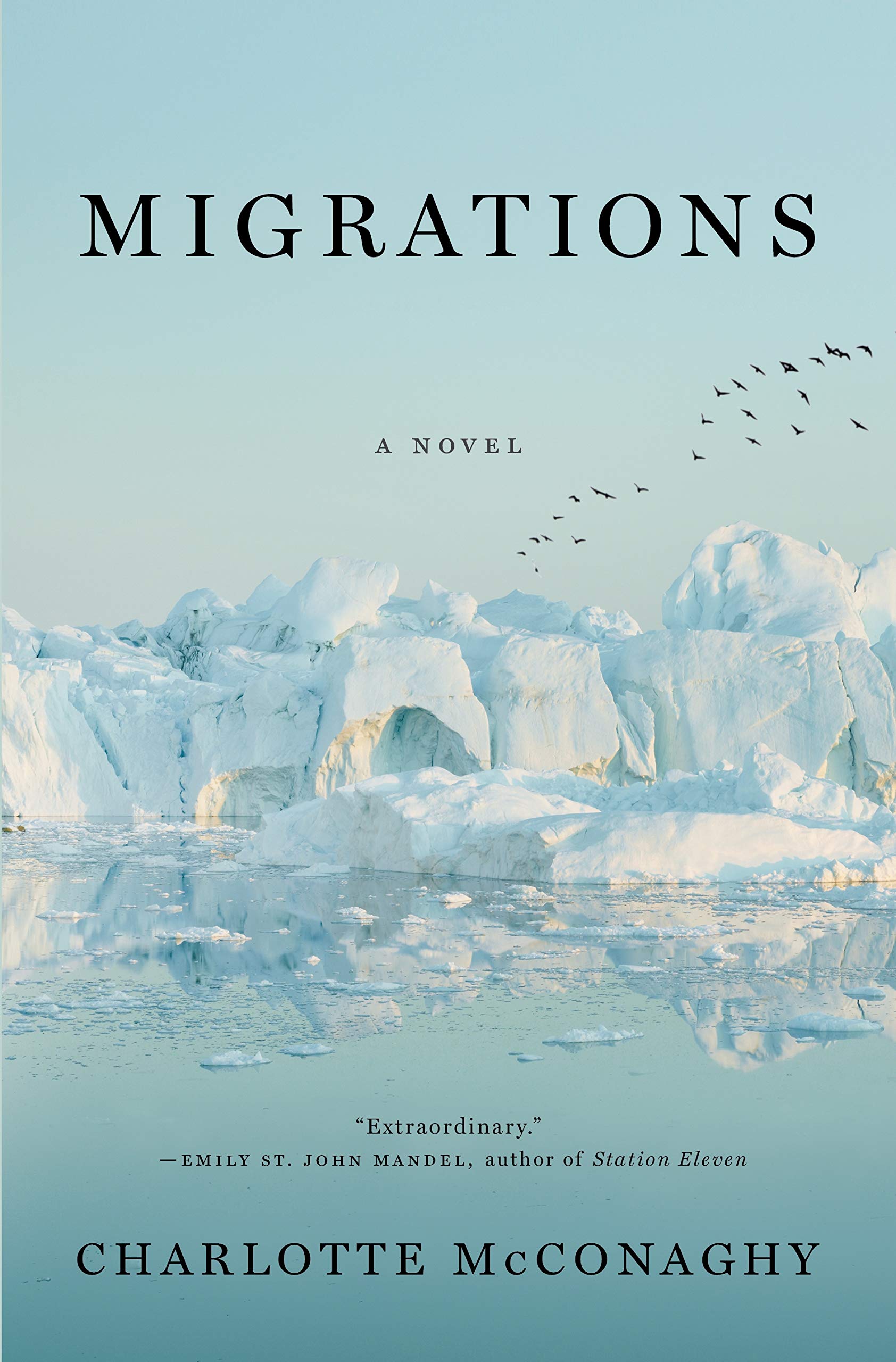
Migrations by Charlotte McConaghy

But there won't be any more journeys after this one, no more oceans explored. And maybe that's why I'm filled with calm. My life has been a migration without a destination, and that in itself is senseless. I leave for no reason, just to be moving, and it breaks my heart a thousand times, a million. It's a relief to at last have a purpose. I wonder what it will feel like to stop. I wonder where we go, afterward, and if we are followed. I suspect we go nowhere, and become nothing, and the only thing that saddens me about this is the idea of never seeing Niall again. We are, all of us, given such a brief moment of time together, it hardly seems fair. But it's precious, and maybe it's enough, and maybe it's right that our bodies dissolve into the earth, giving our energy back to it, feeding the little creatures in the ground and giving nutrients to the soil, and maybe it's right that our consciousness rests. The thought is peaceful.

It is the near future and the earth is on the precipice of ecological collapse. Most animal species have gone or are going extinct: wolves, rhinoceroses, crows. Franny Stone is in Greenland, putting trackers on Arctic terns, one of the few species of bird remaining, and one of the most resilient. They travel from the Arctic to the Antarctic every year in search of food, the longest migration in the world. But the fish, too, are mostly gone, and so despite their resilience, the days of the Arctic terns are numbered, too. Franny, having no other way to track the terns, makes a deal with the captain of a fishing boat--someone who should be an enemy--telling him that if they follow the terns, the terns will bring them to fish. But Franny does not divulge that she's not associated with any university or research program; that she's following the terns for deeper and darker reasons.

I did not enjoy this book. The tone is poisonously, unceasingly serious, and the heroine seems cut from the cloth of television serials like Mare of Easttown--a woman whose self-destructive tendencies cause her to lash out, but who must learn to master her trauma. That's what this book is all about, TRAUMA in big capital letters. Interwoven with the story of the fishing boat, the Saghani, are bits of Franny's backstory, an endlessly unspooling narrative of trauma: an absent father, a disappeared mother, a habit of committing violence while sleepwalking, a tendency to run away for no reason, a stint in jail, a prickly disposition. All of this smaller traumas lead up to a bigger trauma that is only teased, although it's easy enough to fill in the blanks: Franny has, through an act of negligence, killed her researcher husband, and through this guilt she is driven to track the terns that were his own project.

I'd have to paraphrase it, but Charles Baxter described this kind of narrative in his book on fiction Burning Down the House, outlining a belief that the most important thing anyone can do in life, or in a story, is to find and name the source of one's trauma. It makes for dreary reading. On the other hand, there's an interesting thought at the heart of Migrations: that the traumas we receive on an individual level mirror the trauma we inflict on the earth. But Migrations is so wrapped up in the first kind of trauma that the second kind seems only partially fleshed out. Toward the end of the book, after a series of violent setbacks, only Franny and the captain of the Saghani are left out of the crew, and as they sail into the waters of Antarctica, the captain admits he is running, too, from a wife with a terminal illness who didn't want him to see her waste away. But why does anyone in the midst of ecological collapse need an excuse to act irrationally? Migrations struck me as a book about the end of the world that doesn't really think the end of the world is all that interesting.

Tuesday, October 13, 2020

Heaven's Breath: A Natural History of the Wind by Lyall Watson

But wind is different.

For a start, it is invisible. It can creep up out of nowhere and tickle the back of your neck, or throw you flat on your face. It has no shape, size, smell, taste or sound of its own. All its properties are borrowed, all our experience of it comes at second hand. We have nothing to work with but indirect effects. It is big enough and strong enough to tear the largest living things on Earth out by their roots, and yet it can seep through a hairline crack. Wind is elusive, shifty, fugitive, difficult to define--and impossible to ignore.

The wind may seem like a strange thing to write about. It might seem like writing about nothing at all, since wind itself is so ephemeral and substanceless. But wind, as described by naturalist Lyall Watson, may be the only thing worth writing about, its effect on our lives is so important. Without wind, there would be no birds, who rely on it for their migrations. There would be no plants, except perhaps at the margins of oceans and rivers--the interiors of our continents would all be desert. There would be no trade or communication between civilizations, without the wind to push boats across the sea. There would be no weather of any kind, because weather itself is wind, the movement of cold and hot masses of air around the world. And perhaps, even if these other things were true, we would lack spirits, or souls, those mysterious parts of ourselves that people of all civilizations have equated with wind or air.

Watson separates Heaven's Breath into five sections, each each matched to a different relationship: "Wind and Earth," "Wind and Time," "Wind and Life, ""Wind and Body," and "Wind and Mind." When Watson writes about the hard sciences, as in the explanation of the production of trade winds in "Wind and Earth" or his description of the way spiders migrate on wind-driven threads of gossamer in "Wind and Life," he seems to be highly knowledgeable and gifted in the skill of communicating complicated concepts in clear, engaging terms. Heaven's Breath might be one of the most readable non-fiction books I've ever read. Watson's prose, like the wind itself, is full of life: one of the most surprising arguments here is that the air itself is a kind of biome in which innumerable small creatures live by right of nature, not just here in the troposphere where we--gulp--breathe them into our lungs, but even moving about by the billions in the outer reaches of the atmosphere.

When Watson turns his attention toward human beings--in "Wind and Body" and "Wind and Mind"--Heaven's Breath surprised me by outlining my own relationship to the wind. Did you know, for instance, that your feet are typically 15 degrees Centigrade--or 60 Fahrenheit--cooler than your body's core? Or that the "wind chill factor" measures how wind whips your own "aura" of body heat away from your body? The human body, as Watson describes it, is incredibly sensitive to the vagaries of the wind, and so is the mind. He argues that times in which we often feel bad or anxious are really subliminal responses to the shifting of winds, which are themselves related to the magnetic fields of the earth. (One thing I learned from this book is that the human heart has its own magnetic field.) In extreme cases, Watson says, this relationship turns disastrous, as in the hot, dry fohn wind of the Alps that drastically drives up suicides. It's no wonder then, Watson argues, that many of the origin stories of human beings in core mythologies begin with wind.

I really enjoyed Heaven's Breath, although perhaps it needs a little updating since it was published in 1984. In one truly breathtaking passage, Watson acknowledges the possibility that carbon pumped by human industry into the atmosphere will likely lead to an increase in the world's temperature, but holds out optimism for the consequences:

Dust raised by human and natural volcanoes may be cooling Earth's brow, but everything else seems to be working toward a warmer world, one destined to be at least 2 [degrees] Centigrade hotter before another century has passed. If so, it will be warmer than the Early Medieval epoch between AD 1150 and 1300, which was one of the best in post-glacial times and seemed, with the lifting of storm winds and bitter winters, to give the whole world a rush of blood to the head.

Watson goes on to write about the wonders of the Medieval warm period: Viking colonies in Greenland, cathedrals in Europe, flowers in the Sahara. Even "People grew bigger and lived longer." This is, of course, amazingly wrong: climate change threatens to curtail human lifespans on an enormous scale, not increase them. But you have to give Watson credit for recognizing the possibility of global warming before many others, and despite the Pollyanna-ish optimism, Heaven's Breath is still worth reading in the era of climate change, because it understands how closely linked our lives--our bodies, our minds, our ecosystems--are to the weather.

Friday, June 7, 2013

Flight Behavior by Barbara Kingsolver

A young woman from a small town in rural Tennessee is on her way to an afternoon tryst. Not just unhappy with her marriage but with her current situation in general, this appear to be the quickest way out. As she is traipsing through the woods on the way to the determined meeting place, she is quite literally stopped in her tracks as she crests a hill and sees a valley below her that is blanketed in what appears to be gently undulating flames. Perplexed and somewhat shaken, she takes it as a sign and returns to her home.

This is how Flight Behavior opens, with sex and fire and mystery. The excitement fades a little, as it becomes known that the valley was turned orange not by flames, but by monarch butterflies. As the book finds its pace, the reader is introduced to the young woman. Dellarobia is the mother of two. She and her husband Cub live in a small house in a corner of his parents' farm. She and Cub grew up in Feathertown and although she had dreams to leave, they were never actualized. The monarch wintering in the hills of Tennessee rather than the mountains of Mexico start to attract attention. Meanwhile, Cub's father makes known his intention to sell logging rights to his land--the land that is the winter home to thousands of monarchs. In large part, this is the drama of the book. A slow moving collision of minds that you know is going to happen at any time--with those who are accepting of change and those who want to do things they way they have been done.

I found Flight Behavior to be a very slow read. While I was interesting in the story, and in the characters to varying degrees, the book just crawled along. Not much happens. Conversations span across five and siz pages. It may sound like I am saying that Flight Behavior was boring, but that is not the case. Kingsolver's writing helped hold my interest. She paints a detailed picture of small town at a point where change is necessary but with few residents who recognize this fact.

This is the first book by Barbara Kingsolver that I have read. I bought The Poisonwood Bible years ago, fully intending on reading it. It sits on a bookshelf somewhere. Waiting. I can't say that Flight Behavior has made we want to rush over and pluck The Poisonwood Bible from its shelf, but it did bump it up my mental list of book to read.