Showing posts with label Southern Gothic. Show all posts

Monday, June 14, 2021

Other Voices, Other Rooms by Truman Capote

Before birth; yes, what time was it then? A time like now, and when they were dead, it would be still like now: these trees, that sky, this earth, those acorn seeds, sun and wind, all the same, while they, with dust-turned hearts, change only. Now at thirteen Joel was nearer a knowledge of death than in any year to come: a flower was blooming inside him, and soon, when all tight leaves unfurled, when the noon of youth burned whitest, he would turn and look, as others had, for the opening of another door. In the woods they walked the tireless singings of larks had sounded a century, and more, and floods of frogs had galloped in moonlight bands; stars had fallen here, and Indian arrows, too; prancing blacks had played guitars, sung ballads of bandit-buried gold, sung songs grieving and ghostly, ballads of long ago: before birth.

Joel Knox is thirteen. He has been living in New Orleans with a caretaker most of his life, until a letter finally comes from a far-flung estate in the Louisiana backwoods: yes, Joel's biological father, Edward Sansom, would like for Joel to come and stay with him. Arriving at the estate, Joel finds a small cadre of strange and reclusive people: his father's anxious wife Amy; effeminate "cousin" Randolph; Zoo, a black servant who provides the closest thing Joel will get to parenting in this strange place; her ancient father Jesus Fever; the redheaded tomboy Idabel and her twin sister. A strange white-haired lady appears at a window like a ghost and is never seen again. Life with this group turns out to be quiet and strange, like "living in a glass bell," and where is his father anyway?

I picked up Other Voices, Other Rooms because I was inspired, in a perverse way, by Jenn Shapland's My Autobiography of Carson McCullers: Capote and McCullers, she contends, were bitter enemies--McCullers, it seems, accused Capote of cribbing from her. (It's hard not to see her point: look how young Joel longs for nothing more to see snow, like Frankie in The Member of the Wedding, published just two years before. And I have no idea if this is borne out by timing, but the descriptions of cousin Randolph striding through the empty manse in his silk kimono certainly seems to recall McCullers herself, who cultivate this look to accommodate her long-term illness.) With McCullers in mind, though, I became impatient with the familiarity of Capote's southern Gothic: the overgrown mansion, the woman with the scar around her neck, the identical twins.

But I was eventually won over by the dreamlike quality of Other Voices, Other Rooms. Joel is frustrated by the strangeness and loneliness of his new home, but as the days wear on, its strangeness seems to seep into his mind, and his outlook becomes more and more feverish, prone to visions and hysterias. When he is at last allowed to see his father, he is only unsettled more: Edward Sansom is a paraplegic whose eyes are perpetually open, and who tosses tennis balls into the sitting room to demand attention. At last Randolph tells him the full story: many years ago, his girlfriend began an affair with a handsome boxer. Randolph, enraged not by her unfaithfulness but the unwelcome realization that he too was in love with the boxer, tried to shoot them--but hit Sansom, the boxer's manager instead. Now they live here in this house, caring for each other--each an abandoned half, cast off to make a unity.

The estate is an outpost at the end of the earth where the injured and guilty flee. It's only here that Randolph can really live, in his kimono and painted toenails--that white-haired lady at the window, of course, is him, too. It's where Zoo can live and be safe from the possessive lover who gave her the scar, though she lives with the daily fear of his return. This strange place is a haven, but a fragile haven, and it hardly seems a place for a boy as young, and as sensitive, as Joel. Thirteen year old boys have such active imaginations already, and Joel is no exception, but life at Skully Landing threatens to push that imagination into overdrive. An abortive attempt at running away with Idabel is no good; he brings the madness of the place with him, and when he's felt up on a Ferris wheel by a little person--I am not joking--he nearly breaks from reality completely. Only when he's dragged back to his newfound home can he really begin to find himself again.

The strong implication here is that Joel, like Randolph, must learn to accept his own homosexuality, and that Randolph, who nurses him through his pneumonia, is his true exemplar and father figure. (His love for Idabel, we presume, is a response to her masculine nature as opposed to her more feminine sister Florabel.) And yet the book suggests that there are few places in the world where people who have become truly themselves can live without degradation and shame, places that must seem strange to a world to whom they've turned their back.

Monday, December 21, 2015

Reflections in a Golden Eye by Carson McCullers

'You mean,' Captain Penderton said, 'that any fulfillment obtained at the expense of normalcy is wrong, and should not be allowed to bring happiness.  In short, it is better, because it is morally honorable, for the square peg to keep scraping about the round hole rather than to discover and use the unorthodox square that would fit it?'

'Why, you put it exactly right,' the Major said.  'Don't you agree with me?'

'No,' said the Captain, after a short pause.  With gruesome vividness the Captain suddenly looked into his soul and saw himself.  For once he did not see himself as others saw him; there came to him a distorted doll-like image, mean of countenance and grotesque in form.  The Captain dwelt on this vision without compassion.  He accepted it with neither alteration nor excuse.

The comparison I reached for immediately while reading Carson McCullers' Reflections in a Golden Eye is the "four-square house" of The Good Soldier, which comes tumbling down when John Dowell realizes that his wife and best friend have been carrying on an affair for years.  But the "four-square house" of Reflections in a Golden Eye is rotten and termite-ridden to the core: its four pillars--two officers and their wives on a Southern army base during peacetime--already aware of the affair going on among them, and seething with loathing.  McCullers transforms Edwardian reserve and gentility into Southern Gothic, in which things like this happen:

They had been sitting like this late one night when suddenly Mrs. Langdon, who had a high temperature, left the room and ran over to her own house.  The Major did not follow her immediately, as he was comfortably stupefied with whiskey.  Then later Anacleto, the Langdons' Filipino servant, rushed wailing into the room with such a wild-eyed face that they followed him without a word.  They found Mrs. Langdon unconscious and she had cut off the tender nipples of her breasts with the garden shears.

Damn, Mrs. Langdon!  Mrs. Langdon--Alison--is the sensitive and sickly wife of Major Langdon, who is having an affair with the wife of his superior officer, Captain Penderton.  Leonora Penderton (hey--the same name as in The Good Soldier) is oversexed and frustrated by her marriage to the cold, aloof Captain, who seems mostly indifferent to his wife's affair.  Into this volatile group, McCullers adds a fifth--a private named Williams who sneaks into Mrs. Pendleton's room every night to watch her sleep, in the nude.

Williams is something of an enigma--he rarely speaks, and has no friends or close associates.  McCullers depicts him as a "natural," an idiot more at home in the woods than in the order of the barracks.  The Captain obsesses over Williams, whose inscrutability is both threatening and mysterious.  One scholar called Reflections in a Golden Eye one of the great "gay novels," and I admit that I missed the latent homosexuality suggested by the Captain's obsession.  What was clear was the fine line between loving and loathing; the Captain's boiling hatred for Pvt. Williams is closer to real love than anything else in the novel, except perhaps for the relationship between Alison Langdon and her flamboyant servant Anacleto.

McCullers is one of the great novelists of the outsider, the marginalized figure.  Even when she gives us a character with great status and power, like the Captain, she manages to find the deep secret within that puts him at the margins.  She has the same kind of sympathy for Alison Langdon in her sickbed, and even the bitterly objectified and lonely Mrs. Penderton.  The novel's most vivid and realized character, Anacleto, is an outsider twice over: a servant and a foreigner, clinging desperately and slavishly to Mrs. Langdon.  Yet, he professes the kind of bravado and eccentricity that only a marginalized figure can; he's made in the mold of the deaf hedonist Antonapoulos from The Heart is a Lonely Hunter.  McCullers' contempt, on the other hand, is saved for figures like Major Langdon, whose banality and conformity are far greater crimes than his infidelity.

As a closeted homosexual--if that's the best term for him--the Captain is shoved to the margins even of his own consciousness until that image comes to him, "distorted" and "doll-like."  Private Williams, so far outside the realm of human activity that not even McCullers seems to understand or comprehend him, threatens the teetering social stability of these four even without their knowledge.  It's no surprise when the novel, which hums with barely suppressed menace, erupts finally into grand violence.  McCullers wrote in The Heart is a Lonely Hunter that "violence is the most precious flower of poverty"; but she was too often aware of the many ways, poverty besides, people are forced into invisibility and indignity.

Saturday, July 4, 2009

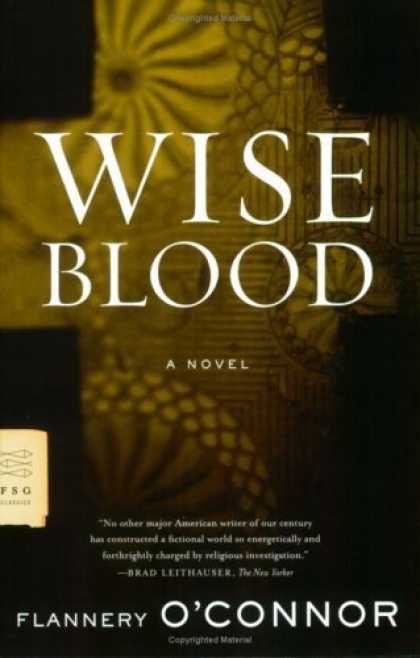
Wise Blood by Flannery O'Connor

The boy didn't need to hear it. There was already a deep and black wordless conviction in him that the way to avoid Jesus was to avoid sin. He knew by the time he was twelve years old that he was going to be a preacher. Later he saw Jesus move from tree to tree in the back of his mind, a wild ragged figure motioning him to turn around and come off into the dark where he was not sure of his footing, where he might be walking on the water and not know it and then suddenly know it and drown.

Hm. I love Flannery O'Connor. Along with Carver, I think she is probably the premiere short story author to come out of 20th Century America. Her stories are invariably dark and tinged with a peculiarly Catholic brand of guilt and tragedy, and distinctively Southern in outlook and style. So why doesn't Wise Blood work?

I think it is because of precisely what I said--O'Connor is a fantastic short story writer, but many great American short story writers, like Carver and Poe, never tried to write anything longer. Poe had a theory he called "the unity of effect" that dictated that a work of literature must be read, and be able to be read, in a single setting to have the maximum impact upon its reader. I don't agree with Poe (who does?) but if he were to return from the dead (Zombie Poe!) and try to defend himself, he might point to Wise Blood, which is stitched together of fascinating parts but somehow fails to come together.

The story follows Hazel Motes, a young man just out of the army heading to the Southern city of Tulkinham. Hazel has some pretty peculiar ideas about Jesus--he can do without him--and when he runs into a street preacher named Asa Hawks, he is determined to outdo him by become a street preacher himself, one who preaches The Church of God Without Christ. You might call that Judaism, or Islam, but to Hazel it's a kind of religious philosophy that rejects the need for salvation. To spite Hawks further, he intends to seduce his underage daughter Lily, but Lily isn't exactly making it difficult for him to seduce her, and Hawks is pretty happy to have the girl out of his household.

Complicating matters is a young man who ingratiates himself to Hazel named Enoch Emery. Enoch believes that he has "Wise Blood," a kind of sixth sense that predicts the future in vague terms. Enoch, wishing to aid Hazel, and driven by his Wise Blood, steals a mummified child from a local museum to serve as the Christ figure in the Church.

There is a scene I liked a lot in which Enoch--an adult who, it is suggested, may be a little bit on the slow side--waits in line with a bunch of children at a theater to see the "star" of a King Kong-like movie only to find out it's a man in an ape suit. Angered and betrayed, he sneaks into the man's van and steals the ape suit, strips off his clothes in the middle of the forest, and becomes, by putting on the suit, the pinnacle of his desires. That's really fascinating in a particularly O'Connoresque way, but the problem is that it is difficult to place that scene, and many others, in the context of the entire novel. The scene is almost exactly duplicated in a short story of O'Connor's, though I don't know which came first. The short story by itself is intriguing, in the context of Wise Blood it is confusing.

Very few novels stump me. Though a lot of ideas may elude me, I am usually able to reflect somewhat meaningfully on a book I've read. Wise Blood is one of the first times that I've felt as if I just don't get the book. There is something going on with Christ figures--the way that Hazel tries to avoid Christ completely, but is bombarded with Christ substitutes, whether they be Hawks, or himself, or the mummified child, or Enoch's ape suit. It is, I suppose, a statement on the way that Christ pervades all things and cannot simply be escaped, even by a nonbeliever.

But that seems only a partial explanation. Why does Hazel want to separate Christ from God? What is the purpose, thematic or otherwise, of Enoch's "Wise Blood," which informs the title but seems to be near-irrelevant? What is the connection between Enoch and Hazel? There are too many questions. The pieces of this novel hang separate from one another and refuse, to my mind, to come together in anything approaching coherence.

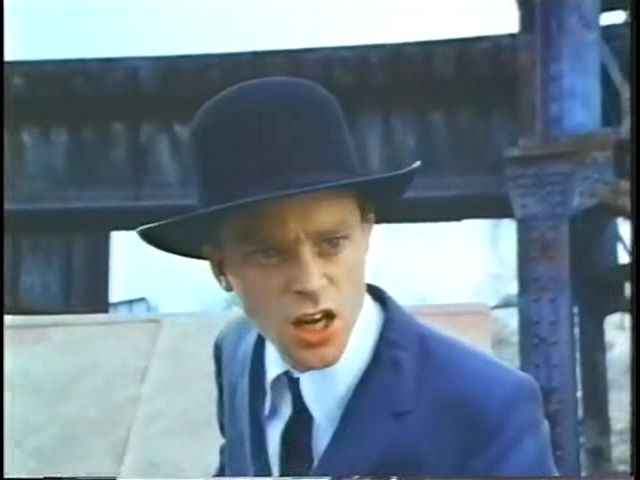
Note: They made a movie of this where Hazel was played by Brad Dourif (One Flew Over the Cuckoo's Nest, That Really Good X-Files Episode Where He Plays a Psychic Murderer Who Speaks to Scully'sDead Father). Brad Dourif was born to play this role.