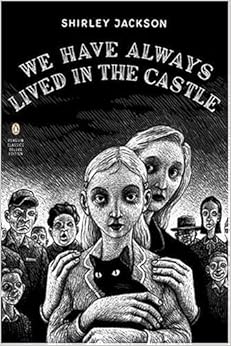
Merricat, said Connie, would you like a cup of tea?
Oh no, said Merricat, you’ll poison me.
Merricat, said Connie, would you like to go to sleep?
Down in the bone yard ten feet deep.
I am not much for horror—Steven King and his counterparts have never appealed to me. There’s something different about Shirley Jackson’s work, though. In high school, she caught my attention with The Lottery. It was a while before I read anything else by her, but I read plenty about her—drawn in to the private life of a neurotic woman prone to staying shut in her house who didn’t like to bring attention to herself with interviews and the like. I knew that anyone able to chill me as well as she had, that could write as eerily as she did, had to either have a wonderful imagination or be just a bit disturbed. Who doesn’t love an eccentric author?
Spoilers. Kind of.
Like most young people, Merricat, the main character of We Have Always Lived in the Caste, is prone to making deals with the universe. If she nails a book to a tree a certain way, her family will be protected from the townspeople who don’t like them. If she walks along the sideway just a certain way, no one will harass her on her bi-weekly trips to and from the town to bring her remaining family members books and food. I say remaining family members because most of her family is dead—killed six years prior with arsenic. Only Merricat, her older sister Catherine, and her senile Uncle Julian remain living in their home, holed away with the money the locals know they horde. Constance was accused of being the one to poison her family and was let off the hook—though everyone still believes she’s guilty because she had always been the one in charge of the meals. In the beginning, the reader can’t be sure whether or not she’s guilty, though we do know she believed her parents and the others deserved to die. Both girls seem strangely removed from the event, and don’t discuss it between themselves with the exception of a brief exchange at the end of the book. Julian, on the other hand, is utterly obsessed with reliving the day of the poisoning from start to finish, because he was one of the intended victims and barely survived. While the sisters have disregard for the dead, they seem to harbor some kind of feelings for Julian:
Once I brought Uncle Julian a new leaf from the chestnut tree and put it on his window sill. I stood outside in the sunlight and looked in at him lying still in the dark room and tried to think of ways I might be kinder.
This is coming from the girl he won’t acknowledge, who he swears to Charles is dead and not in the house at all, that is not allowed to touch his things. In particular, his collection of writing on what they refer to as The Last Day, that he has dedicated his days and nights to finishing, when he can get out of bed at all.
On occasion, a gossipy old woman will come to call on the girls for tea, but the rest of the time, the Blackwoods keep to themselves. Until a cousin with questionable intentions shows up for an extended visit, putting a wrench in the system that the sisters have carefully set up for themselves in order to maintain some sense of a family life and happiness. Merricat has always taken care of her timid older sister and shielded her from the public eye and then this man comes in, making Constance feel guilty for the lack of guidance she’s provided for her fierce but out-of-touch-with-reality younger sister, whose strange behavior is suddenly not so acceptable anymore now that someone else is paying attention and there’s a more suitable caretaker to run the errands and tend to things. The tension comes to a head when Merricat decides that she has to do something to push Charles out of the picture in order to protect her relationship with her sister, who seems to be bending to Charles' logic (and manipulation). First, she tries her magic:
It was important to choose the exact device to drive Charles away. An imperfect magic, or one incorrectly used, might only bring more disaster upon our house. I thought of my mother’s jewels, since this was a day of sparkling things, but they might not be strong on a dull day, and Constance would be angry if I took them out of the box…
When she tires of waiting for the results of her attempts to cast out her “demon” cousin with magic, Merricat takes things a bit too far and in the process, a large section of their house burns down. Just as the firemen come to their rescue (?) so do the people of the town, using the opportunity to tear the place to pieces and wreck everything the fire didn’t damage. From there, we have what seemed to me to be a haunting version of Grey Gardens where the two girls make due the best they can in a deteriorating disaster of a place, refusing visitors and putting up barriers to keep the curious out. They escape mentally, talking about how happy they are “on the moon” even though their uncle has not survived their second round of disaster and have only former tablecloths to wear for clothes and their world seems to revolve around keeping the kitchen, their one unblemished room, perfectly clean so they can take their tea like ladies in their only two remaining cups with handles.
The whodunit plot twist isn’t much of a plot twist, but I don’t think that was ever Jackson’s intention. The horror isn’t so horrifying. But there’s something strange about the love the sisters have for one another despite a horrendous crime and their inability to love anyone else that kept me reading until the last page… and somehow also kept me strangely sympathetic. I think I also had to hang on to see any of Merricat’s magic was going to work. I could argue the answer to that particular question either way.