Showing posts with label Senegal. Show all posts

Friday, June 17, 2022

God's Bits of Wood by Sembene Ousmane

Ever since they left Thies, the women had not stopped singing. As soon as one group allowed the refrain to die, another picked it up, and new verses were born at the hazard of chance or inspiration, one word leading to another and each finding, in its turn, rhythm and its place. No one was very sure any longer where the song began, or if it had an ending. It rolled out over its own length, like the movement of a serpent. It was as long as a life.

I was disappointed by Mohamed Mbougar Sarr's recent novel Brotherhood, a portrait of Senegal under Islamic fascism that struck me as flat and didactic. Honestly, I might never have read it if I'd realized I had another book from Senegal, Sembene Ousmane's God's Bits of Wood sitting on my shelf. But Ousmane's novel about the 1948 Dakar-Niger railway strike cleared away the bad taste I had of Sarr's book, because it is in many ways the opposite: where Sarr creates characters who seem like virtues or vices dressed up in human clothing, the characters of God's Bits of Wood are remarkably real and vivid people caught up in the pressures of colonial politics. In its detail and specificity--helped along by a reliance, as I understand it, on real events--it tells a universal story of resilience and courage.

God's Bits of Wood resembles one of those Dickensian or Tolstoyan social-realist novels in its scope, encompassing a couple dozen characters who take part in, or resist, the railway strike. There's old Fa Keita, who vividly remembers the bloody strike of ten years prior; Penda, the feisty prostitute who helps lead the women's march from Thies to Dakar; blind Maimouna, who refuses to tell anyone who the father of her son is (imaginatively christened "Strike"); young Ad'jibid'ji, a young girl who sneaks into the meetings of the striking union workers, wishing to take part in the struggle. There are the male leaders of the strike, of course, like Lahbib, Doudou, and Beaugosse, but they are overshadowed by the absent figure of Ibrahim Bakayoko, an almost legendary figure who spends much of the novel "down the line."

Bakayoko might be the novel's most interesting figure: the strikers centered at Thies seem to believe his determination and eloquence are what's needed to make the strike successful, and they await his return with a messianic anxiety. And in truth, it's Bakayoko's speech at the final colloquy with the white toubabs who run the railway--crucially, in the local languages of Wolof and Bambara as well as French--that seems to give the strikers the nerve they need to stand up to the toubabs. But he's also a man who refuses to attend the funeral of his own wife after she's killed by strike-breaking police, asserting that he's needed by the cause and has no time. As N'deye, the woman who falls in love with him, discovers, there is no room in Bakayoko's heart for anything else but the struggle. In ordinary times he might be heartless and cruel, but perhaps, in moments like this, he is the most necessary kind of person.

But most of the novel focuses on ordinary villagers caught up in the strike. Without pay or rations, the people along the railway line begin to starve; first the food runs out, and then the water. One funny interlude depicts Ramatoulaye, who captures and kills the prize ram of her brother, who has taken the side of the white toubabs, and distributes the meat to the families of the town. God's Bits of Wood has a special focus on the women who support the strike; though they are not workers like the men, it's their solidarity that allows the strike to succeed. It's the woman's march to Dakar, in the end, that brings the toubabs to the negotiating table. Still, there is a cost, and it's born by these ordinary people: marchers who die of heatstroke, old men who starve, women and children who are shot.

And they are real: when Sarr's characters are hurt or killed, it's hard to weep, because they are only paper, avatars of ideas that can't really die. But for Ousmane, the strike tells a story of real people who put their lives on the line for a great cause. And though the railway strike has its martyrs and idols, like Bakayoko, what's most remarkable about it is how convincingly it depicts a collective victory for working people. To read it is to wonder how we in the U.S. could ever reproduce solidarity like that.

Sunday, June 12, 2022

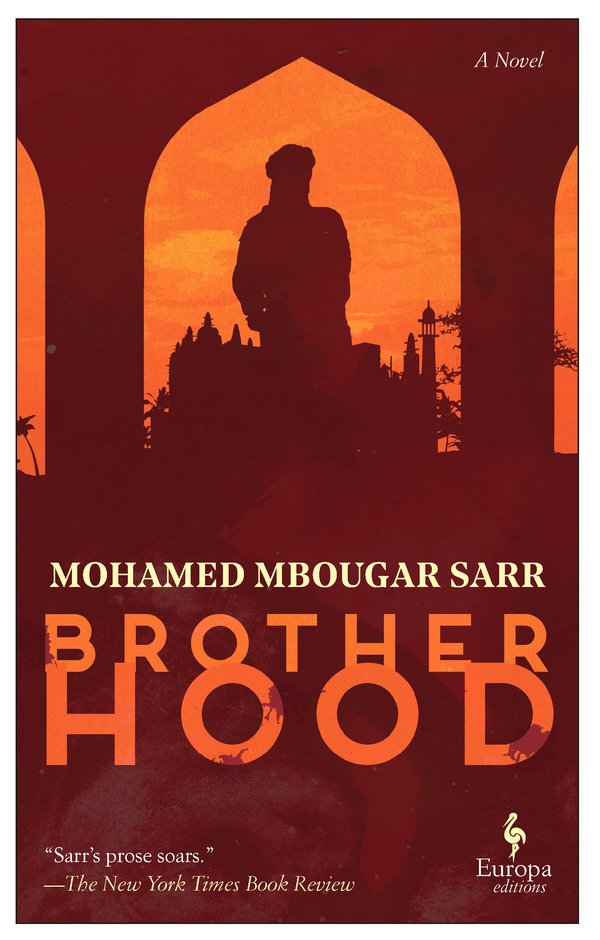
Brotherhood by Mohamed Mbougar Sarr

It was true that in spite of what the Brotherhood had done, there was something that it would never be able to kill in this city: its memory. The memory of the city as it used to be, filled with old noises, with murmurs of rainstorms five years past, with the invigorating laughs and the ever-present smells. All of these things, the had-beens of Kalep, its memory, would never disappear, at the very least not as long as the people refused to forget them. He believed this was where the real battle was. Every war, in his eyes, was a war for memory, in other words a war that must be fought in the name of the survival of memory.

The Senegalese city of Kalep has been under the yoke of an Islamic fundamentalist group calling itself the Brotherhood for years. Their rule is harsh and violent: the novel begins with the beheading of two unmarried lovers, caught by the Islamic police. In the basement of a local bar, a resistance group forms, centered around the doctor Malamine, whose wife Ndey Joor has been badly beaten for not wearing her veil in public, and whose son Ismaila left years ago to join the fundamentalists. Along with a handful of others, Malamine prints a newsletter detailing the crimes of the Brotherhood, exposing its cruelty and provoking the locals to resist. Meanwhile, the calculating, vicious leader of the Brotherhood, Abdel Karim, vows to track down whoever is behind the newsletter and punish them.

Man, I did not think this book was good. I can't remember the last time I read a book that felt so punishingly didactic. Take, for instance, the moment where Malamine's son Idrissa reflects on how the Brotherhood has made it difficult for him to talk to his mother, Ndey Joor. "By relieving them of their right to speak," Mbougar Sarr writes, "the Brotherhood was also relieving them of their need to speak." He then writes, "Every authoritarian regime rises in this way: it manages to convince its people of the futility of communication." Well, who's thinking that? Not Idrissa! Why would he know that "every authoritarian regime rises in this way?" Time and time again, the narrative abandons the immediacy of the characters for abstract political theorizing like this. And rarely are these moments illuminating. The characters become avatars of political struggle; they rarely talk or react like real people. One night in the basement of the bar, Malamine looks at his comrades and assigns each of them an abstract principle:

Dethie was freedom. Codou was Justice. Madjigueen was Equality. Vieux was Denial. Alioune was Beauty. Pere Badji was Mystery. Man was all of these qualities together.

This just doesn't work, I think. It's like an old medieval morality play, but it's not a story that really illuminates the life of people living under fundamentalist regimes.

What worked best about the novel was the exchange of letters between Aissata and Sadobo, the mothers of the two lovers killed in the novel's opening scene. One mother appeared as witness, the other stayed home. In their letters, they discuss--again, much too abstractly, but in a way that is more rooted in real feeling--how to respond to the harsh rule in which they live. This story was, I thought, much more interesting than the "main narrative" about the resistance (all they do is print a newsletter???). That's the novel I sort of wish I had read.

Sadly, I didn't like this book. On a happier note, the addition of Senegal means my "countries read" list is up to 65!