Showing posts with label New York state. Show all posts

Tuesday, July 13, 2021

Mariette in Ecstasy by Ron Hansen

She pets Mariette's wrist and kisses a knuckle. She whispers, "We are so privileged." She holds the palm open and kisses it. "You have turned your face from me too often. You have been frightened by my affection."

With reverence Sister Hermance licks the blood inside the hand wound. "I have tasted you. See?" Tears streak shining paths down her cheeks as she says, "Ever since I first met you, I have loved you more than myself."

Mariette Baptist is a teenager when she leaves her home to join an order of French nuns living in upstate New York. Her sister, Mother Celine, is the prioress at the nunnery, and their father is a severe and skeptical doctor who is befuddled and disappointed by his daughters' calling. As a "postulant"--that is, a probationary not-yet nun--Mariette distinguishes herself through her piety. She confesses to the nunnery priest, Pere Marriott, that she often has visions of Christ in which they converse, and during which she begs to experience the kind of suffering that will bring her closer to him. And yet her piety--and her beauty--are not prized by everyone; to some of the nuns it looks like pride or arrogance. These differences are brought to a crisis when Mariette begins to manifest the stigmata: the wounds in Christ's hand, feet, and side received at the crucifixion.

Is Mariette a saint or a liar? Hansen, as you might expect, offers no clear conclusion to the question: it seems equally likely that the dreamy, aloof Mariette experiences a miracle as it does that she wounds herself, either through a pathological need for attention or a real psychotic break. (Equally likely, that is, if you come into the book willing to believe that such things are possible.) The question dogs the nuns, too, who are divided into pro- and anti-Mariette camps: gossiping, sending letters to the Pere, et cetera. As the Prioress Saint-Raphael--whose responsibility to keep the nunnery together is threatened by Mariette's ecstasy--notes, it is hard to understand God's intention in afflicting Mariette this way. There is no gain, material or spiritual, for the nunnery or anyone else in Mariette's stigmata, not even, it seems, for Mariette. As the Pere observes, the stigmata are gratia dei gratis, given by God's will and not through any desert or lack thereof; saints and reprobates both have manifested the stigmata throughout history. In this way the very uselessness of the stigmata may be part of their miraculousness: a reminder that God's will is inscrutable.

Mariette in Ecstasy is an interesting contrast to Sylvia Townsend Warner's book about a nunnery, The Corner That Held Them. While the latter applies a Marxist lens to the nun's life, showing the ways that even spiritual lives are ultimately shaped by the relations of capital and labor, Mariette in Ecstasy really asks us to consider what the spiritual life of a nun demands. Hansen often lingers on short scenes of pastoral life--the tedium of wash day, the family of skunks that have gotten into the corn cob, stuff like that--in a way that reminds us that a nun's life is one of contemplation and stillness, a life that Mariette's miracles must inevitably interrupt and transform. The antipathy of the anti-Mariette factions may be a kind of jealousy, generated by those who submitted obediently to a life of quietude only to find ostentatiousness rewarded. On the other hand, there is a queer sensuality--queer in both senses--to the pro-Mariette factions captured neatly in the above passage, where Sister Hermance literally licks the wound in Mariette's hand.

I really enjoyed Mariette in Ecstasy. Its pastoral simplicity seems borrowed from the Cather tradition of American writing, but it belies a crypticness that is not easily solved. The question of skepticism--are Mariette's miracles real or fake--is only the most superficial of several questions about faith, belief, and obedience that give the book a quiet power.


Friday, August 28, 2020

The Mare by Mary Gaitskill

What effect could it have on Velvet, all that coming at her and not knowing what it was about? She was poor, she lived in a shit neighborhood, and when she talked about her mother, there was something in her voice that made me think of a shadow on the wall in a horror movie. The woman's voice on the phone confirmed the feeling: She sounded abusive, half crazy. The girl had need, big need. I could feel it under her certainty and diffidence. And here was Ginger with her need, looking at Velvet with shining eyes, calling her "princess," and tucking her in at night. It seemed an unstable mix of things, combustible, a promise that could not be kept.

Velveteen Vargas is an eleven-year old Dominican girl living in Crown Heights, Brooklyn. As part of a program called "Fresh Air," she is sent to stay for two weeks with a white couple living in New York's Hudson Valley. Paul and Ginger, the couple, are childless, and while Paul is skeptical of the program, Ginger devotes herself with abandon to caring for Velvet. When Ginger takes Velvet to the stables next door, Velvet begins a passionate love affair with horse riding, focusing especially on a horse she calls "my mare," but who has the unfortunate name of "Fugly Girl." Velvet grows close to Ginger, and spends years traveling back and forth between Dutchess County and Crown Heights, but she has to keep her riding secret from her tempestuous, abusive mother, Silvia.

I did not like The Mare. It took a long time, but by the end of the novel I was convinced by the young Velvet's voice, which mixes uneasily at times with Gaitskill's steely metaphors, but which ultimately was able to conjure up the reality of an eleven-, twelve-, and then thirteen-year old. But to me, the novel was never able to get escape velocity from the two narrative black holes that threaten it: the cheesiness of the conceit, and the white savior narrative.

It's cheesy: a disadvantaged youth from the big city discovers her love of horse riding? It sounds like a movie on ABC Family. In several ways, Gaitskill leans into the cheese by drawing forced parallels between Velvet's abusive upbringing and the raising of horses. "Abuse," one of the trainers tells Velvet, "is when you don't just hit once, but over and over. I've seen people do things like beat a yearling to the ground 'cause it reared up 'cause it was young." Then there's "Fugly Girl," the horse no one wanted--is there any doubt that this horse will lead Velvet to a victory in the final competition that is the book's climax? Especially when Velvet decides "her mare" is really named "Fiery Girl?"

The other black hole is much deadlier. Although Gaitskill--and Ginger--are well aware of the racial implications of a white woman becoming a surrogate mother to a Dominican girl who already has a mother, that awareness, to me, never rescues The Mare from being a white savior narrative. Gaitskill is immensely talented and cautious, and makes both Ginger and Silvia complicated characters. Gaitskill doesn't fall into the trap of believing that Silvia must be abusive or loving toward Velvet; the truth, as it always is, is that Silvia both loves her daughter and abuses her mightily. And of course, we get to know all about the life Silvia has led, from neglect in the D.R. to poverty in the U.S., and the way it informs her relationship with Velvet. It's a testament to Gaitskill that the character is convincing and sympathetic, but in the end, that didn't seem to me to be enough. This is still a novel about a dark-skinned kid whose life finds direction and meaning when she's introduced to a white woman.

The Mare was a disappointment because I was really taken with Gaitskill's dreamy New York City novel Veronica. I can see elements of that novel, especially on the level of each individual sentence--Gaitskill is a great writer of sentences--here, but something gets lost in the size and scope of it, and the frenetic skipping between narrators. I can imagine a novel I'd have liked to read, one in which Velvet gets to stand alone as the narrator; but is that a novel Gaitskill could get away with?

Saturday, April 28, 2018

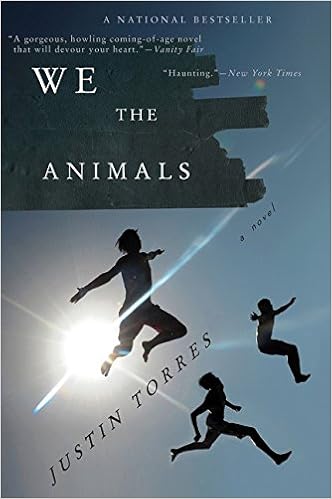
We the Animals by Justin Torres

We were monsters--Frankenstein, the bride of Frankenstein, the baby of Frankenstein.  We fashioned slingshots out of butter knives and rubber bands, crouched under cars, and flung pebbles at white women--we were the Three Bears, taking revenge on Goldilocks for our missing porridge.

The magic of God is three.

We were the magic of God.

Justin Torres' We the Animals tells the story of three brothers--Manny, Joel, and an unnamed narrator, who live in upstate New York.  They live with Ma, white, and sometimes with Paps, who is Latino, both from Brooklyn.  Ma works a graveyard shift at the brewery, getting the hours of the day confused: "She would wake up randomly, mixed up, mistaking one day for another, one hour for the next, order us to brush our teeth and get into PJs and lie in bed in the middle of the day; or when we came into the kitchen in the morning half asleep, she'd be pulling a meat loaf out of the oven, saying, 'What is wrong with you boys?  I been calling and calling for dinner.'"  This hectic air of confusion characterizes their lives, a chaotic freedom that is only exacerbated by the collective energy of their boyhood.  That's reflected in the energy of the prose, which possesses tremendous vitality.

The voice begins in the plural, the narrator's self diffused into a "we" that captures the sense that the brothers are of one piece.  Even when they ally with one and turn on the third, as kids do, it doesn't matter because they are a unit.  Torres manages to make this seem not so much a function of intimacy, but of chaos, as if in the absence of structures that would delineate the limits of family and personhood, each boy dissipates into the other.

Together, the boys witness the pain of their parents' marriage: Paps' frequent absence, his cruelty--toward Ma, toward them--but also, less frequently, his love.  When Paps rapes her, Ma takes the boys to sleep overnight in a park--will this be their life, from now on?  How about when Paps makes them spend nights on the factory floor because both parents work night shifts?  Among other things, We the Animals is a sensitive and complex portrayal of a poor family of color.

The novel is arranged as a series of titled vignettes, and each one is self-contained, though some are stronger than the others.  Over the course of these we see the collective voice disintegrate, as the younger boy begins to be more individuated from his brothers, more sensitive, less prone to violence.  And yet it's a shock when one of the stories begins, not with "we," but "they"--as if the narrator has finally broken away, and become able to look at his brothers with distance.

This separation is caused, or perhaps just accentuated, by his realization that he's gay.  At a bus station bathroom in the middle of the night he searches out another kind of male companionship, fundamentally different from that his brothers had provided, and ultimately is institutionalized for violent homoerotic fantasies, kept in a journal, discovered by his family.  When they confront him, they are arrayed in a line which he stands outside of, like a single point.  And though the novel leaves hope of reconciliation, it clearly sees the loss of the collective identity as something only possible and youth, and something that's lost at a dear price.